
Opening your dashboard
Class 12 Physics Chapter 10 Properties of Magnetic Substances: Previous Year Questions
9 questions on Chapter 10, each solved step by step. Class 12 Physics, ICSE 2026-27.
9 questions with solutions
1–2 marks · Easy difficulty
- 11 mark
Question 1
State how magnetic susceptibility is different for the three types of magnetic materials, i.e. diamagnetic, paramagnetic and ferromagnetic materials.
Solve with AIWritten solution
Solution:
Key idea: Magnetic susceptibility tells us how strongly a substance is magnetised by an applied magnetising field: , where is the intensity of magnetisation and the magnetising field. Its sign and size differ for the three types of materials.
Step 1 — Diamagnetic materials.
For diamagnetic materials (for example bismuth, copper, water), is small and negative, of the order of . It hardly changes with temperature.
Step 2 — Paramagnetic materials.
For paramagnetic materials (for example aluminium, platinum), is small and positive, of the order of to . It decreases as the temperature rises, as (Curie's law).
Step 3 — Ferromagnetic materials.
For ferromagnetic materials (for example iron, nickel, cobalt), is large and positive, of the order of or more. It depends on the applied field, and above the Curie temperature the material becomes paramagnetic.
Therefore, is small and negative for diamagnetic, small and positive for paramagnetic, and very large and positive for ferromagnetic materials.
- 22 marks
Question 2
(i) Explain the term hysteresis.
(ii) Name three elements of the earth's magnetic field which help in defining earth's magnetic field completely.
Solve with AIWritten solution
Solution:
Key idea: (i) In a ferromagnetic material the magnetic field (or the magnetisation) depends not only on the present magnetising field but also on how the material was magnetised before. (ii) The earth's field at a place is a vector, so three independent quantities are needed to fix it.
Step 1 — Explain hysteresis (part i).
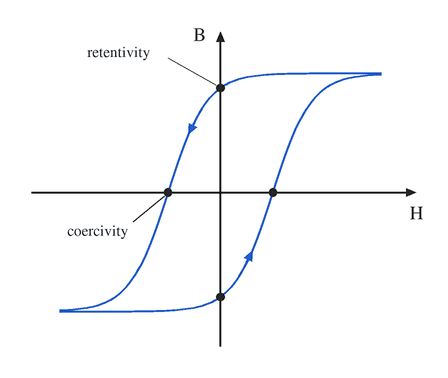
Hysteresis is the lagging of the magnetic induction (or the magnetisation ) behind the magnetising field when a ferromagnetic material is taken through a cycle of magnetisation. When is reduced to zero, does not become zero; the value left is the retentivity. A reverse field, called the coercivity, is needed to bring to zero. Plotting against for a complete cycle gives a closed curve called the hysteresis loop, and the area of the loop is the energy lost as heat per unit volume per cycle.
Step 2 — Name the three elements (part ii).
The three magnetic elements of the earth are the angle of declination (the angle between the magnetic meridian and the geographic meridian), the angle of dip or inclination (the angle the earth's field makes with the horizontal), and the horizontal component of the earth's field.
Therefore, (i) hysteresis is the lagging of behind in a ferromagnetic material taken through a magnetisation cycle, and (ii) the three elements are declination, dip (inclination) and the horizontal component of the earth's field.
- 32 marks
Question 3
(i) Define Curie temperature.
(ii) If magnetic susceptibility of a certain magnetic material is , find its relative permeability.
Solve with AIWritten solution
Solution:
Key idea: (i) Heating a ferromagnetic material disturbs the alignment of the magnetic moments inside its domains. (ii) The relative permeability and the susceptibility are related by .
Step 1 — Define Curie temperature (part i).
The Curie temperature of a ferromagnetic substance is the temperature above which it loses its ferromagnetic property and behaves as a paramagnetic substance. For iron it is about .
Step 2 — Find the relative permeability (part ii).
We add 1 to the given susceptibility .
A value just above 1 shows that the material is paramagnetic.
Therefore, (i) the Curie temperature is the temperature above which a ferromagnetic substance becomes paramagnetic, and (ii) the relative permeability is .
- 41 mark
Question 4
Magnetic susceptibility of platinum is 0.0001. Its relative permeability is :
Solve with AIAnswer
(A) 1.0000
(B) 0.9999
- Correct
(C) 1.0001
(D) 0
Answer: (C) 1.0001
Key idea: The relative permeability and the magnetic susceptibility are related by .
Step 1 — Substitute the susceptibility.
For platinum , so we add it to 1.
Step 2 — Check that it makes sense.
Platinum is paramagnetic, and paramagnetic substances have slightly greater than 1, which agrees with the result.
Why the others are wrong:
- (A) This leaves out the susceptibility altogether; exactly holds only for free space.
- (B) This uses ; a value just below 1 belongs to a diamagnetic substance.
- (D) A relative permeability of 0 would need , which only a superconductor (a perfect diamagnet) reaches; platinum's is small and positive.
Therefore, the correct option is (C): the relative permeability of platinum is .
- 52 marks
Question 5
(i) Explain Curie's law for a paramagnetic substance.
(ii) A rectangular coil having 60 turns and area of is held at right angles to a uniform magnetic field of flux density . Calculate the magnetic flux passing through it.
Solve with AIWritten solution
Solution:
Key idea: (i) In a paramagnetic substance the atomic magnetic moments are partly lined up by the applied field and knocked out of line by thermal agitation, so a higher temperature gives weaker magnetisation. (ii) The magnetic flux through one turn of a coil held perpendicular to a uniform field is ; for turns the total flux linked with the coil is .
Step 1 — State and explain Curie's law (part i).
Curie's law says that the magnetic susceptibility of a paramagnetic substance is inversely proportional to its absolute temperature :
where is the Curie constant of the substance. Equivalently, the magnetisation is proportional to the applied field and inversely proportional to , so . As the temperature rises, thermal motion disturbs the alignment of the atomic magnetic moments more, so the substance is magnetised less.
Step 2 — Find the flux through one turn (part ii).
The coil is at right angles to the field, so the field passes straight through it and the flux through one turn is .
Step 3 — Find the total flux through the coil (part ii).
The coil has 60 turns, and the same flux passes through each, so we multiply by .
Therefore, (i) by Curie's law the susceptibility of a paramagnetic substance is inversely proportional to its absolute temperature, and (ii) the total magnetic flux linked with the coil is , with through each turn.
- 61 mark
Question 6
curie temperature is the temperature above which:
Solve with AIAnswer
- Correct
(A) A ferromagnetic substance behaves like a paramagnetic substance
(B) A paramagnetic substance behaves like a diamagnetic substance.
(C) A ferromagnetic substance behaves like a diamagnetic substance.
(D) A paramagnetic substance behaves like a diamagnetic substance.
Answer: (A) A ferromagnetic substance behaves like a paramagnetic substance
Key idea: Inside a ferromagnetic substance the atomic magnetic moments are lined up in domains. Heating increases thermal agitation, and at a definite temperature, the Curie temperature, this alignment breaks down.
Step 1 — Say what happens above the Curie temperature.
Above the Curie temperature the domain structure is destroyed. The atomic moments still exist, but they point in random directions and only line up slightly in an applied field, just as in a paramagnetic substance.
Step 2 — Pick the option.
So above the Curie temperature a ferromagnetic substance behaves like a paramagnetic substance, which is option (A).
Note: Options (B) and (D) are printed with the same words.
Why the others are wrong:
- (B) A paramagnetic substance does not turn diamagnetic on heating; its susceptibility only becomes smaller, following Curie's law.
- (C) A ferromagnetic substance above its Curie temperature has a small positive susceptibility, so it becomes paramagnetic, not diamagnetic.
- (D) This repeats (B), and is wrong for the same reason.
Therefore, the correct option is (A): above the Curie temperature a ferromagnetic substance behaves like a paramagnetic substance.
- 71 mark
Question 7
Explain the meaning of the following statement:
Curie temperature for soft iron is .
Solve with AIWritten solution
Solution:
Key idea: The Curie temperature of a ferromagnetic material is the temperature above which it loses its ferromagnetism and becomes paramagnetic.
Step 1 — State what happens below .
Below soft iron is ferromagnetic: its atomic magnetic moments are lined up in domains, and it is strongly attracted by a magnet and easily magnetised.
Step 2 — State what happens above .
When soft iron is heated above (about ), thermal agitation destroys the alignment inside the domains. The iron then behaves as a paramagnetic substance: it is only weakly attracted by a magnet, and its susceptibility becomes small and positive. On cooling below this temperature it becomes ferromagnetic again.
Therefore, the statement means that soft iron is ferromagnetic below and becomes paramagnetic above .
- 81 mark
Question 8
The relative permeability of substance 'X' is slightly less than one and that of substance 'Y' is slightly more than one. Then:
Solve with AIAnswer
(A) 'X' is paramagnetic and 'Y' is ferromagnetic.
(B) 'X' is diamagnetic and 'Y' is ferromagnetic.
(C) 'X' is paramagnetic and 'Y' is diamagnetic.
- Correct
(D) 'X' is diamagnetic and 'Y' is paramagnetic.
Answer: (D) 'X' is diamagnetic and 'Y' is paramagnetic.
Key idea: The relative permeability is . Diamagnetic substances have a small negative , paramagnetic ones a small positive , and ferromagnetic ones a very large positive .
Step 1 — Classify X.
For X, is slightly less than 1, so is small and negative. X is diamagnetic.
Step 2 — Classify Y.
For Y, is slightly more than 1, so is small and positive. Y is paramagnetic. A ferromagnetic substance would have in the hundreds or thousands, not just above 1.
Why the others are wrong:
- (A) A paramagnetic substance has slightly more than 1, not less, and a ferromagnetic one has far greater than 1.
- (B) X is correctly diamagnetic, but Y's only slightly above 1 is far too small for a ferromagnetic substance.
- (C) This swaps the two: just below 1 means diamagnetic and just above 1 means paramagnetic.
Therefore, the correct option is (D): X is diamagnetic and Y is paramagnetic.
- 91 mark
Question 9
Magnetic susceptibility () of a material is found to decrease with the rise in its temperature. The material is:
Solve with AIAnswer
(A) diamagnetic.
- Correct
(B) paramagnetic.
(C) ferromagnetic.
(D) not magnetic.
Answer: (B) paramagnetic.
Key idea: Curie's law says that the susceptibility of a paramagnetic material is inversely proportional to its absolute temperature: , where is the Curie constant. (The paper writes the susceptibility as ; it is the quantity usually written .)
Step 1 — Use Curie's law.
In a paramagnetic material, the applied field lines up the atomic magnetic moments while thermal agitation knocks them out of line. A higher temperature means more agitation, so the material is magnetised less and its susceptibility falls as .
Step 2 — Match with the observation.
A susceptibility that decreases steadily as the temperature rises is exactly the behaviour described by Curie's law, so the material is paramagnetic.
Why the others are wrong:
- (A) The susceptibility of a diamagnetic material is negative and practically independent of temperature.
- (C) A ferromagnetic material's susceptibility is not a fixed property: it depends on the applied field and on the material's past magnetisation. The steady fall with temperature that the question describes is the Curie-law behaviour of a paramagnet. A ferromagnet's susceptibility follows a simple law of this kind only above its Curie temperature , where it has become paramagnetic and obeys the Curie–Weiss law .
- (D) A material whose susceptibility changes with temperature is responding to a magnetic field, so it is not non-magnetic.
Therefore, the correct option is (B): the material is paramagnetic.