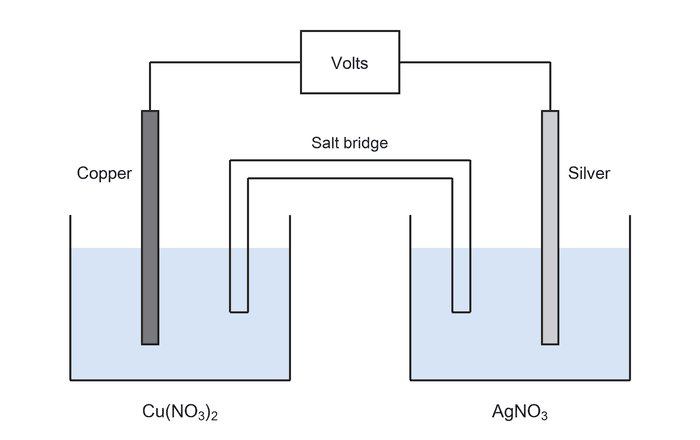
Solution:
Key idea: In the Cu–Ag cell, the electrode with the lower reduction potential (copper, 0.337 V) is the anode and the one with the higher potential (silver, 0.799 V) is the cathode. Then Ecell∘=Ecathode∘−Eanode∘, Ecell=Ecell∘−n0.059logQ at 25∘C, and ΔG=−nFEcell. Kohlrausch's law gives Λm∘ of a salt as the sum of the contributions of all its ions.
Step 1 — (i)1. Write the cell reaction.
Copper is oxidised (Cu→Cu2++2e−) and silver ions are reduced (Ag++e−→Ag). Doubling the silver half-reaction balances the electrons, so n=2.
Cu(s)+2Ag+(aq)→Cu2+(aq)+2Ag(s)
Step 2 — (i)2. Find the standard e.m.f.
The cathode is Ag+/Ag and the anode is Cu2+/Cu.
Ecell∘=0.799−0.337
Ecell∘=0.462 V
Step 3 — (i)3. Set up the Nernst equation.
The reaction quotient is Q=[Ag+]2[Cu2+].
We put Ecell=0.422 V and [Cu2+]=0.1 M, and write x for [Ag+].
0.422=0.462−20.059logx20.1
Step 4 — (i)3. Solve for the logarithm.
We move the terms so that the logarithm stands alone.
0.0295logx20.1=0.040
logx20.1=1.356
Step 5 — (i)3. Solve for the silver-ion concentration.
Taking the antilogarithm gives the ratio, and then we solve for x.
x20.1=22.70
x2=4.405×10⁻³
x≈0.066 M
Step 6 — (i)4. Find the Gibbs energy change.
We use the cell potential at these conditions, Ecell=0.422 V.
ΔG=−2×96500×0.422
ΔG=−81446 J mol−1
ΔG≈−81.4 kJ mol−1
Under standard conditions we would use Ecell∘ instead.
ΔG∘=−2×96500×0.462
ΔG∘≈−89.2 kJ mol−1
Step 7 — (ii) Find the limiting molar conductivity of barium chloride.
One formula unit of BaCl2 gives one Ba2+ and two Cl− ions.
Λm∘(BaCl2)=127.2+2×76.3
Λm∘(BaCl2)=279.8 S cm2 mol−1
Step 8 — (ii) Find the limiting molar conductivity of aluminium sulphate.
One formula unit of Al2(SO4)3 gives two Al3+ and three SO42− ions.
Λm∘(Al2(SO4)3)=2×189+3×160
Λm∘(Al2(SO4)3)=858 S cm2 mol−1
Therefore, (i) the cell reaction is Cu + 2Ag⁺ → Cu²⁺ + 2Ag, E°cell = 0.462 V, [Ag⁺] ≈ 0.066 M and ΔG ≈ −81.4 kJ mol⁻¹; (ii) Λ°m(BaCl₂) = 279.8 S cm² mol⁻¹ and Λ°m(Al₂(SO₄)₃) = 858 S cm² mol⁻¹.