
Opening your dashboard
Class 12 Chemistry Chapter 3 Electrochemistry: Previous Year Questions
44 questions on Chapter 3, each solved step by step. Class 12 Chemistry, ICSE 2026-27.
44 questions with solutions
1–5 marks · Mixed difficulty
The first 22 solutions are on this page. This chapter is a long one, so the rest open on their own page to keep this one quick to load.
- 11 mark
Question 1
Fill in the blanks by choosing the appropriate word/words from those given in the brackets:
(increases, decreases, positive, efficient, 68, non-efficient, no -hydrogen, -hydrogen, negative, Rosenmund's, greater, Cannizzaro, 74, common-ion effect, lesser, buffer action, diamagnetic, paramagnetic)
The more ______ the standard reduction potential of a metal, the ______ is its ability to displace hydrogen from acids.
Solve with AIWritten solution
Solution:
Key idea: A metal displaces hydrogen from an acid when it gives electrons to more readily than hydrogen does. The standard reduction potential of hydrogen is , and a lower (more negative) reduction potential means a stronger tendency to lose electrons.
Step 1 — Link the reduction potential to losing electrons.
A metal with a more negative standard reduction potential is a stronger reducing agent, because it is oxidised more easily.
Step 2 — Apply it to displacing hydrogen.
The more easily the metal is oxidised, the more readily it reduces to . For example, zinc () displaces hydrogen from dilute acids, while copper () does not.
Therefore, the more negative the standard reduction potential of a metal, the greater is its ability to displace hydrogen from acids.
- 21 mark
Question 2
Answer the following questions:
How many hours does it take to reduce 3 moles of to with current intensity?
Solve with AIWritten solution
Solution:
Key idea: By Faraday's first law, the charge needed equals (moles of electrons) × , the Faraday constant ().
The time then follows from .
Step 1 — Write the reduction and count the electrons.
Each ion gains one electron.
So 3 mol of need 3 mol of electrons.
Step 2 — Find the charge.
We multiply the moles of electrons by the Faraday constant.
Step 3 — Find the time in seconds.
The current is , so we divide the charge by the current.
Step 4 — Convert to hours.
One hour has .
Therefore, it takes about 40.2 hours (144750 s).
- 33 marks
Question 3
The specific conductance of a solution of acetic acid at is . The molar conductance at infinite dilution for ion and ion are and respectively. Calculate:
(i) Molar conductance of the solution.
(ii) Degree of dissociation of .
(iii) Dissociation constant for acetic acid.
Solve with AIWritten solution
Solution:
Key idea: Molar conductance is , with in and in .
For a weak electrolyte the degree of dissociation is ; Kohlrausch's law gives .
Ostwald's dilution law then gives .
Step 1 — (i) Find the molar conductance.
We put and into the formula.
Step 2 — (ii) Find the limiting molar conductance.
By Kohlrausch's law, each ion adds its own share at infinite dilution.
Step 3 — (ii) Find the degree of dissociation.
We divide the molar conductance at this concentration by the limiting value.
So only about 4.2 % of the acetic acid molecules are ionised.
Step 4 — (iii) Find the dissociation constant.
For , Ostwald's dilution law gives from and .
Watch out: Many students use the short form . It leads to , close to our value because is small, but the full form above is more exact.
Therefore, (i) Λm = 16.5 ohm⁻¹ cm² mol⁻¹, (ii) α ≈ 0.0423 and (iii) Ka ≈ 1.87 × 10⁻⁵.
- 42 marks
Question 4
Calculate the e.m.f. of the following cell reaction at :
The standard potential () of the cell is .
Solve with AIWritten solution
Solution:
Key idea: The Nernst equation at is , where is the number of electrons transferred and is the reaction quotient (pure solids are left out of ).
Step 1 — Find and write .
Magnesium loses two electrons and gains two electrons, so . The solids Mg and Cu do not appear in .
Step 2 — Substitute into the Nernst equation.
We use from the question and .
Therefore, the e.m.f. of the cell is about 2.68 V.
- 51 mark
Question 5
Fill in the blanks by choosing the appropriate word/words from those given in the brackets:
(Henry's, aldol condensation, absence, do not, ohm, Raoult's, increases, common ion effect, easily, three, solubility product, , two, four, , cannizzaro, , zero, decreases, presence)
The unit of conductance is ______ and that of specific conductance is ______.
Solve with AIWritten solution
Solution:
Key idea: Conductance is the reciprocal of resistance, . Specific conductance is the reciprocal of resistivity, .
Step 1 — Find the unit of conductance.
Resistance is measured in ohm, so its reciprocal is measured in (also called mho, or siemens S in SI units).
Step 2 — Find the unit of specific conductance.
Resistivity is measured in ohm cm, so its reciprocal is measured in (that is, ).
Therefore, the unit of conductance is ohm⁻¹ and that of specific conductance is ohm⁻¹ cm⁻¹.
- 61 mark
Question 6
Complete the following statements by selecting the correct alternative from the choices given:
Electrochemical equivalent is the amount of substance which gets deposited from its solution on passing electrical charge equal to:
Solve with AIAnswer
(A) 96,500 Coulombs
- Correct
(B) 1 Coulomb
(C) 60 Coulombs
(D) 965 Coulombs
Answer: (B) 1 Coulomb
Key idea: Faraday's first law says , where is the mass deposited, is the charge passed and is the electrochemical equivalent of the substance.
Step 1 — Put into the law.
If , the law gives . So is the mass deposited by one coulomb of charge.
Step 2 — Match this with the options.
The electrochemical equivalent is therefore the amount deposited by 1 coulomb, which is option (B).
Why the others are wrong:
- (A) Passing 96,500 C (one faraday) deposits one gram-equivalent of the substance, which is its equivalent mass, not its electrochemical equivalent.
- (C) Passing 60 C deposits , sixty times the electrochemical equivalent.
- (D) Passing 965 C, one-hundredth of a faraday, deposits 0.01 gram-equivalent of the substance (a mass of ), not one electrochemical equivalent.
Therefore, the electrochemical equivalent is the amount deposited by 1 coulomb, so the answer is (B).
- 71 mark
Question 7
Answer the following questions:
Calculate the number of coulombs required to deposit of Al when the electrode reaction is:
Solve with AIWritten solution
Solution:
Key idea: The charge needed is (moles of electrons) × . The electrode reaction shows how many moles of electrons each mole of metal needs.
Step 1 — Find the moles of aluminium.
We divide the mass by the atomic mass.
Step 2 — Find the moles of electrons.
The equation shows 3 mol of electrons per mole of Al.
Step 3 — Find the charge.
One mole of electrons carries .
Therefore, 57900 coulombs are required.
- 83 marks
Question 8
Consider the following cell reaction at :
The standard reduction potentials () for and are and respectively:
(1) Write the cell representation.
(2) What will be the emf of the cell if the concentration of is and that of is ?
(3) Will the cell work spontaneously for the condition given in (2) above?
Solve with AIWritten solution
Solution:
Key idea: In a galvanic cell the anode (oxidation) is written on the left and the cathode (reduction) on the right, with for the salt bridge. The cell e.m.f. is , corrected for concentration by the Nernst equation at . A positive means a spontaneous reaction.
Step 1 — (1) Write the cell representation.
In the reaction , cadmium is oxidised (anode) and silver ions are reduced (cathode).
With the concentrations of part (2), it is .
Step 2 — (2) Find the standard e.m.f.
The cathode is and the anode is .
Step 3 — (2) Write the reaction quotient.
Two electrons are transferred, so . The solids are left out, and is squared because of its coefficient 2.
Step 4 — (2) Apply the Nernst equation.
We use .
Step 5 — (3) Decide whether the cell works spontaneously.
The e.m.f. is positive, so is negative. A negative means the reaction goes on its own.
Therefore, (1) the cell is Cd | Cd²⁺ (0.1 M) ∥ Ag⁺ (0.2 M) | Ag, (2) E(cell) ≈ 1.19 V, and (3) yes, the cell works spontaneously because its e.m.f. is positive.
- 93 marks
Question 9
A solution offers the resistance of 50 ohms to a conductivity cell at . If the cell constant is and molar conductance of at infinite dilution is , calculate:
(i) Specific conductance
(ii) Molar conductance
(iii) Degree of dissociation
Solve with AIWritten solution
Solution:
Key idea: Specific conductance is , where is the cell constant. Then and the degree of dissociation is .
Step 1 — (i) Find the specific conductance.
We divide the cell constant by the measured resistance.
Step 2 — (ii) Find the molar conductance.
We put and into the formula.
Step 3 — (iii) Find the degree of dissociation.
We compare the molar conductance with its value at infinite dilution.
Note: These are the answers for the data printed in the question. Real 0.05 M () is only about 2% ionised, with a molar conductance near 5 ohm⁻¹ cm² mol⁻¹, and its limiting molar conductance is about 272 ohm⁻¹ cm² mol⁻¹ (73.5 for plus 198.6 for ). In a cell of constant 0.50 cm⁻¹ it would show a resistance of roughly 2000 ohm, not 50 ohm. The method of working is the same.
Therefore, (i) κ = 0.01 ohm⁻¹ cm⁻¹, (ii) Λm = 200 ohm⁻¹ cm² mol⁻¹ and (iii) α ≈ 0.424 (about 42.4 % dissociated).
- 101 mark
Question 10
Fill in the blanks by choosing the appropriate word/words from those given in the brackets:
(iodoform, acetaldehyde, positive, greater, acidic, acetone, disaccharide, negative, increases, glucose, decreases, chloroform, polysaccharide, lactose, lesser, basic, cationic hydrolysis, anionic hydrolysis)
On dilution of a solution, its specific conductance ______ while its equivalent conductance ______.
Solve with AIWritten solution
Solution:
Key idea: Specific conductance is the conductance of a fixed volume () of solution. Equivalent (or molar) conductance is the conductance of all the ions from one gram-equivalent (or one mole) of electrolyte, whatever the volume.
Step 1 — See what happens to specific conductance.
Specific conductance is the conductance of of the solution, so it depends on how many ions carry current in that fixed volume. On dilution the number of ions per unit volume falls (even for a weak electrolyte, where the extra ionisation is far too small to make up for the added water), so decreases.
Step 2 — See what happens to equivalent conductance.
Equivalent conductance always refers to the ions from one gram-equivalent of electrolyte. On dilution that same amount is spread through more solution, so the ions attract each other less (strong electrolytes) and more molecules ionise (weak electrolytes). Both effects make the ions from one gram-equivalent carry more current, so the equivalent conductance increases.
Therefore, on dilution of a solution, its specific conductance decreases while its equivalent conductance increases.
- 111 mark
Question 11
Fill in the blanks by choosing the appropriate word/words from those given in the brackets:
(iodoform, acetaldehyde, positive, greater, acidic, acetone, disaccharide, negative, increases, glucose, decreases, chloroform, polysaccharide, lactose, lesser, basic, cationic hydrolysis, anionic hydrolysis)
More ______ the standard reduction potential of a substance, the ______ is its ability to displace hydrogen from acids.
Solve with AIWritten solution
Solution:
Key idea: A metal displaces hydrogen from an acid when it gives electrons to more readily than hydrogen does. The standard reduction potential of hydrogen is , and a lower (more negative) reduction potential means a stronger tendency to lose electrons.
Step 1 — Link the reduction potential to losing electrons.
A substance with a more negative standard reduction potential is a stronger reducing agent, because it is oxidised more easily.
Step 2 — Apply it to displacing hydrogen.
The more easily the substance is oxidised, the more readily it reduces to . For example, magnesium () displaces hydrogen from dilute acids, while silver () does not.
Therefore, the more negative the standard reduction potential of a substance, the greater is its ability to displace hydrogen from acids.
- 121 mark
Question 12
Complete the following statements by selecting the correct alternative from the choices given:
For a spontaneous reaction and will be respectively:
Solve with AIAnswer
- Correct
(A) ve and ve
(B) ve and ve
(C) ve and ve
(D) ve and ve
Answer: (A) ve and ve
Key idea: The Gibbs energy change and the cell e.m.f. are linked by , where and are always positive. A reaction is spontaneous when is negative.
Step 1 — Fix the sign of .
For a spontaneous reaction under standard conditions, is negative.
Step 2 — Find the sign of .
Because of the minus sign in , a negative needs a positive . The two quantities always have opposite signs.
Why the others are wrong:
- (B) A positive with a negative describes a reaction that is NOT spontaneous; its reverse is the spontaneous one.
- (C) Both positive is impossible, because always gives them opposite signs.
- (D) Both negative is impossible for the same reason.
Therefore, for a spontaneous reaction ΔG° is negative and E°cell is positive, so the answer is (A).
- 131 mark
Question 13
Answer the following questions:
Specific conductivity of solution of at is . Calculate its molar conductivity.
Solve with AIWritten solution
Solution:
Key idea: Molar conductivity is , with in and in . The factor 1000 converts litres to .
Step 1 — Substitute the data.
We use and .
Step 2 — Work out the value.
The numerator is 25, and 25 divided by 0.20 gives 125.
Therefore, the molar conductivity of the KCl solution is 125 S cm² mol⁻¹.
- 141 mark
Question 14
Fill in the blanks by choosing the appropriate word/words from those given in the brackets:
(square pyramidal, electrical, 74; 26, , , chemical, 68, 32, tetrahedral, yellow, white, iodoform, Lucas)
A Galvanic cell converts ______ energy into ______ energy.
Solve with AIWritten solution
Solution:
Key idea: A galvanic (voltaic) cell uses a spontaneous redox reaction to push electrons through an external wire.
Step 1 — Identify the energy that goes in.
The energy comes from the chemical reaction inside the cell, for example in the Daniell cell.
Step 2 — Identify the energy that comes out.
The electrons released at the anode flow through the wire to the cathode, which is an electric current. So the cell gives out electrical energy.
Therefore, a Galvanic cell converts chemical energy into electrical energy.
- 155 marks
Question 15
(i) Calculate the emf and for the cell reaction at :
Given and
(ii) Define the following terms :
(1) Equivalent conductivity
(2) Corrosion of metals
Solve with AIWritten solution
Solution:
Key idea: For a cell written as anode | anode ion ∥ cathode ion | cathode, the standard e.m.f. is .
At () the Nernst equation is .
The standard Gibbs energy change is .
Step 1 — (i) Write the cell reaction.
Zinc is the anode (left) and cadmium is the cathode (right), and two electrons are transferred, so .
Step 2 — (i) Find the standard e.m.f.
The paper prints the zinc value without its unit; it is in volts, like the cadmium value.
Step 3 — (i) Find the e.m.f. at the given concentrations.
We first work out the reaction quotient; the solids are left out.
Now we use the Nernst equation with .
Step 4 — (i) Find the standard Gibbs energy change.
We use and the standard e.m.f.
At the given concentrations we would use instead of .
Step 5 — (ii)(1) Define equivalent conductivity.
Equivalent conductivity () is the conducting power of all the ions produced by one gram-equivalent of an electrolyte dissolved in a given volume of solution. It is found from , where is the normality, and its unit is .
Step 6 — (ii)(2) Define corrosion of metals.
Corrosion is the slow destruction of a metal by chemical or electrochemical reaction with its surroundings (oxygen, moisture, carbon dioxide, acids), which turns the metal into compounds such as its oxide, hydroxide or carbonate. The rusting of iron is the common example: at tiny anodic spots , and at cathodic spots oxygen is reduced, ; the is then oxidised further to hydrated iron(III) oxide, (rust).
Therefore, (i) E(cell) ≈ 0.33 V (0.3305 V) and ΔG° ≈ −69.5 kJ mol⁻¹; (ii) equivalent conductivity is the conducting power of all the ions from one gram-equivalent of an electrolyte in a given volume of solution, and corrosion is the slow destruction of a metal by chemical or electrochemical reaction with its surroundings, as in the rusting of iron.
- 165 marks
Question 16
(i) The specific conductivity of a solution containing of anhydrous (mol. wt ) in of a solution is found to be . Calculate the molar and equivalent conductivity of the solution.
(ii) What is an electrochemical series ? How is it useful in predicting whether a metal can liberate hydrogen from acid or not ?
Solve with AIWritten solution
Solution:
Key idea: Molar conductivity is (molarity ), and equivalent conductivity is (normality ). For each formula unit gives , which carries 2 charges, so its normality is twice its molarity.
Step 1 — (i) Find the molarity.
There are 5 g of (molar mass 208) in (1 L) of solution.
Step 2 — (i) Find the molar conductivity.
We put into the formula.
Step 3 — (i) Find the normality.
The equivalent mass of is half its molar mass, so the normality is twice the molarity.
Step 4 — (i) Find the equivalent conductivity.
We use the normality in place of the molarity.
As expected, is half of for this 2 : 1 salt.
Step 5 — (ii) State what the electrochemical series is.
The electrochemical series is the arrangement of electrodes (elements and their ions) in order of their standard reduction potentials, measured against the standard hydrogen electrode, which is taken as .
Step 6 — (ii) Use it to predict whether a metal liberates hydrogen from an acid.
A metal with a negative standard reduction potential (placed below hydrogen when the series runs from positive at the top to negative at the bottom) is a stronger reducing agent than hydrogen. It can reduce to , because the cell made from it and the hydrogen electrode (as cathode) has a positive e.m.f. For zinc we find the following.
The value is positive, so zinc liberates hydrogen.
A metal with a positive standard reduction potential, such as copper (), gives a negative value.
So copper cannot liberate hydrogen from dilute acids.
Therefore, (i) Λm ≈ 241.3 ohm⁻¹ cm² mol⁻¹ and Λeq ≈ 120.6 ohm⁻¹ cm² (g-equiv)⁻¹; (ii) metals with negative standard reduction potentials liberate hydrogen from acids, and those with positive values do not.
- 171 mark
Question 17
Select the correct alternative from the choice given:
The cell reaction is spontaneous or feasible when emf of the cell is:
Solve with AIAnswer
(A) Negative
- Correct
(B) positive
(C) zero
(D) either positive or negative
Answer: (B) positive
Key idea: The Gibbs energy change of a cell reaction is . A reaction is spontaneous (feasible) when is negative.
Step 1 — Write the condition for spontaneity.
The reaction is feasible when .
Step 2 — Translate it into the e.m.f.
Since and are positive, is negative only when is positive.
Why the others are wrong:
- (A) A negative e.m.f. makes positive, so the reaction as written is not spontaneous (its reverse is).
- (C) A zero e.m.f. makes , which means the cell is at equilibrium and no net reaction occurs.
- (D) Only a positive e.m.f. works; a negative e.m.f. never gives a spontaneous reaction as written.
Therefore, the cell reaction is spontaneous when the emf is positive, so the answer is (B).
- 185 marks
Question 18
(i) Calculate the mass of silver deposited at cathode when a current of 2 amperes is passed through a solution of for 15minutes.
(ii) Calculate the emf and for the cell reaction at .
Given, ,
Solve with AIWritten solution
Solution:
Key idea: Faraday's first law: mass deposited , with . For the cell, at (here is the reaction quotient), and .
Step 1 — (i) Find the charge passed.
The current is and the time is 15 minutes, which we first change to seconds.
Step 2 — (i) Find the mass of silver.
The cathode reaction is , so one faraday deposits one mole (108 g) of silver.
Step 3 — (ii) Write the cell reaction.
Magnesium is the anode and copper the cathode, and two electrons are transferred, so .
Step 4 — (ii) Find the e.m.f.
We first work out the reaction quotient; the solids are left out.
Now we use the Nernst equation with .
Step 5 — (ii) Find the Gibbs energy change.
We use the e.m.f. at these concentrations and .
Therefore, (i) about 2.01 g of silver is deposited; (ii) E(cell) ≈ 2.68 V and ΔG ≈ −517.3 kJ mol⁻¹.
- 195 marks
Question 19
(i) Define the following terms:
-
Specific conductance
-
Kohlrausch's law
(ii) The resistance of a conductivity cell containing KCl solution at 298k is 1500ohm. What is the cell constant and molar conductivity of KCl solution, if the conductivity of this solution is at
Solve with AIWritten solution
Solution:
Key idea: Specific conductance and resistance are linked through the cell constant: .
Molar conductivity is .
Step 1 — (i)(1) Define specific conductance.
Specific conductance (conductivity, ) is the conductance of a solution held between two electrodes, each of area , placed apart, that is, the conductance of of the solution. It is the reciprocal of resistivity, , and its unit is ().
Step 2 — (i)(2) State Kohlrausch's law.
Kohlrausch's law of independent migration of ions states that, at infinite dilution, each ion makes a definite contribution to the molar conductivity of an electrolyte, whatever the other ion is. So , where and are the numbers of cations and anions in one formula unit.
Step 3 — (ii) Find the cell constant.
We multiply the conductivity by the resistance.
Step 4 — (ii) Find the molar conductivity.
We put and into the formula.
Therefore, (i) specific conductance is the conductance of 1 cm³ of solution (electrodes of area 1 cm² placed 1 cm apart), and Kohlrausch's law states that at infinite dilution each ion makes its own definite contribution to the molar conductivity, whatever the other ion; (ii) the cell constant is 0.219 cm⁻¹ and the molar conductivity is 146 ohm⁻¹ cm² mol⁻¹.
-
- 201 mark
Question 20
Fill in the blanks by choosing the appropriate word/words from those given in the brackets:
(iodoform, volume, mass, haloform, gram equivalent, chloroform, carbylmine, , high, coke, , low, gram mole, carbon monoxide.
Equivalent conductivity is the conducting power of all the ions furnished by one ______ of an electrolyte present in a definite ______ of the solution.
Solve with AIWritten solution
Solution:
Key idea: Equivalent conductivity compares electrolytes on the basis of one gram-equivalent each.
Step 1 — Identify the amount of electrolyte.
The definition refers to the ions from one gram equivalent of the electrolyte.
Step 2 — Identify what is fixed about the solution.
That gram equivalent is dissolved in a definite volume of solution, held between electrodes 1 cm apart.
Therefore, equivalent conductivity is the conducting power of all the ions furnished by one gram equivalent of an electrolyte present in a definite volume of the solution.
- 212 marks
Question 21
Answer the following questions:
The molar conductivity of NaCl, and HCl at infinite dilution is 126.45, 91.0 and 426.16 respectively. Calculate the molar conductivity for at infinite dilution.
Solve with AIWritten solution
Solution:
Key idea: By Kohlrausch's law, of an electrolyte is the sum of the limiting conductivities of its ions. We can therefore build from three strong electrolytes whose values are known.
Step 1 — Write each value as a sum of ions.
Each strong electrolyte splits into its own two ions.
Step 2 — Combine them.
Adding the first two and subtracting the third removes and and leaves .
Step 3 — Substitute the data.
We use the three values given.
Therefore, the molar conductivity of CH₃COOH at infinite dilution is 390.71 ohm⁻¹ cm² mol⁻¹.
- 223 marks
Question 22
Calculate the emf and for the given cell at :
Given: ,
(, )
Solve with AIWritten solution
Solution:
Key idea: The standard e.m.f. is , the Nernst equation is , and . Because is given, we work out from it.
Step 1 — Write the balanced cell reaction.
Chromium is the anode () and iron is the cathode (). To balance the electrons we take 2 Cr and 3 , so .
Step 2 — Find the standard e.m.f.
The cathode is and the anode is .
Step 3 — Write the reaction quotient.
The coefficients become powers, and the solids are left out.
Step 4 — Work out the Nernst factor.
At , .
Step 5 — Find the e.m.f.
We use and .
Step 6 — Find the Gibbs energy change.
We use the e.m.f. at the given concentrations.
The negative value shows that the cell reaction is spontaneous. (Using the rounded factor 0.059 V gives the same answers to three significant figures.)
Therefore, E(cell) ≈ 0.261 V and ΔG ≈ −150.9 kJ mol⁻¹.
- 233 marks
Question 23
Calculate the degree of dissociation of acetic acid, if it molar conductivity is
(Given: ) and ) )
- 241 mark
Question 24
Select and write the correct alternative from the choices given below:
Which one of the following statements is TRUE for the galvanic cell?
- 251 mark
Question 25
Assertion: If a solution contains both and ions, the ions are reduced first at cathode.
Reason: Cations with higher value are reduced first at cathode.
- 262 marks
Question 26
Calculate the emf of the following cell at 298 K.
Given , ,
1 Faraday =
- 275 marks
Question 27
(i) The specific conductance of formic acid is . Calculate its molar conductivity and degree of dissociation.
Given and
(ii) Calculate the time taken to deposit 1.27 g of copper at cathode when a current of 2 amp. is passed through the solution of .
(Atomic weight of Cu = 63.5 g )
- 285 marks
Question 28
(i) The resistance of a conductivity cell with 0.1M KCl solution is 200 ohm. When the same cell is filled with 0.02 M NaCl solution, the resistance is 1100 ohm. If the conductivity of 0.1 M KCl solution is 0.0129 . Calculate the cell constant and molar conductivity of 0.02 M NaCl solution.
(ii) The emf () of the following reaction is 0.89 V.
Calculate the value of for the reaction. Predict whether the above reaction will be spontaneous or not.
- 291 mark
Question 29
Select and write the correct alternative from the choices given below.
Which one of the following statements is correct regarding the dry cell?
(P) Zinc container acts as an anode in dry cell.
(Q) Zinc container touches the paste of and carbon.
(R) Dry cell can be charged easily.
(S) Graphite rod acts as a cathode in dry cell.
- 301 mark
Question 30
Select and write the correct alternative from the choices given below.
Assertion: Specific conductivity of all electrolytes decreases on dilution.
Reason: On dilution, the number of ions per unit volume decreases.
- 312 marks
Question 31
Calculate the maximum possible electrical work that can be obtained from a galvanic cell under standard conditions at 298K.
Given ;
- 325 marks
Question 32
(i) Study the diagram given below that represents Cu-Ag electrochemical cell and answer the questions that follow.
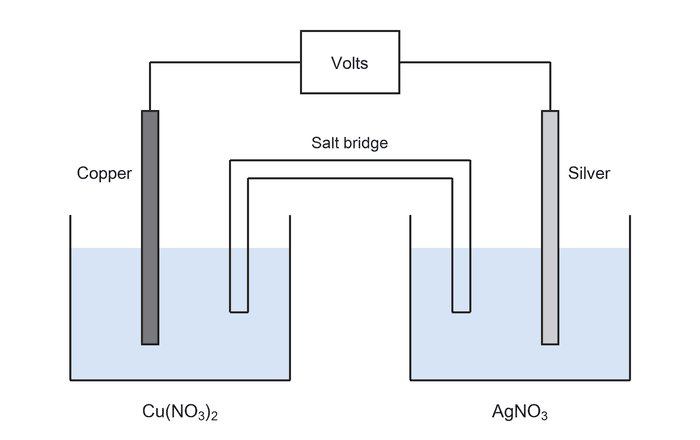
Given ;
-
Write the cell reaction for the above cell.
-
Calculate the standard emf of the cell.
-
If the concentration of is 0.1 M and is 0.422 V, at , calculate the concentration of .
-
Calculate for the cell.
(ii) Calculate and from the following data.
For ,
,
-
- 335 marks
Question 33
(i) A 0.05 M solution offers the resistance of 30.8 ohms to a conductivity cell at 298K. If the cell constant is and the molar conductance of at infinite dilution is , calculate the following:
-
Specific conductance
-
Molar conductance
-
Degree of dissociation
(ii) In the diagram of the electrolytic cell given below, A, B and C are connected in series having electrolytes of , and , respectively.
A steady current of 1.5 A was passed until 1.45 g of Ag was deposited at the cathode of cell B.

(Atomic mass of Ag = 108, Cu = 63.5, Zn = 65.3)
Answer the following questions:
-
How long did the current flow?
-
What weight of Cu and Zn was deposited at the cathode?
-
- 341 mark
Question 34
Fill in the blanks by choosing the appropriate word(s) from those given in the brackets:
[+2, ethane, tetrahedral, square planar, zero dry cell, nickel–cadmium cell, propane, Wolff–Kishner, Stephen, completely filled, incompletely filled, paramagnetic, diamagnetic]
__________ is an example of a primary cell but __________ is an example of a secondary cell
- 352 marks
Question 35
Calculate the number of coulombs required to electroplate 4.75 g of aluminium when electrode reaction is
(Given: Atomic weight of Al , 1 Faraday = 96,500 coulombs)
- 362 marks
Question 36
Calculate the of the following if the cell potential () is 0.59 V.
(Given: )
- 373 marks
Question 37
Answer the following questions.
(a) By referring to electrochemical series, how can anode and cathode half cells be identified in a galvanic cell?
(b) What is the role of salt bridge in a galvanic cell?
(c) Write an advantage and a disadvantage of a fuel cell.
- 383 marks
Question 38
Answer the following questions.
(a) Specific conductance of a solution decreases upon dilution. Why?
(b) The emf of a cell should be positive for a spontaneous reaction. Give a reason.
(c) Name the type of cell in which reaction occurs only in one direction and cannot be reversed by an external energy source. Write any one disadvantage of this type of cell.
- 391 mark
Question 39
Read the information given below and answer the questions that follow.
Kohlrausch observed an interesting pattern between the values of molar conductance at infinite dilution () for strong electrolytes. It was observed that different pairs of electrolytes having a common cation or anion had almost same difference of . On the basis of his observation, he postulated a law known as Kohlrausch's Law of Independent Migration of ions.
The values of molar conductivities at infinite dilution for some cations and anions are as follows:
Ion 127.2 76.3 119.0 160.0 State the Kohlrausch's Law of Independent Migration of ions.
- 401 mark
Question 40
Read the information given below and answer the questions that follow.
Kohlrausch observed an interesting pattern between the values of molar conductance at infinite dilution () for strong electrolytes. It was observed that different pairs of electrolytes having a common cation or anion had almost same difference of . On the basis of his observation, he postulated a law known as Kohlrausch's Law of Independent Migration of ions.
The values of molar conductivities at infinite dilution for some cations and anions are as follows:
Ion 127.2 76.3 119.0 160.0 Calculate the molar conductance at infinite dilution for .
- 411 mark
Question 41
Read the information given below and answer the questions that follow.
Kohlrausch observed an interesting pattern between the values of molar conductance at infinite dilution () for strong electrolytes. It was observed that different pairs of electrolytes having a common cation or anion had almost same difference of . On the basis of his observation, he postulated a law known as Kohlrausch's Law of Independent Migration of ions.
The values of molar conductivities at infinite dilution for some cations and anions are as follows:
Ion 127.2 76.3 119.0 160.0 Arrange the values of for and in increasing order.
- 422 marks
Question 42
Calculate the value of for the following cell at .
Given ,
1 faraday = 96,500 coulombs
- 433 marks
Question 43
(a) The molar conductivity at infinite dilution for and for respectively.
Calculate the degree of dissociation () of acetic acid if its molar conductivity () is .
(b) Compounds [A] and [B] are two electrolytes. Upon dilution, the molar conductivity of compound [A] increases 3 times while that of [B] increases 30 times. Which one of the two is a weak electrolyte? Why?
(c) Can copper sulphate solution be stored in a zinc pot? Give a reason for your answer by referring to the values given below.
,
- 443 marks
Question 44
(a) When a current of 0.75 ampere is passed through a solution for 25 minutes, 0.370 g of copper is deposited. Calculate the atomic weight of copper by using the given information.
(b) Two metals A and B have standard reduction potential values, and respectively.
Which of these metals will liberate gas from dil. ? Why?
(c) Why does the specific conductivity () of a solution decrease on dilution?