
Question 225 marksAsked 2023Medium
Explain the components of the structural genes in the Lac operon system in E. coli. How does the operon function in the presence of lactose?
Confirming your payment
Sign up now and get 250 free tokens.
Previous Year Questions · Question 22 of 31
Explain the components of the structural genes in the Lac operon system in E. coli. How does the operon function in the presence of lactose?
Solution:
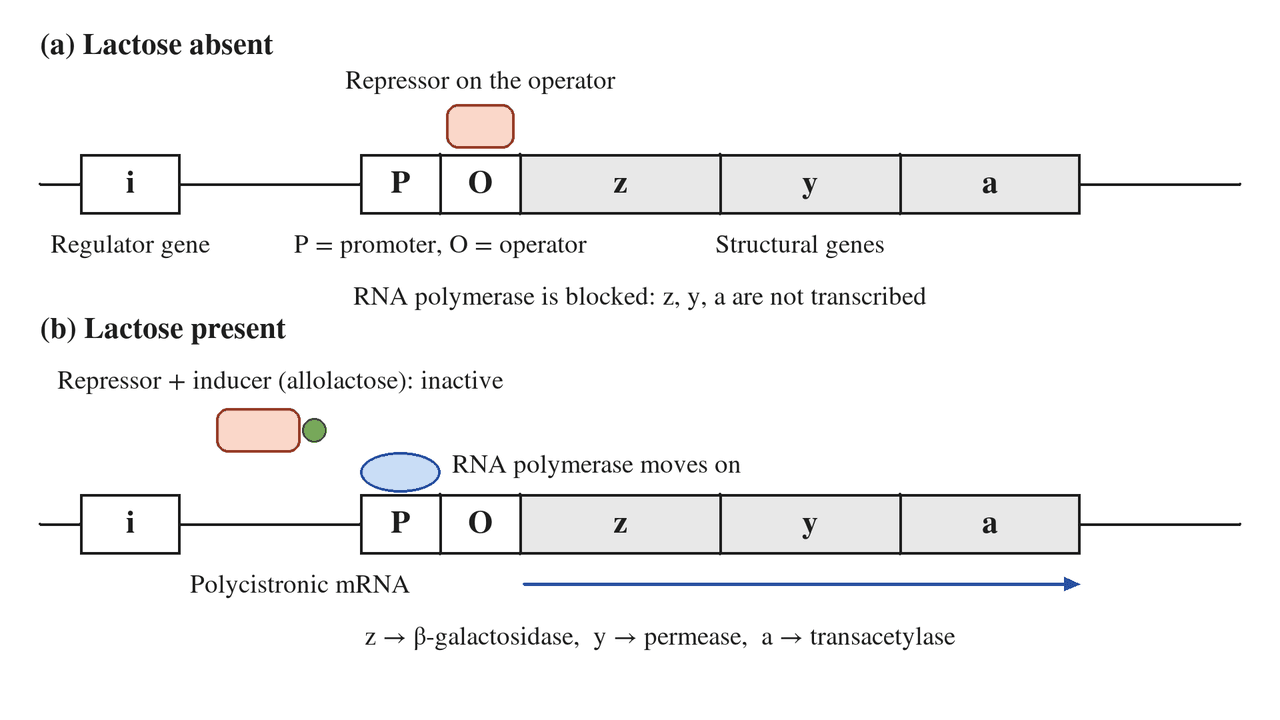
Key idea: The lac operon of E. coli is an inducible operon: the genes needed to use lactose are transcribed only when lactose is present. It contains a promoter, an operator and three structural genes, and is controlled by a repressor made by the regulator (i) gene.
Step 1 — Explain the structural genes.
The lac operon has three structural genes, transcribed together as one polycistronic mRNA:
Step 2 — Name the other parts.
The promoter (P) is where RNA polymerase binds, the operator (O) is the switch next to it, and the regulator gene (i) makes the repressor protein all the time.
Step 3 — Describe the operon without lactose.
When lactose is absent, the repressor binds to the operator. RNA polymerase cannot move into the structural genes, so they are not transcribed.
Step 4 — Describe what lactose does.
When lactose is present, a few molecules enter the cell through the small amount of permease present and are converted to allolactose. This inducer binds to the repressor and changes its shape, so the repressor can no longer bind to the operator and comes off it.
Step 5 — Describe the result.
With the operator free, RNA polymerase transcribes z, y and a into one mRNA, and β-galactosidase, permease and transacetylase are made. The cell can now take in and break down lactose. When all the lactose is used up, the repressor becomes active again, binds the operator, and the operon switches off.
Note: Strong transcription also needs low glucose: the CAP–cAMP complex then binds near the promoter and helps RNA polymerase. With glucose present, transcription stays low even if lactose is available.
Therefore, the structural genes z, y and a code for β-galactosidase, permease and transacetylase; in the presence of lactose the inducer (allolactose) inactivates the repressor, the operator is freed, and RNA polymerase transcribes the three genes so the lactose-using enzymes are made.