
Question 215 marksAsked 2020Medium
(i) Give an account of Meselson and Stahl's experiment.
(ii) What is the significance of Meselson and Stahl's experiment?
Confirming your payment
Sign up now and get 250 free tokens.
Previous Year Questions · Question 21 of 31
(i) Give an account of Meselson and Stahl's experiment.
(ii) What is the significance of Meselson and Stahl's experiment?
Solution:
Key idea: DNA could, in principle, replicate in three ways: conservatively (the old double helix stays whole), semi-conservatively (each new helix keeps one old strand) or dispersively (old and new pieces mixed in both strands). Meselson and Stahl (1958) told these apart by labelling DNA with heavy nitrogen and measuring its density.
Step 1 — (i) Label the DNA with heavy nitrogen.
Escherichia coli was grown for many generations in a medium whose only nitrogen source was . The heavy isotope entered the bases, so all the DNA became heavy ().
Step 2 — (i) Transfer the cells to normal nitrogen.
The cells were then moved to a medium with ordinary . Samples were then taken after each generation (one round of cell division), so the DNA could be followed generation by generation.
Step 3 — (i) Separate DNA by density.
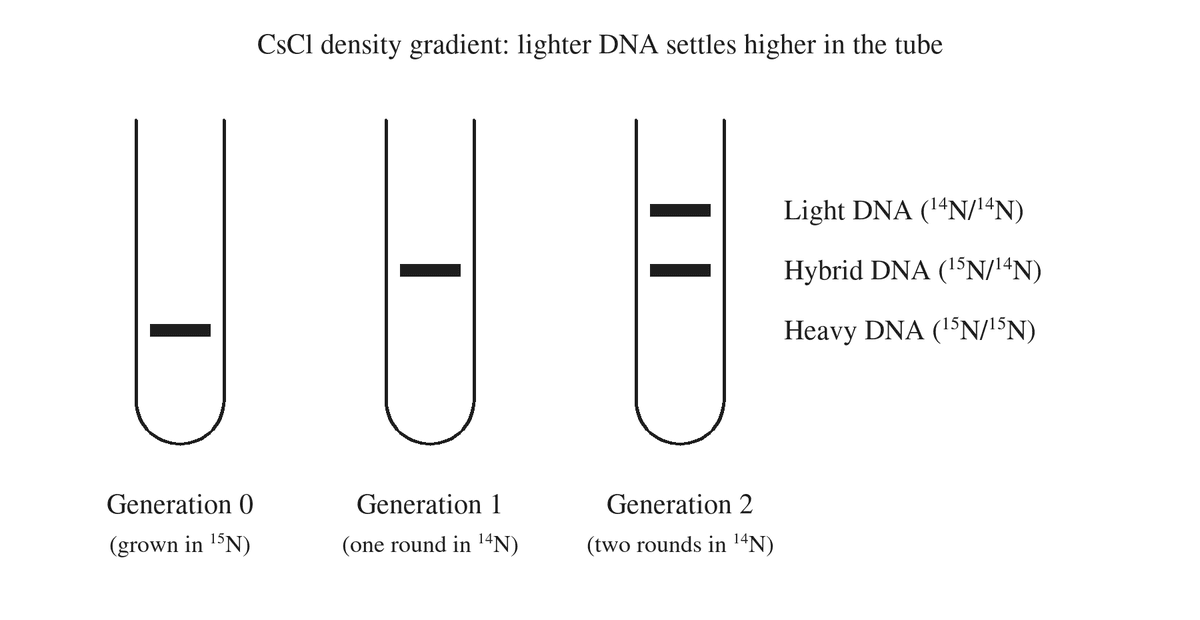
DNA from each sample was spun at high speed in a caesium chloride (CsCl) solution. The CsCl forms a density gradient, and each kind of DNA settles where its density matches the solution: heavy DNA lowest, light DNA highest.
Step 4 — (i) Read the results.
At the start (generation 0) there was one band of heavy DNA. After one generation there was one band of hybrid density, between heavy and light. After two generations there were two equal bands, one hybrid and one light. In later generations the hybrid fraction kept halving.
For example, after three generations it is , and the remaining is light.
Step 5 — (ii) State the significance.
The single hybrid band after one generation rules out conservative replication, which would give separate heavy and light bands. The equal hybrid and light bands after two generations rule out dispersive replication, which would give a single band of intermediate density. So the experiment proved that DNA replicates semi-conservatively: each daughter molecule has one parental strand and one newly made strand.
Note: Textbooks often say that E. coli divides every 20 minutes, which is true in a rich medium. In the 1958 experiment the cells grew in a glucose–salts medium at about 36 °C, where one generation took about 50 minutes (0.81–0.85 hours); the conclusion depends on the number of generations, not on the time.
Therefore, (i) Meselson and Stahl grew E. coli in ¹⁵N, transferred it to ¹⁴N and followed the DNA bands in a CsCl gradient (heavy → hybrid → hybrid + light); (ii) this proved that DNA replication is semi-conservative.