Solution:
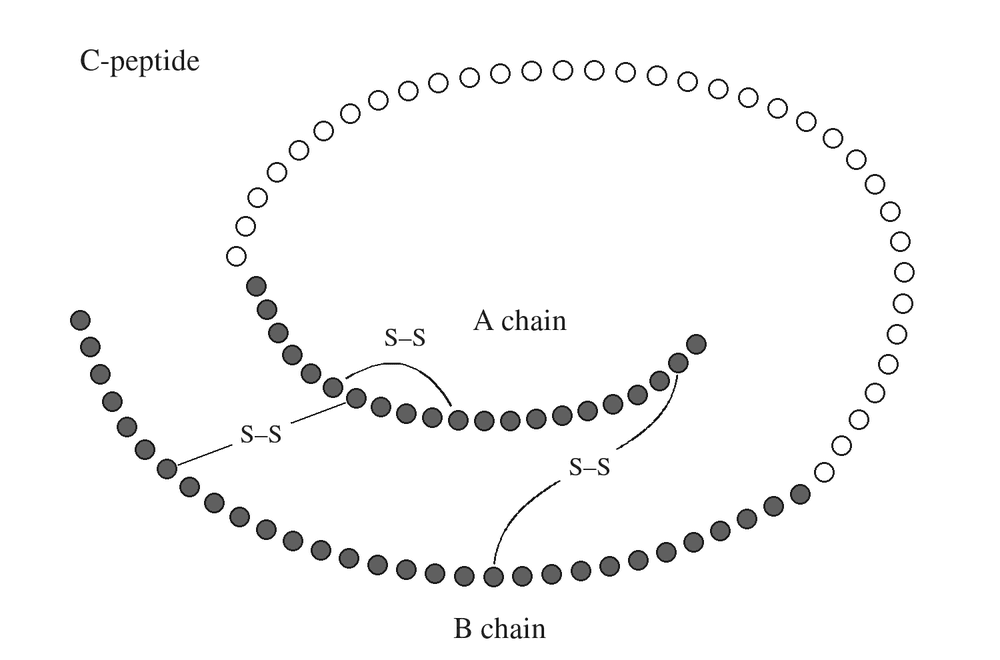
Key idea: Insulin is made in the pancreas as a single-chain prohormone, proinsulin. The figure shows its three parts: the A chain, the B chain and the C-peptide that joins them.
Step 1 — (i) State the change.
To become fully functional, proinsulin must have its C-peptide removed. The extra stretch is cut out, and what remains is mature insulin: the A chain (21 amino acids) and the B chain (30 amino acids) held together.
Step 2 — (ii) Name the technique.
Human insulin is now produced by recombinant DNA technology (genetic engineering), in which the genes for the insulin chains are inserted into bacteria such as E. coli, which then make the chains.
Step 3 — (iii) Say how the chains are held together.
The two polypeptide chains are held together by disulphide (S–S) bridges: two bridges join the A chain to the B chain, and the A chain also has one bridge within itself.
Therefore, (i) the C-peptide is removed, (ii) recombinant DNA technology is used, and (iii) the A and B chains are held together by disulphide bridges.