
Opening your dashboard
Class 12 Biology Chapter 16 Biotechnology and Its Applications: Previous Year Questions
18 questions on Chapter 16, each solved step by step. Class 12 Biology, ICSE 2026-27.
18 questions with solutions
1–5 marks · Mixed difficulty
- 14 marks
Question 1
Explain how insulin can be produced using recombinant DNA technology.
Solve with AIWritten solution
Solution:
Key idea: Recombinant DNA technology lets bacteria make a human protein: the human gene is put into a vector, the vector into a host such as E. coli, and the host is grown in large numbers to make the protein.
Step 1 — Know the structure to be made.
Human insulin has two short polypeptide chains, A (21 amino acids) and B (30 amino acids), joined by disulphide (S–S) bridges. In the pancreas it is first made as a single chain, proinsulin, which carries an extra stretch, the C-peptide; this is removed to give mature insulin. A bacterium cannot remove the C-peptide the way pancreatic cells do, so the method has to work around this.
Step 2 — Prepare the genes.
In the early 1980s the American company Eli Lilly used two DNA sequences corresponding to the A and B chains of human insulin, made chemically (synthesised) so that they code exactly for the human chains.
Step 3 — Insert the genes into a vector.
Each sequence was joined into a plasmid of E. coli (the vector) with the help of restriction enzymes and DNA ligase, placed next to a bacterial gene so that the bacterium would express it.
Step 4 — Transform and culture the bacteria.
The recombinant plasmids were introduced into E. coli cells (transformation). The transformed bacteria were grown in large numbers in bioreactors (fermenters), where they made the A and B chains separately.
Step 5 — Extract, purify and combine the chains.
The A and B chains were extracted and purified from the bacteria (downstream processing) and then combined by creating disulphide bonds between them, forming functional human insulin (Humulin).
Step 6 — Note the newer methods.
Today insulin is also made by expressing a single proinsulin gene in bacteria or yeast and then cutting out the C-peptide with enzymes, which gives correctly joined A and B chains.
Therefore, human insulin is produced by inserting synthetic genes for the A and B chains into E. coli plasmids, growing the transformed bacteria to make the two chains, and joining the purified chains by disulphide bonds.
- 22 marks
Question 2
What is RNA inteiference? Give any one application of RNA interference.
Solve with AIWritten solution
Solution:
Key idea: RNA interference (RNAi) is a natural defence method found in most eukaryotic organisms: a double-stranded RNA silences a matching messenger RNA so that its protein is not made.
Step 1 — Explain RNA interference.
In RNAi, a double-stranded RNA (dsRNA) that is complementary to a particular mRNA binds to it (after being processed in the cell) and stops its translation, so the gene is silenced. The dsRNA may come from an infecting virus with an RNA genome, or from mobile genetic elements (transposons) that pass through an RNA stage.
Step 2 — Give an application.
RNAi is used to make tobacco plants resistant to the nematode Meloidogyne incognita, which infects their roots and reduces yield. Using Agrobacterium vectors, nematode-specific genes were introduced into the host plant so that it produced both sense and antisense RNA. These two complementary RNAs formed dsRNA, which silenced the specific mRNA of the nematode. The parasite could not survive in the transgenic host, so the plant was protected.
Note: RNAi occurs in most eukaryotes, but a few, such as baker's yeast (Saccharomyces cerevisiae), have lost it.
Note: The paper prints "inteiference"; it means "interference".
Therefore, RNA interference is the silencing of a specific mRNA by a complementary double-stranded RNA, and one application is making tobacco plants resistant to the root nematode Meloidogyne incognita.
- 34 marks
Question 3
Give the significance of transgenic animals.
Solve with AIWritten solution
Solution:
Key idea: Transgenic animals are animals whose DNA has been altered to carry and express an extra (foreign) gene. Rats, rabbits, pigs, sheep, cows and fish have been made transgenic, though over 95 % of all transgenic animals are mice.
Step 1 — Study of normal physiology and development.
Transgenic animals are designed to show how genes are regulated and how they affect normal body functions and growth, for example the study of proteins such as insulin-like growth factor: a gene that changes its formation is introduced, and the effect on growth is studied.
Step 2 — Study of disease.
Many transgenic animals serve as models for human diseases, so that new treatments can be studied. Models exist for cancer, cystic fibrosis, rheumatoid arthritis and Alzheimer's disease.
Step 3 — Biological products.
Transgenic animals can produce useful human proteins. Transgenic animals that make human alpha-1-antitrypsin, used to treat emphysema, have been developed. In 1997 the first transgenic cow, Rosie, produced milk with human alpha-lactalbumin (2.4 grams per litre), which is nutritionally more balanced for human babies than natural cow milk.
Step 4 — Vaccine safety testing.
Transgenic mice are being developed to test the safety of vaccines before they are used on humans; transgenic mice have been used to test the safety of the polio vaccine.
Step 5 — Chemical safety (toxicity) testing.
Transgenic animals carrying genes that make them more sensitive to toxic substances are exposed to chemicals and studied, so results are obtained in less time than with ordinary animals.
Therefore, transgenic animals are significant for studying normal physiology and development, serving as models of human disease, producing biological products, testing vaccine safety and testing chemical safety.
- 41 mark
Question 4
Define the following :
Biopatent
Solve with AIWritten solution
Solution:
Key idea: A patent is a right given by a government to an inventor; a biopatent is a patent on something biological.
Step 1 — Define the term.
A biopatent is a patent granted for a biological entity or process, such as a genetically modified organism, a gene, a cell line or a method that uses living organisms, and for the products derived from it.
Step 2 — Say what it gives.
It gives the holder the exclusive right to make, use and sell the invention for a limited period (20 years in India), so others cannot use it commercially without permission.
Therefore, a biopatent is a patent granted for a biological material, organism or process, giving its holder exclusive commercial rights for a fixed period.
- 53 marks
Question 5
Explain gene therapy, with reference to treatment of SCID.
Solve with AIWritten solution
Solution:
Key idea: Gene therapy corrects a gene defect by inserting a normal, working gene into the cells of a person with a hereditary disease. The first clinical gene therapy was given in 1990 to a 4-year-old child with adenosine deaminase (ADA) deficiency.
Step 1 — Explain what gene therapy is.
Gene therapy is a set of methods that allows a defective gene to be corrected in a person (usually a child) diagnosed with a hereditary disease. A normal gene is delivered into the person's cells to take over the function of the non-functional gene.
Step 2 — Explain the defect in SCID.
The enzyme adenosine deaminase (ADA) is crucial for the immune system to work. When its gene is deleted or faulty, toxic products build up and destroy the lymphocytes, causing severe combined immunodeficiency (SCID): the child has almost no defence against infections.
Step 3 — Describe the treatment.
The treatment is carried out in three stages:
- Lymphocytes are taken from the patient's blood and grown in culture outside the body.
- A functional ADA gene (cDNA) is introduced into these lymphocytes using a retroviral vector.
- The genetically engineered lymphocytes are returned to the patient, where they make ADA.
Step 4 — Explain why it must be repeated and what else is used.
These lymphocytes are not immortal, so the patient needs periodic infusions of engineered lymphocytes. A long-lasting cure is possible if the ADA gene is introduced into the patient's own blood-forming (haematopoietic) stem cells from the bone marrow, which keep producing corrected lymphocytes. Bone-marrow transplantation and enzyme replacement therapy (injecting functional ADA) are other treatments, but they are not complete cures in every patient.
Note: Older texts say a permanent cure needs the gene to be introduced at an early embryonic stage; changing the genes of embryos for treatment is not permitted in India or in most other countries, and an approved stem-cell gene therapy for ADA-SCID (licensed in Europe in 2016) gives long-lasting correction instead.
Therefore, gene therapy treats ADA-SCID by inserting a functional ADA gene, through a retroviral vector, into the patient's lymphocytes (or blood stem cells) and returning these cells to the body so that they make the missing enzyme.
- 61 mark
Question 6
Answer the following questions briefly to the point.
What is the function of GEAC?
Solve with AIWritten solution
Solution:
Key idea: GEAC is the Genetic Engineering Appraisal Committee, the Indian government body that regulates genetically modified organisms (GMOs).
Step 1 — State where it works.
It works under the Ministry of Environment, Forest and Climate Change, under rules made in 1989 under the Environment (Protection) Act, 1986. (It was called the Genetic Engineering Approval Committee until it was renamed in 2010.)
Step 2 — State its function.
GEAC makes decisions on the validity of GM research and on the safety of introducing GM organisms for public services. It appraises proposals for large-scale use and for the release of GM organisms and products into the environment, such as field trials and commercial cultivation of GM crops.
Therefore, the function of GEAC is to judge the validity of genetic-modification research and the safety of releasing GM organisms and their products for public use.
- 71 mark
Question 7
Expand the following:
ADA
Solve with AIWritten solution
Solution:
Key idea: ADA is the enzyme whose deficiency causes one form of severe combined immunodeficiency (SCID), the first disease treated by gene therapy.
Step 1 — Expand the abbreviation.
ADA stands for Adenosine Deaminase.
Step 2 — State its role.
This enzyme is crucial for the working of the immune system, because it removes toxic products that would otherwise kill lymphocytes.
Therefore, ADA = Adenosine Deaminase.
- 81 mark
Question 8
Define the following:
Biopiracy
Solve with AIWritten solution
Solution:
Key idea: Developing countries such as India are rich in biological resources and in traditional knowledge about them, which can be exploited by others.
Step 1 — Define the term.
Biopiracy is the use of bio-resources (plants, animals, microbes, genes) and the traditional knowledge related to them by multinational companies and other organisations without proper authorisation from the countries and people concerned, and without compensatory payment to them.
Step 2 — Give an example.
A patent taken in the USA on rice derived from Indian Basmati varieties is a well-known example.
Therefore, biopiracy is the unauthorised use of a country's biological resources and traditional knowledge for commercial gain without sharing the benefits.
- 95 marks
Question 9
Explain the steps involved in the production of human insulin by Recombinant DNA technology.
Solve with AIWritten solution
Solution:
Key idea: Recombinant DNA technology lets bacteria make a human protein: the human gene is put into a vector, the vector into a host such as E. coli, and the host is grown in large numbers to make the protein.
Step 1 — Know the structure to be made.
Human insulin has two short polypeptide chains, A (21 amino acids) and B (30 amino acids), joined by disulphide (S–S) bridges. In the pancreas it is first made as a single chain, proinsulin, which carries an extra stretch, the C-peptide; this is removed to give mature insulin. A bacterium cannot remove the C-peptide the way pancreatic cells do, so the method has to work around this.
Step 2 — Prepare the genes.
In the early 1980s the American company Eli Lilly used two DNA sequences corresponding to the A and B chains of human insulin, made chemically (synthesised) so that they code exactly for the human chains.
Step 3 — Insert the genes into a vector.
Each sequence was joined into a plasmid of E. coli (the vector) with the help of restriction enzymes and DNA ligase, placed next to a bacterial gene so that the bacterium would express it.
Step 4 — Transform and culture the bacteria.
The recombinant plasmids were introduced into E. coli cells (transformation). The transformed bacteria were grown in large numbers in bioreactors (fermenters), where they made the A and B chains separately.
Step 5 — Extract, purify and combine the chains.
The A and B chains were extracted and purified from the bacteria (downstream processing) and then combined by creating disulphide bonds between them, forming functional human insulin (Humulin).
Step 6 — Note the newer methods.
Today insulin is also made by expressing a single proinsulin gene in bacteria or yeast and then cutting out the C-peptide with enzymes, which gives correctly joined A and B chains.
Step 7 — State why this insulin is preferred.
Insulin from slaughtered cattle and pigs differs slightly from human insulin and caused allergy or other reactions in some patients. Insulin made this way is identical to human insulin and can be made in large amounts.
Therefore, human insulin is produced by inserting synthetic genes for the A and B chains into E. coli plasmids, growing the transformed bacteria to make the two chains, purifying them and joining them by disulphide bonds.
- 101 mark
Question 10
Answer the following questions briefly.
Which one of the following factors is responsible for activation of protoxin into active Bt toxin of Bacillus thuringiensis?
Solve with AIAnswer
(A) Body temperature
(B) Moist surface of midgut
- Correct
(C) Alkaline pH of gut
(D) Acidic pH of stomach
Answer: (C) Alkaline pH of gut
Key idea: Bacillus thuringiensis makes Bt toxin as an inactive protoxin in crystals, so the bacterium does not kill itself. The toxin becomes active only inside the gut of the insect that eats it.
Step 1 — Follow the protoxin into the insect.
When an insect larva eats the crystals, the alkaline pH of its gut dissolves (solubilises) them, and the protoxin is converted into the active toxin.
Step 2 — State what the active toxin does.
The active toxin binds to the surface of the midgut epithelial cells and makes pores in them. The cells swell and burst (lyse), and the insect dies.
Why the others are wrong:
- (A) Body temperature does not activate the protoxin; the crystals stay inactive at the same temperature until they meet the alkaline gut contents.
- (B) The moist surface of the midgut is where the active toxin acts, but moisture alone does not dissolve the crystals; the alkaline pH does.
- (D) In an acidic stomach, as in mammals, the crystals stay undissolved and inactive, which is one reason Bt toxin is harmless to humans.
Therefore, the protoxin is activated by the alkaline pH of the insect's gut, option (C).
- 112 marks
Question 11
State the steps involved in the process of gene therapy for the treatment of ADA deficiency.
Solve with AIWritten solution
Solution:
Key idea: In ADA deficiency the gene for adenosine deaminase is faulty, so lymphocytes die and severe combined immunodeficiency (SCID) results. Gene therapy supplies a working ADA gene to the patient's own cells.
Step 1 — Take lymphocytes from the patient.
Lymphocytes are collected from the patient's blood and grown in a culture outside the body.
Step 2 — Insert a functional ADA gene.
A functional ADA cDNA is introduced into the cultured lymphocytes using a retroviral vector.
Step 3 — Return the cells to the patient.
The genetically engineered lymphocytes are infused back into the patient, where they make the ADA enzyme. Because these cells are not immortal, the infusion has to be repeated periodically.
Note: A long-lasting correction is achieved by putting the ADA gene into the patient's own bone-marrow stem cells, which keep forming corrected lymphocytes.
Therefore, the steps are: culture the patient's lymphocytes, introduce a functional ADA cDNA with a retroviral vector, and return the engineered lymphocytes to the patient (repeated periodically).
- 121 mark
Question 12
Answer the following questions briefly.
Give the name of the target pest of gene cry 1 Ac.
Solve with AIWritten solution
Solution:
Key idea: Different cry genes of Bacillus thuringiensis make toxins that kill different groups of insects; each gene is chosen for the pest of a particular crop.
Step 1 — Recall which pests the genes control.
The genes cry1Ac and cry2Ab control the cotton bollworms, while cry1Ab controls the corn borer.
Step 2 — Name the pest.
So the target pest of cry1Ac is the cotton bollworm (such as Helicoverpa armigera), which is why it is used in Bt cotton.
Note: In India the pink bollworm has now become resistant to Bt cotton in many areas, so Bt crops still need resistance management.
Therefore, the target pest of the gene cry1Ac is the cotton bollworm.
- 131 mark
Question 13
Answer the following questions briefly.
In humans, somatic gene therapy was carried out to correct an immunodeficiency disease. Name this disease.
Solve with AIWritten solution
Solution:
Key idea: The first clinical gene therapy, in 1990, was given to a 4-year-old child whose immune system did not work because of a missing enzyme.
Step 1 — Identify the defect.
The child lacked the enzyme adenosine deaminase (ADA), so the child's lymphocytes were destroyed.
Step 2 — Name the disease.
This immunodeficiency disease is severe combined immunodeficiency (SCID) caused by ADA deficiency.
Therefore, the disease is SCID (severe combined immunodeficiency) due to adenosine deaminase deficiency.
- 143 marks
Question 14
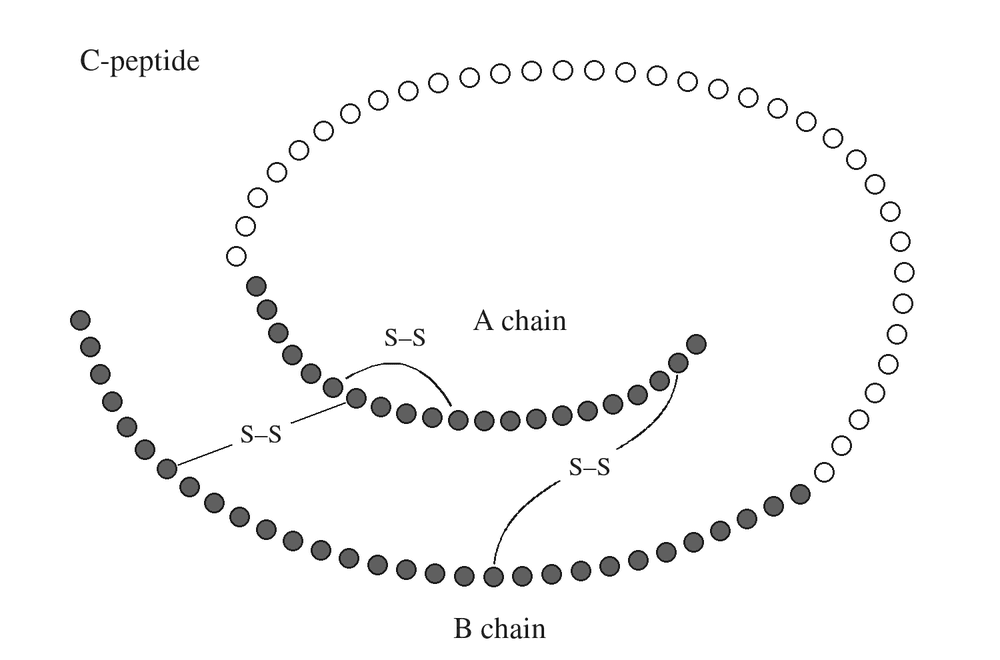
The diagram given below represents the schematic structure of proinsulin, which undergoes certain modifications before it becomes a fully functional insulin.
Study the diagram carefully and answer the questions that follow:
(i) State the change the proinsulin undergoes to become fully functional.
(ii) Name the modern scientific technique used for the production of human insulin.
(iii) How are the two polypeptide chains of the fully functional insulin held together?
Solve with AIWritten solution
Solution:
Key idea: Insulin is made in the pancreas as a single-chain prohormone, proinsulin. The figure shows its three parts: the A chain, the B chain and the C-peptide that joins them.
Step 1 — (i) State the change.
To become fully functional, proinsulin must have its C-peptide removed. The extra stretch is cut out, and what remains is mature insulin: the A chain (21 amino acids) and the B chain (30 amino acids) held together.
Step 2 — (ii) Name the technique.
Human insulin is now produced by recombinant DNA technology (genetic engineering), in which the genes for the insulin chains are inserted into bacteria such as E. coli, which then make the chains.
Step 3 — (iii) Say how the chains are held together.
The two polypeptide chains are held together by disulphide (S–S) bridges: two bridges join the A chain to the B chain, and the A chain also has one bridge within itself.
Therefore, (i) the C-peptide is removed, (ii) recombinant DNA technology is used, and (iii) the A and B chains are held together by disulphide bridges.
- 152 marks
Question 15
Explain biopiracy with the help of an example.
Solve with AIWritten solution
Solution:
Key idea: India and other developing countries are rich in biodiversity and in traditional knowledge about how to use it. Taking these for profit without permission or payment is biopiracy.
Step 1 — Explain biopiracy.
Biopiracy is the use of bio-resources and traditional knowledge by multinational companies or other organisations without proper authorisation from the countries and people concerned and without compensatory payment. Often the company takes a patent on a product or use that local people developed over generations.
Step 2 — Give an example.
India has about 27 documented varieties of Basmati rice, known for their aroma and flavour. In 1997 an American company got patent rights on Basmati rice through the US Patent and Trademark Office, which let it sell a "new" variety of Basmati in the US and abroad. This "new" variety had actually been derived from Indian farmers' varieties, crossed with semi-dwarf varieties, and was claimed as an invention. After India challenged the patent, most of its claims were withdrawn or rejected by 2001.
Step 3 — State why it matters.
Such cases take away benefits from the countries and communities that conserved the resource, so laws are now being made to prevent unauthorised use and to ensure benefit sharing.
Therefore, biopiracy is the unauthorised commercial use of bio-resources and traditional knowledge without paying their owners, as in the patent taken in the USA on rice derived from Indian Basmati.
- 161 mark
Question 16
Given below are two statements marked Assertion and Reason. Read the two statements carefully and choose the correct option.
Assertion: RNAi technique is applied to plants and animals to protect them from pest infestation.
Reason: This technique inhibits the expression of certain genes in pests.
Solve with AIAnswer
- Correct
(A) Both Assertion and Reason are true and Reason is the correct explanation for Assertion.
(B) Both Assertion and Reason are true but Reason is not the correct explanation for Assertion.
(C) Assertion is true and Reason is false.
(D) Both Assertion and Reason are false.
Answer: (A) Both Assertion and Reason are true and Reason is the correct explanation for Assertion.
Key idea: RNA interference (RNAi) silences a specific gene: a double-stranded RNA matching a pest's mRNA binds to that mRNA and stops its translation.
Step 1 — Judge the Assertion.
RNAi is used to protect organisms from pests. The best-known case is tobacco made resistant to the nematode Meloidogyne incognita; RNAi crops against insect pests are also grown, and RNAi is being developed to protect animals such as honeybees and shrimps from their pathogens and parasites. The Assertion is true.
Step 2 — Judge the Reason.
In this technique, double-stranded RNA made in (or given to) the host enters the pest and silences specific genes, so their proteins are not made. The Reason is true.
Step 3 — Decide whether the Reason explains the Assertion.
Silencing an essential gene of the pest is exactly how RNAi protects the host: the pest cannot survive or multiply. So the Reason is the correct explanation.
Why the others are wrong:
- (B) The Reason does explain the Assertion, since gene silencing is the mechanism of protection.
- (C) The Reason is true, because RNAi does inhibit the expression of particular genes.
- (D) Both statements are true, so this option fails.
Therefore, both statements are true and the Reason correctly explains the Assertion, option (A).
- 171 mark
Question 17
Give a reason for each of the following:
Kanika was suffering from SCID and needed periodic infusion of transformed lymphocytes.
Solve with AIWritten solution
Solution:
Key idea: In gene therapy for SCID, a functional ADA gene is put into the patient's lymphocytes, which are then returned to the body.
Step 1 — Recall what is infused.
Kanika received her own lymphocytes into which a functional ADA gene had been inserted, so that they could make the missing enzyme.
Step 2 — Explain why it must be repeated.
These lymphocytes are not immortal: they live for a limited time and then die. As they die, the ADA level falls again, so fresh transformed lymphocytes have to be infused from time to time.
Therefore, Kanika needed periodic infusions because the genetically engineered lymphocytes have a limited life span and are not immortal.
- 183 marks
Question 18
(i) How is mature insulin different from pro-insulin secreted by pancreas in humans?
(ii) Name the company that produced genetically engineered insulin for the first time.
(iii) Why is functional insulin produced by rDNA technology better than the ones produced earlier?
Solve with AIWritten solution
Solution:
Key idea: Insulin is made in the pancreas as proinsulin; removing its C-peptide gives mature insulin. Recombinant DNA technology now makes human insulin in microbes.
Step 1 — (i) Compare mature insulin with proinsulin.
Proinsulin is a single polypeptide chain made of the B chain, an extra connecting C-peptide and the A chain. Mature insulin has no C-peptide: it consists of two chains, A (21 amino acids) and B (30 amino acids), held together by disulphide bridges. Only mature insulin is functional.
Step 2 — (ii) Name the company.
The American company Eli Lilly produced genetically engineered human insulin, by preparing DNA sequences for the A and B chains and putting them into plasmids of E. coli.
Step 3 — (iii) Explain why it is better.
We compare it with the insulin used before:
- Earlier, insulin was extracted from the pancreas of slaughtered cattle and pigs. It differs from human insulin by a few amino acids (pig insulin by 1, cow insulin by 3), so some patients developed allergy or other immune reactions to the foreign protein.
- The supply depended on the number of animals slaughtered, so it could not meet the needs of the growing number of diabetic patients.
- Insulin made by rDNA technology is identical to human insulin, very pure and can be made in large quantities to meet demand.
Note: Human insulin was first made by rDNA technology in a laboratory in 1978; Eli Lilly then produced it on a large scale, and it was approved for use by patients in 1982.
Therefore, (i) mature insulin lacks the C-peptide and has two chains joined by disulphide bridges, (ii) Eli Lilly produced it, and (iii) rDNA insulin is identical to human insulin, causes no reaction to animal protein and can be made in large amounts.