Solution:
Key idea: To get a product in large amounts, cells must be grown in a large volume where every cell gets enough nutrients and oxygen. How well a vessel mixes its contents decides this.
Step 1 — Compare the two vessels.
In a sparged vessel, air is simply bubbled through the culture from below. The bubbles rise and mix it, but in a large vessel the mixing and oxygen supply are uneven. In a stirred-tank vessel, a motor-driven stirrer mixes the whole culture thoroughly.
Step 2 — Explain the advantage of the stirrer.
The stirrer spreads nutrients, oxygen and heat evenly through the vessel, so the temperature and pH stay uniform. It also breaks the incoming air into small bubbles, which gives a large area for oxygen to dissolve. So the cells grow well everywhere in the vessel.
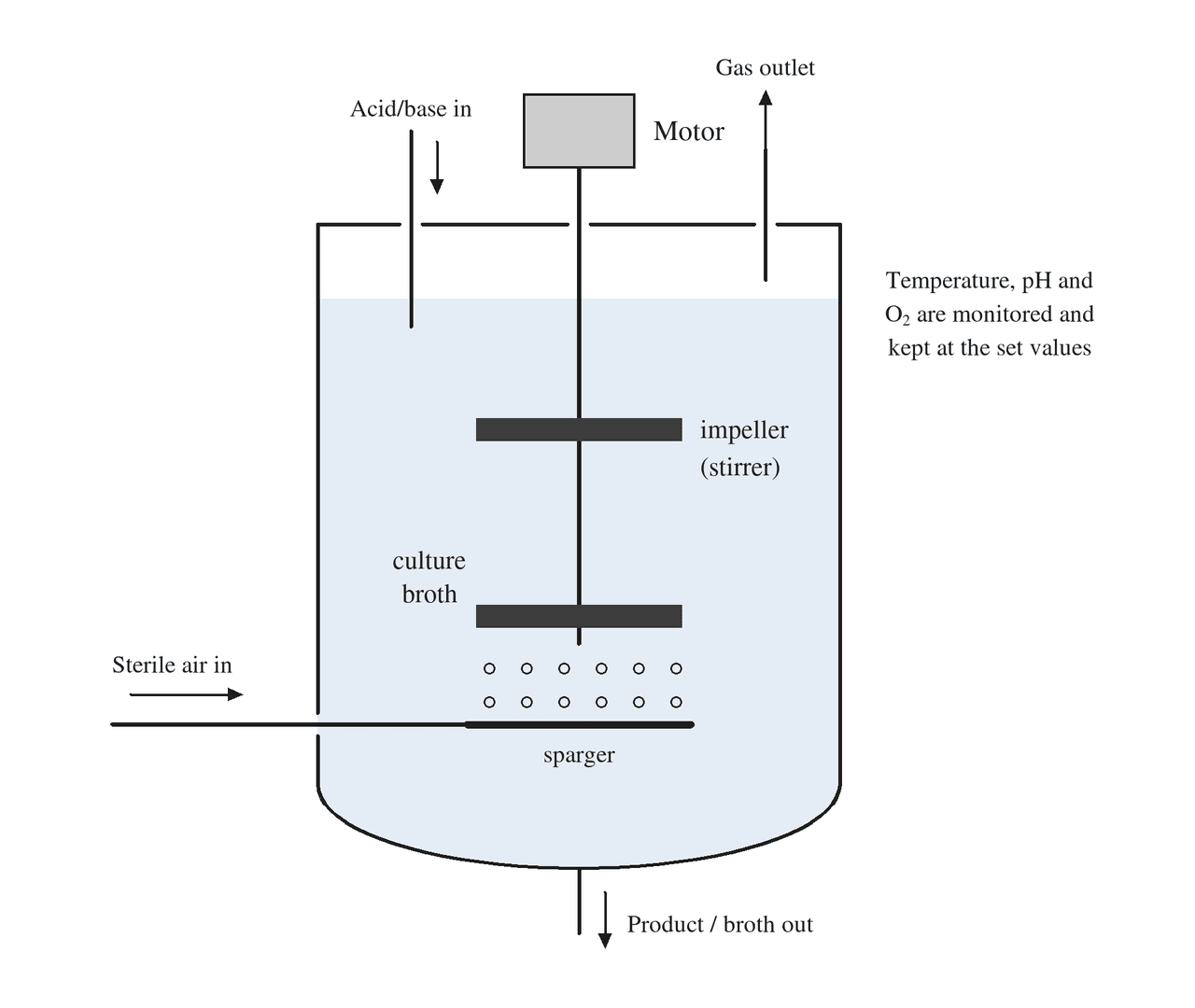
Note: A simple sparged (bubble) vessel is gentler and is useful for cells that are easily damaged by stirring, but for large-scale production of most products the stirred-tank type is preferred.
Therefore, the vessel with the stirrer (a stirred-tank bioreactor) is more advantageous, because it mixes the culture evenly and provides better oxygen supply to all the cells.
