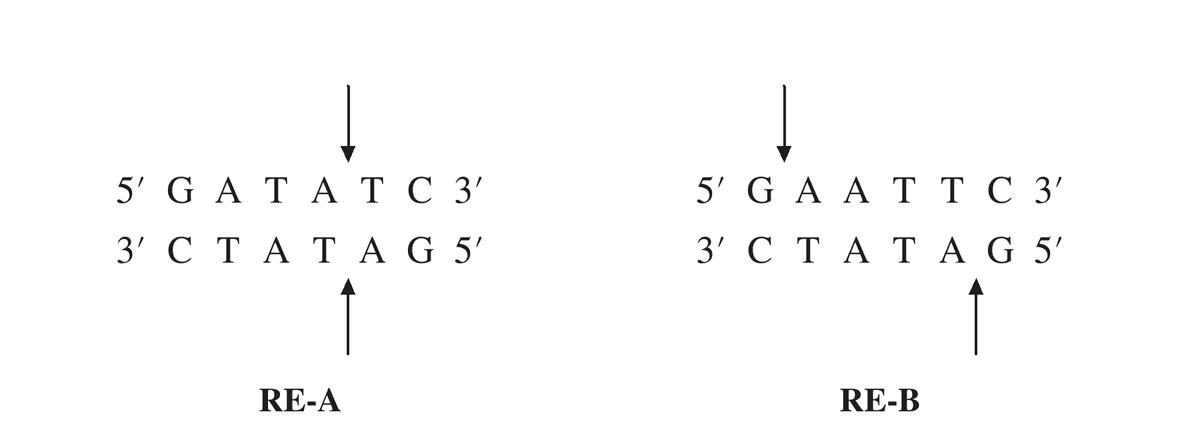
Solution:
Key idea: A restriction endonuclease cuts both strands of DNA at fixed points in its recognition sequence. If the two strands are cut at the same point the ends are blunt; if the cuts are staggered, each end has a short single-stranded overhang, a sticky end.
(i) Role of restriction endonucleases in rDNA technology
Step 1 — State the role.
Restriction endonucleases act as molecular scissors. They cut the DNA of the source organism to free the gene of interest, and cut the vector at one chosen site. When both are cut with the same enzyme, they have matching ends, so DNA ligase can join the gene into the vector to make recombinant DNA.
(ii) Separated fragments
Step 2 — Read the RE-A site.
The arrows show RE-A cutting the upper strand between the 4th and 5th bases (5′ GATA | TC 3′) and the lower strand at the same point (3′ CTAT | AG 5′). Both cuts are at the same position, so the fragments have blunt ends: 5′-GATA-3′ paired with 3′-CTAT-5′, and 5′-TC-3′ paired with 3′-AG-5′.
Step 3 — Read the RE-B site.
The arrows show RE-B cutting the upper strand after the first G (5′ G | AATTC 3′) and the lower strand before its last G. The cuts are staggered, so each fragment gets a single-stranded AATT overhang (sticky end): 5′-G-3′ paired with 3′-CTTAA-5′, and 5′-AATTC-3′ paired with 3′-G-5′.
Note: The paper prints the lower strand of RE-B as 3′ CTATAG 5′, which cannot pair with 5′ GAATTC 3′ (A pairs only with T, and G with C). We take the lower strand as 3′ CTTAAG 5′, the only strand that pairs with it; the cut points shown by the arrows are unchanged.
Step 4 — Draw the fragments.
The drawing shows the two fragments from each site, with the paired bases joined.
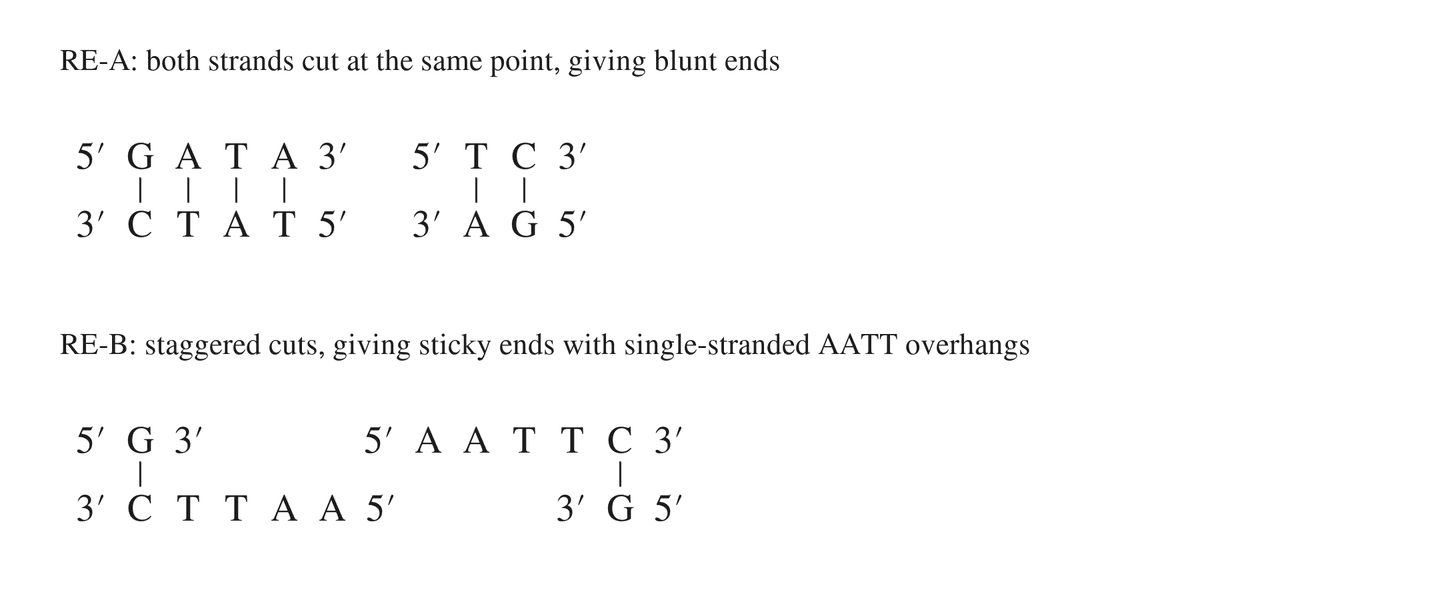
Therefore, (i) restriction endonucleases cut DNA at specific sites so that a gene and a vector get matching ends and can be joined; (ii) RE-A gives blunt-ended fragments (GATA/CTAT and TC/AG) and RE-B gives sticky-ended fragments with AATT overhangs (G/CTTAA and AATTC/G).