Solution:
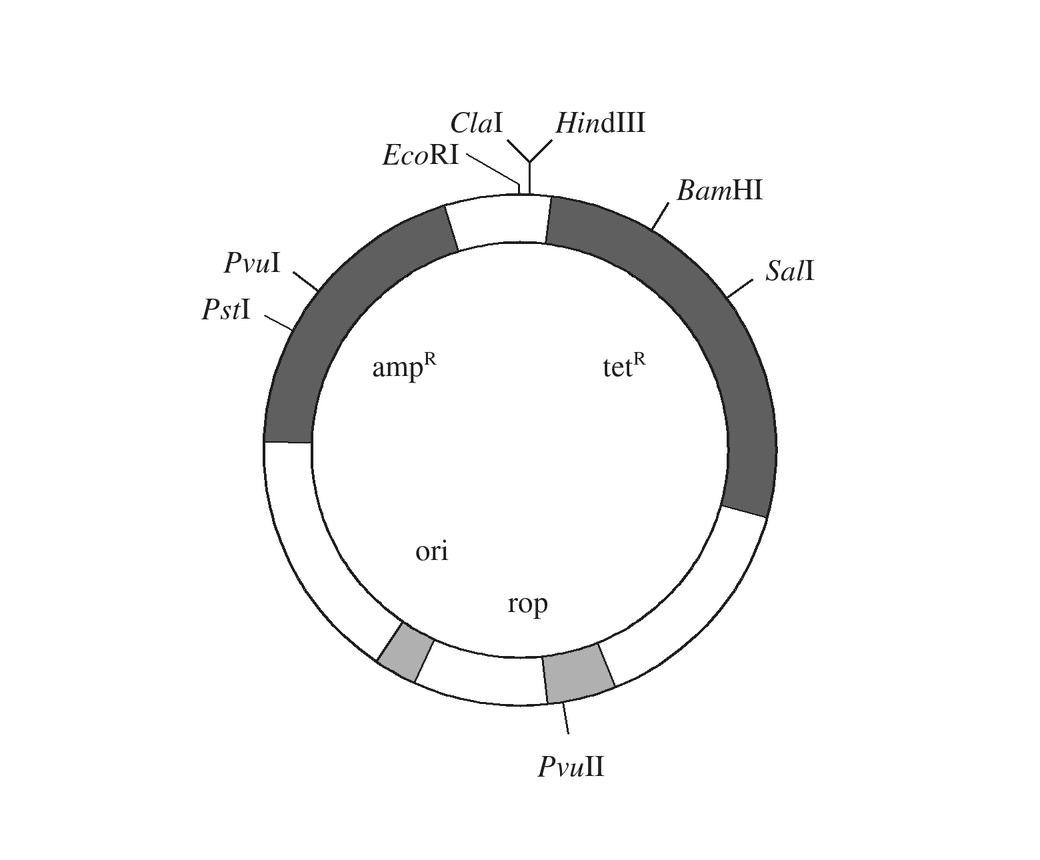
Key idea: The map shows a plasmid with the antibiotic-resistance genes ampR and tetR, an origin of replication (ori), the rop gene and single sites for several restriction enzymes; this is the well-known E. coli cloning vector pBR322.
Step 1 — Name the vector and its host, part (a).
The vector is pBR322, an artificial plasmid. It is put into the bacterium Escherichia coli, where its ori lets it replicate.
Step 2 — Name two restriction sites, part (b).
Any two of the sites shown: EcoRI, BamHI, HindIII, ClaI, SalI, PstI, PvuI and PvuII. For example, BamHI and SalI lie inside the tetR gene, and PstI and PvuI lie inside the ampR gene.
Step 3 — Name two selection markers, part (c).
The selectable markers are ampR (resistance to ampicillin) and tetR (resistance to tetracycline). They let us pick out transformed cells, and inserting a gene into one of them inactivates it, which identifies the recombinants.
Therefore, (a) the vector is pBR322, inserted in E. coli; (b) two restriction sites are EcoRI and BamHI; (c) two selection markers are ampR and tetR.