
Question 123 marksAsked 2020Medium
What is a bioreactor? Explain important features of a Stirred tank bioreactor.
Confirming your payment
Sign up now and get 250 free tokens.
Previous Year Questions · Question 12 of 29
What is a bioreactor? Explain important features of a Stirred tank bioreactor.
Solution:
Key idea: A small flask can grow only a little product. To make a product in large amounts, cells are grown in a bioreactor, where every condition they need is controlled.
Step 1 — Define a bioreactor.
A bioreactor is a large vessel (often 100 to 1,000 litres or more) in which raw materials are converted into a specific product by microbes, plant or animal cells, or their enzymes. It provides the best growth conditions: temperature, pH, substrate, salts, vitamins and oxygen.
Step 2 — Shape and stirrer.
A stirred-tank bioreactor is usually a cylinder or has a curved base, which helps the contents mix. A motor-driven stirrer (impeller) mixes the culture evenly, so that nutrients, oxygen and heat reach all the cells.
Step 3 — Oxygen supply (sparger).
Sterile air is bubbled into the culture through a sparger. The stirrer breaks the air into small bubbles and spreads them, which gives a large area for oxygen to dissolve.
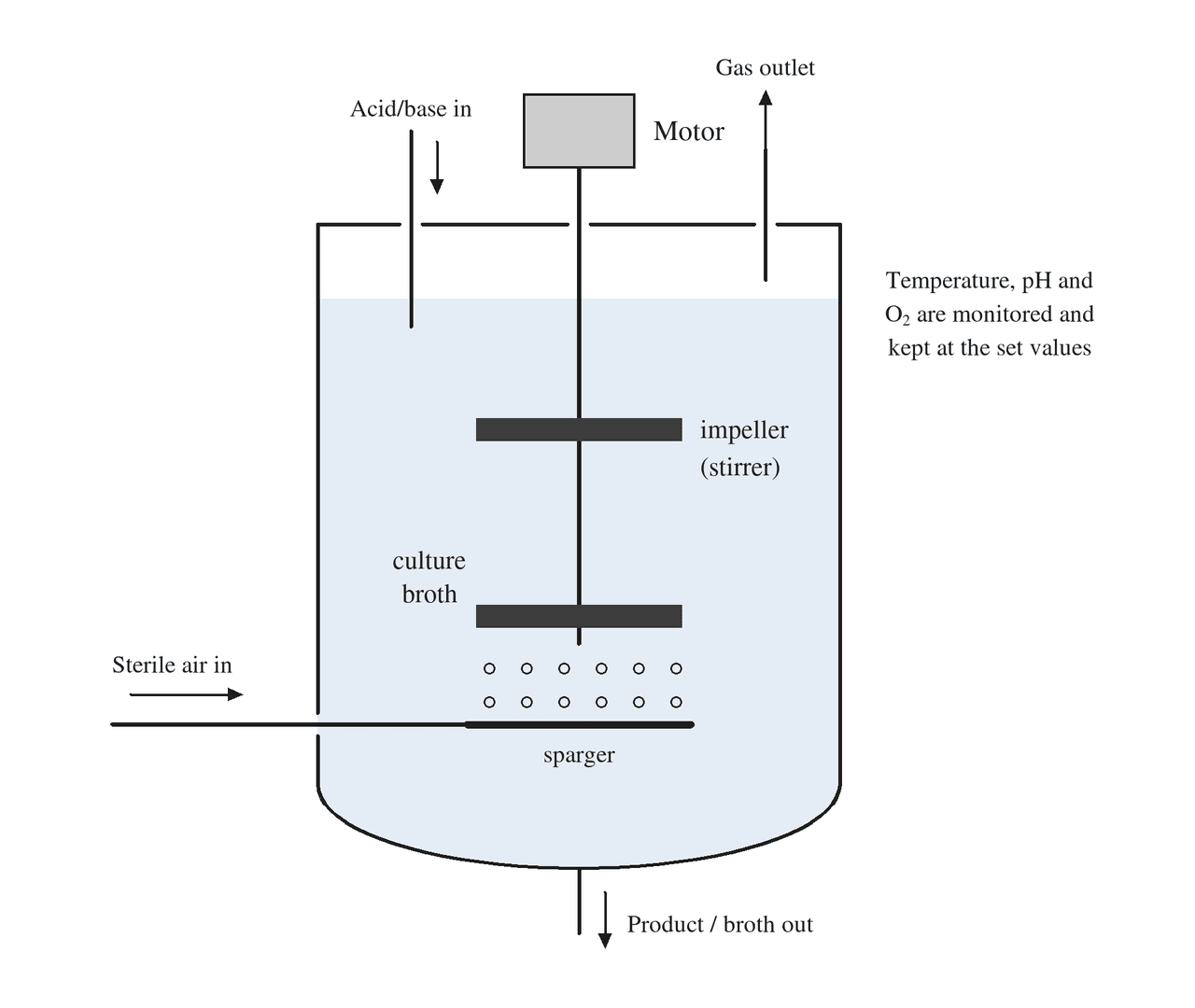
Step 4 — Control and sampling systems.
It also has a foam control system, temperature and pH control systems (with acid and base inlets) and sampling ports, through which small volumes of the culture can be taken out from time to time to check its progress.
Therefore, a bioreactor is a large vessel in which cells or enzymes convert raw materials into a product under controlled conditions; a stirred-tank bioreactor has a curved base, a stirrer for even mixing, a sparger for sterile air, foam, temperature and pH control, and sampling ports.