
Question 105 marksAsked 2019Medium
(i) What is restriction endonuclease? Give the rules of their nomenclature?
(ii) Explain the mechanism of action of restriction endonuclease that makes them suitable for genetic engineering.
Confirming your payment
Sign up now and get 250 free tokens.
Previous Year Questions · Question 10 of 29
(i) What is restriction endonuclease? Give the rules of their nomenclature?
(ii) Explain the mechanism of action of restriction endonuclease that makes them suitable for genetic engineering.
Solution:
Key idea: Restriction endonucleases are the "molecular scissors" of genetic engineering. Each one cuts DNA only at a particular base sequence, so DNA can be cut in exactly the same places every time.
(i) Definition and rules of naming
Step 1 — Define restriction endonuclease.
A restriction endonuclease is an enzyme that recognises a specific short base sequence in double-stranded DNA (its recognition sequence, usually 4–8 bp long) and cuts both strands at particular points within or near it. "Endo" means it cuts inside the DNA, not at its ends. Bacteria make these enzymes to destroy (restrict) the DNA of invading viruses.
Step 2 — Give the naming rules.
The name is built from the source organism:
For example, EcoRI comes from Escherichia coli, strain RY13, and was the first enzyme isolated from it.
(ii) Mechanism of action
Step 3 — Recognition of a palindrome.
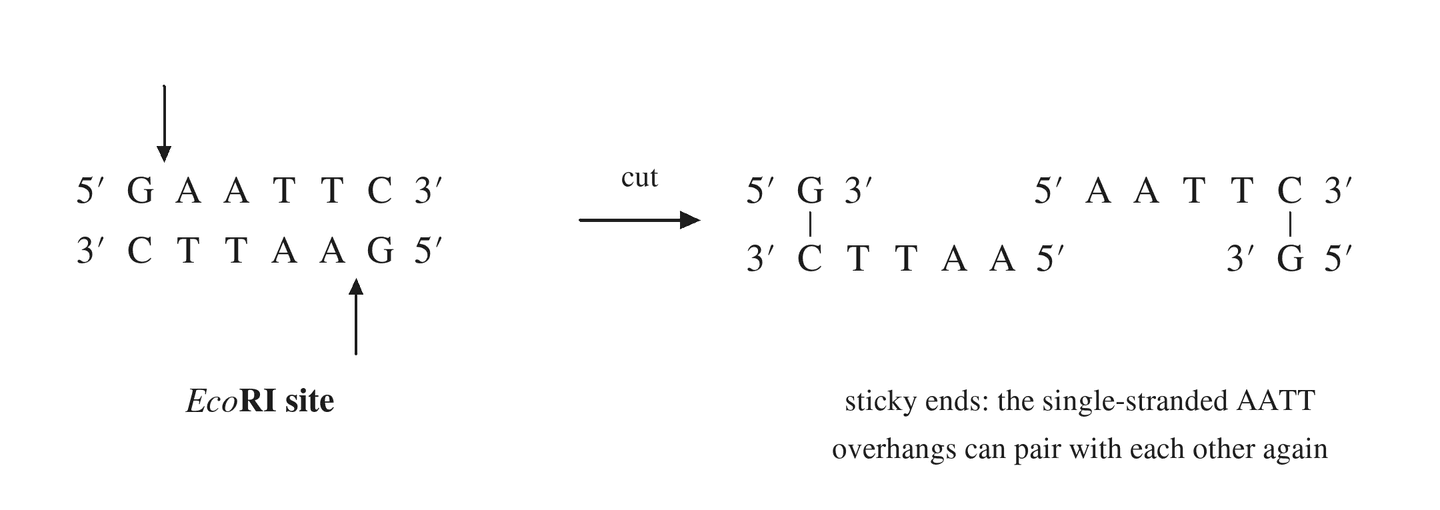
The enzyme binds the DNA and moves along it until it finds its recognition sequence. This sequence is a palindrome: it reads the same on the two strands when both are read in the 5′ → 3′ direction. For EcoRI it is 5′-GAATTC-3′ on one strand and also 5′-GAATTC-3′ on the other.
Step 4 — Cutting the sugar-phosphate backbone.
The enzyme breaks one phosphodiester bond in each strand. EcoRI cuts each strand between G and A. Because the two cuts are a little apart on the two strands, each fragment is left with a short single-stranded overhang, 5′-AATT, called a sticky end.
Step 5 — Why this makes them suitable for genetic engineering.
Sticky ends pair by hydrogen bonds with complementary sticky ends. If the source DNA and the vector are cut with the same enzyme, both have matching sticky ends, so the gene fits into the vector, and the enzyme DNA ligase then seals the backbone to make recombinant DNA. Because the cuts are exact and repeatable, the same fragment is obtained every time.
Therefore, (i) a restriction endonuclease cuts DNA at a specific recognition sequence and is named by genus (1 letter), species (2 letters), strain and order of isolation (e.g. EcoRI); (ii) it recognises a palindrome and makes staggered cuts that leave sticky ends, which let DNA from any source be joined to a vector cut with the same enzyme.