
Question 75 marksAsked 2018Medium
Give an account of the Blue-White Method of selection of recombinants.
Confirming your payment
Sign up now and get 250 free tokens.
Previous Year Questions · Question 7 of 29
Give an account of the Blue-White Method of selection of recombinants.
Solution:
Key idea: After transformation, most host cells either take up no plasmid or take up a plasmid without the foreign gene. Blue-white selection picks out the cells that carry the recombinant plasmid by a simple colour test, based on insertional inactivation of the gene for the enzyme β-galactosidase.
Step 1 — Describe the vector.
The vector (for example a pUC plasmid) carries an antibiotic-resistance gene (such as ) and part of the lacZ gene, which codes for β-galactosidase. The cloning sites lie inside the lacZ gene.
Step 2 — Insert the gene of interest.
The foreign DNA is inserted into a cloning site within lacZ. This breaks up the gene, so a recombinant plasmid can no longer make β-galactosidase. This loss of a gene's activity by inserting DNA into it is called insertional inactivation.
Step 3 — Plate the cells on the selection medium.
The cells are spread on an agar medium containing the antibiotic (ampicillin), a colourless chromogenic substrate called X-gal, and IPTG to switch on the lacZ gene. Only cells that have taken up a plasmid can grow on ampicillin.
Step 4 — Read the colours.
In cells with a non-recombinant plasmid, lacZ is intact, so β-galactosidase splits X-gal into a blue product and the colonies are blue. In cells with a recombinant plasmid, lacZ is inactivated, X-gal is not split and the colonies stay white.
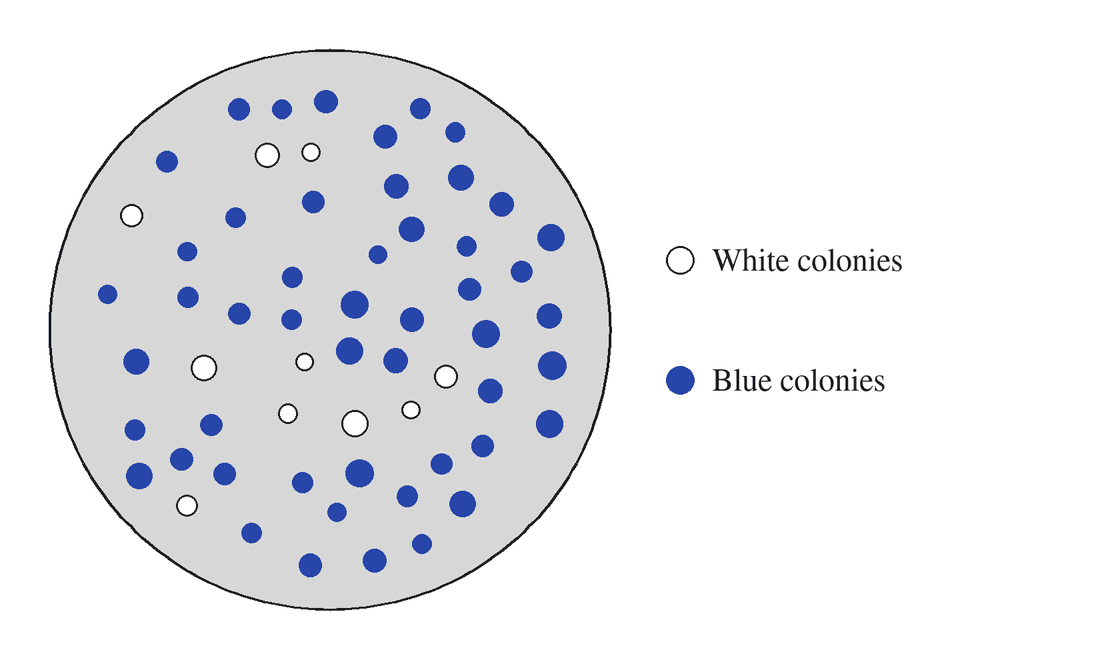
Step 5 — Pick the recombinants.
The white colonies are picked out and grown, because they carry the gene of interest. This method is quicker than replica plating on two antibiotics, which needs two plates and a comparison of colonies.
Therefore, in the blue-white method, the insert inactivates the vector's β-galactosidase gene, so on X-gal medium recombinant colonies stay white while non-recombinant colonies turn blue.