Solution:
Key idea: Sewage is treated in two stages: primary treatment removes solid particles physically, and secondary treatment uses microbes to remove the dissolved and suspended organic matter.
(i) Difference between primary and secondary treatment
Step 1 — Compare the two stages.
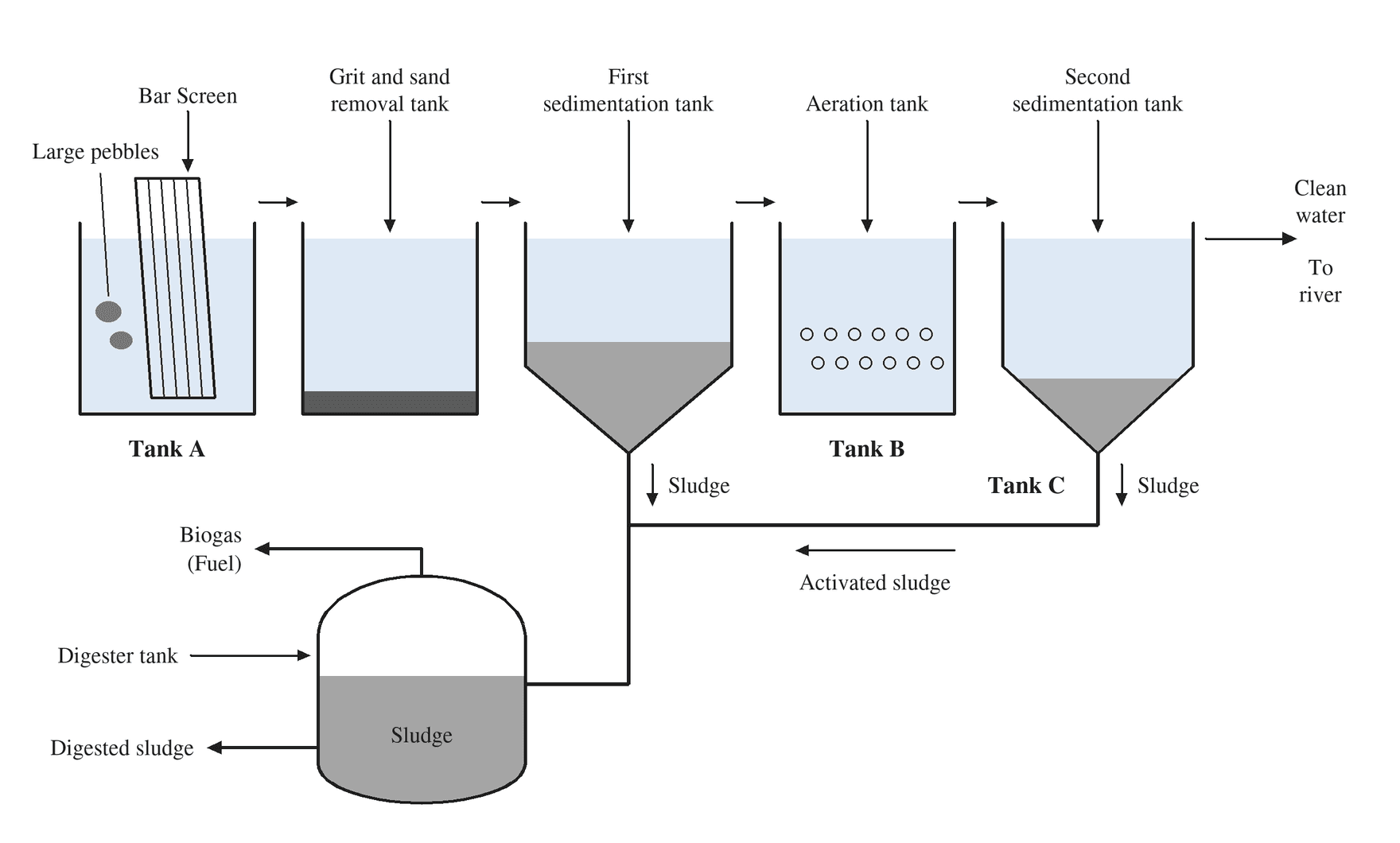
Primary treatment (Tank A, the grit and sand removal tank and the first sedimentation tank) is a physical process: large and small particles are removed by screening, by letting grit settle and by sedimentation. Secondary treatment (Tank B) is a biological process: aerobic microbes feed on the organic matter in the water and so reduce its BOD.
(ii) Tank to which flocs are added
Step 2 — Identify the tank.
Flocs (masses of bacteria held together by fungal filaments) grow in the aeration tank, and part of the activated sludge, which is full of flocs, is pumped back into it as an inoculum. This return pipe is not drawn in the diagram, but it is part of every activated-sludge plant. So flocs are added in Tank B, the aeration tank.
(iii) Purpose of using microbes
Step 3 — State the purpose.
The aerobic microbes in the flocs consume most of the organic matter, which greatly lowers the BOD of the sewage so that the water can be released into rivers safely. In the digester, anaerobic bacteria digest the sludge and give biogas, which is used as a fuel.
Therefore, (i) primary treatment is physical removal of solids while secondary treatment is biological breakdown of organic matter by microbes; (ii) flocs are added in Tank B; (iii) microbes are used to break down the organic matter and lower the BOD of sewage (and to give biogas from the sludge).