
Opening your dashboard
Class 12 Biology Chapter 14 Microbes in Human Welfare: Previous Year Questions
15 questions on Chapter 14, each solved step by step. Class 12 Biology, ICSE 2026-27.
15 questions with solutions
1–3 marks · Mixed difficulty
- 12 marks
Question 1
Why are bio-fertilizers preferred over chemical fertilizers?
Solve with AIWritten solution
Solution:
Key idea: Biofertilisers are living microbes (for example Rhizobium, Azotobacter, Azospirillum, cyanobacteria and mycorrhizal fungi) that add nutrients to the soil or help plants take them up. Chemical fertilisers are factory-made salts of nitrogen, phosphorus and potassium.
Step 1 — State how biofertilisers help the soil.
Nitrogen-fixing bacteria and cyanobacteria fix atmospheric nitrogen into forms plants can use, and mycorrhizal fungi help roots absorb phosphorus. They also add organic matter, which improves soil structure and keeps the soil fertile year after year.
Step 2 — State the harm done by chemical fertilisers.
Heavy use of chemical fertilisers can make the soil acidic and harm useful soil microbes. The excess washes into ponds and rivers, where it causes eutrophication (algal blooms), and nitrates seep into groundwater. They are also costly, and nitrogen fertilisers are made using fossil fuels, which are non-renewable.
Step 3 — Compare the two.
Biofertilisers are natural, renewable, cheap and eco-friendly, and they do not pollute soil or water. This is why they are preferred, although they may be combined with smaller doses of chemical fertilisers where a crop needs a quick supply of nutrients.
Therefore, biofertilisers are preferred because they enrich the soil naturally and renewably, improve soil structure and long-term fertility, are cheap, and cause no soil or water pollution, unlike chemical fertilisers.
- 21 mark
Question 2
Give a brief answer for each of the following:
Why are the spores of Bacillus thuringiensis used as bioinsecticide?
Solve with AIWritten solution
Solution:
Key idea: Bacillus thuringiensis (Bt) is a soil bacterium that, when it forms spores, also makes protein crystals (Cry proteins) that are poisonous to certain insect larvae.
Step 1 — Recall what the spores carry.
Dried spores of Bt, mixed with their protein crystals, are sold in sachets. Farmers mix them with water and spray them on plants such as cotton and vegetables.
Step 2 — Explain how they kill the pest.
The Cry protein is an inactive protoxin. When a caterpillar eats the sprayed leaves, the alkaline pH of its gut dissolves the crystals and activates the toxin. The active toxin binds to the cells lining the midgut and makes pores in them, so the cells swell and burst and the larva dies.
Step 3 — State why this is useful.
The toxin acts only on particular groups of insects (for example the larvae of moths and butterflies, some beetles and mosquitoes). It does not harm humans, other animals or most useful insects, and it breaks down in the environment, so it is an eco-friendly bioinsecticide.
Therefore, Bt spores are used as a bioinsecticide because they carry Cry protein crystals that are activated in the alkaline gut of insect larvae and kill them, while being harmless to humans and the environment.
- 33 marks
Question 3
Study the table given below. Do not copy the table, but write the answers in the correct order.
Scientific Name Commercial Product Use (a) ______ Streptokinase (b) ______ Monascus purpureus (c) ______ (d) ______ (e) ______ Lactic acid (f) ______ Solve with AIWritten solution
Solution:
Key idea: Many medicines and industrial chemicals are made by microbes. Each blank is filled by recalling which microbe makes the product, or what the product is used for.
Step 1 — Fill the streptokinase row, (a) and (b).
Streptokinase is produced by the bacterium Streptococcus (and today also by genetically engineered microbes). It is used as a clot buster: it dissolves blood clots in the blood vessels of patients who have had a myocardial infarction (heart attack).
Step 2 — Fill the Monascus purpureus row, (c) and (d).
The fungus Monascus purpureus (a mould) produces statins. Statins lower the level of cholesterol in the blood, because they block the enzyme that the liver uses to make cholesterol.
Step 3 — Fill the lactic acid row, (e) and (f).
Lactic acid is produced by the bacterium Lactobacillus. Lactic acid is used in the food industry as a preservative and to give a sour taste (as in curd and pickles).
Therefore, the answers in order are: (a) Streptococcus; (b) clot buster, to dissolve blood clots in heart-attack patients; (c) statins; (d) to lower blood cholesterol; (e) Lactobacillus; (f) as a food preservative and souring agent.
- 43 marks
Question 4
Give the biological names for the following:
(i) The Mould from which Penicillin is obtained.
(ii) Baker's Yeast
(iii) Microbes used to control the insect larvae growing on cotton.
(iv) Microbes used to produce Swiss Cheese.
(v) The fungus is being grown as biocontrol agent.
(vi) A symbiotic Nitrogen fixing bacterium found in the root nodules
Solve with AIWritten solution
Solution:
Key idea: A biological (scientific) name has two parts, the genus and the species, and is written in italics. Each item names a well-known useful microbe.
Step 1 — Name the microbes used in medicine and food, (i), (ii) and (iv).
These three microbes give us an antibiotic, bread and cheese.
(i) Penicillin was discovered in the mould Penicillium notatum by Alexander Fleming. Fleming's mould is now classified as Penicillium rubens, and penicillin today comes from high-yielding Penicillium strains.
(ii) Baker's yeast is Saccharomyces cerevisiae. It ferments sugar in dough and releases carbon dioxide, which makes the dough rise.
(iv) Swiss cheese is made with the bacterium Propionibacterium shermanii (today named Propionibacterium freudenreichii subsp. shermanii). The carbon dioxide it releases makes the large holes in the cheese.
Step 2 — Name the biocontrol agents, (iii) and (v).
These two microbes are used to control pests and plant diseases.
(iii) Insect larvae (caterpillars) on cotton are controlled with Bacillus thuringiensis, whose toxic Cry proteins kill the larvae.
(v) The fungus grown as a biocontrol agent is Trichoderma. These free-living fungi of the root zone attack several fungi that cause plant diseases.
Step 3 — Name the nitrogen-fixing symbiont, (vi).
This bacterium lives inside the roots of pea-family plants.
(vi) The bacterium in the root nodules of leguminous plants is Rhizobium. It fixes atmospheric nitrogen into ammonia, which the plant uses.
Therefore: (i) Penicillium notatum; (ii) Saccharomyces cerevisiae; (iii) Bacillus thuringiensis; (iv) Propionibacterium shermanii; (v) Trichoderma; (vi) Rhizobium.
- 51 mark
Question 5
Each of the following sub-parts, (i) to (iv) has four choices. Choose the best option in each case:
Which of the following is paired incorrectly:
Solve with AIAnswer
(A) Cyclosporin A - Trichoderma polysporum
- Correct
(B) Streptokinase - Saccharomyces cerevisiae
(C) Swiss Cheese - Propionibacterium
(D) Penicillin - Penicillium
Answer: (B) Streptokinase - Saccharomyces cerevisiae
Key idea: Each product must be matched with the microbe that actually makes it.
Step 1 — Recall the source of streptokinase.
Streptokinase, the clot-busting enzyme, is made by the bacterium Streptococcus. Saccharomyces cerevisiae is baker's and brewer's yeast, used for bread, beer and wine and for making ethanol.
Step 2 — Pick the wrong pair.
So the pair "Streptokinase - Saccharomyces cerevisiae" is incorrect, which is option (B).
Why the others are wrong:
- (A) This pairing is correct: cyclosporin A, the immunosuppressive drug used in organ transplants, is produced by the fungus Trichoderma polysporum (today classified as Tolypocladium inflatum).
- (C) This pairing is correct: Propionibacterium releases carbon dioxide that makes the large holes in Swiss cheese.
- (D) This pairing is correct: penicillin is obtained from the mould Penicillium.
Therefore, the incorrectly paired option is (B).
- 61 mark
Question 6
Give a reason for each of the following:
Cyanobacteria increase the productivity in paddy fields.
Solve with AIWritten solution
Solution:
Key idea: Cyanobacteria (blue-green algae) are autotrophic microbes, and many of them can fix atmospheric nitrogen. They act as biofertilisers.
Step 1 — Recall where cyanobacteria grow well.
Paddy fields stay flooded for long periods. This warm, waterlogged, sunny habitat suits cyanobacteria such as Anabaena, Nostoc and Oscillatoria, which grow freely in the standing water.
Step 2 — Explain how they raise productivity.
These cyanobacteria fix atmospheric nitrogen into compounds that the rice plants can absorb, so less chemical fertiliser is needed. When they die, they also add organic matter to the soil, which improves its fertility.
Therefore, cyanobacteria increase the productivity of paddy fields because they fix atmospheric nitrogen and add organic matter to the soil, acting as natural biofertilisers.
- 72 marks
Question 7
What is biogas? Name any two main constituents of biogas.
Solve with AIWritten solution
Solution:
Key idea: Biogas is made when microbes break down organic waste in the absence of oxygen (anaerobic digestion).
Step 1 — Define biogas.
Biogas is a mixture of gases, mainly methane, produced by the anaerobic breakdown of organic matter such as cattle dung, sewage sludge and plant wastes. The methane is made by anaerobic archaea called methanogens (for example Methanobacterium), which also live in the rumen of cattle. Biogas burns readily and is used as a fuel for cooking and lighting.
Step 2 — Name its main constituents.
Biogas is mostly methane (about 50–70 %) and carbon dioxide (about 30–45 %), with small amounts of hydrogen sulphide and hydrogen.
Therefore, biogas is a fuel gas formed by the anaerobic microbial digestion of organic wastes; its two main constituents are methane and carbon dioxide.
- 83 marks
Question 8
The scientists from a research institute collected samples of water from sewage pipes of two different cities A and B. On analysis, the BOD value of the sample from city A was found to be 500 mg/L. The BOD value of the sample from city B was 200 mg/L.
(i) Which one of the two cities needs the sewage treatment plant?
(ii) Briefly discuss the steps involved in the treatment of sewage.
(iii) What will be the effect of sewage treatment on the value of BOD?
Solve with AIWritten solution
Solution:
Key idea: BOD (biochemical oxygen demand) is the amount of oxygen that microbes would use up in breaking down the organic matter in one litre of water. The more organic matter (sewage) the water holds, the higher its BOD, so BOD measures how polluted the water is.
(i) Which city needs the sewage treatment plant
Step 1 — Compare the two BOD values.
City A's sample has a BOD of 500 mg/L, which is two and a half times city B's value of 200 mg/L. So city A's sewage carries far more organic matter.
Step 2 — Decide.
City A's sewage would use up much more of a river's dissolved oxygen, killing fish and other animals, so city A needs the sewage treatment plant more urgently.
Note: A BOD of 200 mg/L is also far above the level allowed for water released into rivers (only a few tens of mg/L at most), so city B's sewage must also be treated before it is discharged.
(ii) Steps in the treatment of sewage
Step 3 — Primary treatment (physical).
Floating debris is removed by filtering through screens, and grit (soil and small pebbles) is removed by letting it settle. The sewage then stands in a primary settling tank, where solids settle as primary sludge; the liquid above is the primary effluent.
Step 4 — Secondary treatment (biological).
The primary effluent goes into large aeration tanks, where it is stirred and air is pumped in. Useful aerobic microbes grow fast and form flocs (masses of bacteria held together by fungal filaments), which feed on the organic matter and so greatly reduce the BOD.
Step 5 — Settling and sludge digestion.
When the BOD has fallen enough, the water passes into a settling tank, where the flocs settle as activated sludge. A small part of it is pumped back into the aeration tank as an inoculum. The rest goes into anaerobic sludge digesters, where anaerobic bacteria digest it and produce biogas (methane, hydrogen sulphide and carbon dioxide). The treated water (effluent) is released into rivers and streams.
(iii) Effect of treatment on BOD
Step 6 — State the effect.
Because the microbes consume most of the organic matter, sewage treatment lowers the BOD greatly; the treated water has a much lower BOD than the raw sewage.
Therefore, (i) city A (BOD 500 mg/L) needs the treatment plant most; (ii) sewage is treated by primary (physical removal of solids) and secondary (microbial digestion in aeration tanks, settling of activated sludge, anaerobic digestion of sludge) treatment; (iii) the treatment greatly reduces the BOD.
- 91 mark
Question 9
Answer the following questions briefly.
Home-made fruit juices are turbid, while the bottled, fruit juices purchased from the market are clear. Give a reason for this difference.
Solve with AIWritten solution
Solution:
Key idea: Fruit juice looks cloudy because it contains suspended pectin (from the cell walls of the fruit) and proteins.
Step 1 — Explain the turbidity of home-made juice.
Home-made juice is only squeezed and strained, so pectin and proteins stay suspended in it and make it turbid.
Step 2 — Explain how bottled juice is cleared.
Bottled juices are treated with microbial enzymes, pectinases and proteases, which break down the pectin and proteins. The juice then becomes clear.
Therefore, bottled juices are clear because they are clarified with microbial pectinases and proteases, while home-made juices are not treated with these enzymes.
- 101 mark
Question 10
Answer the following questions briefly.
Give a reason for each of the following:
(b) Streptokinase is administered to the patients having myocardial infarction.
Solve with AIWritten solution
Solution:
Key idea: A myocardial infarction (heart attack) happens when a blood clot blocks a coronary artery, so part of the heart muscle gets no oxygen.
Step 1 — Recall what streptokinase is.
Streptokinase is an enzyme produced by the bacterium Streptococcus (and now also by genetically engineered microbes).
Step 2 — Explain why it is given.
Streptokinase activates plasminogen in the blood to form plasmin, an enzyme that digests fibrin, the protein mesh of a clot. The clot dissolves and blood flow through the coronary artery is restored, so it is called a clot buster.
Therefore, streptokinase is given to patients with myocardial infarction because it dissolves the blood clots blocking the coronary arteries.
- 112 marks
Question 11
Microbes are useful to human beings in diverse ways. Give the biological name of the following microbe:
(i) Lactic acid producing bacterium.
(ii) Microbe known as Baker's yeast.
(iii) Fungus which helps in the production cyclosporin-A.
(iv) Microbe used in the production of statins.
Solve with AIWritten solution
Solution:
Key idea: Each microbe is named by its genus and species, written in italics.
Step 1 — Name the household microbes, (i) and (ii).
These two microbes are used at home to make curd and bread.
(i) The lactic acid producing bacterium is Lactobacillus. It changes milk into curd by producing lactic acid, which makes the milk proteins clot.
(ii) Baker's yeast is Saccharomyces cerevisiae, which makes bread dough rise.
Step 2 — Name the industrial microbes, (iii) and (iv).
These two fungi are grown in industry to make medicines.
(iii) Cyclosporin A, an immunosuppressive drug for organ-transplant patients, is produced by the fungus Trichoderma polysporum (today classified as Tolypocladium inflatum).
(iv) Statins, which lower blood cholesterol, are produced by the fungus Monascus purpureus (a mould).
Therefore: (i) Lactobacillus; (ii) Saccharomyces cerevisiae; (iii) Trichoderma polysporum; (iv) Monascus purpureus.
- 121 mark
Question 12
Answer the following questions briefly.
Observe the relationship between the first two words/terms and then fill in the fourth word/term.
Lipase: Candida lipolytica :: Taq polymerase: ______
Solve with AIWritten solution
Solution:
Key idea: In an analogy, the second pair must show the same relationship as the first pair. Here each enzyme is matched with the microbe from which it is obtained.
Step 1 — Find the relationship in the first pair.
Lipase is an enzyme that breaks down fats, and Candida lipolytica is the yeast from which it is obtained for industrial use, for example in detergents. So the first term is an enzyme and the second term is the microbe that is its source.
Step 2 — Find the source of Taq polymerase.
Taq polymerase is a heat-stable DNA polymerase used in PCR. It is obtained from the bacterium Thermus aquaticus, which lives in hot springs; the name "Taq" comes from Thermus aquaticus.
Note: The yeast Candida lipolytica is now classified as Yarrowia lipolytica.
Therefore, Lipase : Candida lipolytica :: Taq polymerase : Thermus aquaticus.
- 132 marks
Question 13
As a student of food technology, Leena has planned to produce two dairy-based processed food products that would be completely organic in nature.
Suggest any two food products that Leena can produce.
Solve with AIWritten solution
Solution:
Key idea: Dairy foods such as curd and cheese are made by the action of microbes on milk, without any chemical additives.
Step 1 — Suggest the first product: curd or yoghurt.
Lactic acid bacteria such as Lactobacillus (with Streptococcus thermophilus for yoghurt) are added to milk. They convert milk sugar (lactose) into lactic acid, which makes the milk proteins clot into curd. The lactic acid bacteria also check the growth of disease-causing microbes in the curd.
Step 2 — Suggest the second product: cheese.
Milk is curdled and the curd is ripened by chosen microbes. For example, Propionibacterium shermanii (today named Propionibacterium freudenreichii subsp. shermanii) gives the holes in Swiss cheese and the fungus Penicillium roqueforti ripens Roquefort cheese.
Note: Lactic acid bacteria are often said to raise the vitamin B₁₂ content of curd, but most strains cannot make vitamin B₁₂; the B₁₂ in curd comes mainly from the milk itself.
Therefore, Leena can produce curd (yoghurt) and cheese; buttermilk is another such product.
- 143 marks
Question 14
Microbes have been used by humans in household, industrial and agricultural setups. One such use is shown in the diagram given below.
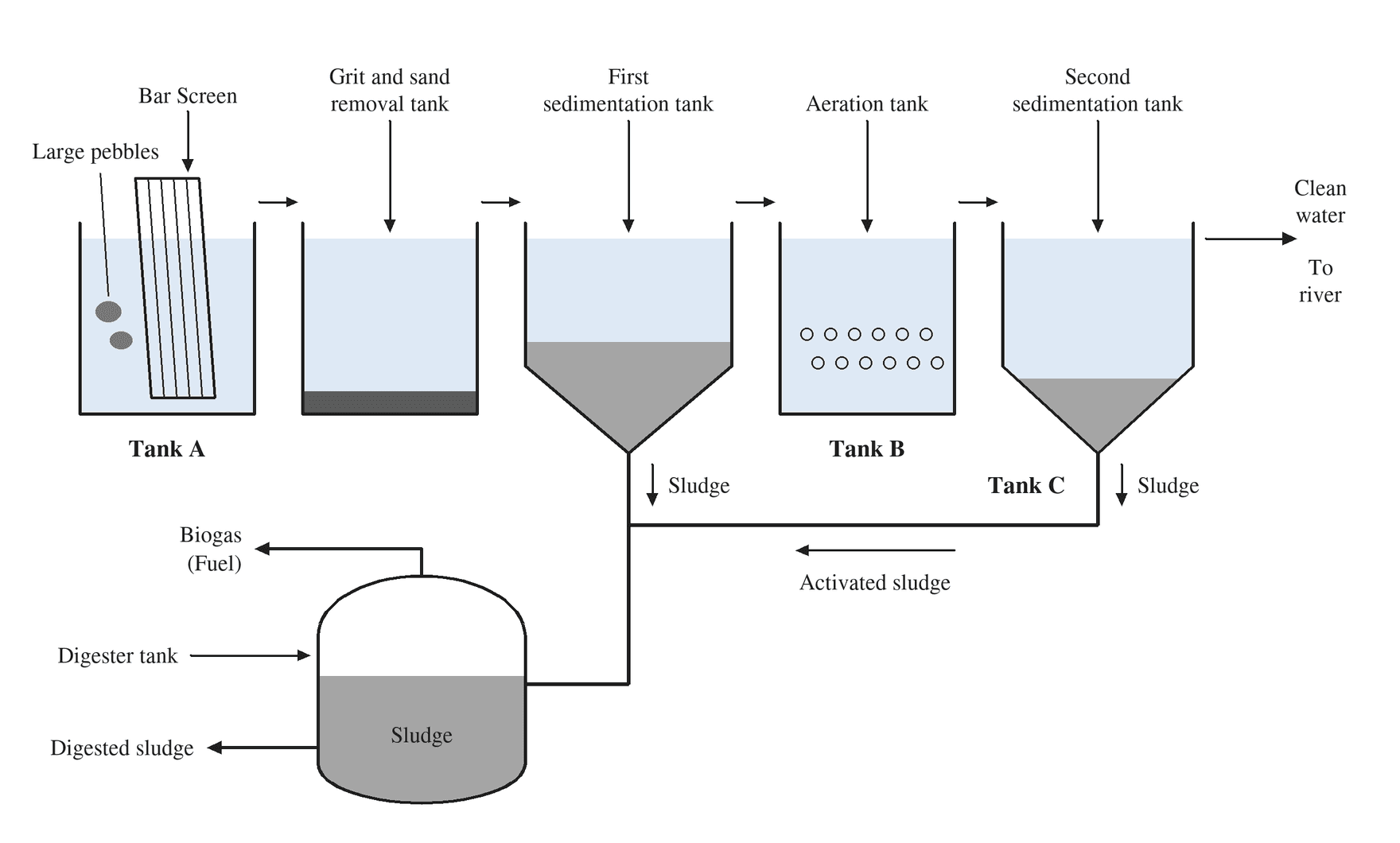
(i) Tank A represents primary treatment of sewage while Tank B shows its secondary treatment. State one difference between the two kinds of sewage treatment.
(ii) Identify the tank in which flocs are added.
(iii) What is the purpose of using microbes in sewage treatment?
Solve with AIWritten solution
Solution:
Key idea: Sewage is treated in two stages: primary treatment removes solid particles physically, and secondary treatment uses microbes to remove the dissolved and suspended organic matter.
(i) Difference between primary and secondary treatment
Step 1 — Compare the two stages.
Primary treatment (Tank A, the grit and sand removal tank and the first sedimentation tank) is a physical process: large and small particles are removed by screening, by letting grit settle and by sedimentation. Secondary treatment (Tank B) is a biological process: aerobic microbes feed on the organic matter in the water and so reduce its BOD.
(ii) Tank to which flocs are added
Step 2 — Identify the tank.
Flocs (masses of bacteria held together by fungal filaments) grow in the aeration tank, and part of the activated sludge, which is full of flocs, is pumped back into it as an inoculum. This return pipe is not drawn in the diagram, but it is part of every activated-sludge plant. So flocs are added in Tank B, the aeration tank.
(iii) Purpose of using microbes
Step 3 — State the purpose.
The aerobic microbes in the flocs consume most of the organic matter, which greatly lowers the BOD of the sewage so that the water can be released into rivers safely. In the digester, anaerobic bacteria digest the sludge and give biogas, which is used as a fuel.
Therefore, (i) primary treatment is physical removal of solids while secondary treatment is biological breakdown of organic matter by microbes; (ii) flocs are added in Tank B; (iii) microbes are used to break down the organic matter and lower the BOD of sewage (and to give biogas from the sludge).
- 151 mark
Question 15
A farmer notices that the leaves of his cabbage plants are curling up because of heavy infestation of aphids.
Suggest one ecofriendly method to control their spread in the cabbage plants.
Solve with AIWritten solution
Solution:
Key idea: Biological control uses a pest's natural enemies, instead of chemical insecticides, to keep the pest in check.
Step 1 — Find a natural enemy of aphids.
Ladybird beetles (ladybugs) and their larvae feed on aphids in large numbers.
Step 2 — Suggest the method.
The farmer can release ladybird beetles in the cabbage field (or protect those already present by not spraying broad-spectrum insecticides). They eat the aphids and stop their spread without polluting the crop or the soil.
Therefore, an eco-friendly method is biological control: release ladybird beetles, which feed on the aphids.