Solution:
Concept: A rating such as '100 W, 220 V' means the appliance uses 100 W when connected to 220 V. From it, the resistance is R = V² ÷ P and the safe (normal working) current is I = P ÷ V. In parallel the p.d. is the same across each resistor, the currents add up (I = I₁ + I₂ + …), and the equivalent resistance is given by 1/R = 1/R₁ + 1/R₂ + …, less than the smallest one. For two resistors, R = R₁R₂ ÷ (R₁ + R₂).
Step 1 — Find each bulb's resistance (part a1).
From the rating, R = V² ÷ P.
R=18122=18144=8 Ω
Step 2 — Find the total resistance (part a2).
B₂ and B₃ are in parallel, and this pair is in series with B₁.
Rp=8+88×8=4 Ω
Rtotal=8+4=12 Ω
Step 3 — Find the current (part a2).
The battery's 12 V drives the current through 12 Ω.
I=1212=1 A
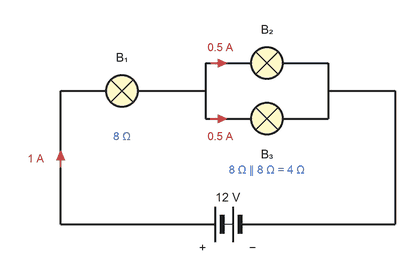
Step 4 — Remove B₃ (part b).
Now B₁ and B₂ are in series, so the total resistance is 16 Ω, more than 12 Ω, and the current falls.
I′=8+812=0.75 A
Step 5 — Compare the power in B₁ (part b).
The brightness of B₁ depends on the power I²R it receives.
Pbefore=12×8=8 W
Pafter=0.752×8=4.5 W
So B₁ glows less brightly.
Watch out: Removing a bulb from a PARALLEL pair raises the total resistance, so the bulb in series with the pair gets less current.
Therefore, (a)(1) the resistance of each bulb is 8 Ω; (a)(2) the current drawn from the cell is 1 A; (b) the brightness of B₁ decreases (its power falls from 8 W to 4.5 W).

