
Question 351 markMCQAsked 2025Easy
An alloy constantan has resistivity Ω m at 25°C. If the temperature of this alloy is increased to 50°C then its resistivity will be:
Confirming your payment
Sign up now and get 250 free tokens.
Previous Year Questions · Question 35 of 48
An alloy constantan has resistivity Ω m at 25°C. If the temperature of this alloy is increased to 50°C then its resistivity will be:
(A) Ω m
(B) Ω m
(C) Ω m
(D) Ω m
Answer: (B) Ω m
Concept: With a rise in temperature the resistance of a metal increases, that of an alloy (manganin, constantan, nichrome) increases only very slightly, and that of a semiconductor or carbon decreases.
Step 1 — Recall the property of constantan.
Constantan is an alloy whose specific resistance remains almost unchanged when its temperature changes; that is why it is used for standard resistances.
Step 2 — Apply it.
For a pure metal, heating from 25 °C to 50 °C would raise the resistivity noticeably. For constantan the change is negligible, so its resistivity stays about 5 × 10⁻⁷ Ω m.
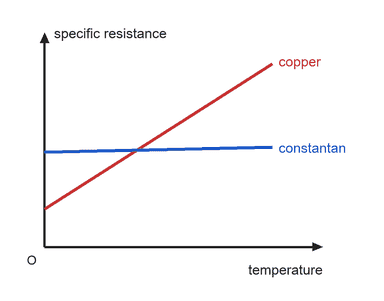
Watch out: The resistivity of an alloy like constantan hardly changes on heating; it neither halves nor multiplies.
Why the other options are wrong:
Therefore, the resistivity stays 5 × 10⁻⁷ Ω m, option (B).