Solution:
Concept: Ohm's law: the current in a conductor is directly proportional to the p.d. across its ends, provided its physical conditions (temperature) stay the same. So V = IR, where R is the resistance, measured in ohm (1 Ω = 1 V A⁻¹).
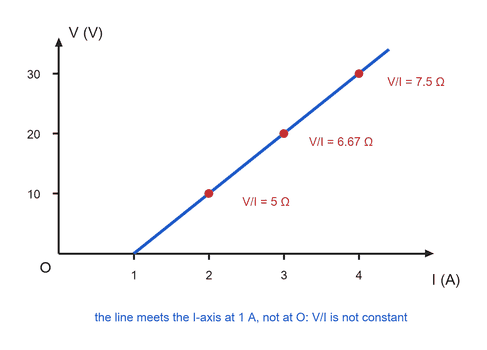
Step 1 — Work out V/I for each reading (part b).
A conductor is ohmic only if V/I is the same for every reading. We divide each voltage by its current.
210=5 Ω
320=6.67 Ω
430=7.5 Ω
Step 2 — Decide (part a).
The ratio V/I is not constant: it increases as the current increases. So V is not proportional to I, Ohm's law is not obeyed, and the conductor is non-ohmic. On a graph, the points lie on a line that does not pass through the origin.
Step 3 — State Ohm's law (part c).
The current flowing through a conductor is directly proportional to the potential difference across its ends, provided its temperature and other physical conditions remain unchanged.
IV=R(a constant)
Watch out: A straight-line graph is not enough: an ohmic graph must also pass through the origin.
Therefore, (a) the conductor is non-ohmic; (b) V/I is 5 Ω, 6.67 Ω and 7.5 Ω, not constant; (c) the current through a conductor is directly proportional to the p.d. across it, at constant temperature.
