Solution:
Concept: In series the same current flows through each resistor, the p.d.s add up (V = V₁ + V₂ + …), and the equivalent resistance is R = R₁ + R₂ + …, more than the largest one. Electrical power is the rate of spending electrical energy, P = W ÷ t; since W = VIt, this gives P = VI, which can also be written P = I²R or P = V² ÷ R. Its S.I. unit is the watt; one watt is one joule per second (1 V × 1 A).
Step 1 — Find the change in resistance (part a).
If each bulb has resistance R, five bulbs in series give 5R; with one removed, four bulbs give 4R. So the total resistance decreases.
Step 2 — Find the change in current.
The supply voltage V is the same, so the current rises from V ÷ 5R to V ÷ 4R.
4RV>5RV
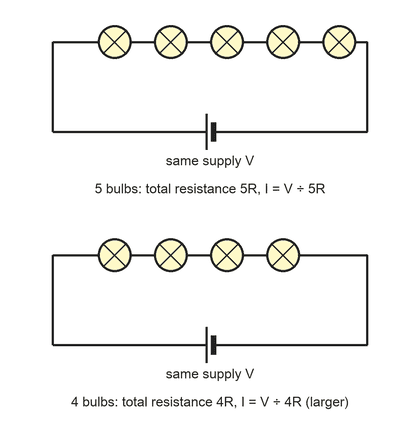
Step 3 — Find the change in brightness (part b).
Each bulb's power is I²R, and I is now larger, so each bulb takes more power and glows brighter: the intensity of light increases.
Watch out: Fewer bulbs in series means LESS resistance and MORE current, not less.
Therefore, (a) the resistance decreases; (b) the intensity of light increases.
