Solution:
Concept: In an ideal pulley system the string is light and slides without friction, so the tension T is the same all along one string. Every strand that holds up a movable pulley pulls it up with T, and the effort pulls the free end with E = T. A fixed pulley only changes the direction of the force; a movable pulley hangs in two strands, so they share its load. Mechanical advantage (M.A.) is load ÷ effort. Velocity ratio (V.R.) is the velocity of the effort ÷ the velocity of the load, which is the distance moved by the effort ÷ the distance moved by the load in the same time. Efficiency η is work output ÷ work input, and it works out to M.A. ÷ V.R.
Given: Load 30 kgf in both cases; both efforts move through the same distance; ideal pulleys.
Step 1 — Part (a): the efforts.
In an ideal single fixed pulley the effort equals the load, so E1 = 30 kgf for Suhas. In an ideal single movable pulley two strands share the load, so Radha's effort is half of it:
E2=230 kgf=15 kgf
E2E1=1530=12
Step 2 — Part (b): how far each load rises.
Both efforts move through the same distance, say d. The fixed pulley has V.R. = 1, so Suhas's load rises d. The movable pulley has V.R. = 2, so Radha's load rises only d/2.
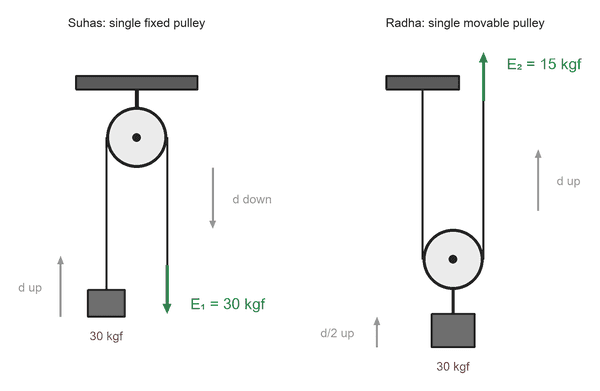
Step 3 — Part (b): the potential energies.
Potential energy gained = weight × height, and both loads weigh 30 kgf:
P.E. (Radha)P.E. (Suhas)=30×2d30×d=12
This matches the work put in: E1d is 30d and E2d is 15d, also in the ratio 2 : 1.
Step 4 — Part (c): the efficiencies.
In an ideal situation no energy is wasted, so both efficiencies are 100%, and their ratio is 1 : 1.
Watch out: The efforts move the SAME distance, so the movable pulley's load rises only half as far; the potential energies are not equal.
Therefore, (a) the efforts are in the ratio 2 : 1; (b) the potential energies gained are in the ratio 2 : 1; (c) the efficiencies are in the ratio 1 : 1.
