Solution:
Concept: A lever is a rigid bar that turns about a fixed point, the fulcrum F. Its class depends on what lies in the middle: the fulcrum (class I), the load (class II) or the effort (class III). When it balances, effort × effort arm = load × load arm, so M.A. = effort arm ÷ load arm.
Given: Class II cutter; same hand position and same resistance in both cases; E1>E2.
Step 1 — Find F, L and E in the cutter.
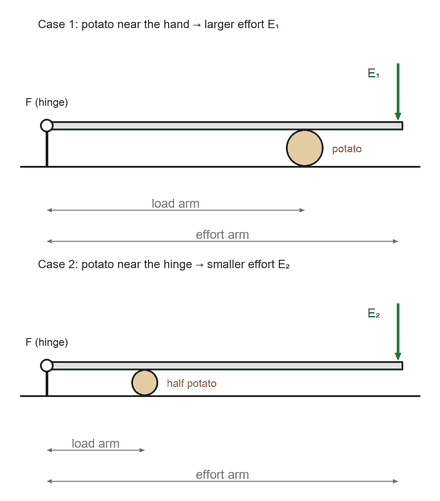
In the cutter the hinge is the fulcrum. The hand at the end of the handle applies the effort, and the potato (the load) lies between them, as in every class II lever.
Step 2 — See what stays the same.
The hand is at the same place both times, so the effort arm is the same. The resistance of the potato (the load) is taken to be the same too.
Step 3 — Write the lever balance.
For the lever to cut, the moments balance:
E×effort arm=L×load arm
E=effort armL×load arm
With L and the effort arm fixed, a larger effort means a longer load arm.
Step 4 — Pick the case.
Since E1>E2, the load arm was longer in Case 1: the potato was farther from the hinge, that is, closer to the hand. In Case 2 the potato was nearer the hinge, so the load arm was shorter and less effort was needed.
Watch out: The phrase 'closer to the hand' means farther from the hinge, so the load arm is longer, not shorter.
Therefore, (a) in Case 1 the potato was closer to her hand; (b) with the same effort arm and load, the effort is proportional to the load arm, so the larger effort E1 means the potato was farther from the hinge (the fulcrum), that is, nearer the hand.
