
Question 203 marksAsked 2025Easy
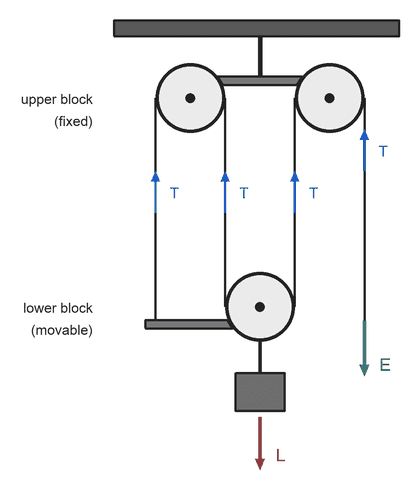
Draw a block and tackle system of pulleys with velocity ratio equal to 3.
Confirming your payment
Sign up now and get 250 free tokens.
Previous Year Questions · Question 20 of 31
Draw a block and tackle system of pulleys with velocity ratio equal to 3.
Solution:
Concept: In a block and tackle one string passes round all the pulleys of an upper (fixed) block and a lower (movable) block. With the effort applied downward, the number of strands holding up the lower block equals the total number of pulleys n. Each strand pulls up with T, so ideally L = nT and E = T, and V.R. = n. Tension is a pull: in every strand it acts along the string, towards the pulley the strand runs to (Selina's convention), so it pulls the lower block up and also pulls back on the hand at the free end.
Given: V.R. = 3.
Step 1 — Choose the pulleys.
V.R. = 3 needs 3 strands holding up the lower block. With the effort applied downward this means 3 pulleys in all, so we put two in the upper (fixed) block and one in the lower (movable) block. The upper block, which does not have to be lifted, gets the extra pulley when the total is odd.
Step 2 — Thread the string.
Tie one end of the string to the hook of the lower block. Take it up over the first upper pulley, then down under a lower pulley, and keep going alternately over the upper and under the lower pulleys. The free end comes down from the last upper pulley.
Step 3 — Mark the forces.
The load L hangs from the hook of the lower block and acts downward. The effort E is applied at the free end of the string and acts downward. The tension T acts in every strand, pointing up: in the strands holding the lower block it pulls the block up, and in the free strand it pulls back up against the hand.
Step 4 — Check the velocity ratio.
When the lower block rises by 1 unit, each of the 3 strands holding it becomes 1 unit shorter, so the free end must be pulled through 3 units.
Watch out: Count only the strands that hold up the lower block; the free strand pulled by the hand does not hold it up when the effort is applied downward.
Therefore, two pulleys in the upper (fixed) block and one in the lower (movable) block, with the string tied to the lower block, the load L and the effort E acting downward and the tension T upward in every strand, give V.R. = 3.