
Question 193 marksAsked 2025Medium
Three levers X, Y, Z of equal lengths are shown in the diagram.
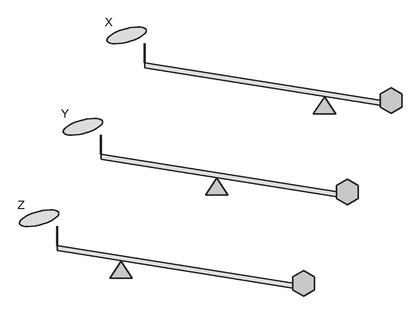
(a) Which class of lever do these belong to?
(b) Among these (X, Y or Z) which one will give the maximum mechanical advantage? Justify your answer.
Confirming your payment
Sign up now and get 250 free tokens.
Previous Year Questions · Question 19 of 31
Three levers X, Y, Z of equal lengths are shown in the diagram.
(a) Which class of lever do these belong to?
(b) Among these (X, Y or Z) which one will give the maximum mechanical advantage? Justify your answer.
Solution:
Concept: A lever is a rigid bar that turns about a fixed point, the fulcrum F. Its class depends on what lies in the middle: the fulcrum (class I), the load (class II) or the effort (class III). When it balances, effort × effort arm = load × load arm, so M.A. = effort arm ÷ load arm.
Given: Three levers X, Y, Z of equal length, with the fulcrum in different places.
Step 1 — Part (a): find F, L and E.
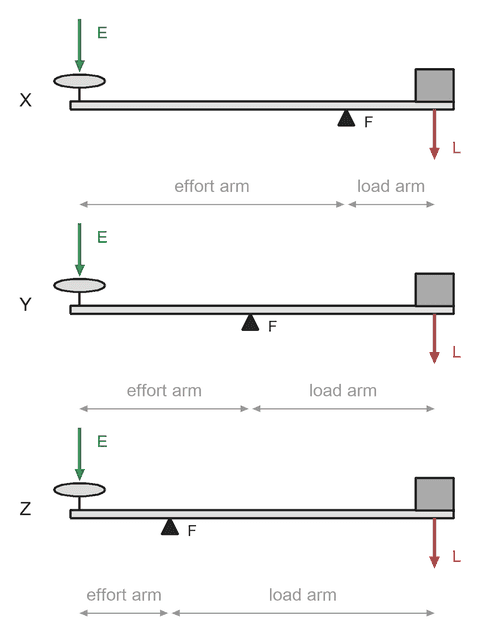
In each lever the effort is applied at the pan on one end, the heavy block at the other end is the load, and the fulcrum lies between them. So all three are class I levers.
Step 2 — Part (b): compare the arms.
The three levers have equal lengths, but the fulcrum is in a different place in each. In X the fulcrum is nearest the load, so X has the longest effort arm and the shortest load arm. In Y the fulcrum is near the middle, so the two arms are nearly equal. In Z the fulcrum is nearest the pan, so its effort arm is short and its load arm long.
Step 3 — Part (b): compare the M.A.
For a lever,
This ratio is largest for X (more than 1), about 1 for Y and less than 1 for Z. So X lifts the load with the least effort.
Watch out: Measure both arms from the fulcrum; the longer the effort arm compared with the load arm, the larger the M.A.
Therefore, (a) they are class I levers; (b) lever X gives the maximum M.A., because its fulcrum is nearest the load, so its effort arm is the longest and its load arm the shortest.