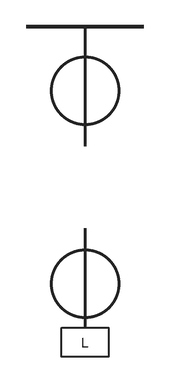
Solution:
Concept: Mechanical advantage (M.A.) is load ÷ effort. Velocity ratio (V.R.) is the velocity of the effort ÷ the velocity of the load, which is the distance moved by the effort ÷ the distance moved by the load in the same time. Efficiency η is work output ÷ work input, and it works out to M.A. ÷ V.R. In an ideal pulley system the string is light and slides without friction, so the tension T is the same all along one string. Every strand that holds up a movable pulley pulls it up with T, and the effort pulls the free end with E = T. A fixed pulley only changes the direction of the force; a movable pulley hangs in two strands, so they share its load.
Given: V.R. = 2; load L = 48 kgf; efficiency η = 80%, that is 0.8.
Step 1 — Part (a): count the strands needed.
A V.R. of 2 needs two strands holding up the lower (movable) pulley.
Step 2 — Part (a): connect the pulleys.
Tie one end of the string to the hook of the upper (fixed) pulley's block. Take it down and under the lower (movable) pulley, then up and over the fixed pulley, and apply the effort downward at the free end. The tension T acts up in both strands holding the movable pulley, and up (towards the fixed pulley) in the effort strand.

Step 3 — Part (a): check the V.R.
When the load rises by 1 unit, both strands holding the movable pulley become 1 unit shorter, so the effort end moves 2 units:
V.R.=1 unit2 units=2
Step 4 — Part (b) 1: mechanical advantage.
Since efficiency = M.A. ÷ V.R., the M.A. is the efficiency times the V.R.:
M.A.=η×V.R.=0.8×2=1.6
Step 5 — Part (b) 2: effort needed.
Since M.A. = L ÷ E, the effort is the load divided by the M.A.:
E=M.A.L=1.648 kgf=30 kgf
An ideal system would need only 24 kgf (half the load); the extra 6 kgf goes into friction and lifting the movable pulley.
Watch out: Use the efficiency as a decimal (0.8), not as 80, when you multiply it by the V.R.
Therefore, (a) string tied to the hook of the fixed pulley's block, passed under the movable pulley and over the fixed pulley, with the effort pulled down (V.R. = 2); (b) 1. M.A. = 1.6; 2. effort = 30 kgf.