Solution:
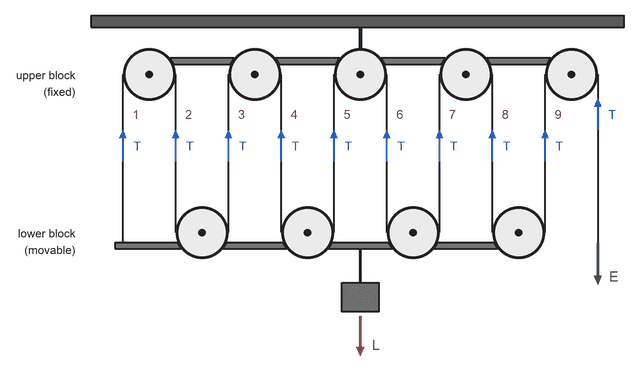
Concept: In a block and tackle one string passes round all the pulleys of an upper (fixed) block and a lower (movable) block. With the effort applied downward, the number of strands holding up the lower block equals the total number of pulleys n. Each strand pulls up with T, so ideally L = nT and E = T, and V.R. = n.
Given: Block and tackle of 9 pulleys, compared with a single movable pulley.
Step 1 — Part (a): compare the velocity ratios.
A block and tackle of 9 pulleys, with the effort applied downward, holds the lower block on 9 strands, so its V.R. is 9 and its ideal M.A. is 9. A single movable pulley has V.R. 2 and ideal M.A. 2. Ideally the efforts are:
Etackle=9L
Emovable=2L
So Meera needs a much smaller effort, one-ninth of the load instead of one-half. She can also pull downward, which is easier than the upward pull a single movable pulley needs.
Step 2 — Part (b): split the pulleys.
With 9 pulleys one block must have one more pulley than the other. The better choice is 5 in the upper block and 4 in the lower block.
Step 3 — Part (b): why the upper block.
The lower block is lifted together with the load, so every pulley in it adds weight that the effort must also raise. A lighter lower block wastes less effort, so the M.A. and the efficiency are higher. Also, with the string tied to the lower block, the free end leaves the last pulley of the upper block, so the effort is applied downward while all 9 strands still hold up the lower block (V.R. = 9).
Watch out: More pulleys in the lower block would not raise the V.R.; they would only make the block heavier and lower the efficiency.
Therefore, (a) the block and tackle has V.R. = 9 (ideal M.A. 9) against 2, so a much smaller effort lifts the load, and it is applied downward; (b) the movable lower block then has fewer pulleys and is lighter, so less effort is wasted in lifting it and the M.A. and efficiency are higher.
