Solution:
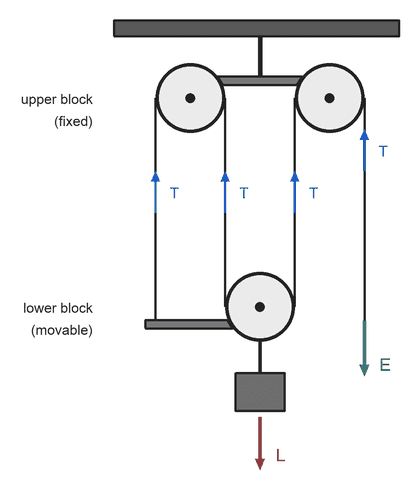
Concept: (i) Two gear wheels in mesh turn in the inverse ratio of their numbers of teeth. (ii) Mechanical advantage (M.A.) is load ÷ effort. Velocity ratio (V.R.) is the velocity of the effort ÷ the velocity of the load, which is the distance moved by the effort ÷ the distance moved by the load in the same time. Efficiency η is work output ÷ work input, and it works out to M.A. ÷ V.R. In a block and tackle one string passes round all the pulleys of an upper (fixed) block and a lower (movable) block. With the effort applied downward, the number of strands holding up the lower block equals the total number of pulleys n. Each strand pulls up with T, so ideally L = nT and E = T, and V.R. = n.
Given: (i) driving wheel 32 teeth, driven wheel 8 teeth; (ii) three pulleys, load L = 120 N, effort E = 50 N.
Step 1 — Part (i): count the turns.
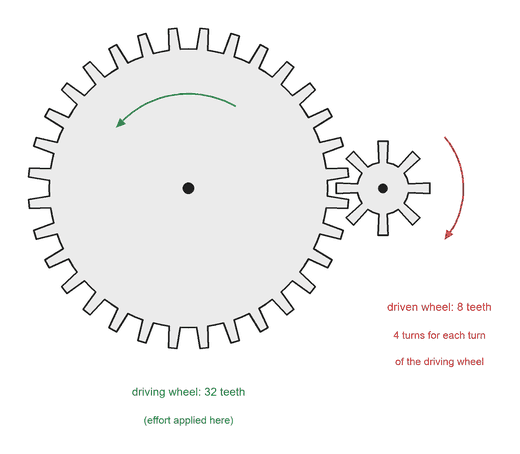
The effort turns the bigger wheel (the driving wheel, 32 teeth). Its teeth push the teeth of the smaller wheel (the driven wheel, 8 teeth) one by one. In one turn, 32 teeth of the big wheel pass the meeting point, and every 8 of them turn the small wheel once:
turns of the small wheel=832=4
Step 2 — Part (i): where it is used.
The driven wheel turns 4 times as fast as the driving wheel, so the arrangement is used to gain speed, with a larger effort. For example, in a bicycle the large toothed wheel turned by the pedals drives the small toothed wheel on the rear wheel.
Step 3 — Part (ii): mechanical advantage.
The M.A. is the load divided by the effort:
M.A.=50 N120 N=2.4
Step 4 — Part (ii): velocity ratio.
Three pulleys used as a block and tackle with the effort applied downward (two pulleys in the fixed block, one in the movable block) hold the lower block on three strands, so V.R. = 3.
Step 5 — Part (ii): efficiency.
The efficiency is the M.A. divided by the V.R., written as a percentage:
η=32.4×100%=80%
So 80% of the work done by the effort lifts the load; the rest is spent against friction and in lifting the lower block.
Watch out: Efficiency is M.A. ÷ V.R.; do not divide the load by the number of pulleys and call that the efficiency.
Note: The printed question does not say how the three pulleys are arranged; the block and tackle reading (V.R. = 3) is the usual one. Two movable pulleys and one fixed pulley, each movable pulley in its own string, would give V.R. = 4 and an efficiency of 60%.
Therefore, (i) the gear is used to gain speed (the small wheel turns 4 times for each turn of the big one), as in a bicycle; (ii) M.A. = 2.4 and efficiency = 80%.
