Solution:
Concept: In an ideal pulley system the string is light and slides without friction, so the tension T is the same all along one string. Every strand that holds up a movable pulley pulls it up with T, and the effort pulls the free end with E = T. A fixed pulley only changes the direction of the force; a movable pulley hangs in two strands, so they share its load.
Given: Load L = 20 kgf; weight of pulley A and friction neglected.
Step 1 — Part (i): name the pulleys.
Pulley A is held up by the string and moves up with the load, so A is a movable pulley. Pulley B is hung from the support and only turns, so B is a fixed pulley.
Step 2 — Part (ii): purpose of B.
Without B, the free end of the string from A would have to be pulled upward. B turns the string so the effort at C is applied downward, which is easier: the person can use their own weight. B does not change the size of the effort.
Step 3 — Part (iii): forces on A.
Pulley A hangs in two strands of the same string. Each pulls it up with the tension T, and together they hold the load of 20 kgf (the pulley's weight and friction are neglected):
2T=20 kgf
T=220 kgf=10 kgf
Step 4 — Part (iii): the effort.
The effort at C pulls the same string over the fixed pulley B, so it equals the tension:
E=T=10 kgf
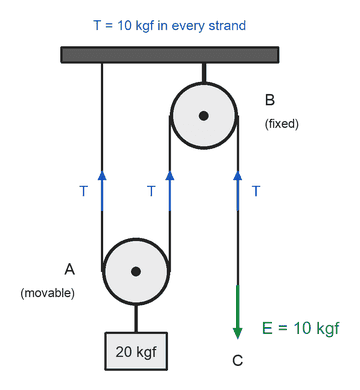
Step 5 — Check with the M.A.
This arrangement has M.A. = 2:
M.A.=10 kgf20 kgf=2
Watch out: The fixed pulley B does not halve the effort again: it only turns the string. Only the movable pulley A shares the load between two strands.
Therefore, (i) A is a movable pulley and B is a fixed pulley; (ii) B changes the direction of the effort, so it can be applied downward; (iii) the effort at C is 10 kgf.

