Solution:
Concept: A conductor carrying a current I across a magnetic field of flux density B feels a force. When the conductor of length l is at right angles to the field, the force is F = BIl; it is zero when the conductor is along the field. Fleming's left-hand rule: Stretch the forefinger, the central (middle) finger and the thumb of the left hand at right angles to each other. If the forefinger points along the magnetic field and the central finger along the current, the thumb gives the direction of the force (motion) on the conductor.
(a) True or False
Step 1 — Find the field.
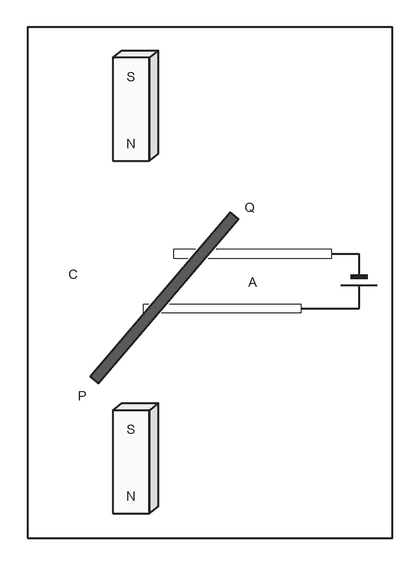
The N pole of the upper magnet faces the S pole of the lower magnet, so the field between them points vertically downward.
Step 2 — Find the current.
The long plate (+) of the cell is at the bottom and is joined to the front rail, so the current flows along the front rail and through the rod from P to Q.
Step 3 — Find the force.
With the forefinger pointing down (field) and the central finger from P to Q (current), the thumb of the left hand points towards C. So the statement is True.

(b) Law used
Step 4 — Name the rule.
The direction of motion is found by Fleming's left-hand rule.
(c) Thicker rod
Step 5 — State the effect.
With the same cell connected, the force increases.
(d) Justification
Step 6 — Explain why.
A rod of the same length but greater area of cross-section has less resistance, because R = ρl ÷ a. With the same cell, a larger current I flows through it. The force is proportional to the current.
F=BIl
B and l are unchanged, so a larger I gives a larger force.
Watch out: The force does not depend on the thickness itself; it increases only because the current increases.
Therefore, (a) True; (b) Fleming's left-hand rule; (c) the force increases; (d) the thicker rod has less resistance, so a larger current flows, and F = BIl increases with the current.