Solution:
Concept: Clock rule: Look at one face (end) of a current loop or solenoid. If the current at that face flows anticlockwise, the face behaves as a north pole; if it flows clockwise, the face behaves as a south pole. Steel keeps its magnetism after the current stops, so the removed bar is a permanent magnet. Field lines leave a north pole, curve round outside the magnet and enter its south pole.
Step 1 — Find the current.
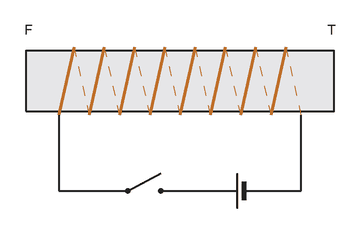
The long plate (+) of the cell is on the left, so the current flows through the switch and enters the coil at the F end. On the front of the bar each turn carries the current upward.
Step 2 — Find the poles.
Looking at the end F, this current goes round anticlockwise, so F becomes a north pole and T a south pole. Steel keeps this magnetism after the bar is removed.
(a) and (b) The magnetised bar and its lines of force
Step 3 — Draw the bar and its field.
Draw the bar FT with N marked at F and S at T. Draw two field lines that leave F, curve round outside the bar and enter T, with arrows pointing from F towards T.
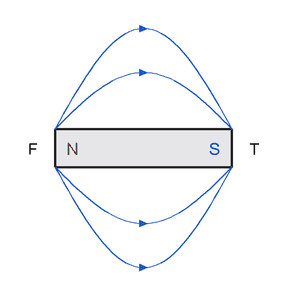
Watch out: Arrows on the lines of force point from N to S OUTSIDE the magnet.
Therefore, the bar FT is magnetised with F as the north pole and T as the south pole, and its lines of force run outside the bar from F round to T.