Solution:
Concept: A current in a wire sets up a magnetic field round the wire (Oersted, 1820). Round a long straight wire the field lines are concentric circles in planes at right angles to the wire, centred on the wire. The field is stronger for a larger current and weaker farther from the wire, and reversing the current reverses the direction of the field. Right-hand thumb rule: Hold the current-carrying wire in the right hand with the thumb stretched along the direction of the current; the curled fingers then point in the direction of the magnetic field lines round the wire.
(a) One factor
Step 1 — Name a factor.
The induced current in an a.c. generator is larger when the coil turns faster, so the speed of rotation of the coil is one factor. (The number of turns, the area of the coil and the strength of the magnetic field also count.)
(b) 1. Rule
Step 2 — Name the rule.
The direction of the field round the wire, and so the deflection of the compass, is given by the right-hand thumb rule.
(b) 2. Direction of the current
Step 3 — Read the compass.
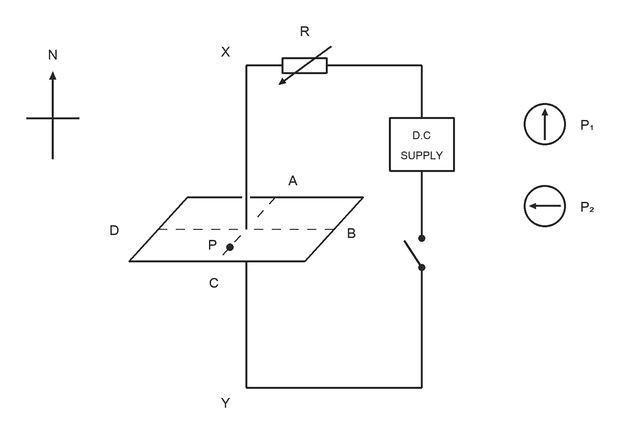
Before the current flows the needle points north (P₁). After it flows the needle points west (P₂), so the field of the wire at P points west.
Step 4 — Place P.
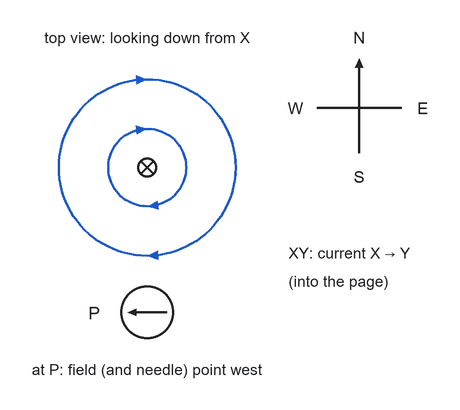
P lies on the card on the south side of the conductor (towards C). Seen from above, a field pointing west on the south side of the wire means the field lines go round clockwise.
Step 5 — Use the thumb rule.
Clockwise field lines, seen from above, mean the current flows downward, away from the viewer, that is, from X to Y.
(b) 3. Resistance R increased
Step 6 — Explain the effect.
A larger R gives a smaller current in XY, so the field becomes weaker: the lines of force become less dense (farther apart) and are noticeable only up to a smaller distance from the wire. They stay circles in the same direction.
Watch out: Work out on which side of the wire P lies before reading the compass; the same west-pointing needle on the north side would mean the opposite current.
Therefore, (a) the speed of rotation of the coil; (b) 1. the right-hand thumb rule; 2. the current flows from X to Y; 3. the field becomes weaker and the lines of force become less dense (farther apart).