
Question 223 marksAsked 2024Easy
Below is the diagram of a transformer :
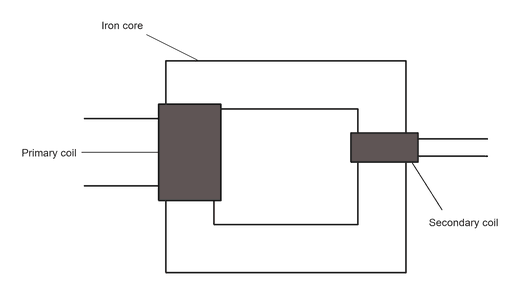
(a) Identify the type of transformer.
(b) In this type of transformer which of the wire is thicker, the primary or the secondary? Give a reason.
Confirming your payment
Sign up now and get 250 free tokens.
Previous Year Questions · Question 22 of 39
Below is the diagram of a transformer :
(a) Identify the type of transformer.
(b) In this type of transformer which of the wire is thicker, the primary or the secondary? Give a reason.
Solution:
Concept: A transformer works on mutual induction and only with a.c.: the changing current in the primary coil sets up a changing flux in the soft iron core, and this changing flux, linked with the secondary coil, induces an e.m.f. in it. The e.m.f. per turn is the same in both coils, so Es ÷ Ep is equal to Ns ÷ Np (the turns ratio). In an ideal transformer the power in equals the power out, so the current changes the opposite way: Is ÷ Ip is equal to Np ÷ Ns. In an ideal transformer the power going in equals the power coming out, so Es × Is is equal to Ep × Ip. The coil working at the lower voltage therefore carries the larger current.
(a) Type of transformer
Step 1 — Compare the coils.
In the figure the primary coil is much bigger (more turns) than the secondary coil, so Ns is less than Np and the output voltage is lower than the input. It is a step-down transformer.
(b) Thicker wire
Step 2 — Compare the currents.
In a step-down transformer Es is less than Ep. The power is almost the same in both coils, so the secondary carries the larger current.
Since Ep is more than Es, Is is more than Ip.
Step 3 — Choose the thicker coil.
A thick wire has less resistance, so it heats less (I²R) and wastes less energy as heat. So the secondary, which carries the larger current, is made of thicker wire.
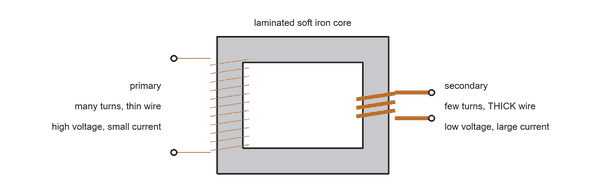
Watch out: In a step-DOWN transformer the SECONDARY is thick; in a step-up transformer the primary is.
Therefore, (a) it is a step-down transformer, and (b) the secondary wire is thicker, because it carries the larger current and a thick wire reduces the heating (copper) loss.