Solution:
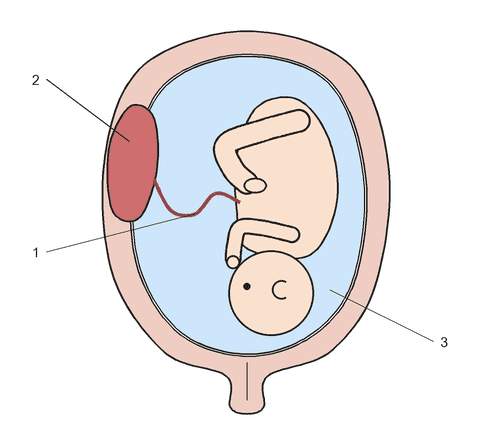
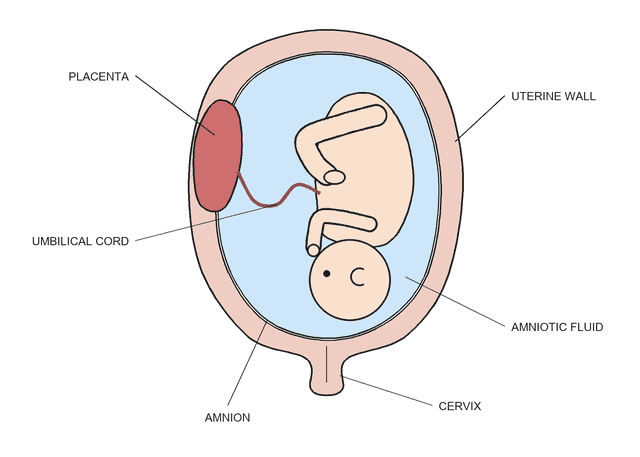
Concept: The figure shows a foetus in the uterus. A cord (1) joins it to a disc on the uterine wall (2), and it floats in a fluid (3) held in a membrane sac, the amnion. Gestation is the full period of development of the embryo (later the foetus) in the uterus, from implantation to birth. In humans it is about 280 days (40 weeks), counted from the first day of the mother's last menstrual period.
Step 1 — Part (i) — label the parts.
Part 1 is the cord joining the foetus to the uterine wall, part 2 is the disc on the uterine wall where the cord ends, and part 3 is the fluid round the foetus inside its sac.
1 — Umbilical cord
2 — Placenta
3 — Amniotic fluid (inside the amnion)
Step 2 — Part (ii) — two functions of the placenta (2).
The placenta lets materials pass between the mother's blood and the foetus's blood by diffusion, without the two bloods mixing.
Nutrition and oxygen: glucose, amino acids, fats, vitamins, mineral ions and oxygen pass from the mother's blood into the foetus's blood.
Removal of wastes: carbon dioxide and urea pass from the foetus's blood into the mother's blood, and her lungs and kidneys remove them.
It also passes on some antibodies, and it works as an endocrine gland, making hormones such as progesterone and oestrogen.
Step 3 — Part (iii) — significance of the amniotic fluid (3).
The fluid surrounds the foetus on all sides, so it cushions and supports it.
It acts as a shock absorber, protecting the foetus from jerks and bumps, and it keeps an even pressure all round it. It also lets the foetus move a little and keeps it from sticking to the amnion.
Step 4 — Part (iv) — gestation.
Gestation is the full period of development of the embryo (foetus) in the uterus, from implantation to birth.
In humans the normal gestation period is about 280 days (about 40 weeks, or nine months), counted from the first day of the mother's last menstrual period.
Step 5 — Part (v) — sex chromosomes.
The sex of the embryo is fixed at fertilisation by the sperm: every egg carries an X, and the sperm carries either an X or a Y.
Male embryo — XY (44 + XY in each body cell)
Female embryo — XX (44 + XX in each body cell)

Watch out: The amniotic fluid is the fluid; the amnion is the membrane sac that holds it.
Therefore, 1 is the umbilical cord, 2 the placenta and 3 the amniotic fluid; the placenta supplies food and oxygen and removes wastes, the amniotic fluid protects the foetus from shocks, gestation lasts about 280 days, and the sex chromosomes are XY in a male and XX in a female embryo.