
Opening your dashboard
Class 11 Physics Chapter 1 Physical World: Practice Questions
63 questions on Chapter 1, each worked through on its own page with the AI tutor. Class 11 Physics, ICSE 2026-27.
63 questions
1–3 marks · Mixed difficulty
- 11 mark
Question 1
Riya notices that the swings of a long pendulum in her school laboratory seem to take the same time whether they are wide or narrow. She then times 20 swings at amplitudes of , and , using the same string length and the same bob each time. In the scientific method, keeping the string length and the bob unchanged while only the amplitude is varied is an example of
- 22 marks
Question 2
The chapter describes physics as the study of matter and energy. Matter has mass and takes up space; light, radio waves and heat, which have no mass of their own, are forms of energy. Classify each of the following as matter or energy, giving a reason:
(i) the radio waves sent out by a mobile-phone tower
(ii) the air pumped into a football
(iii) the heat flowing from a hot iron into a shirt
(iv) the beam of electrons inside an old television picture tube
- 31 mark
Question 3
A statement is a scientific hypothesis only if an experiment or observation could, at least in principle, show it to be wrong. Which of these statements is a scientific hypothesis in this sense?
- 43 marks
Question 4
(Hypothetical data.) Two solid iron balls, of masses and , are released together from a height of . For such dense balls air resistance is very small, so each falls with the acceleration , and the distance fallen from rest in time is .
(a) Find the time each ball takes to reach the ground.
(b) Suppose someone claims, as Aristotle did, that a body twice as heavy falls twice as fast. If the ball took the time found in (a), how long would this claim say the ball takes?
(c) Both balls are seen to land together. What does this tell us about how a claim in physics is judged?
- 52 marks
Question 5
Physicists use two approaches. Unification means explaining many different-looking phenomena with a few concepts or laws. Reductionism means explaining the properties of a large, complex system from the behaviour of its simpler parts. Say which approach each example shows, with a reason:
(i) One set of equations of electromagnetism explains electric forces, magnetic forces and the travel of light.
(ii) The pressure and temperature of a gas in a cylinder are explained from the motion of its molecules.
- 61 mark
Question 6
Physics is a quantitative science: its statements give measured values, with units, that anyone can check. Which of these statements is quantitative?
- 73 marks
Question 7
Classical physics (mainly the work of Newton and Maxwell) describes bodies very accurately when their speed is much smaller than the speed of light, . When is close to , modern physics (Einstein's theory of relativity) is needed. For each body below, find and say which physics is needed:
(i) a cricket ball bowled at
(ii) the International Space Station orbiting at about
(iii) a proton in a particle accelerator moving at
- 82 marks
Question 8
Name the main branch of physics (choosing from mechanics, optics, acoustics and electronics) that each task belongs to, and give the reason:
(i) cutting down echoes in a school auditorium
(ii) choosing the lens for a pair of reading glasses
(iii) working out the path a satellite will follow around the Earth
(iv) designing a transistor circuit that makes a microphone's weak signal stronger
- 91 mark
Question 9
Classical physics (Newton's mechanics, the physics of heat, and Maxwell's electromagnetism) explains most everyday events, but some facts about atoms needed modern (quantum) physics. Which of these can be explained only by modern physics?
- 103 marks
Question 10
(Hypothetical data.) The chapter divides mechanics into statics (bodies at rest) and dynamics, which has two parts: kinematics (describing motion without asking its cause) and kinetics (studying motion together with the forces that cause it). A lift and its passengers have a total mass of ; take .
(a) While the lift stands still at a floor, find the tension in its cable.
(b) A sensor shows that, after starting, the lift's upward speed rises steadily from to in . Find its acceleration.
(c) Using Newton's second law (net upward force = mass × acceleration), find the cable tension while the lift speeds up.
For each part, name the branch of mechanics it belongs to.
- 112 marks
Question 11
Thermodynamics deals with heat and energy changes and the direction in which they take place. (Hypothetical data.) A kettle heats of water from to . The specific heat capacity of water is .
(a) How much heat does the water take in? (Use .)
(b) The hot water is then poured into a cup and left in a room at . In which direction does heat flow by itself, and until when does this flow continue?
- 121 mark
Question 12
Seismologists find where an earthquake started from the times at which its waves reach recording stations in different cities, and they use the same waves to learn about the layers deep inside the Earth. This work belongs mainly to which branch of physics?
- 133 marks
Question 13
(Hypothetical data.) Nanophysics studies bodies only a few nanometres () across. Model a metal grain as a cube of side in which the atoms sit in a simple cubic pattern, apart, with one atom to each small cube of side .
(a) How many atoms lie along one edge, and how many atoms are there in the whole grain?
(b) The atoms that are not on the surface form a cube with two fewer atoms along each edge. What percentage of the atoms are on the surface?
(c) For a cube of the same metal the surface atoms are only about of all its atoms. Use your answers to say why matter at the nanoscale can behave differently from a large piece of the same material.
- 141 mark
Question 14
A proton is about across, and the Earth's diameter is about . By about how many powers of ten (orders of magnitude) is the Earth's diameter larger than a proton?
- 153 marks
Question 15
The chapter gives the largest length met in physics as about (the distance of the most remote quasars) and the longest time as about . The age of the universe is about billion years. Take and .
(a) How long does light take to travel ? Give the answer in seconds and in billions of years.
(b) Express the age of the universe in seconds.
(c) Compare the two answers, and say what this tells us about the light we receive from the most distant objects.
- 161 mark
Question 16
On a powers-of-ten scale, equal steps stand for equal ratios, so the point halfway between and is . Which of these lengths lies closest to the halfway point between the size of a proton (about ) and the distance of the most remote quasars (about )?
- 173 marks
Question 17
(Hypothetical data.) To picture the range of times in physics, imagine the whole age of the universe, about billion years, squeezed into one calendar year of , with the present moment at midnight at the end of 31 December. Written human history goes back about years, and the Sun formed about billion years ago.
(a) What fraction of the age of the universe is years?
(b) How many seconds before midnight on this calendar does written history begin?
(c) About how many days before midnight does the Sun form on this calendar?
- 183 marks
Question 18
The figure shows a powers-of-ten ruler for lengths: each small mark stands for ten times the length at the mark to its left. The points , , and each sit at the power of ten nearest to one of these lengths:
- the height of Mount Everest, about
- the Earth–Sun distance, about
- the diameter of a hydrogen atom, about
- the diameter of a red blood cell, about

(a) Match each point with its length.
(b) As read from the ruler, how many times larger is the length at than the length at ?
- 191 mark
Question 19
An MRI scanner makes detailed pictures of soft tissues such as the brain without using X-rays. Which physics does it rely on?
- 202 marks
Question 20
(Hypothetical data.) Take the diameter of an atom to be about and the diameter of its nucleus to be about . If a model of the atom were built with the nucleus as large as a cricket ball, across, how wide would the whole atom be? What does this show about the structure of the atom?
- 211 mark
Question 21
Chemists learn how the atoms are arranged inside a crystal of common salt by using a technique that comes from physics. Which technique is it?
- 222 marks
Question 22
(Hypothetical data.) The electrical signal from the heart reaches the skin of the chest with a peak value of about . The amplifier in an ECG machine turns this into a signal that drives its display.
(a) By what factor (the gain) does the amplifier multiply the signal?
(b) Use this example to explain why the chapter says that biology needs physics.
- 232 marks
Question 23
(Hypothetical data.) The amount of light a telescope collects from a star is proportional to the area of its main mirror. A large telescope has a main mirror across, and the dark-adapted pupil of a human eye is across. How many times more light does the telescope collect than the eye? Use your result to explain why astronomy depends on physics.
- 241 mark
Question 24
Geologists have found that some of the oldest rocks on the Earth are about 4 billion years old. Which method, based on physics, is used to find such ages?
- 253 marks
Question 25
(Hypothetical data.) A student films a ball falling from rest and measures the distance it has fallen after time :
(s) 0.20 0.40 0.60 0.80 (m) 0.196 0.784 1.764 3.136 (a) Show that has the same value for every reading, and write the law connecting and as an equation.
(b) Use your equation to predict the distance fallen in .
(c) Explain how this example shows the link between physics and mathematics.
- 261 mark
Question 26
Each device below is paired with the physical principle on which it works. Which pairing is NOT correct?
- 273 marks
Question 27
(Hypothetical data.) A family in Jaipur wants rooftop solar panels to supply its daily use of of electrical energy. Each panel has an area of and turns of the sunlight falling on it into electrical energy. Take the sunlight on the panels to be for the equivalent of hours a day.
(a) Find the electrical power output of one panel in this sunlight.
(b) Find the electrical energy one panel gives in a day, in kWh.
(c) How many panels does the family need? Name the physical effect by which a panel turns light into electricity.
- 281 mark
Question 28
Physics and technology help each other in both directions. Which of the following is an example of technology leading to new physics, rather than physics leading to new technology?
- 292 marks
Question 29
Satellites of the Global Positioning System (GPS) carry atomic clocks. Because of the satellites' speed and their height above the Earth, the theory of relativity predicts that these clocks run fast by about per day compared with clocks on the ground. A GPS receiver finds its distance from a satellite by timing a radio signal that travels at .
(a) If this effect were not corrected, by about how much could a distance found by the system be wrong after one day?
(b) What does this example show about the link between basic physics and everyday technology?
- 303 marks
Question 30
(Hypothetical data.) A village has homes. Each home replaces four filament bulbs with four LED lamps that give about the same amount of light. The lamps are used for hours every evening.
(a) Find the electrical energy the village saves each day, in kWh.
(b) Find the energy saved in a 30-day month.
(c) The LED lamp and the filament bulb give about the same light, yet the LED takes far less power. Explain where most of the energy goes in a filament bulb, and what physics makes the LED better.
- 311 mark
Question 31
Arrange the following in the order in which they were made, earliest first.
P. Production and detection of electromagnetic waves by Hertz
Q. Discovery of the neutron by Chadwick
R. Discovery of electromagnetic induction by Faraday
S. Invention of the transistor by Bardeen, Brattain and Shockley
- 321 mark
Question 32
Which of the following scientists is correctly matched with their work?
- 332 marks
Question 33
James Chadwick discovered the neutron in 1932. Only ten years later, Enrico Fermi and his team started the first nuclear reactor.
(a) Why was the neutron, rather than the proton or the alpha particle, the right particle for splitting uranium nuclei?
(b) Once the reactor has started, why can it keep going on its own?
- 341 mark
Question 34
In 1900 Max Planck put forward the idea that energy is given out and taken in only in small packets, called quanta. He introduced this idea to explain
- 353 marks
Question 35
Galileo studied balls rolling on inclines. A ball is released from rest at A, at a height above the lowest point O. It rolls down the first incline to O and then up a second incline, as shown in the figure. Ignore all energy losses due to friction and air resistance.
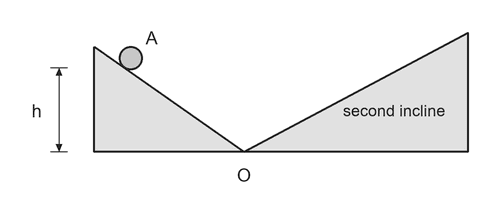
(a) How high does the ball rise on the second incline?
(b) What happens as the second incline is made less and less steep, and finally horizontal?
(c) What law of motion did Galileo conclude from this?
- 361 mark
Question 36
John Bardeen is the only person to have won the Nobel Prize in Physics twice. His two prizes were for
- 373 marks
Question 37
In a hydrogen atom the electron and the proton are about apart.
(a) Find the electric force and the gravitational force between them.
(b) How many times greater is the electric force than the gravitational force?
(c) Would this ratio change if the two particles were twice as far apart? Explain.
Take , , , and .
- 381 mark
Question 38
The electric force between two protons is about times the gravitational force between them. Yet the Moon is held in its orbit round the Earth by gravity and not by electric forces. The main reason is that
- 393 marks
Question 39
Inside a nucleus, two neighbouring protons may be only about apart.
(a) Find the electric force of repulsion between them.
(b) If this were the only force on one of the protons, what acceleration would it give that proton?
(c) Nuclei are stable. Which force holds them together, and why can it not be gravity?
Take , and .
- 402 marks
Question 40
A book lies at rest on a table. The table pushes the book upwards with a force (the normal force) equal to the book's weight.
(a) Which fundamental force is this normal force at the atomic level?
(b) Explain why it cannot be the gravitational attraction between the table and the book, nor the strong nuclear force.
- 412 marks
Question 41
(Hypothetical data.) Two students of masses and sit side by side with their centres about apart. Treating them as point masses, find the gravitational force between them and compare it with the weight of the student. Why do they not feel this attraction?
Take and .
- 421 mark
Question 42
Match each effect with the fundamental force mainly responsible for it, taking P, Q, R and S respectively.
P. The tension in a rope that is lifting a bucket
Q. The rise and fall of the ocean tides
R. Protons and neutrons being held together in a nucleus
S. A neutron in a nucleus changing into a proton in beta decay
- 433 marks
Question 43
A proton is made of two up quarks and one down quark (uud), and a neutron of one up quark and two down quarks (udd). An up quark carries a charge of and a down quark a charge of .
(a) Show that these quark charges give the correct charges of the proton and the neutron.
(b) Two other particles made of three quarks are uuu and ddd. Find the charge of each.
(c) Two neutrons in a nucleus attract each other. Explain why this attraction cannot be an electric force.
- 443 marks
Question 44
(Hypothetical data.) A tennis ball of mass is dropped from rest from a window above the ground. It reaches the ground at a speed of . Take .
(a) Find the loss of potential energy of the ball and its kinetic energy just before it reaches the ground.
(b) Is mechanical energy conserved in this fall? Where has the difference gone?
(c) Does this mean that the law of conservation of total energy has been broken? Explain.
- 453 marks
Question 45
A uranium-238 nucleus at rest gives out an alpha particle and becomes a thorium-234 nucleus. The alpha particle moves off at . Take the masses of the alpha particle and the thorium nucleus as and .
(a) Which conservation law fixes the motion of the thorium nucleus, and why does it apply here?
(b) Find the speed of the thorium nucleus and state its direction.
(c) The momenta of the two particles are equal in size. Why, then, is the speed of the thorium nucleus so much smaller?
- 461 mark
Question 46
Which of the following processes is forbidden by the law of conservation of charge?
- 473 marks
Question 47
A free neutron (n) changes into a proton (p) and an electron (). The electrons given out in beta decay come out with a whole range of energies. To explain this, Pauli suggested in 1930, two years before the neutron itself was discovered, that a third, almost undetectable particle is also given out in beta decay; it is now called the electron antineutrino ().
Use the numbers below to check each process against the laws of conservation of charge, baryon number and lepton number.
Charge (in units of ): p , n , , . Baryon number: p , n , , . Lepton number: p , n , , .
(a)
(b)
Which of the two can actually happen?
- 481 mark
Question 48
In a nuclear power reactor, the total mass of the products is less than the mass of the fuel used up by . Taking , the energy released is
- 493 marks
Question 49
When of carbon burns completely in of oxygen, of carbon dioxide is formed and about of heat is given out. Take .
(a) Using , find the mass that is lost when this heat escapes to the surroundings.
(b) A good laboratory balance can detect a change in mass of about . Could this loss of mass be detected?
(c) Hence explain why chemists can use the law of conservation of mass, although it is not an exact law.
- 502 marks
Question 50
(Hypothetical data.) A glass rod and a piece of silk cloth are both uncharged. After the rod is rubbed with the silk, the rod carries a charge of . Assume that no charge leaks away.
(a) What charge does the silk carry? Which law tells you this?
(b) How many electrons were transferred, and in which direction? Take .
- 512 marks
Question 51
“Politics is the art of the possible”. Similarly, ‘Science is the art of the soluble’. Explain this beautiful aphorism on the nature and practice of science.
- 523 marks
Question 52
Though India now has a large base in science and technology, which is fast expanding, it is still a long way from realising its potential of becoming a world leader in science. Name some important factors, which in your view, have hindered the advancement of science in India.
- 533 marks
Question 53
The industrial revolution in England and Western Europe more than two centuries ago was triggered by some key scientific and technological advances. What were these advances?
- 543 marks
Question 54
Attempt to formulate your ‘moral’ views on the practice of science. Imagine yourself stumbling upon a discovery, which has great academic interest but is certain to have nothing but dangerous consequences for the human society. How, if at all, will you resolve your dilemma?
- 553 marks
Question 55
Science, like any knowledge, can be put to good or bad use, depending on the user. Given below are some of the applications of science. Formulate your views on whether the particular application is good, bad or something that cannot be so clearly categorised.
(a) Mass vaccination against smallpox to curb and finally eradicate this disease from the population (this has already been successfully done in India)
(b) Television for eradication of illiteracy and for mass communication of news and ideas
(c) Prenatal sex determination
(d) Computers for increase in work efficiency
(e) Putting artificial satellites into orbits around the Earth
(f) Development of nuclear weapons
(g) Development of new and powerful techniques of chemical and biological warfare
(h) Purification of water for drinking
(i) Plastic surgery
(j) Cloning
- 563 marks
Question 56
India has had a long and unbroken tradition of great scholarship — in mathematics, astronomy, linguistics, logic and ethics. Yet, in parallel with this, several superstitious and obscurantistic attitudes and practices flourished in our society and unfortunately continue even today — among many educated people too. How will you use your knowledge of science to develop strategies to counter these attitudes?
- 572 marks
Question 57
“It is more important to have beauty in the equations of physics than to have them agree with experiments.” The great British physicist P.A.M. Dirac held this view. Criticize this statement. Though the statement quoted above may be disputed, most physicists do have a feeling that the great laws of physics are at once simple and beautiful. Some of the notable physicists, besides Dirac, who have articulated this feeling, are: Einstein, Bohr, Heisenberg, Chandrasekhar and Feynman. You are urged to make special efforts to get access to general books and writing by these and other great masters of physics. Their writings are truly inspiring!
- 582 marks
Question 58
Textbooks on science may give you a wrong impression that studying science is dry and all too serious and that scientists are absent-minded introverts who never laugh or grin. This image of science and scientists is patently false. Scientists, like any other group of humans, have their share of humourists and many have led their lives with a great sense of fun and adventure, even as they seriously pursued their scientific work. Two great physicists of this genre are Gamow and Feynman. You will enjoy reading their books.
- 592 marks
Question 59
“Every great physical theory starts as a heresy and ends as a dogma.” Give some examples from the history of science for the validity of the incisive remark.
- 602 marks
Question 60
No physicist has ever ‘seen’ an atom. Yet all physicists believe in the existence of atoms. An intelligent but superstitious man advances this analogy to argue that ‘ghosts’ exist even though no one has seen one. How will you refute his argument?
- 612 marks
Question 61
Some of the most profound statements on the nature of science have come from Albert Einstein, one of the greatest scientists of all time. What do you think did Einstein mean when he said, “The most incomprehensible thing about the world is that it is comprehensible”?
- 622 marks
Question 62
“It is more important to have beauty in the equations of physics than to have them agree with experiments.” The great British physicist P.A.M. Dirac held this view. Criticize this statement.
- 632 marks
Question 63
It is often said that the world is witnessing now a second industrial revolution, which will transform the society as radically as did the first. List some key contemporary areas of science and technology which are responsible for the revolution.