
Question 503 marksEasy
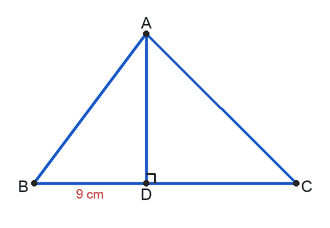
In triangle ABC, AD is perpendicular to BC. sin B = 0·8, BD = 9 cm and tan C = 1. Find the length of AB, AD, AC and DC.
Confirming your payment
Sign up now and get 250 free tokens.
Trigonometrical Ratios · Question 50 of 60
In triangle ABC, AD is perpendicular to BC. sin B = 0·8, BD = 9 cm and tan C = 1. Find the length of AB, AD, AC and DC.
Solution:
Concept: In a figure, first find every missing side with Pythagoras' theorem in the right triangles. Then, for each angle, use the right triangle that contains it: perpendicular = side opposite the angle, base = side next to it, hypotenuse = side opposite the right angle.
Given: AD ⊥ BC, sin B = 0·8, BD = 9 cm and tan C = 1.
Step 1 — Find cos B.
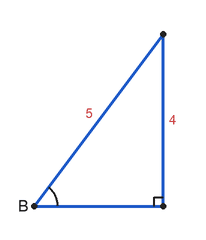
We write 0.8 as a fraction and draw a triangle with perpendicular 4 and hypotenuse 5; its base is 3.
Step 2 — Find AB.
In right triangle ADB, BD = 9 cm is the base for angle B. We write x for the length of AB in cm.
So AB = 15 cm.
Step 3 — Find AD.
AD is opposite angle B.
Step 4 — Find DC and AC.
In right triangle ADC, , and this is 1. So DC equals AD, which is 12 cm.
Watch out: A tangent of 1 means the two legs of triangle ADC are equal.
Therefore, AB = 15 cm, AD = 12 cm, AC = cm ≈ 16.97 cm and DC = 12 cm.