Confirming your payment

Skip to content

Sign up now and get .

Opening your dashboard

Class 9 Maths Chapter 22: Trigonometrical Ratios Solutions

60 textbook questions with step-by-step answers, free to read, for ICSE 2026-27.

AI Tutor

Get talked through Ch 22, not just shown the answer

Reading a finished solution is not the same as being able to do it. The AI tutor takes one question at a time and works it with you, in your own words, until you can.

  • Ask it out loud, in your own words
  • It gives you the next step, not the answer
  • Stuck on part (ii)? Start there
Ch 22 solutions

60 questions with solutions

1–3 marks · Mixed difficulty

The first 17 solutions are on this page. This chapter is a long one, so the rest open on their own page to keep this one quick to load.

  1. 1

    Question 1

    If sin⁡A=513\sin A = \dfrac{5}{13} the value of tan A is :

    MCQEasy
    1 mark
    Solve with AI
    Answer
    • (A) 512\dfrac{5}{12}

      Correct
    • (B) 1213\dfrac{12}{13}

    • (C) 125\dfrac{12}{5}

    • (D) 1312\dfrac{13}{12}

    Answer: (A) 512\dfrac{5}{12}

    Concept: When one ratio is given, draw a right triangle whose sides are in that ratio (a common multiple kk cancels in every ratio), find the third side by Pythagoras' theorem, and read off the other ratios. Recall: sin⁡=perpendicularhypotenuse\sin = \dfrac{\text{perpendicular}}{\text{hypotenuse}}, cos⁡=basehypotenuse\cos = \dfrac{\text{base}}{\text{hypotenuse}}, tan⁡=perpendicularbase\tan = \dfrac{\text{perpendicular}}{\text{base}}, and cosec⁡\operatorname{cosec}, sec⁡\sec, cot⁡\cot are their reciprocals.

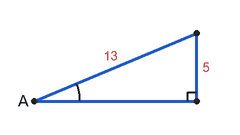
    Step 1 — Draw the triangle.

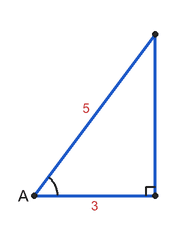
    Sine is perpendicular ÷ hypotenuse, and sin⁡A=513\sin A = \dfrac{5}{13}. So take a right triangle with perpendicular 5 and hypotenuse 13.
    Class 9 Maths Trigonometrical Ratios

    Step 2 — Find the base.

    We use Pythagoras' theorem for the missing side.

    base=132−52=169−25=144=12\begin{aligned} \text{base} &= \sqrt{13^2 - 5^2} \\ &= \sqrt{169 - 25} \\ &= \sqrt{144} \\ &= 12 \end{aligned}

    Step 3 — Find tan A.

    Now we divide the perpendicular by the base.

    tan⁡A=perpendicularbase=512\begin{aligned} \tan A &= \dfrac{\text{perpendicular}}{\text{base}} \\ &= \dfrac{5}{12} \end{aligned}

    Watch out: The tangent uses the base, not the hypotenuse.

    Why the other options are wrong:

    • (B) 1213\dfrac{12}{13}: 1213\dfrac{12}{13} is basehypotenuse\dfrac{\text{base}}{\text{hypotenuse}}, the ratio cos⁡A\cos A.
    • (C) 125\dfrac{12}{5}: 125\dfrac{12}{5} is baseperpendicular\dfrac{\text{base}}{\text{perpendicular}}, the ratio cot⁡A\cot A and the reciprocal of tan⁡A\tan A.
    • (D) 1312\dfrac{13}{12}: 1312\dfrac{13}{12} is hypotenusebase\dfrac{\text{hypotenuse}}{\text{base}}, the ratio sec⁡A\sec A.

    Therefore, tan⁡A=512\tan A = \dfrac{5}{12}, option (A).

  2. 2

    Question 2

    If tan⁡A=35\tan A = \dfrac{3}{5}, the value of sin⁡2A+cos⁡2A\sin^2 A + \cos^2 A is :

    MCQEasy
    1 mark
    Solve with AI
    Answer
    • (A) 925\dfrac{9}{25}

    • (B) 1

      Correct
    • (C) 916\dfrac{9}{16}

    • (D) 169\dfrac{16}{9}

    Answer: (B) 1

    Concept: For every angle A: sin⁡2A+cos⁡2A=1\sin^2 A + \cos^2 A = 1, sec⁡2A−tan⁡2A=1\sec^2 A - \tan^2 A = 1 and cosec⁡2A−cot⁡2A=1\operatorname{cosec}^2 A - \cot^2 A = 1.

    They come from Pythagoras' theorem p2+b2=h2p^2 + b^2 = h^2 divided by h2h^2, by b2b^2 or by p2p^2.

    Step 1 — Use the identity.

    The identity sin⁡2A+cos⁡2A=1\sin^2 A + \cos^2 A = 1 holds for every angle, so the value is 1 whatever tan⁡A\tan A is.

    Step 2 — Check with a triangle.

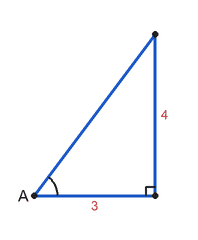
    Take perpendicular 3 and base 5, because tan⁡A=35\tan A = \dfrac{3}{5}. Pythagoras' theorem gives the hypotenuse.

    Class 9 Maths Trigonometrical Ratios

    hypotenuse=32+52=9+25=34\begin{aligned} \text{hypotenuse} &= \sqrt{3^2 + 5^2} \\ &= \sqrt{9 + 25} \\ &= \sqrt{34} \end{aligned}

    Step 3 — Add the squares.

    So sin⁡A=334\sin A = \dfrac{3}{\sqrt{34}} and cos⁡A=534\cos A = \dfrac{5}{\sqrt{34}}. We add their squares.

    sin⁡2A+cos⁡2A=934+2534=3434=1\begin{aligned} \sin^2 A + \cos^2 A &= \dfrac{9}{34} + \dfrac{25}{34} \\ &= \dfrac{34}{34} \\ &= 1 \end{aligned}

    Watch out: sin⁡2A\sin^2 A means (sin⁡A)2(\sin A)^2; the given tan⁡A\tan A is not needed for this identity.

    Why the other options are wrong:

    • (A) 925\dfrac{9}{25}: 925\dfrac{9}{25} is tan⁡2A\tan^2 A, not sin⁡2A+cos⁡2A\sin^2 A + \cos^2 A.
    • (C) 916\dfrac{9}{16}: 916\dfrac{9}{16} would be tan⁡2A\tan^2 A for a triangle with sides 3 and 4; here the sum is always 1.
    • (D) 169\dfrac{16}{9}: 169\dfrac{16}{9} does not come from this triangle; the sum of the two squares is always 1.

    Therefore, sin⁡2A+cos⁡2A=1\sin^2 A + \cos^2 A = 1, option (B).

  3. 3

    Question 3

    If cot⁡A=512\cot A = \dfrac{5}{12}, the value of cot⁡2A−cosec⁡2A\cot^2 A - \operatorname{cosec}^2 A is :

    MCQEasy
    1 mark
    Solve with AI
    Answer
    • (A) 1

    • (B) 2

    • (C) –2

    • (D) –1

      Correct

    Answer: (D) –1

    Concept: For every angle A: sin⁡2A+cos⁡2A=1\sin^2 A + \cos^2 A = 1, sec⁡2A−tan⁡2A=1\sec^2 A - \tan^2 A = 1 and cosec⁡2A−cot⁡2A=1\operatorname{cosec}^2 A - \cot^2 A = 1.

    They come from Pythagoras' theorem p2+b2=h2p^2 + b^2 = h^2 divided by h2h^2, by b2b^2 or by p2p^2.

    Step 1 — Draw the triangle.

    Cotangent is base ÷ perpendicular, and cot⁡A=512\cot A = \dfrac{5}{12}. So take base 5 and perpendicular 12.

    Class 9 Maths Trigonometrical Ratios

    hypotenuse=52+122=25+144=169=13\begin{aligned} \text{hypotenuse} &= \sqrt{5^2 + 12^2} \\ &= \sqrt{25 + 144} \\ &= \sqrt{169} \\ &= 13 \end{aligned}

    Step 2 — Write the two ratios.

    Cosecant is hypotenuse ÷ perpendicular, so cosec⁡A=1312\operatorname{cosec} A = \dfrac{13}{12}, while cot⁡A=512\cot A = \dfrac{5}{12}.

    Step 3 — Subtract the squares.

    We square each ratio and subtract.

    cot⁡2A−cosec⁡2A=25144−169144=−144144=−1\begin{aligned} \cot^2 A - \operatorname{cosec}^2 A &= \dfrac{25}{144} - \dfrac{169}{144} \\ &= -\dfrac{144}{144} \\ &= -1 \end{aligned}

    Watch out: The order matters: cosec⁡2A−cot⁡2A\operatorname{cosec}^2 A - \cot^2 A is 1, but cot⁡2A−cosec⁡2A\cot^2 A - \operatorname{cosec}^2 A is −1-1.

    Why the other options are wrong:

    • (A) 1: 1 is cosec⁡2A−cot⁡2A\operatorname{cosec}^2 A - \cot^2 A, the subtraction the other way round.
    • (B) 2: The identity gives −1-1 for every angle, so the value can never be 2.
    • (C) –2: The identity gives −1-1 for every angle, so the value can never be −2-2.

    Therefore, cot⁡2A−cosec⁡2A=−1\cot^2 A - \operatorname{cosec}^2 A = -1, option (D).

  4. 4

    Question 4

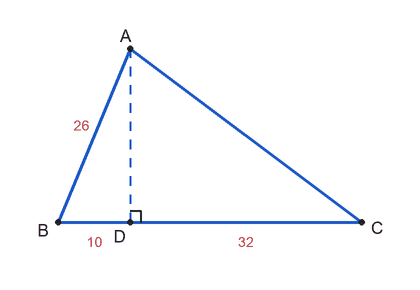
    In the given figure (each observation is in cm) tan C is :
    Class 9 Maths Trigonometrical Ratios

    MCQEasy
    1 mark
    Solve with AI
    Answer
    • (A) 35\dfrac{3}{5}

    • (B) 43\dfrac{4}{3}

    • (C) 34\dfrac{3}{4}

      Correct
    • (D) 45\dfrac{4}{5}

    Answer: (C) 34\dfrac{3}{4}

    Concept: In a figure, first find every missing side with Pythagoras' theorem in the right triangles. Then, for each angle, use the right triangle that contains it: perpendicular = side opposite the angle, base = side next to it, hypotenuse = side opposite the right angle.

    Step 1 — Find AD.

    In right triangle ADB, AB = 26 cm is the hypotenuse and BD = 10 cm, so Pythagoras' theorem gives AD.

    AD=262−102=676−100=576=24\begin{aligned} \text{AD} &= \sqrt{26^2 - 10^2} \\ &= \sqrt{676 - 100} \\ &= \sqrt{576} \\ &= 24 \end{aligned}

    Step 2 — Find tan C.

    In right triangle ADC, AD is opposite angle C and DC = 32 cm is next to it.

    tan⁡C=ADDC=2432=34\begin{aligned} \tan C &= \dfrac{\text{AD}}{\text{DC}} \\ &= \dfrac{24}{32} \\ &= \dfrac{3}{4} \end{aligned}

    Step 3 — Find AC for the other ratios.

    To test the other options we also need the hypotenuse AC of triangle ADC.

    AC=242+322=576+1024=1600=40\begin{aligned} \text{AC} &= \sqrt{24^2 + 32^2} \\ &= \sqrt{576 + 1024} \\ &= \sqrt{1600} \\ &= 40 \end{aligned}

    Watch out: The side AB (26 cm) is not in triangle ADC; find AD first and work only in triangle ADC.

    Why the other options are wrong:

    • (A) 35\dfrac{3}{5}: 2440\dfrac{24}{40} (in lowest terms 35\dfrac{3}{5}) is ADAC\dfrac{\text{AD}}{\text{AC}}, the ratio sin⁡C\sin C.
    • (B) 43\dfrac{4}{3}: 3224\dfrac{32}{24} (in lowest terms 43\dfrac{4}{3}) is DCAD\dfrac{\text{DC}}{\text{AD}}, the ratio cot⁡C\cot C.
    • (D) 45\dfrac{4}{5}: 3240\dfrac{32}{40} (in lowest terms 45\dfrac{4}{5}) is DCAC\dfrac{\text{DC}}{\text{AC}}, the ratio cos⁡C\cos C.

    Therefore, tan⁡C=34\tan C = \dfrac{3}{4}, option (C).

  5. 5

    Question 5

    If 5 cos A = 3, the value of sec⁡2A−tan⁡2A\sec^2 A - \tan^2 A is :

    MCQEasy
    1 mark
    Solve with AI
    Answer
    • (A) 1

      Correct
    • (B) –1

    • (C) 34\dfrac{3}{4}

    • (D) 43\dfrac{4}{3}

    Answer: (A) 1

    Concept: For every angle A: sin⁡2A+cos⁡2A=1\sin^2 A + \cos^2 A = 1, sec⁡2A−tan⁡2A=1\sec^2 A - \tan^2 A = 1 and cosec⁡2A−cot⁡2A=1\operatorname{cosec}^2 A - \cot^2 A = 1.

    They come from Pythagoras' theorem p2+b2=h2p^2 + b^2 = h^2 divided by h2h^2, by b2b^2 or by p2p^2.

    Step 1 — Find cos A.

    We divide both sides of 5cos⁡A=35\cos A = 3 by 5.

    cos⁡A=35\cos A = \dfrac{3}{5}

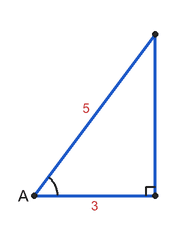
    So take base 3 and hypotenuse 5.

    Class 9 Maths Trigonometrical Ratios

    perpendicular=52−32=25−9=16=4\begin{aligned} \text{perpendicular} &= \sqrt{5^2 - 3^2} \\ &= \sqrt{25 - 9} \\ &= \sqrt{16} \\ &= 4 \end{aligned}

    Step 2 — Write sec A and tan A.

    We read both ratios from the triangle.

    sec⁡A=hypotenusebase=53\begin{aligned} \sec A &= \dfrac{\text{hypotenuse}}{\text{base}} \\ &= \dfrac{5}{3} \end{aligned} tan⁡A=perpendicularbase=43\begin{aligned} \tan A &= \dfrac{\text{perpendicular}}{\text{base}} \\ &= \dfrac{4}{3} \end{aligned}

    Step 3 — Subtract the squares.

    We square each ratio and subtract.

    sec⁡2A−tan⁡2A=259−169=99=1\begin{aligned} \sec^2 A - \tan^2 A &= \dfrac{25}{9} - \dfrac{16}{9} \\ &= \dfrac{9}{9} \\ &= 1 \end{aligned}

    Watch out: The order matters: sec⁡2A−tan⁡2A\sec^2 A - \tan^2 A is 1, but tan⁡2A−sec⁡2A\tan^2 A - \sec^2 A is −1-1.

    Why the other options are wrong:

    • (B) –1: −1-1 is tan⁡2A−sec⁡2A\tan^2 A - \sec^2 A, the subtraction the other way round.
    • (C) 34\dfrac{3}{4}: 34\dfrac{3}{4} is baseperpendicular\dfrac{\text{base}}{\text{perpendicular}}, the ratio cot⁡A\cot A.
    • (D) 43\dfrac{4}{3}: 43\dfrac{4}{3} is tan⁡A\tan A itself, not sec⁡2A−tan⁡2A\sec^2 A - \tan^2 A.

    Therefore, sec⁡2A−tan⁡2A=1\sec^2 A - \tan^2 A = 1, option (A).

  6. 6

    Question 6

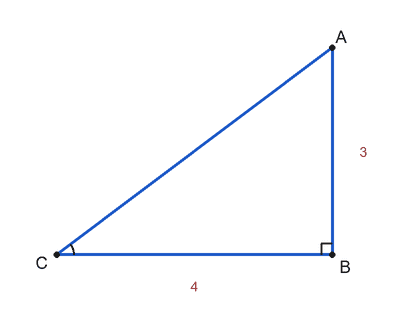
    From the following figure, find the values of :

    (i) sin A

    (ii) cos A

    (iii) cot A

    (iv) sec C

    (v) cosec C

    (vi) tan C.
    Class 9 Maths Trigonometrical Ratios

    Easy
    3 marks
    Solve with AI
    Written solution

    Solution:

    Concept: In a figure, first find every missing side with Pythagoras' theorem in the right triangles. Then, for each angle, use the right triangle that contains it: perpendicular = side opposite the angle, base = side next to it, hypotenuse = side opposite the right angle.

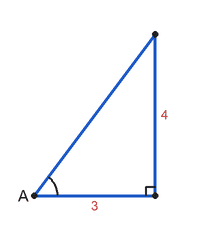
    Given: AB = 3, BC = 4 and ∠B = 90°.

    Step 1 — Find the hypotenuse.

    Triangle ABC has its right angle at B, with AB = 3 and BC = 4, so AC is the hypotenuse.

    AC=32+42=9+16=25=5\begin{aligned} \text{AC} &= \sqrt{3^2 + 4^2} \\ &= \sqrt{9 + 16} \\ &= \sqrt{25} \\ &= 5 \end{aligned}

    Step 2 — Name the sides for angle A.

    For angle A, the perpendicular is BC = 4 (opposite A) and the base is AB = 3.

    sin⁡A=BCAC=45\begin{aligned} \sin A &= \dfrac{\text{BC}}{\text{AC}} \\ &= \dfrac{4}{5} \end{aligned} cos⁡A=ABAC=35\begin{aligned} \cos A &= \dfrac{\text{AB}}{\text{AC}} \\ &= \dfrac{3}{5} \end{aligned} cot⁡A=ABBC=34\begin{aligned} \cot A &= \dfrac{\text{AB}}{\text{BC}} \\ &= \dfrac{3}{4} \end{aligned}

    Step 3 — Name the sides for angle C.

    For angle C, the perpendicular is AB = 3 (opposite C) and the base is BC = 4.

    sec⁡C=ACBC=54\begin{aligned} \sec C &= \dfrac{\text{AC}}{\text{BC}} \\ &= \dfrac{5}{4} \end{aligned} cosec⁡C=ACAB=53\begin{aligned} \operatorname{cosec} C &= \dfrac{\text{AC}}{\text{AB}} \\ &= \dfrac{5}{3} \end{aligned} tan⁡C=ABBC=34\begin{aligned} \tan C &= \dfrac{\text{AB}}{\text{BC}} \\ &= \dfrac{3}{4} \end{aligned}

    Watch out: The perpendicular and the base change places when you move from angle A to angle C.

    Therefore, (i) sin⁡A=45\sin A = \dfrac{4}{5}, (ii) cos⁡A=35\cos A = \dfrac{3}{5}, (iii) cot⁡A=34\cot A = \dfrac{3}{4}, (iv) sec⁡C=54\sec C = \dfrac{5}{4}, (v) cosec⁡C=53\operatorname{cosec} C = \dfrac{5}{3}, (vi) tan⁡C=34\tan C = \dfrac{3}{4}.

  7. 7

    Question 7

    From the following figure, find the values of :

    (i) cos B

    (ii) tan C

    (iii) sin⁡2B+cos⁡2B\sin^2 B + \cos^2 B

    (iv) sin B.cos C + cos B.sin C

    Class 9 Maths Trigonometrical Ratios

    Easy
    3 marks
    Solve with AI
    Written solution

    Solution:

    Concept: In a figure, first find every missing side with Pythagoras' theorem in the right triangles. Then, for each angle, use the right triangle that contains it: perpendicular = side opposite the angle, base = side next to it, hypotenuse = side opposite the right angle.

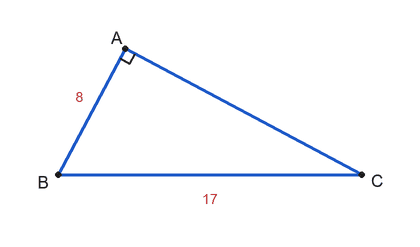
    Given: ∠A = 90°, AB = 8 and BC = 17.

    Step 1 — Find AC.

    The right angle is at A, so BC = 17 is the hypotenuse and AB = 8.

    AC=172−82=289−64=225=15\begin{aligned} \text{AC} &= \sqrt{17^2 - 8^2} \\ &= \sqrt{289 - 64} \\ &= \sqrt{225} \\ &= 15 \end{aligned}

    Step 2 — Part (i).

    For angle B, the base is AB and the hypotenuse is BC.

    cos⁡B=ABBC=817\begin{aligned} \cos B &= \dfrac{\text{AB}}{\text{BC}} \\ &= \dfrac{8}{17} \end{aligned}

    Step 3 — Part (ii).

    For angle C, the perpendicular is AB and the base is AC.

    tan⁡C=ABAC=815\begin{aligned} \tan C &= \dfrac{\text{AB}}{\text{AC}} \\ &= \dfrac{8}{15} \end{aligned}

    Step 4 — Part (iii).

    For angle B the perpendicular is AC, so we find sin B and then add the squares of sin B and cos B.

    sin⁡B=ACBC=1517\begin{aligned} \sin B &= \dfrac{\text{AC}}{\text{BC}} \\ &= \dfrac{15}{17} \end{aligned} sin⁡2B+cos⁡2B=225289+64289=289289=1\begin{aligned} \sin^2 B + \cos^2 B &= \dfrac{225}{289} + \dfrac{64}{289} \\ &= \dfrac{289}{289} \\ &= 1 \end{aligned}

    Step 5 — Part (iv).

    For angle C the base is AC and the perpendicular is AB. We find cos C and sin C, then substitute all four ratios.

    cos⁡C=ACBC=1517\begin{aligned} \cos C &= \dfrac{\text{AC}}{\text{BC}} \\ &= \dfrac{15}{17} \end{aligned} sin⁡C=ABBC=817\begin{aligned} \sin C &= \dfrac{\text{AB}}{\text{BC}} \\ &= \dfrac{8}{17} \end{aligned} sin⁡Bcos⁡C+cos⁡Bsin⁡C=1517×1517+817×817=225289+64289=1\begin{aligned} \sin B \cos C + \cos B \sin C &= \dfrac{15}{17} \times \dfrac{15}{17} + \dfrac{8}{17} \times \dfrac{8}{17} \\ &= \dfrac{225}{289} + \dfrac{64}{289} \\ &= 1 \end{aligned}

    Watch out: BC is the hypotenuse here, because it is opposite the right angle at A.

    Therefore, (i) cos⁡B=817\cos B = \dfrac{8}{17}, (ii) tan⁡C=815\tan C = \dfrac{8}{15}, (iii) 1, (iv) 1.

  8. 8

    Question 8

    From the following figure, find the values of :

    (i) cos A

    (ii) cosec A

    (iii) tan⁡2A−sec⁡2A\tan^2 A - \sec^2 A

    (iv) sin C

    (v) sec C

    (vi) cot⁡2C−1sin⁡2C\cot^2 C - \dfrac{1}{\sin^2 C}

    Class 9 Maths Trigonometrical Ratios

    Easy
    3 marks
    Solve with AI
    Written solution

    Solution:

    Concept: In a figure, first find every missing side with Pythagoras' theorem in the right triangles. Then, for each angle, use the right triangle that contains it: perpendicular = side opposite the angle, base = side next to it, hypotenuse = side opposite the right angle.

    Given: BD ⊥ AC, AD = 3, BD = 4 and BC = 12.

    Step 1 — Find AB and DC.

    BD is perpendicular to AC, so triangles ADB and CDB are right-angled at D. In triangle ADB, AD = 3 and BD = 4.

    AB=32+42=9+16=25=5\begin{aligned} \text{AB} &= \sqrt{3^2 + 4^2} \\ &= \sqrt{9 + 16} \\ &= \sqrt{25} \\ &= 5 \end{aligned}

    In triangle CDB, BC = 12 is the hypotenuse and BD = 4.

    DC=122−42=144−16=128=82\begin{aligned} \text{DC} &= \sqrt{12^2 - 4^2} \\ &= \sqrt{144 - 16} \\ &= \sqrt{128} \\ &= 8 \sqrt{2} \end{aligned}

    Step 2 — Parts (i) and (ii).

    For angle A in triangle ADB, the perpendicular is BD = 4, the base is AD = 3 and the hypotenuse is AB = 5.

    cos⁡A=ADAB=35\begin{aligned} \cos A &= \dfrac{\text{AD}}{\text{AB}} \\ &= \dfrac{3}{5} \end{aligned} cosec⁡A=ABBD=54\begin{aligned} \operatorname{cosec} A &= \dfrac{\text{AB}}{\text{BD}} \\ &= \dfrac{5}{4} \end{aligned}

    Step 3 — Part (iii).

    Here tan⁡A=43\tan A = \dfrac{4}{3} and sec⁡A=53\sec A = \dfrac{5}{3}. We subtract the squares.

    tan⁡2A−sec⁡2A=169−259=−99=−1\begin{aligned} \tan^2 A - \sec^2 A &= \dfrac{16}{9} - \dfrac{25}{9} \\ &= -\dfrac{9}{9} \\ &= -1 \end{aligned}

    Step 4 — Parts (iv) and (v).

    For angle C in triangle CDB, the perpendicular is BD = 4, the base is DC =82= 8\sqrt{2} and the hypotenuse is BC = 12.

    sin⁡C=BDBC=412=13\begin{aligned} \sin C &= \dfrac{\text{BD}}{\text{BC}} \\ &= \dfrac{4}{12} \\ &= \dfrac{1}{3} \end{aligned} sec⁡C=BCDC=1282=322=324\begin{aligned} \sec C &= \dfrac{\text{BC}}{\text{DC}} \\ &= \dfrac{12}{8\sqrt{2}} \\ &= \dfrac{3}{2\sqrt{2}} \\ &= \dfrac{3\sqrt{2}}{4} \end{aligned}

    Step 5 — Part (vi).

    Since 1sin⁡C=cosec⁡C\dfrac{1}{\sin C} = \operatorname{cosec} C, the expression is cot⁡2C−cosec⁡2C\cot^2 C - \operatorname{cosec}^2 C. We find both ratios in triangle CDB.

    cot⁡C=DCBD=824=22\begin{aligned} \cot C &= \dfrac{\text{DC}}{\text{BD}} \\ &= \dfrac{8\sqrt{2}}{4} \\ &= 2\sqrt{2} \end{aligned} cosec⁡C=BCBD=124=3\begin{aligned} \operatorname{cosec} C &= \dfrac{\text{BC}}{\text{BD}} \\ &= \dfrac{12}{4} \\ &= 3 \end{aligned} cot⁡2C−1sin⁡2C=(22)2−32=8−9=−1\begin{aligned} \cot^2 C - \dfrac{1}{\sin^2 C} &= \left(2\sqrt{2}\right)^2 - 3^2 \\ &= 8 - 9 \\ &= -1 \end{aligned}

    Watch out: Use triangle ADB for angle A and triangle CDB for angle C; BC is not a side of triangle ADB.

    Therefore, (i) cos⁡A=35\cos A = \dfrac{3}{5}, (ii) cosec⁡A=54\operatorname{cosec} A = \dfrac{5}{4}, (iii) −1-1, (iv) sin⁡C=13\sin C = \dfrac{1}{3}, (v) sec⁡C=324\sec C = \dfrac{3\sqrt{2}}{4}, (vi) −1-1.

  9. 9

    Question 9

    From the following figure, find the values of :

    (i) sin B

    (ii) tan C

    (iii) sec⁡2B−tan⁡2B\sec^2 B - \tan^2 B

    (iv) sin⁡2C+cos⁡2C\sin^2 C + \cos^2 C

    Class 9 Maths Trigonometrical Ratios

    Easy
    3 marks
    Solve with AI
    Written solution

    Solution:

    Concept: In a figure, first find every missing side with Pythagoras' theorem in the right triangles. Then, for each angle, use the right triangle that contains it: perpendicular = side opposite the angle, base = side next to it, hypotenuse = side opposite the right angle.

    Given: AD ⊥ BC, AB = 13, BD = 5 and DC = 16.

    Step 1 — Find AD and AC.

    AD is perpendicular to BC. In right triangle ADB, AB = 13 and BD = 5.

    AD=132−52=169−25=144=12\begin{aligned} \text{AD} &= \sqrt{13^2 - 5^2} \\ &= \sqrt{169 - 25} \\ &= \sqrt{144} \\ &= 12 \end{aligned}

    In right triangle ADC, AD = 12 and DC = 16.

    AC=122+162=144+256=400=20\begin{aligned} \text{AC} &= \sqrt{12^2 + 16^2} \\ &= \sqrt{144 + 256} \\ &= \sqrt{400} \\ &= 20 \end{aligned}

    Step 2 — Parts (i) and (ii).

    Angle B lies in triangle ADB and angle C in triangle ADC; AD is opposite both of them.

    sin⁡B=ADAB=1213\begin{aligned} \sin B &= \dfrac{\text{AD}}{\text{AB}} \\ &= \dfrac{12}{13} \end{aligned} tan⁡C=ADDC=1216=34\begin{aligned} \tan C &= \dfrac{\text{AD}}{\text{DC}} \\ &= \dfrac{12}{16} \\ &= \dfrac{3}{4} \end{aligned}

    Step 3 — Part (iii).

    We find sec B and tan B in triangle ADB.

    sec⁡B=ABBD=135\begin{aligned} \sec B &= \dfrac{\text{AB}}{\text{BD}} \\ &= \dfrac{13}{5} \end{aligned} tan⁡B=ADBD=125\begin{aligned} \tan B &= \dfrac{\text{AD}}{\text{BD}} \\ &= \dfrac{12}{5} \end{aligned} sec⁡2B−tan⁡2B=16925−14425=2525=1\begin{aligned} \sec^2 B - \tan^2 B &= \dfrac{169}{25} - \dfrac{144}{25} \\ &= \dfrac{25}{25} \\ &= 1 \end{aligned}

    Step 4 — Part (iv).

    We find sin C and cos C in triangle ADC.

    sin⁡C=ADAC=1220=35\begin{aligned} \sin C &= \dfrac{\text{AD}}{\text{AC}} \\ &= \dfrac{12}{20} \\ &= \dfrac{3}{5} \end{aligned} cos⁡C=DCAC=1620=45\begin{aligned} \cos C &= \dfrac{\text{DC}}{\text{AC}} \\ &= \dfrac{16}{20} \\ &= \dfrac{4}{5} \end{aligned} sin⁡2C+cos⁡2C=925+1625=2525=1\begin{aligned} \sin^2 C + \cos^2 C &= \dfrac{9}{25} + \dfrac{16}{25} \\ &= \dfrac{25}{25} \\ &= 1 \end{aligned}

    Watch out: AB is not in triangle ADC, so find AC before using angle C.

    Therefore, (i) sin⁡B=1213\sin B = \dfrac{12}{13}, (ii) tan⁡C=34\tan C = \dfrac{3}{4}, (iii) 1, (iv) 1.

  10. 10

    Question 10

    Given : sin⁡A=35\sin A = \dfrac{3}{5}, find :

    (i) tan A

    (ii) cos A

    Easy
    3 marks
    Solve with AI
    Written solution

    Solution:

    Concept: When one ratio is given, draw a right triangle whose sides are in that ratio (a common multiple kk cancels in every ratio), find the third side by Pythagoras' theorem, and read off the other ratios. Recall: sin⁡=perpendicularhypotenuse\sin = \dfrac{\text{perpendicular}}{\text{hypotenuse}}, cos⁡=basehypotenuse\cos = \dfrac{\text{base}}{\text{hypotenuse}}, tan⁡=perpendicularbase\tan = \dfrac{\text{perpendicular}}{\text{base}}, and cosec⁡\operatorname{cosec}, sec⁡\sec, cot⁡\cot are their reciprocals.

    Given: sin⁡A=35\sin A = \dfrac{3}{5}.

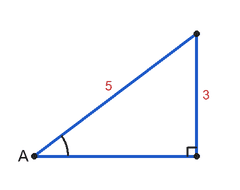
    Step 1 — Draw the triangle.

    Since sin⁡A=35\sin A = \dfrac{3}{5}, take perpendicular 3 and hypotenuse 5, and find the base.
    Class 9 Maths Trigonometrical Ratios

    base=52−32=25−9=16=4\begin{aligned} \text{base} &= \sqrt{5^2 - 3^2} \\ &= \sqrt{25 - 9} \\ &= \sqrt{16} \\ &= 4 \end{aligned}

    Step 2 — Part (i).

    We divide the perpendicular by the base.

    tan⁡A=perpendicularbase=34\begin{aligned} \tan A &= \dfrac{\text{perpendicular}}{\text{base}} \\ &= \dfrac{3}{4} \end{aligned}

    Step 3 — Part (ii).

    We divide the base by the hypotenuse.

    cos⁡A=basehypotenuse=45\begin{aligned} \cos A &= \dfrac{\text{base}}{\text{hypotenuse}} \\ &= \dfrac{4}{5} \end{aligned}

    Watch out: The base is the side next to the angle that is not the hypotenuse; mixing up base and perpendicular swaps sin with cos and tan with cot.

    Therefore, (i) tan⁡A=34\tan A = \dfrac{3}{4}, (ii) cos⁡A=45\cos A = \dfrac{4}{5}.

  11. 11

    Question 11

    From the following figure, find the values of :

    (i) sin A

    (ii) sec A

    (iii) cos⁡2A+sin⁡2A\cos^2 A + \sin^2 A

    Class 9 Maths Trigonometrical Ratios

    Easy
    3 marks
    Solve with AI
    Written solution

    Solution:

    Concept: In a figure, first find every missing side with Pythagoras' theorem in the right triangles. Then, for each angle, use the right triangle that contains it: perpendicular = side opposite the angle, base = side next to it, hypotenuse = side opposite the right angle.

    Given: ∠B = 90°, AB = a and BC = a.

    Step 1 — Find the hypotenuse.

    The right angle is at B and both AB and BC are a, so AC is the hypotenuse.

    AC=a2+a2=2a2=a2\begin{aligned} \text{AC} &= \sqrt{a^2 + a^2} \\ &= \sqrt{2a^2} \\ &= a\sqrt{2} \end{aligned}

    Step 2 — Part (i).

    For angle A, the perpendicular is BC = a.

    sin⁡A=BCAC=aa2=12=22\begin{aligned} \sin A &= \dfrac{\text{BC}}{\text{AC}} \\ &= \dfrac{a}{a\sqrt{2}} \\ &= \dfrac{1}{\sqrt{2}} \\ &= \dfrac{\sqrt{2}}{2} \end{aligned}

    Step 3 — Part (ii).

    For angle A, the base is AB = a.

    sec⁡A=ACAB=a2a=2\begin{aligned} \sec A &= \dfrac{\text{AC}}{\text{AB}} \\ &= \dfrac{a\sqrt{2}}{a} \\ &= \sqrt{2} \end{aligned}

    Step 4 — Part (iii).

    The base AB is also a, so cos⁡A\cos A has the same value as sin⁡A\sin A, and both squares are 12\dfrac{1}{2}.

    cos⁡A=ABAC=aa2=12\begin{aligned} \cos A &= \dfrac{\text{AB}}{\text{AC}} \\ &= \dfrac{a}{a\sqrt{2}} \\ &= \dfrac{1}{\sqrt{2}} \end{aligned} cos⁡2A+sin⁡2A=12+12=1\begin{aligned} \cos^2 A + \sin^2 A &= \dfrac{1}{2} + \dfrac{1}{2} \\ &= 1 \end{aligned}

    Watch out: aa cancels in every ratio, so the answers do not depend on the length aa.

    Therefore, (i) sin⁡A=12\sin A = \dfrac{1}{\sqrt{2}}, (ii) sec⁡A=2\sec A = \sqrt{2}, (iii) 1.

  12. 12

    Question 12

    Given : cos⁡A=513\cos A = \dfrac{5}{13}

    evaluate : (i) sin⁡A−cot⁡A2tan⁡A\dfrac{\sin A - \cot A}{2\tan A} (ii) cot⁡A+1cos⁡A\cot A + \dfrac{1}{\cos A}

    Easy
    3 marks
    Solve with AI
    Written solution

    Solution:

    Concept: When one ratio is given, draw a right triangle whose sides are in that ratio (a common multiple kk cancels in every ratio), find the third side by Pythagoras' theorem, and read off the other ratios. Recall: sin⁡=perpendicularhypotenuse\sin = \dfrac{\text{perpendicular}}{\text{hypotenuse}}, cos⁡=basehypotenuse\cos = \dfrac{\text{base}}{\text{hypotenuse}}, tan⁡=perpendicularbase\tan = \dfrac{\text{perpendicular}}{\text{base}}, and cosec⁡\operatorname{cosec}, sec⁡\sec, cot⁡\cot are their reciprocals.

    Given: cos⁡A=513\cos A = \dfrac{5}{13}.

    Step 1 — Draw the triangle.

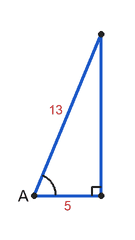
    Since cos⁡A=513\cos A = \dfrac{5}{13}, take base 5 and hypotenuse 13.

    Class 9 Maths Trigonometrical Ratios

    perpendicular=132−52=169−25=144=12\begin{aligned} \text{perpendicular} &= \sqrt{13^2 - 5^2} \\ &= \sqrt{169 - 25} \\ &= \sqrt{144} \\ &= 12 \end{aligned}

    So sin⁡A=1213\sin A = \dfrac{12}{13}, tan⁡A=125\tan A = \dfrac{12}{5} and cot⁡A=512\cot A = \dfrac{5}{12}.

    Step 2 — Part (i): the numerator.

    We subtract the two fractions over the common denominator 156.

    sin⁡A−cot⁡A=1213−512=144−65156=79156\begin{aligned} \sin A - \cot A &= \dfrac{12}{13} - \dfrac{5}{12} \\ &= \dfrac{144 - 65}{156} \\ &= \dfrac{79}{156} \end{aligned}

    Step 3 — Part (i): divide.

    The denominator is 2tan⁡A=2452\tan A = \dfrac{24}{5}, and dividing by it means multiplying by 524\dfrac{5}{24}.

    sin⁡A−cot⁡A2tan⁡A=79156×524=3953744\begin{aligned} \dfrac{\sin A - \cot A}{2\tan A} &= \dfrac{79}{156} \times \dfrac{5}{24} \\ &= \dfrac{395}{3744} \end{aligned}

    Step 4 — Part (ii).

    Here 1cos⁡A=135\dfrac{1}{\cos A} = \dfrac{13}{5}. We add over the common denominator 60.

    cot⁡A+1cos⁡A=512+135=25+15660=18160\begin{aligned} \cot A + \dfrac{1}{\cos A} &= \dfrac{5}{12} + \dfrac{13}{5} \\ &= \dfrac{25 + 156}{60} \\ &= \dfrac{181}{60} \end{aligned}

    Watch out: 1cos⁡A\dfrac{1}{\cos A} is sec⁡A=135\sec A = \dfrac{13}{5}; do not add 1 to the denominator.

    Therefore, (i) 3953744\dfrac{395}{3744}, (ii) 18160=3160\dfrac{181}{60} = 3\dfrac{1}{60}.

  13. 13

    Question 13

    Given : sec⁡A=2921\sec A = \dfrac{29}{21}, evaluate : sin⁡A−1tan⁡A\sin A - \dfrac{1}{\tan A}

    Easy
    3 marks
    Solve with AI
    Written solution

    Solution:

    Concept: When one ratio is given, draw a right triangle whose sides are in that ratio (a common multiple kk cancels in every ratio), find the third side by Pythagoras' theorem, and read off the other ratios. Recall: sin⁡=perpendicularhypotenuse\sin = \dfrac{\text{perpendicular}}{\text{hypotenuse}}, cos⁡=basehypotenuse\cos = \dfrac{\text{base}}{\text{hypotenuse}}, tan⁡=perpendicularbase\tan = \dfrac{\text{perpendicular}}{\text{base}}, and cosec⁡\operatorname{cosec}, sec⁡\sec, cot⁡\cot are their reciprocals.

    Given: sec⁡A=2921\sec A = \dfrac{29}{21}.

    Step 1 — Draw the triangle.

    Secant is hypotenuse ÷ base, and sec⁡A=2921\sec A = \dfrac{29}{21}. So take hypotenuse 29 and base 21.

    Class 9 Maths Trigonometrical Ratios

    perpendicular=292−212=841−441=400=20\begin{aligned} \text{perpendicular} &= \sqrt{29^2 - 21^2} \\ &= \sqrt{841 - 441} \\ &= \sqrt{400} \\ &= 20 \end{aligned}

    Step 2 — Write the ratios.

    So sin⁡A=2029\sin A = \dfrac{20}{29} and tan⁡A=2021\tan A = \dfrac{20}{21}. Turning tan⁡A\tan A upside down, 1tan⁡A=2120\dfrac{1}{\tan A} = \dfrac{21}{20}.

    Step 3 — Subtract.

    The common denominator of 29 and 20 is 580.

    sin⁡A−1tan⁡A=2029−2120=400−609580=−209580\begin{aligned} \sin A - \dfrac{1}{\tan A} &= \dfrac{20}{29} - \dfrac{21}{20} \\ &= \dfrac{400 - 609}{580} \\ &= -\dfrac{209}{580} \end{aligned}

    Watch out: 1tan⁡A\dfrac{1}{\tan A} is cot⁡A=2120\cot A = \dfrac{21}{20}; the answer is negative because cot⁡A>1>sin⁡A\cot A > 1 > \sin A here.

    Therefore, sin⁡A−1tan⁡A=−209580\sin A - \dfrac{1}{\tan A} = -\dfrac{209}{580}.

  14. 14

    Question 14

    Given : tan⁡A=43\tan A = \dfrac{4}{3}, find : cosec⁡Acot⁡A−sec⁡A\dfrac{\operatorname{cosec} A}{\cot A - \sec A}

    Easy
    3 marks
    Solve with AI
    Written solution

    Solution:

    Concept: When one ratio is given, draw a right triangle whose sides are in that ratio (a common multiple kk cancels in every ratio), find the third side by Pythagoras' theorem, and read off the other ratios. Recall: sin⁡=perpendicularhypotenuse\sin = \dfrac{\text{perpendicular}}{\text{hypotenuse}}, cos⁡=basehypotenuse\cos = \dfrac{\text{base}}{\text{hypotenuse}}, tan⁡=perpendicularbase\tan = \dfrac{\text{perpendicular}}{\text{base}}, and cosec⁡\operatorname{cosec}, sec⁡\sec, cot⁡\cot are their reciprocals.

    Given: tan⁡A=43\tan A = \dfrac{4}{3}.

    Step 1 — Draw the triangle.

    Since tan⁡A=43\tan A = \dfrac{4}{3}, take perpendicular 4 and base 3.

    Class 9 Maths Trigonometrical Ratios

    hypotenuse=42+32=16+9=25=5\begin{aligned} \text{hypotenuse} &= \sqrt{4^2 + 3^2} \\ &= \sqrt{16 + 9} \\ &= \sqrt{25} \\ &= 5 \end{aligned}

    So cosec⁡A=54\operatorname{cosec} A = \dfrac{5}{4}, cot⁡A=34\cot A = \dfrac{3}{4} and sec⁡A=53\sec A = \dfrac{5}{3}.

    Step 2 — Work out the denominator.

    We subtract over the common denominator 12.

    cot⁡A−sec⁡A=34−53=9−2012=−1112\begin{aligned} \cot A - \sec A &= \dfrac{3}{4} - \dfrac{5}{3} \\ &= \dfrac{9 - 20}{12} \\ &= -\dfrac{11}{12} \end{aligned}

    Step 3 — Divide.

    Dividing by −1112-\dfrac{11}{12} means multiplying by −1211-\dfrac{12}{11}.

    cosec⁡Acot⁡A−sec⁡A=54×(−1211)=−1511\begin{aligned} \dfrac{\operatorname{cosec} A}{\cot A - \sec A} &= \dfrac{5}{4} \times \left(-\dfrac{12}{11}\right) \\ &= -\dfrac{15}{11} \end{aligned}

    Watch out: Keep the minus sign of the denominator; it makes the answer negative.

    Therefore, cosec⁡Acot⁡A−sec⁡A=−1511\dfrac{\operatorname{cosec} A}{\cot A - \sec A} = -\dfrac{15}{11}, or −1411-1\dfrac{4}{11} as a mixed number.

  15. 15

    Question 15

    Given : 4 cot A = 3, find :

    (i) sin A

    (ii) sec A

    (iii) cosec⁡2A−cot⁡2A\operatorname{cosec}^2 A - \cot^2 A.

    Easy
    3 marks
    Solve with AI
    Written solution

    Solution:

    Concept: When one ratio is given, draw a right triangle whose sides are in that ratio (a common multiple kk cancels in every ratio), find the third side by Pythagoras' theorem, and read off the other ratios. Recall: sin⁡=perpendicularhypotenuse\sin = \dfrac{\text{perpendicular}}{\text{hypotenuse}}, cos⁡=basehypotenuse\cos = \dfrac{\text{base}}{\text{hypotenuse}}, tan⁡=perpendicularbase\tan = \dfrac{\text{perpendicular}}{\text{base}}, and cosec⁡\operatorname{cosec}, sec⁡\sec, cot⁡\cot are their reciprocals.

    Given: 4cot⁡A=34\cot A = 3.

    Step 1 — Draw the triangle.

    We divide both sides of 4cot⁡A=34\cot A = 3 by 4.

    cot⁡A=34\cot A = \dfrac{3}{4}

    So take base 3 and perpendicular 4.

    Class 9 Maths Trigonometrical Ratios

    hypotenuse=32+42=9+16=25=5\begin{aligned} \text{hypotenuse} &= \sqrt{3^2 + 4^2} \\ &= \sqrt{9 + 16} \\ &= \sqrt{25} \\ &= 5 \end{aligned}

    Step 2 — Parts (i) and (ii).

    We read the ratios from the triangle.

    sin⁡A=perpendicularhypotenuse=45\begin{aligned} \sin A &= \dfrac{\text{perpendicular}}{\text{hypotenuse}} \\ &= \dfrac{4}{5} \end{aligned} sec⁡A=hypotenusebase=53\begin{aligned} \sec A &= \dfrac{\text{hypotenuse}}{\text{base}} \\ &= \dfrac{5}{3} \end{aligned}

    Step 3 — Part (iii).

    Here cosec⁡A=54\operatorname{cosec} A = \dfrac{5}{4} and cot⁡A=34\cot A = \dfrac{3}{4}.

    cosec⁡2A−cot⁡2A=2516−916=1616=1\begin{aligned} \operatorname{cosec}^2 A - \cot^2 A &= \dfrac{25}{16} - \dfrac{9}{16} \\ &= \dfrac{16}{16} \\ &= 1 \end{aligned}

    Watch out: The base is the side next to the angle that is not the hypotenuse; mixing up base and perpendicular swaps sin with cos and tan with cot.

    Therefore, (i) sin⁡A=45\sin A = \dfrac{4}{5}, (ii) sec⁡A=53\sec A = \dfrac{5}{3} (or 1231\dfrac{2}{3}), (iii) 1.

  16. 16

    Question 16

    Given : cos A = 0.6; find all other trigonometrical ratios for angle A.

    Easy
    3 marks
    Solve with AI
    Written solution

    Solution:

    Concept: When one ratio is given, draw a right triangle whose sides are in that ratio (a common multiple kk cancels in every ratio), find the third side by Pythagoras' theorem, and read off the other ratios. Recall: sin⁡=perpendicularhypotenuse\sin = \dfrac{\text{perpendicular}}{\text{hypotenuse}}, cos⁡=basehypotenuse\cos = \dfrac{\text{base}}{\text{hypotenuse}}, tan⁡=perpendicularbase\tan = \dfrac{\text{perpendicular}}{\text{base}}, and cosec⁡\operatorname{cosec}, sec⁡\sec, cot⁡\cot are their reciprocals.

    Given: cos⁡A=0.6\cos A = 0.6.

    Step 1 — Draw the triangle.

    We first write the decimal as a fraction in its lowest terms.

    cos⁡A=0.6=610=35\begin{aligned} \cos A &= 0.6 \\ &= \dfrac{6}{10} \\ &= \dfrac{3}{5} \end{aligned}

    So take base 3 and hypotenuse 5.

    Class 9 Maths Trigonometrical Ratios

    perpendicular=52−32=25−9=16=4\begin{aligned} \text{perpendicular} &= \sqrt{5^2 - 3^2} \\ &= \sqrt{25 - 9} \\ &= \sqrt{16} \\ &= 4 \end{aligned}

    Step 2 — Write the five other ratios.

    We read each ratio from the triangle with perpendicular 4, base 3 and hypotenuse 5.

    sin⁡A=perpendicularhypotenuse=45\begin{aligned} \sin A &= \dfrac{\text{perpendicular}}{\text{hypotenuse}} \\ &= \dfrac{4}{5} \end{aligned} tan⁡A=perpendicularbase=43\begin{aligned} \tan A &= \dfrac{\text{perpendicular}}{\text{base}} \\ &= \dfrac{4}{3} \end{aligned} cot⁡A=baseperpendicular=34\begin{aligned} \cot A &= \dfrac{\text{base}}{\text{perpendicular}} \\ &= \dfrac{3}{4} \end{aligned} sec⁡A=hypotenusebase=53\begin{aligned} \sec A &= \dfrac{\text{hypotenuse}}{\text{base}} \\ &= \dfrac{5}{3} \end{aligned} cosec⁡A=hypotenuseperpendicular=54\begin{aligned} \operatorname{cosec} A &= \dfrac{\text{hypotenuse}}{\text{perpendicular}} \\ &= \dfrac{5}{4} \end{aligned}

    Watch out: Change the decimal to a fraction in its lowest terms first.

    Therefore, sin⁡A=45\sin A = \dfrac{4}{5}, tan⁡A=43\tan A = \dfrac{4}{3}, cot⁡A=34\cot A = \dfrac{3}{4}, sec⁡A=53\sec A = \dfrac{5}{3} and cosec⁡A=54\operatorname{cosec} A = \dfrac{5}{4}.

  17. 17

    Question 17

    In a right-angled triangle, it is given that A is an acute angle and tan⁡A=512\tan A = \dfrac{5}{12}.

    Find the values of :

    (i) cos A (ii) sin A (iii) cos⁡A+sin⁡Acos⁡A−sin⁡A\dfrac{\cos A + \sin A}{\cos A - \sin A}

    Easy
    3 marks
    Solve with AI
    Written solution

    Solution:

    Concept: When one ratio is given, draw a right triangle whose sides are in that ratio (a common multiple kk cancels in every ratio), find the third side by Pythagoras' theorem, and read off the other ratios. Recall: sin⁡=perpendicularhypotenuse\sin = \dfrac{\text{perpendicular}}{\text{hypotenuse}}, cos⁡=basehypotenuse\cos = \dfrac{\text{base}}{\text{hypotenuse}}, tan⁡=perpendicularbase\tan = \dfrac{\text{perpendicular}}{\text{base}}, and cosec⁡\operatorname{cosec}, sec⁡\sec, cot⁡\cot are their reciprocals.

    Given: A is acute and tan⁡A=512\tan A = \dfrac{5}{12}.

    Step 1 — Draw the triangle.

    Since tan⁡A=512\tan A = \dfrac{5}{12}, take perpendicular 5 and base 12.

    Class 9 Maths Trigonometrical Ratios

    hypotenuse=52+122=25+144=169=13\begin{aligned} \text{hypotenuse} &= \sqrt{5^2 + 12^2} \\ &= \sqrt{25 + 144} \\ &= \sqrt{169} \\ &= 13 \end{aligned}

    Step 2 — Parts (i) and (ii).

    We read the two ratios from the triangle.

    cos⁡A=basehypotenuse=1213\begin{aligned} \cos A &= \dfrac{\text{base}}{\text{hypotenuse}} \\ &= \dfrac{12}{13} \end{aligned} sin⁡A=perpendicularhypotenuse=513\begin{aligned} \sin A &= \dfrac{\text{perpendicular}}{\text{hypotenuse}} \\ &= \dfrac{5}{13} \end{aligned}

    Step 3 — Part (iii).

    We put both values in; the common denominator 13 cancels.

    cos⁡A+sin⁡Acos⁡A−sin⁡A=1213+5131213−513=1713713=177\begin{aligned} \dfrac{\cos A + \sin A}{\cos A - \sin A} &= \dfrac{\frac{12}{13} + \frac{5}{13}}{\frac{12}{13} - \frac{5}{13}} \\ &= \dfrac{\frac{17}{13}}{\frac{7}{13}} \\ &= \dfrac{17}{7} \end{aligned}

    Watch out: The base is the side next to the angle that is not the hypotenuse; mixing up base and perpendicular swaps sin with cos and tan with cot.

    Therefore, (i) cos⁡A=1213\cos A = \dfrac{12}{13}, (ii) sin⁡A=513\sin A = \dfrac{5}{13}, (iii) 177=237\dfrac{17}{7} = 2\dfrac{3}{7}.

  18. 18

    Question 18

    Given : sin⁡θ=pq\sin \theta = \dfrac{p}{q},

    find cos θ + sin θ in terms of p and q.

    Easy
    3 marks
  19. 19

    Question 19

    If cos⁡A=12\cos A = \dfrac{1}{2} and sin⁡B=12\sin B = \dfrac{1}{\sqrt{2}}, find the value of : tan⁡A−tan⁡B1+tan⁡Atan⁡B\dfrac{\tan A - \tan B}{1 + \tan A \tan B}. Here angles A and B are from different right triangles.

    Easy
    3 marks
  20. 20

    Question 20

    If cos⁡A=12\cos A = \dfrac{1}{\sqrt{2}} and sin⁡B=32\sin B = \dfrac{\sqrt{3}}{2}, the value of tan⁡B−tan⁡A1+tan⁡Atan⁡B\dfrac{\tan B - \tan A}{1 + \tan A \tan B} is :

    MCQEasy
    1 mark
  21. 21

    Question 21

    From the given figure, the value of cos y is :

    Class 9 Maths Trigonometrical Ratios

    MCQEasy
    1 mark
  22. 22

    Question 22

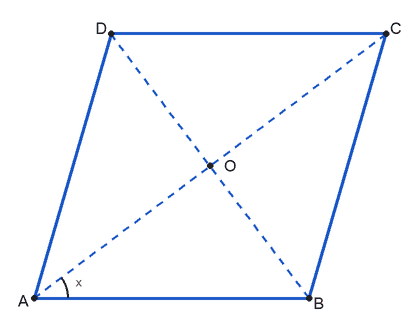
    ABCD is a rhombus with diagonals BD and AC equal to 12 cm and 16 cm respectively. The value of cosec x is :
    Class 9 Maths Trigonometrical Ratios

    MCQEasy
    1 mark
  23. 23

    Question 23

    If sin⁡A−cosec⁡A=2\sin A - \operatorname{cosec} A = 2, the value of sin⁡2A+cosec⁡2A\sin^2 A + \operatorname{cosec}^2 A is :

    MCQEasy
    1 mark
  24. 24

    Question 24

    If cot⁡A=5\cot A = \sqrt{5}, the value of cosec⁡2A−sec⁡2A\operatorname{cosec}^2 A - \sec^2 A is :

    MCQEasy
    1 mark
  25. 25

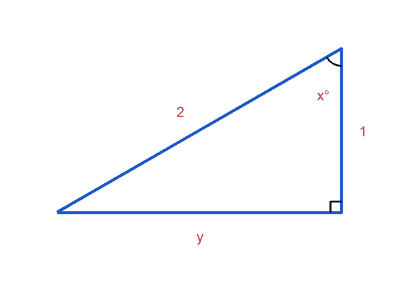
    Question 25

    From the following figure, find :

    (i) y

    (ii) sin x°

    (iii) (sec x° – tan x°) (sec x° + tan x°)
    Class 9 Maths Trigonometrical Ratios

    Easy
    3 marks
  26. 26

    Question 26

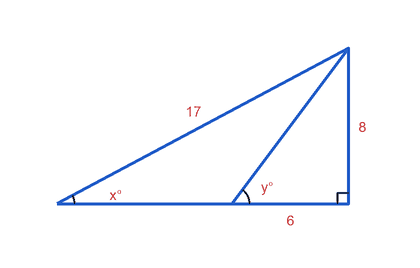
    Use the given figure to find :

    (i) sin x°

    (ii) cos y°

    (iii) 3 tan x° – 2 sin y° + 4 cos y°.
    Class 9 Maths Trigonometrical Ratios

    Easy
    3 marks
  27. 27

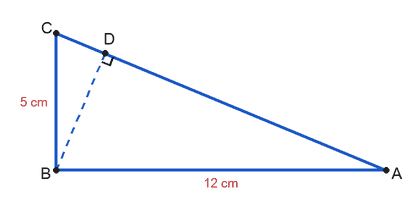
    Question 27

    In the diagram, given below, triangle ABC is right-angled at B and BD is perpendicular to AC. Find :

    (i) cos ∠DBC

    (ii) cot ∠DBA
    Class 9 Maths Trigonometrical Ratios

    Easy
    3 marks
  28. 28

    Question 28

    In the given figure, triangle ABC is right-angled at B. D is the foot of the perpendicular from B to AC. Given that BC = 3 cm and AB = 4 cm. Find :

    (i) tan ∠DBC

    (ii) sin ∠DBA
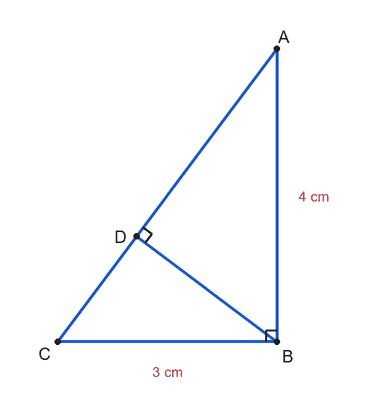
    Class 9 Maths Trigonometrical Ratios

    Easy
    3 marks
  29. 29

    Question 29

    In triangle ABC, AB = AC = 15 cm and BC = 18 cm, find cos ∠ABC.

    Class 9 Maths Trigonometrical Ratios

    Easy
    3 marks
  30. 30

    Question 30

    In the figure, given below, ABC is an isosceles triangle with BC = 8 cm and AB = AC = 5 cm. Find :

    (i) sin B (ii) tan C

    (iii) sin⁡2B+cos⁡2B\sin^2 B + \cos^2 B

    (iv) tan C – cot B

    Class 9 Maths Trigonometrical Ratios

    Easy
    3 marks
  31. 31

    Question 31

    In triangle ABC; ∠ABC = 90°, ∠CAB = x°, tan⁡x°=34\tan x° = \dfrac{3}{4} and BC = 15 cm. Find the measures of AB and AC.

    Class 9 Maths Trigonometrical Ratios

    Easy
    3 marks
  32. 32

    Question 32

    Using the measurements given in the following figure :

    (i) Find the value of sin ϕ and tan θ.

    (ii) Write an expression for AD in terms of θ.
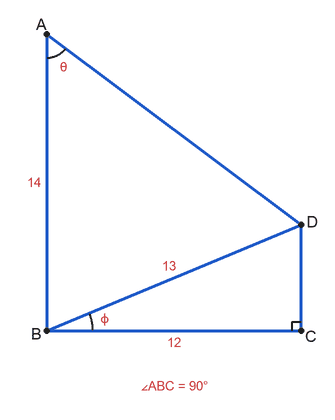
    Class 9 Maths Trigonometrical Ratios

    Medium
    3 marks
  33. 33

    Question 33

    In the given figure; BC = 15 cm and sin⁡B=45\sin B = \dfrac{4}{5}.

    (i) Calculate the measures of AB and AC.

    (ii) Now, if tan ∠ADC = 1; calculate the measures of CD and AD.

    Class 9 Maths Trigonometrical Ratios

    Also, show that : tan⁡2B−1cos⁡2B=−1\tan^2 B - \dfrac{1}{\cos^2 B} = -1.

    Easy
    3 marks
  34. 34

    Question 34

    If sin⁡A+cosec⁡A=2\sin A + \operatorname{cosec} A = 2;

    find the value of sin⁡2A+cosec⁡2A\sin^2 A + \operatorname{cosec}^2 A.

    Easy
    3 marks
  35. 35

    Question 35

    If tan⁡A+cot⁡A=5\tan A + \cot A = 5;

    find the value of tan⁡2A+cot⁡2A\tan^2 A + \cot^2 A.

    Easy
    3 marks
  36. 36

    Question 36

    Given : 4 sin θ = 3 cos θ; find the value of :

    (i) sin θ (ii) cos θ

    (iii) cot⁡2θ−cosec⁡2θ\cot^2 \theta - \operatorname{cosec}^2 \theta.

    (iv) 4cos⁡2θ−3sin⁡2θ+24\cos^2 \theta - 3\sin^2 \theta + 2

    Easy
    3 marks
  37. 37

    Question 37

    Given : 17 cos θ = 15;

    find the value of tan θ + 2 sec θ.

    Easy
    3 marks
  38. 38

    Question 38

    Given: 5 cos A – 12 sin A = 0; evaluate :

    sin⁡A+cos⁡A2cos⁡A−sin⁡A\dfrac{\sin A + \cos A}{2\cos A - \sin A}

    Easy
    3 marks
  39. 39

    Question 39

    If 5 cot θ = 12, find the value of :

    cosec⁡θ+sec⁡θ\operatorname{cosec} \theta + \sec \theta

    Easy
    3 marks
  40. 40

    Question 40

    If tan⁡x=113\tan x = 1\dfrac{1}{3}, find the value of :

    4sin⁡2x−3cos⁡2x+24\sin^2 x - 3\cos^2 x + 2

    Easy
    3 marks
  41. 41

    Question 41

    If cosec⁡θ=5\operatorname{cosec} \theta = \sqrt{5}, find the value of :

    (i) 2−sin⁡2θ−cos⁡2θ2 - \sin^2 \theta - \cos^2 \theta

    (ii) 2+1sin⁡2θ−cos⁡2θsin⁡2θ2 + \dfrac{1}{\sin^2 \theta} - \dfrac{\cos^2 \theta}{\sin^2 \theta}

    Easy
    3 marks
  42. 42

    Question 42

    If sec⁡A=2\sec A = \sqrt{2}, find the value of :

    3cos⁡2A+5tan⁡2A4tan⁡2A−sin⁡2A\dfrac{3\cos^2 A + 5\tan^2 A}{4\tan^2 A - \sin^2 A}

    Easy
    3 marks
  43. 43

    Question 43

    If cot θ = 1; find the value of :

    5tan⁡2θ+2sin⁡2θ−35\tan^2 \theta + 2\sin^2 \theta - 3

    Easy
    3 marks
  44. 44

    Question 44

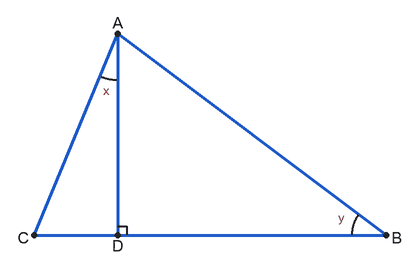
    In the following figure :

    AD ⊥ BC, AC = 26, CD = 10, BC = 42, ∠DAC = x and ∠B = y.

    Find the value of :

    (i) cot x

    (ii) 1sin⁡2y−1tan⁡2y\dfrac{1}{\sin^2 y} - \dfrac{1}{\tan^2 y}

    (iii) 6cos⁡x−5cos⁡y+8tan⁡y\dfrac{6}{\cos x} - \dfrac{5}{\cos y} + 8\tan y.

    Class 9 Maths Trigonometrical Ratios

    Medium
    3 marks
  45. 45

    Question 45

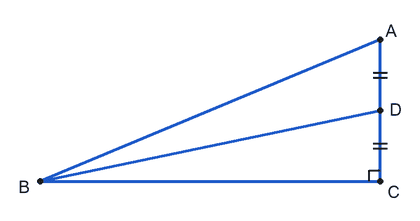
    In the given figure; ∠C = 90° and D is mid-point of AC. Find :

    (i) tan⁡∠CABtan⁡∠CDB\dfrac{\tan \angle CAB}{\tan \angle CDB}

    (ii) tan⁡∠ABCtan⁡∠DBC\dfrac{\tan \angle ABC}{\tan \angle DBC}

    Class 9 Maths Trigonometrical Ratios

    Easy
    3 marks
  46. 46

    Question 46

    If 3 cos A = 4 sin A, find the value of :

    (i) cos A (ii) 3−cot⁡2A+cosec⁡2A3 - \cot^2 A + \operatorname{cosec}^2 A

    Easy
    3 marks
  47. 47

    Question 47

    In triangle ABC, ∠B = 90° and tan A = 0·75. If AC = 30 cm, find the lengths of AB and BC.
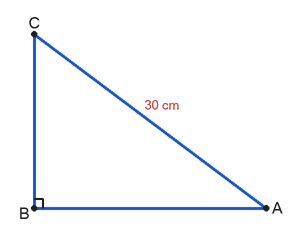
    Class 9 Maths Trigonometrical Ratios

    Easy
    3 marks
  48. 48

    Question 48

    In rhombus ABCD, diagonals AC and BD intersect each other at point O.
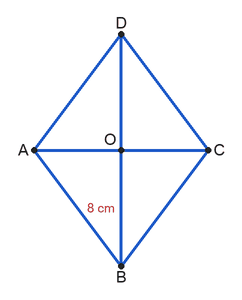
    Class 9 Maths Trigonometrical Ratios

    If cosine of angle CAB is 0·6 and OB = 8 cm, find the lengths of the side and the diagonals of the rhombus.

    Easy
    3 marks
  49. 49

    Question 49

    In triangle ABC, AB = AC = 15 cm and BC = 18 cm.

    Class 9 Maths Trigonometrical Ratios

    Find :

    (i) cos B (ii) sin C

    (iii) tan⁡2B−sec⁡2B+2\tan^2 B - \sec^2 B + 2

    Easy
    3 marks
  50. 50

    Question 50

    In triangle ABC, AD is perpendicular to BC. sin B = 0·8, BD = 9 cm and tan C = 1. Find the length of AB, AD, AC and DC.
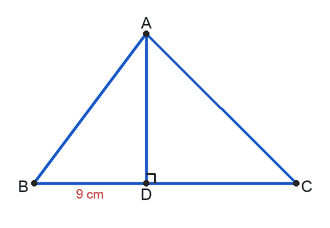
    Class 9 Maths Trigonometrical Ratios

    Easy
    3 marks
  51. 51

    Question 51

    Given : q tan A = p, find the value of :

    psin⁡A−qcos⁡Apsin⁡A+qcos⁡A\dfrac{p\sin A - q\cos A}{p\sin A + q\cos A}.

    Easy
    3 marks
  52. 52

    Question 52

    If sin A = cos A, find the value of

    2tan⁡2A−2sec⁡2A+52\tan^2 A - 2\sec^2 A + 5.

    Easy
    3 marks
  53. 53

    Question 53

    In rectangle ABCD, diagonal BD = 26 cm and cotangent of angle ABD = 1·5. Find the area and the perimeter of the rectangle ABCD.
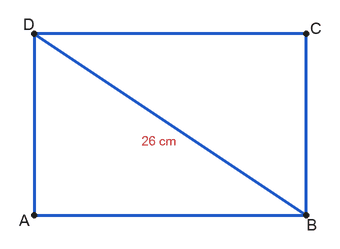
    Class 9 Maths Trigonometrical Ratios

    Medium
    3 marks
  54. 54

    Question 54

    If 2 sin x = √3 , evaluate.

    (i) 4sin⁡3x−3sin⁡x4\sin^3 x - 3\sin x.

    (ii) 3cos⁡x−4cos⁡3x3\cos x - 4\cos^3 x.

    Easy
    3 marks
  55. 55

    Question 55

    If sin⁡A=32\sin A = \dfrac{\sqrt{3}}{2} and cos⁡B=32\cos B = \dfrac{\sqrt{3}}{2}, find the value of : tan⁡A−tan⁡B1+tan⁡Atan⁡B\dfrac{\tan A - \tan B}{1 + \tan A \tan B}.

    Easy
    3 marks
  56. 56

    Question 56

    If sec⁡A=2\sec A = \sqrt{2}, find : 3cot⁡2A+2sin⁡2Atan⁡2A−cos⁡2A\dfrac{3\cot^2 A + 2\sin^2 A}{\tan^2 A - \cos^2 A}.

    Easy
    3 marks
  57. 57

    Question 57

    If 5 cos θ = 3, evaluate : cosec⁡θ−cot⁡θcosec⁡θ+cot⁡θ\dfrac{\operatorname{cosec} \theta - \cot \theta}{\operatorname{cosec} \theta + \cot \theta}.

    Easy
    3 marks
  58. 58

    Question 58

    If cosec⁡A+sin⁡A=515\operatorname{cosec} A + \sin A = 5\dfrac{1}{5}, find the value of cosec⁡2A+sin⁡2A\operatorname{cosec}^2 A + \sin^2 A.

    Easy
    3 marks
  59. 59

    Question 59

    If 5 cos θ = 6 sin θ; evaluate :

    (i) tan θ (ii) 12sin⁡θ−3cos⁡θ12sin⁡θ+3cos⁡θ\dfrac{12\sin \theta - 3\cos \theta}{12\sin \theta + 3\cos \theta}

    Easy
    3 marks
  60. 60

    Question 60

    Use the informations given in the following figure to evaluate : 10sin⁡x+6sin⁡y−6cot⁡y\dfrac{10}{\sin x} + \dfrac{6}{\sin y} - 6\cot y.

    Class 9 Maths Trigonometrical Ratios

    Easy
    3 marks
Inside Ch 22

What Class 9 Maths Ch 22 covers

The sections of the chapter, in the order the book takes them. Every question above comes from one of these.

  1. 01Perpendicular, Base and Hypotenuse in a Right Triangle
  2. 02Notation of Angles
  3. 03Trigonometrical Ratios
  4. 04Reciprocal Relations
Common questions

Class 9 Maths Ch 22 questions students ask

How many questions are there in Class 9 Maths Ch 22?

60 questions. Every one is solved step by step on this page.

Are these Class 9 Maths solutions free?

Yes. Every question and its full working is free to read, with no account needed.

Can I download the Class 9 Maths Ch 22 solutions as a PDF?

There is no PDF to download. Every solution is on this page instead, which means it is searchable, always the current syllabus, and readable on a phone. Use your browser's print option if you want it on paper.