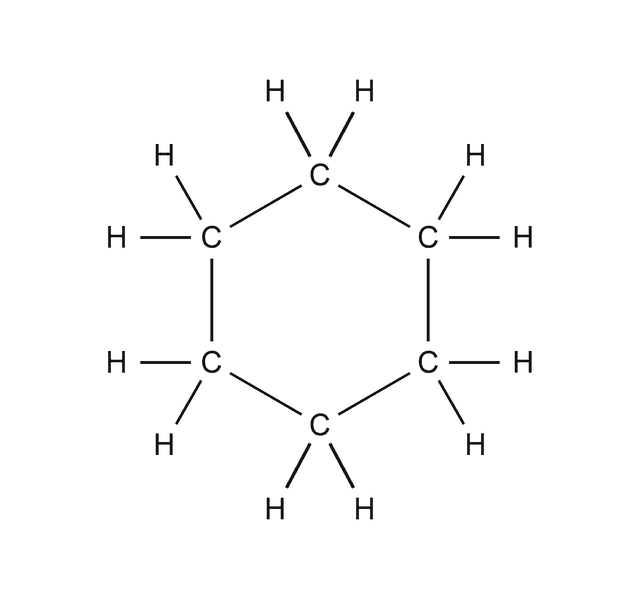
Solution:
Concept: From a structural formula we count the atoms to get the molecular formula, reduce it to the simplest ratio for the empirical formula, and then find each element's share of the molecular mass. The percentage of an element in a compound is its mass in one molecule (formula unit) divided by the molecular mass, multiplied by 100.
Step 1 — (a) Count the atoms.
The figure shows a ring of 6 carbon atoms, and each carbon carries 2 hydrogen atoms, so there are 6 carbon atoms and 6 × 2 = 12 hydrogen atoms (this compound is cyclohexane).
Step 2 — (b) Molecular formula.
Writing the atom counts as subscripts gives the molecular formula C6H12.
Step 3 — (b) Empirical formula.
The HCF of 6 and 12 is 6, so we divide both subscripts by 6.
C : H=6:12=1:2
So the empirical formula is CH2.
Step 4 — (c) Molecular mass.
We add the masses of 6 carbon and 12 hydrogen atoms (C = 12, H = 1).
Molecular mass=6×12+12×1=72+12=84 u
Step 5 — (c) Percentage of each element.
Carbon contributes 72 and hydrogen 12 of the 84 units of mass.
% of C=8472×100≈85.71%
% of H=8412×100≈14.29%
As a check, 85.71 + 14.29 = 100.
Watch out: The percentage uses the mass of the element (6 × 12 = 72 for carbon), not the number of atoms.
Therefore, (a) 6 C and 12 H atoms; (b) molecular formula C₆H₁₂, empirical formula CH₂; (c) C = 85.71% and H = 14.29%.