Solution:
Concept: These blanks test the meaning of symbols, formulae and radicals, and reading valencies from formulae (the total valency of one element equals the total valency of the other).
Step 1 — (a) Dalton's symbols.
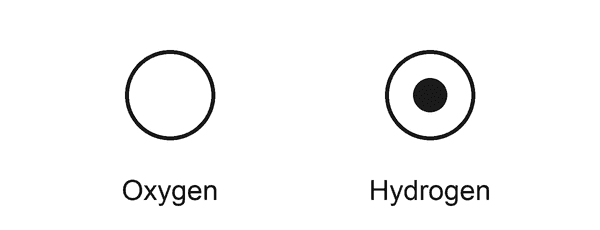
Dalton drew each element as a circle: oxygen as a plain circle and hydrogen as a circle with a dot at its centre.
Step 2 — (b) and (c) Symbol and formula.
A symbol represents one atom of an element, and the symbolic expression for a molecule is called a (molecular) formula.
Step 3 — (d) Radicals in sodium chloride.
Sodium, Na+, is the positive part, so it is a basic radical; chloride, Cl−, is the negative part, so it is an acidic radical.
Step 4 — (e) Valency of phosphorus.
Each chlorine has valency 1, so the valency of phosphorus equals the number of chlorine atoms: 3 in PCl3 and 5 in PCl5.
Step 5 — (f) Valency of iron.
In the same way, iron has valency 2 in FeCl2 and 3 in FeCl3.
Step 6 — (g) Iron (III) carbonate.
Iron (III) is Fe3+ and carbonate is CO32−. Criss-crossing 3 and 2 gives Fe2(CO3)3.
Note: Fe₂(CO₃)₃ is the formula the criss-cross method gives; the compound itself is not stable and is not met in the laboratory.
Therefore, (a) plain circle, circle with a central dot; (b) one; (c) formula; (d) basic, acidic; (e) 3, 5; (f) 2, 3; (g) Fe₂(CO₃)₃.
