
Opening your dashboard
Class 8 Physics Chapter 8: Electricity Solutions
155 textbook questions with step-by-step answers, free to read, for ICSE 2026-27.
Get talked through Ch 8, not just shown the answer
Reading a finished solution is not the same as being able to do it. The AI tutor takes one question at a time and works it with you, in your own words, until you can.
- Ask it out loud, in your own words
- It gives you the next step, not the answer
- Stuck on part (ii)? Start there
155 questions with solutions
1–4 marks · Mixed difficulty
- 11 mark
Question 1
All wires used in electric circuits should be covered with :
Solve with AIAnswer
(A) colouring material
(B) conducting material
- Correct
(C) an insulating material
(D) none of the above.
Answer: (C) an insulating material
Concept: Metals such as copper conduct electricity; plastics and rubber are insulators, which do not let current pass.
Step 1 — See why a covering is needed.
The copper inside a wire carries the current. If it were bare, current could pass into anyone who touched it, and two bare wires touching each other would cause a short circuit.
Step 2 — Choose the material.
So every wire is covered with an insulating material such as plastic (PVC) or rubber, which does not let current through.
Watch out: The colour of the covering only tells us which wire it is; it is the insulating property that protects us.
Why the other options are wrong:
- (A) colouring material: Colour is only used to identify the wires (live, neutral, earth); colour alone gives no protection.
- (B) conducting material: A conducting covering would let current pass to anyone touching the wire, which is dangerous.
- (D) none of the above: Option (C) is correct, so 'none of the above' is wrong.
Therefore, all wires should be covered with an insulating material, option (C).
- 21 mark
Question 2
Electrical work done per unit time is :
Solve with AIAnswer
(A) electrical energy
(B) electric current
(C) electric voltage
- Correct
(D) electrical power.
Answer: (D) electrical power
Concept: Electrical power is the electrical work done (energy supplied) per unit time: . For a source of potential difference sending current , . Its unit is the watt (W), and 1 kW is 1000 W.
Step 1 — Recall the meaning of power.
Power is the rate of doing work, that is, work done in unit time.
Step 2 — Apply it to electricity.
So electrical work done per unit time is electrical power, measured in watt.
Watch out: Energy is the total work done; power is how fast it is done.
Why the other options are wrong:
- (A) electrical energy: Electrical energy is the total work done, not the work done per unit time.
- (B) electric current: Electric current is the rate of flow of charge, not of work.
- (C) electric voltage: Voltage (potential difference) is the work done in moving a unit charge, not the work done per unit time.
Therefore, electrical work done per unit time is electrical power, option (D).
- 31 mark
Question 3
One kilowatt is equal to :
Solve with AIAnswer
(A) 100 watt
- Correct
(B) 1000 watt
(C) 10 watt
(D) none of these.
Answer: (B) 1000 watt
Concept: The prefix kilo means one thousand (for example, 1 km is 1000 m).
Step 1 — Use the meaning of kilo.
Since kilo means one thousand, one kilowatt is one thousand watt.
Step 2 — Write the result.
So 1 kW is 1000 W.
Why the other options are wrong:
- (A) 100 watt: 100 W is only one-tenth of a kilowatt.
- (C) 10 watt: 10 W is only one-hundredth of a kilowatt.
- (D) none of these: Option (B) is correct, so 'none of these' is wrong.
Therefore, one kilowatt is equal to 1000 watt, option (B).
- 41 mark
Question 4
Fuse wire is an alloy of :
Solve with AIAnswer
- Correct
(A) tin-lead
(B) copper-lead
(C) tin-copper
(D) lead-silver.
Answer: (A) tin-lead
Concept: A fuse is a safety device: a short, thin wire of low melting point (an alloy of tin and lead) connected in series in the live wire. When too large a current flows, it heats up and melts, breaking the circuit before the wiring or appliances are damaged.
Step 1 — Recall what a fuse wire must do.
A fuse wire must melt quickly when the current becomes too large, so its material needs a low melting point.
Step 2 — Name the alloy.
An alloy of tin and lead (about half of each) melts at only about 200 °C, much lower than copper, so it is used for fuse wire.
Why the other options are wrong:
- (B) copper-lead: Copper melts at about 1085 °C, so a copper-lead alloy is not the standard fuse material.
- (C) tin-copper: Tin-copper (bronze) melts at a high temperature, so it would not melt in time.
- (D) lead-silver: Lead-silver is not the alloy used for fuse wire.
Therefore, fuse wire is an alloy of tin and lead, option (A).
- 51 mark
Question 5
A fuse wire should have :
Solve with AIAnswer
- Correct
(A) a low melting point
(B) high melting point
(C) very high melting point
(D) none of the above.
Answer: (A) a low melting point
Concept: A fuse is a safety device: a short, thin wire of low melting point (an alloy of tin and lead) connected in series in the live wire. When too large a current flows, it heats up and melts, breaking the circuit before the wiring or appliances are damaged.
Step 1 — Recall how a fuse works.
A fuse breaks the circuit by melting as soon as the current exceeds its safe limit.
Step 2 — Decide the property.
To melt quickly, the fuse wire must have a low melting point.
Why the other options are wrong:
- (B) high melting point: A wire with a high melting point would not melt when excess current flows, so it would not protect the circuit.
- (C) very high melting point: A very high melting point is even worse: the wiring would burn before the fuse melted.
- (D) none of the above: Option (A) is correct, so 'none of the above' is wrong.
Therefore, a fuse wire should have a low melting point, option (A).
- 61 mark
Question 6
When switch of an electric appliance is put off, it disconnects :
Solve with AIAnswer
- Correct
(A) the live wire
(B) the neutral wire
(C) the earth wire
(D) the live and the neutral wires.
Answer: (A) the live wire
Concept: A switch is always put in the live wire, so that when it is off the appliance is cut off from the high voltage and is safe to touch.
Step 1 — Recall where the switch is.
The switch of an appliance is connected in the live wire.
Step 2 — See what switching off does.
Putting the switch off breaks the live wire, so the appliance is no longer connected to the high voltage and is safe.
Why the other options are wrong:
- (B) the neutral wire: The switch is not put in the neutral wire; if it were, the appliance would stay connected to the live wire even when switched off, which is dangerous.
- (C) the earth wire: The earth wire is never switched; it must always stay connected for safety.
- (D) the live and the neutral wires: An appliance switch breaks only the live wire. (The main switch of the house is the one that breaks both live and neutral.)
Therefore, putting off the switch disconnects the live wire, option (A).
- 71 mark
Question 7
The purpose of an electric meter in a house is :
Solve with AIAnswer
(A) to give the cost of electricity directly
- Correct
(B) to give the consumption of electrical energy
(C) to safeguard the circuit from electrical short circuit
(D) to put on or off the mains.
Answer: (B) to give the consumption of electrical energy
Concept: Electricity is generated at a power station and reaches our homes through transmission lines, sub-stations and the electric (kWh) meter, which records the energy we use. We pay for electrical energy, measured in the commercial unit kilowatt hour (kWh), also called one unit. 1 kWh is the energy used by a 1 kW appliance in 1 hour. In joule, 1 kWh comes to J.
Step 1 — Recall what the meter records.
The electric meter (kWh meter) measures the electrical energy consumed in the house, in kilowatt hour (units).
Step 2 — See how it is used.
The bill is worked out from the number of units the meter records, multiplied by the rate per unit.
Why the other options are wrong:
- (A) to give the cost directly: The meter shows units of energy, not rupees; the cost is found by multiplying the units by the rate.
- (C) to safeguard against short circuit: Protection from a short circuit is given by the fuse or MCB, not by the meter.
- (D) to put the mains on or off: The mains is put on or off by the main switch, not by the meter.
Therefore, the purpose of an electric meter is to give the consumption of electrical energy, option (B).
- 81 mark
Question 8
If out of the two lighted bulbs in a room, one bulb suddenly fuses, then :
Solve with AIAnswer
(A) the other bulb will glow more
(B) the other bulb will glow less
(C) the other bulb will also fuse
- Correct
(D) the other bulb will remain lighted and unaffected.
Answer: (D) the other bulb will remain lighted and unaffected
Concept: In a house, every appliance is connected in parallel across the live and neutral wires of the mains. Each one then gets the full supply voltage, has its own path for current and can be switched on or off without affecting the others.
Step 1 — Recall how room bulbs are connected.
The bulbs in a room are connected in parallel across the mains, each on its own branch.
Step 2 — See what a fused bulb does.
When one bulb fuses, only its own branch is broken. The other bulb still has the full supply voltage across it, so it keeps glowing exactly as before.
Watch out: The other bulb would go off only in a series circuit, which is not used in houses.
Why the other options are wrong:
- (A) the other bulb will glow more: The voltage across the other bulb does not change, so it does not glow more.
- (B) the other bulb will glow less: The voltage across the other bulb does not change, so it does not glow less.
- (C) the other bulb will also fuse: Bulbs in parallel do not depend on each other; the other bulb does not fuse.
Therefore, the other bulb will remain lighted and unaffected, option (D).
- 91 mark
Question 9
Fill in the blank :
The unit in which we pay the cost of electricity is ........
Solve with AIWritten solution
Solution:
Concept: We pay for electrical energy, measured in the commercial unit kilowatt hour (kWh), also called one unit. 1 kWh is the energy used by a 1 kW appliance in 1 hour. In joule, 1 kWh comes to J.
Step 1 — Recall what we pay for.
The electricity bill charges for the electrical energy we use.
Step 2 — Name the unit.
This energy is sold in kilowatt hours (units).
Therefore, the unit in which we pay the cost of electricity is the kilowatt hour (kWh).
- 101 mark
Question 10
Fill in the blank :
The electrical energy consumed in a house is measured by ........
Solve with AIWritten solution
Solution:
Concept: Electricity is generated at a power station and reaches our homes through transmission lines, sub-stations and the electric (kWh) meter, which records the energy we use.
Step 1 — Recall the measuring device.
The energy used in a house is recorded by the electric meter fixed near the main board.
Step 2 — Name it by its unit.
The meter reads in kWh, so it is called the kWh meter.
Therefore, the electrical energy consumed in a house is measured by the kWh meter (electric meter).
- 111 mark
Question 11
Fill in the blank :
In a household electrical circuit, the appliances are connected in ........ with the mains.
Solve with AIWritten solution
Solution:
Concept: In a house, every appliance is connected in parallel across the live and neutral wires of the mains. Each one then gets the full supply voltage, has its own path for current and can be switched on or off without affecting the others.
Step 1 — Decide what each appliance needs.
Each appliance must get the full supply voltage and work independently of the others.
Step 2 — Choose the arrangement.
Only a parallel connection gives every appliance the same voltage and its own switch.
Therefore, in a household electrical circuit, the appliances are connected in parallel with the mains.
- 121 mark
Question 12
Fill in the blank :
A switch is connected to the ........ wire.
Solve with AIWritten solution
Solution:
Concept: A switch is always put in the live wire, so that when it is off the appliance is cut off from the high voltage and is safe to touch.
Step 1 — Decide what switching off must do.
Switching off must cut the appliance off from the wire that is at high voltage.
Step 2 — Name the wire.
The wire at high voltage is the live wire, so the switch goes in it.
Therefore, a switch is connected to the live wire.
- 131 mark
Question 13
Fill in the blank :
The insulated wire in red colour in a cable is the ........ wire.
Solve with AIWritten solution
Solution:
Concept: The three wires of a household cable are colour coded: live red or brown, neutral black or light blue, and earth green (or green with yellow stripes).
Step 1 — Recall the colour code.
Red (or brown) insulation marks the live wire.
Step 2 — Fill the blank.
So the red wire is the live wire, which is at high voltage.
Therefore, the insulated wire in red colour in a cable is the live wire.
- 141 mark
Question 14
Fill in the blank :
One kilowatt hour is equal to........ joule.
Solve with AIWritten solution
Solution:
Concept: We pay for electrical energy, measured in the commercial unit kilowatt hour (kWh), also called one unit. 1 kWh is the energy used by a 1 kW appliance in 1 hour. In joule, 1 kWh comes to J.
Step 1 — Write 1 kWh in watt and second.
One kilowatt is 1000 W and one hour is 3600 s.
Step 2 — Multiply.
Energy is power multiplied by time, and 1 W × 1 s is 1 J:
Watch out: Change the hour into seconds (3600 s), not minutes.
Therefore, one kilowatt hour is equal to joule.
- 151 mark
Question 15
Fill in the blank :
A fuse wire should have low ........
Solve with AIWritten solution
Solution:
Concept: A fuse is a safety device: a short, thin wire of low melting point (an alloy of tin and lead) connected in series in the live wire. When too large a current flows, it heats up and melts, breaking the circuit before the wiring or appliances are damaged.
Step 1 — Recall how a fuse works.
A fuse protects the circuit by melting when excess current flows.
Step 2 — Fill the blank.
To melt quickly, the fuse wire needs a low melting point.
Therefore, a fuse wire should have low melting point.
- 161 mark
Question 16
Write true or false :
A fuse wire has a high melting point.
Solve with AIWritten solution
Solution:
Concept: A fuse is a safety device: a short, thin wire of low melting point (an alloy of tin and lead) connected in series in the live wire. When too large a current flows, it heats up and melts, breaking the circuit before the wiring or appliances are damaged.
Step 1 — Recall how a fuse works.
A fuse protects the circuit by melting when the current is too large.
Step 2 — Check the statement.
A wire with a high melting point would not melt in time, so the statement is false.
Therefore, the statement is false: a fuse wire has a low melting point, so that it melts when excess current flows.
- 171 mark
Question 17
Write true or false :
Flow of protons constitutes electric current.
Solve with AIWritten solution
Solution:
Concept: In a metal wire, the positive protons are held inside the nuclei of the atoms; only the free electrons can move through the wire.
Step 1 — See which charges move in a wire.
When a cell is connected, the free electrons drift through the wire and form the current.
Step 2 — Check the statement.
The protons stay fixed in the nuclei and do not flow through the wire, so the statement is false.
Watch out: In general any moving charge forms a current (ions carry the current in a solution or a cell), but in metal wires the current is a flow of electrons.
Therefore, the statement is false: flow of electrons constitutes the electric current in a wire.
- 181 mark
Question 18
Write true or false :
A fuse wire is made of silver.
Solve with AIWritten solution
Solution:
Concept: A fuse is a safety device: a short, thin wire of low melting point (an alloy of tin and lead) connected in series in the live wire. When too large a current flows, it heats up and melts, breaking the circuit before the wiring or appliances are damaged.
Step 1 — Recall the fuse material.
A fuse wire needs a low melting point, so it is made of an alloy of tin and lead.
Step 2 — Check the statement.
Silver melts at a high temperature (about 960 °C), so it is not the fuse material; the statement is false.
Therefore, the statement is false: a fuse wire is made of an alloy of tin and lead, which has a low melting point.
- 191 mark
Question 19
Write true or false :
S.I. unit and commercial unit of electrical energy are same.
Solve with AIWritten solution
Solution:
Concept: We pay for electrical energy, measured in the commercial unit kilowatt hour (kWh), also called one unit. 1 kWh is the energy used by a 1 kW appliance in 1 hour. In joule, 1 kWh comes to J.
Step 1 — Name the S.I. unit.
The S.I. unit of energy is the joule (J).
Step 2 — Name the commercial unit.
The commercial unit is the kilowatt hour (kWh). One kWh equals J.
Step 3 — Check the statement.
The two units are different, so the statement is false.
Therefore, the statement is false: the S.I. unit of electrical energy is the joule and the commercial unit is the kilowatt hour.
- 201 mark
Question 20
Write true or false :
Overloading of electric current in circuits can lead to an electrical short circuit.
Solve with AIWritten solution
Solution:
Concept: Overloading means drawing more current from a circuit than it is designed for, for example by running many appliances from one socket.
Step 1 — See what overloading does.
A very large current flows, and the wires become very hot.
Step 2 — Follow the effect.
The heat can melt or burn the insulation. The live and neutral wires may then touch each other, causing a short circuit and even an electric fire.
Step 3 — Check the statement.
So overloading can lead to a short circuit, and the statement is true.
Therefore, the statement is true: overloading can lead to a short circuit.
- 211 mark
Question 21
Write true or false :
Our body can allow electricity to pass through it.
Solve with AIWritten solution
Solution:
Concept: The human body contains water with dissolved salts (ions), so it conducts electricity.
Step 1 — Recall what happens on touching a live wire.
A person who touches a live wire while standing on the ground gets an electric shock.
Step 2 — Check the statement.
The shock happens because current passes through the body, so the statement is true.
Therefore, the statement is true: our body allows electricity to pass through it.
- 221 mark
Question 22
Write true or false :
The metallic cases of all appliances are insulators of electricity.
Solve with AIWritten solution
Solution:
Concept: The earth wire joins the metal body of an appliance to the ground. If the live wire touches the body, the current flows to the earth through this wire instead of through a person.
Step 1 — Recall what metals do.
Metals are good conductors of electricity.
Step 2 — Check the statement.
The metal cases of appliances are therefore conductors, not insulators. That is why they are earthed. The statement is false.
Therefore, the statement is false: the metallic cases of appliances are conductors of electricity.
- 231 mark
Question 23
Write true or false :
The earth wire protects us from an electric shock.
Solve with AIWritten solution
Solution:
Concept: The earth wire joins the metal body of an appliance to the ground. If the live wire touches the body, the current flows to the earth through this wire instead of through a person.
Step 1 — See what can go wrong.
If the insulation breaks, the live wire may touch the metal body of an appliance.
Step 2 — See what the earth wire does.
The current then flows to the earth through the earth wire, which offers an easy path, instead of through the person touching the body. So the statement is true.
Therefore, the statement is true: the earth wire protects us from an electric shock.
- 241 mark
Question 24
Write true or false :
A switch should not be touched with wet hands.
Solve with AIWritten solution
Solution:
Concept: Water with dissolved salts conducts electricity, and wet skin lets current pass far more easily than dry skin.
Step 1 — See the danger.
If water from wet hands gets into a switch, it can connect us to the live parts, and wet skin lets a large current flow through the body.
Step 2 — Check the statement.
So switches should never be touched with wet hands; the statement is true.
Therefore, the statement is true: a switch should not be touched with wet hands.
- 251 mark
Question 25
Write true or false :
All electrical appliances in a household circuit work at the same voltage.
Solve with AIWritten solution
Solution:
Concept: In a house, every appliance is connected in parallel across the live and neutral wires of the mains. Each one then gets the full supply voltage, has its own path for current and can be switched on or off without affecting the others.
Step 1 — Recall the connection.
In a house every appliance is connected directly across the live and neutral wires.
Step 2 — Check the statement.
So every appliance gets the same supply voltage, and the statement is true.
Therefore, the statement is true: all appliances in a household circuit work at the same voltage.
- 261 mark
Question 26
Write true or false :
In a cable, the green wire is the live wire.
Solve with AIWritten solution
Solution:
Concept: The three wires of a household cable are colour coded: live red or brown, neutral black or light blue, and earth green (or green with yellow stripes).
Step 1 — Recall the colour code.
Green (or green with yellow stripes) marks the earth wire; red or brown marks the live wire.
Step 2 — Check the statement.
So the green wire is not the live wire, and the statement is false.
Therefore, the statement is false: in a cable the green wire is the earth wire, and the live wire is red or brown.
- 271 mark
Question 27
Write true or false :
A fuse is connected to the live wire.
Solve with AIWritten solution
Solution:
Concept: A fuse is a safety device: a short, thin wire of low melting point (an alloy of tin and lead) connected in series in the live wire. When too large a current flows, it heats up and melts, breaking the circuit before the wiring or appliances are damaged.
Step 1 — Recall where the fuse is.
The fuse is connected in series in the live wire.
Step 2 — Check the statement.
When it melts, the appliance is cut off from the high voltage, which is exactly why it is put there. The statement is true.
Therefore, the statement is true: a fuse is connected to the live wire.
- 281 mark
Question 28
Write true or false :
A switch is connected to the neutral wire.
Solve with AIWritten solution
Solution:
Concept: A switch is always put in the live wire, so that when it is off the appliance is cut off from the high voltage and is safe to touch.
Step 1 — Recall where the switch is.
A switch is connected in the live wire.
Step 2 — Check the statement.
A switch in the neutral wire would leave the appliance connected to the live wire when switched off, which is dangerous. So the statement is false.
Therefore, the statement is false: a switch is connected to the live wire.
- 291 mark
Question 29
Match with the correct option from Column B :
Column A : (a) Electric power
Column B :
(i) volt
(ii) joule
(iii) volt × ampere
(iv) watt
(v) ampere
(vi) electrical energy
Solve with AIWritten solution
Solution:
Concept: Match each quantity with its unit, or each unit with the quantity it measures. Electrical power is the electrical work done (energy supplied) per unit time: . For a source of potential difference sending current , . Its unit is the watt (W), and 1 kW is 1000 W.
Step 1 — Recall the unit of power.
Electric power is measured in watt (1 W is 1 J/s).
Step 2 — Find it in Column B.
Item (iv) is 'watt'.
Therefore, (a) electric power matches (iv) watt.
- 301 mark
Question 30
Match with the correct option from Column B :
Column A : (b) kWh
Column B :
(i) volt
(ii) joule
(iii) volt × ampere
(iv) watt
(v) ampere
(vi) electrical energy
Solve with AIWritten solution
Solution:
Concept: Match each quantity with its unit, or each unit with the quantity it measures. We pay for electrical energy, measured in the commercial unit kilowatt hour (kWh), also called one unit. 1 kWh is the energy used by a 1 kW appliance in 1 hour. In joule, 1 kWh comes to J.
Step 1 — Recall what kWh measures.
The kilowatt hour is the commercial unit of electrical energy (1 kWh is J).
Step 2 — Find it in Column B.
Item (vi) is 'electrical energy'.
Watch out: KWh is not a unit of power, even though it contains 'kW'; it is power multiplied by time.
Therefore, (b) kWh matches (vi) electrical energy.
- 311 mark
Question 31
Match with the correct option from Column B :
Column A : (c) Electric current
Column B :
(i) volt
(ii) joule
(iii) volt × ampere
(iv) watt
(v) ampere
(vi) electrical energy
Solve with AIWritten solution
Solution:
Concept: Match each quantity with its unit, or each unit with the quantity it measures.
Step 1 — Recall the unit of current.
Electric current is measured in ampere (A).
Step 2 — Find it in Column B.
Item (v) is 'ampere'.
Therefore, (c) electric current matches (v) ampere.
- 321 mark
Question 32
Match with the correct option from Column B :
Column A : (d) Electrical energy
Column B :
(i) volt
(ii) joule
(iii) volt × ampere
(iv) watt
(v) ampere
(vi) electrical energy
Solve with AIWritten solution
Solution:
Concept: Match each quantity with its unit, or each unit with the quantity it measures.
Step 1 — Recall the S.I. unit of energy.
Electrical energy, like all energy, is measured in joule (J) in S.I. units.
Step 2 — Find it in Column B.
Item (ii) is 'joule'.
Therefore, (d) electrical energy matches (ii) joule.
- 331 mark
Question 33
Match with the correct option from Column B :
Column A : (e) watt
Column B :
(i) volt
(ii) joule
(iii) volt × ampere
(iv) watt
(v) ampere
(vi) electrical energy
Solve with AIWritten solution
Solution:
Concept: Match each quantity with its unit, or each unit with the quantity it measures. Electrical power is the electrical work done (energy supplied) per unit time: . For a source of potential difference sending current , . Its unit is the watt (W), and 1 kW is 1000 W.
Step 1 — Use the power formula.
Power is voltage multiplied by current, so one watt is one volt multiplied by one ampere.
Step 2 — Find it in Column B.
Item (iii) is 'volt × ampere'.
Therefore, (e) watt matches (iii) volt × ampere.
- 341 mark
Question 34
Match with the correct option from Column B :
Column A : (f) Potential difference
Column B :
(i) volt
(ii) joule
(iii) volt × ampere
(iv) watt
(v) ampere
(vi) electrical energy
Solve with AIWritten solution
Solution:
Concept: Match each quantity with its unit, or each unit with the quantity it measures.
Step 1 — Recall the unit of potential difference.
Potential difference is measured in volt (V).
Step 2 — Find it in Column B.
Item (i) is 'volt'.
Therefore, (f) potential difference matches (i) volt.
- 353 marks
Question 35
From where does electricity come to our homes ?
Solve with AIWritten solution
Solution:
Concept: Electricity is generated at a power station and reaches our homes through transmission lines, sub-stations and the electric (kWh) meter, which records the energy we use.
Step 1 — Start at the power station.
Electricity is generated at power stations, which are usually far away from the towns where it is used. The book gives the generating voltage as 11 kV.
Step 2 — Step it up for transmission.
At the power station the voltage is raised (to 132 kV in the book's example), because sending power at high voltage means a smaller current and less loss of energy as heat in the long transmission wires.
Step 3 — Step it down in stages.
At sub-stations along the way the voltage is lowered step by step (33 kV, then 11 kV), and at the city sub-station it is brought down to the 220 V used in houses.
Step 4 — Bring it into the house.
From the city sub-station it reaches our house by overhead wires on poles or by an underground cable, and enters through the electric meter.
Note: The chapter (and the exam) uses 220 V. The supply declared in India today is 230 V at 50 Hz; the voltage at a socket may vary a little either side of it.
Note: Long-distance lines in India today also run at 220 kV, 400 kV and 765 kV; the stage values above are the book's simple example.
Therefore, electricity comes to our homes from a distant power station, through transmission lines and sub-stations, at 220 V.
- 363 marks
Question 36
What is an electric meter ? Where is it fixed in our house ?
Solve with AIWritten solution
Solution:
Concept: Electricity is generated at a power station and reaches our homes through transmission lines, sub-stations and the electric (kWh) meter, which records the energy we use.
Step 1 — Say what it is.
An electric meter is a device that measures the electrical energy consumed by a consumer, in kilowatt hour (kWh). That is why it is also called the kWh meter.
Step 2 — Say where it is fixed.
It is fixed at the mains board, usually near the entrance or on an outside wall of the house, after the supply company's fuse and before the main switch and the distribution board.
Therefore, the electric meter measures the electrical energy we use in kWh, and it is fixed at the mains board where the supply enters the house.
- 372 marks
Question 37
State the purpose of kWh meter.
Solve with AIWritten solution
Solution:
Concept: We pay for electrical energy, measured in the commercial unit kilowatt hour (kWh), also called one unit. 1 kWh is the energy used by a 1 kW appliance in 1 hour. In joule, 1 kWh comes to J.
Step 1 — Say what it measures.
A kWh meter measures the electrical energy consumed in a house, shop or factory over a period of time, in kilowatt hour (units).
Step 2 — Say how it is used.
The electricity bill is worked out from the number of units it records.
Therefore, the purpose of a kWh meter is to measure the electrical energy consumed, so that the bill can be calculated.
- 382 marks
Question 38
For which unit do we pay our electricity bill ?
Solve with AIWritten solution
Solution:
Concept: We pay for electrical energy, measured in the commercial unit kilowatt hour (kWh), also called one unit. 1 kWh is the energy used by a 1 kW appliance in 1 hour. In joule, 1 kWh comes to J.
Step 1 — Recall what is charged.
The bill charges for electrical energy, not for power or current.
Step 2 — Name the unit.
The energy is counted in kilowatt hours, called units; an older name is the B.O.T. (Board of Trade) unit.
Therefore, we pay our electricity bill for the kilowatt hour (kWh), the unit of electrical energy.
- 393 marks
Question 39
How can you check just by seeing the meter whether electricity is in use or not ?
Solve with AIWritten solution
Solution:
Concept: When current flows through an electric meter, its recording part works: the disc of an older meter turns, and a digital meter's pulse lamp blinks.
Step 1 — Look at the meter when power is used.
If any appliance in the house is on, current flows through the meter. The disc rotates (or the pulse lamp of a digital meter blinks) and the reading keeps increasing.
Step 2 — Look at the meter when nothing is used.
If the disc is at rest, the lamp does not blink and the reading does not change, then no electricity is being used.
Therefore, a rotating disc (or blinking lamp, or changing reading) shows that electricity is in use; a still disc shows that it is not.
- 402 marks
Question 40
One day the meter reading was 7643 units while on the following day, it was 7657 units. What is the consumption of electricity in a day ?
Solve with AIWritten solution
Solution:
Concept: The energy used in a period is the final meter reading minus the initial reading; one unit is 1 kWh.
Given: First reading 7643 units; next day's reading 7657 units.
Step 1 — Subtract the readings.
The energy used in the day is the reading on the next day minus the reading on the first day:
Watch out: Subtract the earlier reading from the later one, not the other way round.
Therefore, the consumption of electricity in a day is 14 units (14 kWh).
- 413 marks
Question 41
A source of potential difference V volt sends current I ampere in a circuit for time t second. Write expressions for (a) electrical energy supplied by the source, and (b) electrical power spent by the source.
Solve with AIWritten solution
Solution:
Concept: The work done in moving a charge through a potential difference is , and a current flowing for time carries charge .
Step 1 — Find the charge.
The current flows for seconds, so the charge that passes is
Step 2 — Find the energy.
(a) The energy supplied is the work done in moving this charge through the potential difference :
Step 3 — Find the power.
(b) Power is the energy supplied per second, so we divide the energy by the time:
Therefore, (a) the electrical energy supplied is joule and (b) the electrical power spent is watt.
- 423 marks
Question 42
Name the unit in which you pay the cost of your electricity bill. How is it related to joule ?
Solve with AIWritten solution
Solution:
Concept: We pay for electrical energy, measured in the commercial unit kilowatt hour (kWh), also called one unit. 1 kWh is the energy used by a 1 kW appliance in 1 hour. In joule, 1 kWh comes to J.
Step 1 — Name the unit.
We pay for electricity in kilowatt hour (kWh).
Step 2 — Change it into joule.
1 kWh is the energy used by a 1 kW (1000 W) appliance in 1 hour (3600 s):
Therefore, we pay in kilowatt hour, and 1 kWh = joule.
- 432 marks
Question 43
If an appliance of power P watt is used for time t hour, how much electrical energy is consumed in kWh ?
Solve with AIWritten solution
Solution:
Concept: Energy in kWh is power in kW multiplied by time in hours, and 1 kW is 1000 W.
Step 1 — Change the power into kW.
The power is watt, so in kilowatt it is divided by 1000:
Step 2 — Multiply by the time.
The appliance runs for hours, so the energy in kWh is
Watch out: Divide by 1000 to turn watt into kilowatt before using the answer in kWh.
Therefore, the electrical energy consumed is kWh.
- 442 marks
Question 44
State one property of the material of a fuse wire.
Solve with AIWritten solution
Solution:
Concept: A fuse is a safety device: a short, thin wire of low melting point (an alloy of tin and lead) connected in series in the live wire. When too large a current flows, it heats up and melts, breaking the circuit before the wiring or appliances are damaged.
Step 1 — Recall what a fuse must do.
A fuse must melt as soon as the current becomes too large.
Step 2 — State the property.
So its material has a low melting point (about 200 °C for tin-lead). It also has a higher resistivity than copper, so it heats up faster than the connecting wires.
Therefore, the material of a fuse wire has a low melting point.
- 452 marks
Question 45
Name the material of a fuse wire.
Solve with AIWritten solution
Solution:
Concept: A fuse is a safety device: a short, thin wire of low melting point (an alloy of tin and lead) connected in series in the live wire. When too large a current flows, it heats up and melts, breaking the circuit before the wiring or appliances are damaged.
Step 1 — Recall the need.
A fuse wire needs a material with a low melting point.
Step 2 — Name the material.
An alloy of tin and lead (about 50% of each) melts at about 200 °C, so it is used.
Therefore, a fuse wire is made of an alloy of tin and lead.
- 463 marks
Question 46
How does a fuse protect the electric wiring (or an appliance) from being damaged ?
Solve with AIWritten solution
Solution:
Concept: A fuse is a safety device: a short, thin wire of low melting point (an alloy of tin and lead) connected in series in the live wire. When too large a current flows, it heats up and melts, breaking the circuit before the wiring or appliances are damaged.
Step 1 — Place the fuse.
A fuse is a short, thin wire of low melting point connected in series in the live wire.
Step 2 — See what a fault does.
If there is a short circuit, overloading or a sudden rise in voltage, a very large current flows.
Step 3 — See how the fuse acts.
This large current heats the fuse wire until it melts. A gap forms in the live wire, the circuit breaks and no current flows.
Step 4 — See the result.
The wiring and the appliance are saved from overheating, burning or catching fire. After the fault is removed, a new fuse wire of the correct rating is fitted.
Therefore, the fuse melts and breaks the live wire as soon as the current becomes too large, which saves the wiring and appliances from damage.
- 472 marks
Question 47
Write the full form of M.C.B.
Solve with AIWritten solution
Solution:
Concept: An M.C.B. is an automatic switch used in place of a fuse.
Step 1 — Expand the letters.
M stands for Miniature, C for Circuit and B for Breaker.
Therefore, M.C.B. stands for Miniature Circuit Breaker.
- 483 marks
Question 48
How is M.C.B. superior to the fuse wire ?
Solve with AIWritten solution
Solution:
Concept: An M.C.B. (miniature circuit breaker) does the job of a fuse, but it is an automatic switch that can be reset.
Step 1 — It switches off by itself.
An M.C.B. switches off automatically, very quickly, when an excess current flows.
Step 2 — It is simply reset.
After the fault is put right, it is just reset by raising its knob; nothing has to be replaced. A blown fuse wire has to be replaced by a new one.
Step 3 — It is safe and convenient.
It is easy and safe to operate: there are no loose wires to handle, and no risk of fitting a fuse wire of the wrong rating.
Therefore, an M.C.B. is superior because it switches off automatically, is simply reset after a fault, and is safer and easier to use than a fuse wire.
- 492 marks
Question 49
With which wire : live or neutral is the fuse wire connected ?
Solve with AIWritten solution
Solution:
Concept: A fuse is a safety device: a short, thin wire of low melting point (an alloy of tin and lead) connected in series in the live wire. When too large a current flows, it heats up and melts, breaking the circuit before the wiring or appliances are damaged.
Step 1 — Decide which wire must be cut.
The fuse must cut the appliance off from the wire that is at high potential, which is the live wire.
Step 2 — See why not the neutral.
A fuse in the neutral wire would leave the appliance connected to the live wire even after it melted, so it would still be dangerous.
Therefore, the fuse wire is connected in series in the live wire.
- 502 marks
Question 50
State the voltage at which electricity is supplied to our houses.
Solve with AIWritten solution
Solution:
Concept: Household supply in India is alternating current (A.C.) of frequency 50 Hz.
Step 1 — State the voltage.
The chapter gives the voltage of the household supply as 220 V, at a frequency of 50 Hz.
Note: The chapter (and the exam) uses 220 V. The supply declared in India today is 230 V at 50 Hz; the voltage at a socket may vary a little either side of it.
Therefore, electricity is supplied to our houses at 220 V (A.C., 50 Hz).
- 512 marks
Question 51
State the colour coding of the three wires in a cable used for wiring in a household electrical circuit.
Solve with AIWritten solution
Solution:
Concept: The three wires have insulation of different colours so that they can be told apart easily and connected correctly.
Step 1 — Give the colour of each wire.
The colour coding is shown in the table.
Wire Colour Live wire Red or brown Neutral wire Black or light blue Earth wire Green (or green with yellow stripes) Therefore, the live wire is red or brown, the neutral wire is black or light blue, and the earth wire is green (or green and yellow).
- 523 marks
Question 52
Why is the metal covering of an electrical appliance earthed?
Solve with AIWritten solution
Solution:
Concept: The earth wire joins the metal body of an appliance to the ground. If the live wire touches the body, the current flows to the earth through this wire instead of through a person.
Step 1 — See the danger.
If the insulation breaks, the live wire may touch the metal body of the appliance. The body then becomes live, and a person touching it could get a fatal shock.
Step 2 — See how earthing helps.
If the metal body is earthed, this current flows through the earth wire, which has very low resistance, to the earth instead of through the person. The large current also blows the fuse (or trips the MCB) and cuts off the supply.
Therefore, the metal covering is earthed so that any leaked current passes safely to the earth and we are protected from an electric shock.
- 534 marks
Question 53
What is an electric fuse ? State its purpose in the household electrical circuit.
Solve with AIWritten solution
Solution:
Concept: A fuse is a safety device: a short, thin wire of low melting point (an alloy of tin and lead) connected in series in the live wire. When too large a current flows, it heats up and melts, breaking the circuit before the wiring or appliances are damaged.
Step 1 — Define the fuse.
An electric fuse is a safety device used to limit the current in an electric circuit. It is a short, thin wire of a material of low melting point (an alloy of tin and lead, about 50% each), fixed between two metal terminals in a porcelain holder that fits into a porcelain socket.
Step 2 — Give its first purpose.
It protects the wiring and the appliances if the current goes above the safe value because of a short circuit, overloading or a sudden rise in voltage.
Step 3 — Explain how it does this.
It is connected in series in the live wire. When excess current flows, the fuse wire heats up and melts, a gap forms in the live wire, and the circuit breaks. No current then flows, so the wiring and appliances are saved from burning or catching fire.
Step 4 — Restore the circuit.
After the fault is removed, a new fuse wire of the correct rating is fixed between the terminals to complete the circuit again.
Watch out: Never replace a blown fuse with a thicker wire; it would not melt in time.
Therefore, a fuse is a thin wire of low melting point in the live wire that melts and breaks the circuit when the current becomes too large, protecting the wiring and appliances.
- 543 marks
Question 54
What do you mean by short circuiting of a circuit?
Solve with AIWritten solution
Solution:
Concept: A short circuit happens when the current finds a path of almost zero resistance, bypassing the appliance.
Step 1 — Say how it happens.
Short circuiting occurs when the live wire comes in direct contact with the neutral wire (or with the earth wire), usually because the insulation is poor or has broken.
Step 2 — See what the current does.
The current then bypasses the appliance and flows through a path of very low resistance, so a very large current suddenly flows through the wires.
Step 3 — See the danger.
This large current produces a lot of heat, which can burn the wires, damage the appliances and even cause an electric fire.
Step 4 — Name the protection.
A fuse or M.C.B. in the live wire breaks the circuit as soon as the current becomes too large.
Therefore, short circuiting is the direct contact of the live wire with the neutral (or earth) wire, which lets a very large current flow and can cause a fire.
- 553 marks
Question 55
In the household electric circuit, if one bulb is fused in a room, the other bulbs keep glowing. Explain the reason.
Solve with AIWritten solution
Solution:
Concept: In a house, every appliance is connected in parallel across the live and neutral wires of the mains. Each one then gets the full supply voltage, has its own path for current and can be switched on or off without affecting the others.
Step 1 — Recall the connection.
In a household circuit all the bulbs (and other appliances) are connected in parallel across the live and neutral wires.
Step 2 — See what a fused bulb breaks.
In a parallel connection each bulb has its own branch. When one bulb fuses, only its own branch is broken.
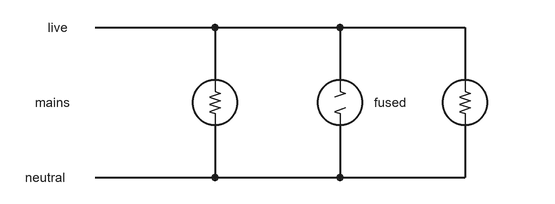
Step 3 — See what happens to the others.
The other branches are still complete and still have the full supply voltage across them, so current keeps flowing through them. (In a series circuit there is only one path, so one fused bulb would put all the others off.)
Therefore, the other bulbs keep glowing because the bulbs are connected in parallel, each on its own branch.
- 564 marks
Question 56
Draw a labelled diagram with the necessary switches to connect a bulb, a fan and a plug socket in a room with the mains. In what arrangement will you connect them to the mains ?
Solve with AIWritten solution
Solution:
Concept: In a house, every appliance is connected in parallel across the live and neutral wires of the mains. Each one then gets the full supply voltage, has its own path for current and can be switched on or off without affecting the others. A switch is always put in the live wire, so that when it is off the appliance is cut off from the high voltage and is safe to touch.
Step 1 — Put a fuse in the live wire.
A fuse is connected in the live wire coming from the mains, to protect the whole room circuit.
Step 2 — Connect each appliance across the mains.
The bulb, the fan and the plug socket are each connected between the live wire and the neutral wire, on separate branches.
Step 3 — Give each its own switch.
Each branch has its own switch, in the live side of that branch, so each appliance can be switched off separately and is safe when off.
Step 4 — Earth the socket.
The socket's L terminal goes to the live wire through its switch, its N terminal to the neutral wire, and its third (earth) terminal E to the earth wire.
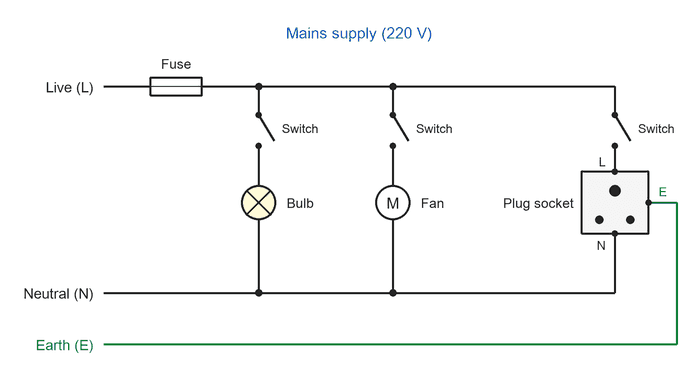
Watch out: The switches go in the live wire, never in the neutral wire.
Therefore, the bulb, fan and plug socket are connected in parallel with the mains, each with its own switch in the live wire, so each gets the full supply voltage and works independently.
- 573 marks
Question 57
Fig. 8.15 shows the reading on the dials of a meter. State what is its reading.
 Solve with AI
Written solution
Solution:
Concept: Read the dials from left to right (thousands, hundreds, tens, units). When a pointer is between two numbers, take the number it has just passed, that is, the smaller one, following the direction in which that dial is numbered.
Step 1 — Note the numbering.
Dials 1 and 4 are numbered clockwise, while dials 2 and 3 are numbered anticlockwise.
Step 2 — Read the thousands dial.
On dial 1 the pointer is between 2 and 3, so the thousands digit is 2.
Step 3 — Read the hundreds dial.
On dial 2 (anticlockwise) the pointer is between 7 and 8, so the hundreds digit is 7.
Step 4 — Read the tens dial.
On dial 3 (anticlockwise) the pointer is between 8 and 9, so the tens digit is 8.
Step 5 — Read the units dial.
On dial 4 the pointer points at 9, so the units digit is 9.
Watch out: On an anticlockwise dial the numbers increase anticlockwise; read the number the pointer has passed in that direction.
Note: The units pointer sits almost exactly on 9 (very slightly short of it). Read strictly as 'just short of 9', the units digit would be 8 and the reading 2788 kWh.
Therefore, the meter reading is 2789 kWh (units).
- 582 marks
Question 58
Can we use copper wire as a fuse wire ? Give reason.
Solve with AIWritten solution
Solution:
Concept: A fuse is a safety device: a short, thin wire of low melting point (an alloy of tin and lead) connected in series in the live wire. When too large a current flows, it heats up and melts, breaking the circuit before the wiring or appliances are damaged.
Step 1 — Look at copper's properties.
Copper has a very high melting point (about 1085 °C) and a low resistance.
Step 2 — See what would happen.
An ordinary copper wire would therefore not melt even when the current goes well above the safe limit. The circuit would not break, and the wiring and appliances could be damaged or catch fire.
Watch out: Never 'mend' a fuse with a piece of ordinary wiring wire.
Note: Very thin tinned-copper wire of a marked current rating is in fact sold as fuse wire for rewirable fuses; what must never be used is ordinary copper wire, which is far too thick to melt in time.
Therefore, no, an ordinary copper wire cannot be used as a fuse wire, because its high melting point and low resistance stop it melting when excess current flows.
- 592 marks
Question 59
Which fuse wire is thick : 5 A or 15 A ?
Solve with AIWritten solution
Solution:
Concept: A fuse wire melts when the heat produced in it is too great. A thicker wire has less resistance and more metal, so it needs a larger current to melt it.
Step 1 — Link rating with thickness.
A fuse rated 15 A must carry up to 15 A without melting, while a 5 A fuse must melt just above 5 A.
Step 2 — Decide which is thicker.
To carry the larger current without melting, the 15 A fuse wire is made thicker.
Therefore, the 15 A fuse wire is thicker than the 5 A fuse wire.
- 603 marks
Question 60
Fig. 8.16 shows two ways of connecting the three bulbs A, B and C to a battery. Name the two arrangements. Which of them do you prefer to use in a household circuit ? Give a reason to support your answer.
 Solve with AI
Written solution
Solution:
Concept: In a series arrangement there is only one path for the current; in a parallel arrangement each bulb has its own path across the supply.
Step 1 — Name arrangement (a).
In Fig. 8.16 (a) the bulbs A, B and C are joined one after another in a single loop with the cell, so this is a series arrangement.
Step 2 — Name arrangement (b).
In Fig. 8.16 (b) each bulb is on a separate branch across the cell, with its own switch, so this is a parallel arrangement.
Step 3 — Choose for the house.
The parallel arrangement (b) is preferred in a household circuit, because:
- each bulb gets the same full voltage of the supply, so each works properly;
- each bulb has its own switch and can be put on or off independently;
- if one bulb fuses, the others keep glowing, whereas in the series arrangement (a) all the bulbs would go off.
Therefore, (a) is a series and (b) a parallel arrangement, and the parallel arrangement (b) is preferred in a household circuit.
- 612 marks
Question 61
How are the electrical appliances connected in a house circuit : in series or in parallel ? Give reason.
Solve with AIWritten solution
Solution:
Concept: In a house, every appliance is connected in parallel across the live and neutral wires of the mains. Each one then gets the full supply voltage, has its own path for current and can be switched on or off without affecting the others.
Step 1 — State the arrangement.
The electrical appliances in a house circuit are connected in parallel.

Step 2 — Give the reasons.
In parallel:
- every appliance gets the same supply voltage (220 V);
- each appliance has its own path for current, so it can be switched on or off with its own switch without affecting the others;
- if one appliance fails or one bulb fuses, the other appliances keep working.
Therefore, household appliances are connected in parallel, so that each gets the full voltage and works independently.
- 624 marks
Question 62
An electrical appliance is rated as 60 W – 150 V.
(a) What do you understand by this statement?
(b) How much current will flow through the appliance when in use ?
Solve with AIWritten solution
Solution:
Concept: The rating of an appliance gives the power it consumes when it works at the stated voltage. Since , the current is .
Given: W, V.
Step 1 — Explain the rating.
(a) The rating 60 W – 150 V means that when the appliance is connected to a 150 V supply, it consumes electrical power of 60 W, that is, it uses 60 J of electrical energy every second.
Step 2 — Find the current.
(b) The current is the power divided by the voltage:
Watch out: Divide power by voltage (not voltage by power) to get the current.
Therefore, (a) the appliance uses 60 W when run on 150 V, and (b) the current through it is 0.4 A.
- 634 marks
Question 63
An electric iron of power 1.5 kW is used for 30 minutes to press clothes. Calculate the electrical energy consumed in (a) kilowatt hour (b) joule.
Solve with AIWritten solution
Solution:
Concept: We pay for electrical energy, measured in the commercial unit kilowatt hour (kWh), also called one unit. 1 kWh is the energy used by a 1 kW appliance in 1 hour. In joule, 1 kWh comes to J.
Given: kW, min.
Step 1 — Change the time into hours.
The iron is used for 30 minutes, which is half an hour:
Step 2 — Find the energy in kWh.
(a) Energy is power multiplied by time, with power in kW and time in h:
Step 3 — Change kWh into joule.
(b) Each kWh is J, so we multiply by this number:
Watch out: Use the time in hours (0.5 h), not 30, when the answer is wanted in kWh.
Therefore, the energy consumed is (a) 0.75 kWh and (b) J.
- 643 marks
Question 64
Assuming the electric consumption per day to be 12 kWh and the rate of electricity to be ₹ 6.25 per unit, find how much money is to be paid in a month of 30 days ?
Solve with AIWritten solution
Solution:
Concept: Cost of electricity is the energy consumed in kWh multiplied by the rate per kWh (unit).
Given: Consumption 12 kWh per day; rate ₹ 6.25 per unit; 30 days.
Step 1 — Find the energy for the month.
The daily consumption is multiplied by the number of days:
Step 2 — Find the cost.
Each unit (kWh) costs ₹ 6.25, so we multiply the units by 6.25:
So the money to be paid is ₹ 2,250.
Therefore, the money to be paid for the month of 30 days is ₹ 2,250.
- 654 marks
Question 65
In a premise 5 bulbs each of 100 W, 2 fans each of 60 W, 2 A.Cs each of 1.5 kW are used for 5 h per day. Find :
(a) total power consumed per day,
(b) total power consumed in 30 days,
(c) total electrical energy consumed in 30 days,
(d) the cost of electricity at the rate of ₹ 6.25 per unit.
Solve with AIWritten solution
Solution:
Concept: Total power is the sum of (number × power) for all the appliances. Power is a rate, so it does not add up from day to day; it is the energy (kWh = kW × h) that adds up, and the cost is the energy multiplied by the rate.
Given: 5 bulbs × 100 W, 2 fans × 60 W, 2 A.C.s × 1.5 kW; 5 h per day; 30 days; ₹ 6.25 per unit.
Step 1 — Find the total power.
(a) We add the power of all the appliances, with each A.C. at 1.5 kW, that is, 1500 W:
So the appliances together draw 3620 W whenever they are all on.
Step 2 — Power over 30 days.
(b) Power is the rate at which energy is used, so on each of the 30 days the appliances still draw 3620 W (3.62 kW). What grows with the days is the time of use:
Step 3 — Find the energy in 30 days.
(c) Energy is power multiplied by time:
This is 18.1 kWh per day.
Step 4 — Find the cost.
(d) Each unit costs ₹ 6.25, so we multiply the energy by 6.25:
So the cost is ₹ 3,393.75.
Watch out: Do not add power over days; multiply power by time to get energy, and only then add or charge for it.
Note: The book's answer to (b) prints 108.6 kW. That figure comes from multiplying 3.62 kW by 30 days, so it is not a power. Multiplied by the 5 hours of use each day, it gives the energy in (c), 543 kWh.
Therefore, (a) the total power is 3620 W (3.62 kW), (b) it is still 3620 W on each of the 30 days, (c) the energy consumed in 30 days is 543 kWh, and (d) the cost is ₹ 3,393.75.
- 661 mark
Question 66
When a glass rod is rubbed with dry silk cloth, the charge acquired by the silk cloth is :
Solve with AIAnswer
(A) positive
- Correct
(B) negative
(C) both positive and negative
(D) none of the above.
Answer: (B) negative
Concept: When two different materials are rubbed together, electrons are transferred from one to the other. The body that gains electrons becomes negatively charged and the body that loses electrons becomes positively charged, by the same amount. Glass rubbed with silk gives its electrons to the silk; fur rubbed on ebonite gives its electrons to the ebonite.
Step 1 — See which way the electrons move.
When a glass rod is rubbed with dry silk, free electrons pass from the glass rod to the silk.
Step 2 — Decide the charge on the silk.
The silk gains these electrons. A body with extra electrons is negatively charged, so the silk becomes negative (and the glass rod, which lost them, becomes positive).
Watch out: The glass rod becomes positive, so it is easy to give the silk the same sign by mistake; the two always get opposite charges.
Why the other options are wrong:
- (A) positive: The glass rod becomes positive because it loses electrons; the silk gains them and becomes negative.
- (C) both positive and negative: A body that gains electrons has a net negative charge; it cannot be positive and negative at the same time.
- (D) none of the above: The silk does get charged, since electrons are transferred to it.
Therefore, the silk cloth acquires a negative charge, option (B).
- 671 mark
Question 67
When an ebonite rod is rubbed with fur, the rod acquires :
Solve with AIAnswer
(A) positive charge
- Correct
(B) negative charge
(C) no charge
(D) none of the above.
Answer: (B) negative charge
Concept: When two different materials are rubbed together, electrons are transferred from one to the other. The body that gains electrons becomes negatively charged and the body that loses electrons becomes positively charged, by the same amount. Glass rubbed with silk gives its electrons to the silk; fur rubbed on ebonite gives its electrons to the ebonite.
Step 1 — See which way the electrons move.
When an ebonite rod is rubbed with fur, free electrons pass from the fur to the ebonite rod.
Step 2 — Decide the charge on the rod.
The ebonite rod gains electrons, so it becomes negatively charged; the fur, which lost them, becomes positively charged.
Watch out: Ebonite rubbed with fur is the standard example of a negative charge, just as glass rubbed with silk is the standard example of a positive charge.
Why the other options are wrong:
- (A) positive charge: The fur becomes positive, because it loses electrons; the rod gains them.
- (C) no charge: Ebonite is an insulator, and insulators do get charged by rubbing; the charge stays on the rubbed part.
- (D) none of the above: Option (B) is correct, so "none of the above" is wrong.
Therefore, the ebonite rod acquires a negative charge, option (B).
- 681 mark
Question 68
When a negatively charged body is brought closer to another negatively charged body, then they will show :
Solve with AIAnswer
(A) attraction
(B) no effect
- Correct
(C) repulsion
(D) none of the above.
Answer: (C) repulsion
Concept: There are two kinds of charge, positive and negative. Like charges repel each other and unlike charges attract each other. A charged body also attracts light uncharged bodies.
Step 1 — Compare the two charges.
Both bodies are negatively charged, so they carry like charges.
Step 2 — Apply the law of charges.
Like charges repel each other, so the two bodies push each other away.
Why the other options are wrong:
- (A) attraction: Attraction happens between unlike charges (or between a charged and an uncharged body), not between two negative charges.
- (B) no effect: Two charged bodies always exert a force on each other, so there is an effect.
- (D) none of the above: Option (C) is correct, so "none of the above" is wrong.
Therefore, the two negatively charged bodies show repulsion, option (C).
- 691 mark
Question 69
Charging a conductor by bringing another charged conductor close to it without touching is called :
Solve with AIAnswer
- Correct
(A) induction
(B) conduction
(C) convection
(D) radiation.
Answer: (A) induction
Concept: A conductor can be charged in two ways. In conduction the charged body touches the conductor; the charge is shared and the conductor gets the same kind of charge. In induction the charged body is only held near the conductor (without touching) and the conductor is earthed for a moment; it gets the opposite kind of charge.
Step 1 — Note the key words.
The charged conductor is brought close to the other conductor without touching it.
Step 2 — Name the method.
Charging without contact, only by keeping a charged body near, is called induction.
Watch out: Touching means conduction; only bringing near means induction.
Why the other options are wrong:
- (B) conduction: In conduction the charged body touches the conductor, but here there is no touching.
- (C) convection: Convection is a way in which heat is transferred by moving fluid; it is not a method of charging.
- (D) radiation: Radiation is a way in which heat travels without a medium; it is not a method of charging.
Therefore, charging a conductor by bringing a charged conductor close to it without touching is called induction, option (A).
- 701 mark
Question 70
The factor responsible for charging a conductor is :
Solve with AIAnswer
(A) transfer of protons
(B) transfer of neutrons
- Correct
(C) transfer of electrons
(D) transfer of both protons and electrons.
Answer: (C) transfer of electrons
Concept: Every substance is made of atoms. An atom has equal numbers of protons (positive, held in the nucleus) and electrons (negative, moving round the nucleus), so it is electrically neutral. Only electrons, and mainly the loosely held free electrons, can move from one body to another.
Step 1 — Recall which particles can move.
Protons and neutrons are held tightly inside the nucleus of an atom. Only electrons, especially the loosely held free electrons, can leave one body and go to another.
Step 2 — Link it to charging.
A body that gains electrons becomes negative, and a body that loses electrons becomes positive. So charging is caused by the transfer of electrons.
Watch out: A positive charge does not mean that protons have been added; it means electrons have been removed.
Why the other options are wrong:
- (A) transfer of protons: Protons stay inside the nucleus; they are not transferred when bodies are charged.
- (B) transfer of neutrons: Neutrons carry no charge, so even if they moved they could not charge a body.
- (D) transfer of both protons and electrons: Protons are not transferred at all, so a transfer of both protons and electrons does not happen.
Therefore, a conductor is charged by the transfer of electrons, option (C).
- 711 mark
Question 71
Two objects when rubbed together get charged. The charges on them are :
Solve with AIAnswer
- Correct
(A) equal and opposite
(B) equal and similar
(C) unequal and similar
(D) unequal and opposite
Answer: (A) equal and opposite
Concept: When two different materials are rubbed together, electrons are transferred from one to the other. The body that gains electrons becomes negatively charged and the body that loses electrons becomes positively charged, by the same amount. Glass rubbed with silk gives its electrons to the silk; fur rubbed on ebonite gives its electrons to the ebonite. Charge is neither made nor destroyed; it only moves from one body to another (conservation of charge).
Step 1 — Count the electrons.
Every electron lost by one object is gained by the other, so the amount of charge on the two objects is equal.
Step 2 — Find the kinds of charge.
One object has extra electrons (negative) and the other is short of the same number (positive), so the charges are opposite. Their total is still zero, as it was before rubbing.
Why the other options are wrong:
- (B) equal and similar: The charges cannot be similar, because one object gains electrons and the other loses them.
- (C) unequal and similar: The charges are neither unequal nor similar; they are equal and opposite.
- (D) unequal and opposite: The charges are opposite, but they cannot be unequal: exactly as many electrons are gained as are lost.
Therefore, the charges on the two rubbed objects are equal and opposite, option (A).
- 721 mark
Question 72
When a glass rod is rubbed with silk, the glass rod and the silk get charged because :
Solve with AIAnswer
(A) electrons are transferred from the silk to the glass rod
- Correct
(B) electrons are transferred from the glass rod to the silk
(C) protons are transferred from the silk to the glass rod
(D) protons are transferred from the glass rod to the silk.
Answer: (B) electrons are transferred from the glass rod to the silk
Concept: When two different materials are rubbed together, electrons are transferred from one to the other. The body that gains electrons becomes negatively charged and the body that loses electrons becomes positively charged, by the same amount. Glass rubbed with silk gives its electrons to the silk; fur rubbed on ebonite gives its electrons to the ebonite.
Step 1 — Recall the charges.
After rubbing, the glass rod is positive and the silk is negative.
Step 2 — Work out the electron movement.
A body becomes positive by losing electrons and negative by gaining them. So the electrons must have moved from the glass rod to the silk.
Watch out: Only electrons move on rubbing; protons never leave the nucleus.
Why the other options are wrong:
- (A) electrons are transferred from the silk to the glass rod: If electrons moved from the silk to the glass, the glass rod would become negative, but it becomes positive.
- (C) protons are transferred from the silk to the glass rod: Protons are held in the nucleus and are not transferred by rubbing.
- (D) protons are transferred from the glass rod to the silk: Protons are not transferred by rubbing; the glass becomes positive by losing electrons.
Therefore, the rod and the silk get charged because electrons are transferred from the glass rod to the silk, option (B).
- 731 mark
Question 73
The conductor of electricity is :
Solve with AIAnswer
(A) wood
(B) glass
(C) ebonite
- Correct
(D) human body.
Answer: (D) human body
Concept: Conductors (metals such as copper, silver, brass and mercury) have a large number of free electrons, so charge flows through them easily. Insulators (glass, ebonite, silk, wood, plastic, rubber) have very few free electrons, so charge stays where it is put.
Step 1 — Sort the options.
Wood, glass and ebonite are insulators: they hardly let charge flow through them.
Step 2 — Pick the conductor.
The human body lets charge flow through it, because the water in our body contains dissolved salts (ions) that can move. This is why touching a live wire gives an electric shock.
Watch out: The human body is not as good a conductor as a metal, but it conducts well enough to be dangerous.
Why the other options are wrong:
- (A) wood: Dry wood is an insulator.
- (B) glass: Glass is an insulator.
- (C) ebonite: Ebonite is an insulator (it is used as the insulating plug of a gold leaf electroscope).
Therefore, the conductor of electricity among these is the human body, option (D).
- 741 mark
Question 74
A gold leaf electroscope is to be charged positively by conduction. For this :
Solve with AIAnswer
(A) a positively charged rod is held close to the disc of electroscope
- Correct
(B) a positively charged rod is placed in contact with the disc of electroscope
(C) a negatively charged rod is held close to the disc of electroscope
(D) a negatively charged rod is touched with the disc of electroscope
Answer: (B) a positively charged rod is placed in contact with the disc of electroscope
Concept: A conductor can be charged in two ways. In conduction the charged body touches the conductor; the charge is shared and the conductor gets the same kind of charge. In induction the charged body is only held near the conductor (without touching) and the conductor is earthed for a moment; it gets the opposite kind of charge.
Step 1 — Use what conduction means.
Charging by conduction means the charged rod must touch the disc.
Step 2 — Choose the charge on the rod.
In conduction the electroscope gets the same kind of charge as the rod. To make it positive, the rod must be positive. So a positively charged rod is placed in contact with the disc.
Watch out: Holding a rod close (without contact) is induction, which gives the opposite charge.
Why the other options are wrong:
- (A) a positively charged rod is held close to the disc of electroscope: Holding the rod close without touching is induction, not conduction.
- (C) a negatively charged rod is held close to the disc of electroscope: Holding the rod close without touching is induction, not conduction.
- (D) a negatively charged rod is touched with the disc of electroscope: Touching with a negative rod is conduction, but it would make the electroscope negative.
Therefore, to charge the electroscope positively by conduction, a positively charged rod is placed in contact with the disc, option (B).
- 751 mark
Question 75
A glass rod rubbed with silk is touched with the disc of a negatively charged gold leaf electroscope. The divergence of leaves will :
Solve with AIAnswer
- Correct
(A) decrease
(B) increase
(C) remain unchanged
(D) first decrease and then increase.
Answer: (A) decrease
Concept: A gold leaf electroscope has two thin gold leaves hanging from a brass rod with a brass disc (cap) at its top. Any charge given to the disc spreads down to both leaves; the leaves then carry like charges and diverge (open out). More charge on the leaves means more divergence; less charge, less divergence.
Step 1 — Find the charge on the rod.
A glass rod rubbed with silk is positively charged.
Step 2 — See what happens at the electroscope.
The electroscope is negative. The positive rod pulls the electrons up towards the disc, and on contact part of the negative charge is neutralised. So the leaves are left with less negative charge.
Step 3 — Decide the effect on the leaves.
Less charge on the leaves means a weaker repulsion, so the divergence decreases.
Watch out: An increase in divergence would need the rod to carry the same kind of charge as the electroscope (negative).
Note: If the glass rod were very strongly charged, the leaves could collapse and then diverge again with a positive charge; the book's key is the usual observation, a decrease, and it is kept.
Why the other options are wrong:
- (B) increase: The divergence would increase only if the rod were negatively charged, like the electroscope.
- (C) remain unchanged: The divergence stays the same only for an uncharged insulated rod; this rod is charged.
- (D) first decrease and then increase: The leaves first close and then open again only when the rod's positive charge is larger than the electroscope's negative charge; the expected observation for an ordinary rubbed rod is just a decrease.
Therefore, the divergence of the leaves will decrease, option (A).
- 761 mark
Question 76
The rod in a gold leaf electroscope is made up of :
Solve with AIAnswer
(A) wood
- Correct
(B) brass
(C) glass
(D) ebonite.
Answer: (B) brass
Concept: A gold leaf electroscope has two thin gold leaves hanging from a brass rod with a brass disc (cap) at its top. Any charge given to the disc spreads down to both leaves; the leaves then carry like charges and diverge (open out). More charge on the leaves means more divergence; less charge, less divergence.
Step 1 — Think about what the rod must do.
The rod carries charge from the disc down to the leaves, so it must be a conductor.
Step 2 — Pick the conductor.
Of the options only brass (an alloy of copper and zinc) is a metal conductor. So the rod is made of brass, with a brass disc at its top.
Why the other options are wrong:
- (A) wood: Wood is an insulator, so charge could not flow through it to the leaves.
- (C) glass: Glass is an insulator; it is used for the case, not for the rod.
- (D) ebonite: Ebonite is an insulator; it is used for the plug that insulates the rod from the case.
Therefore, the rod of a gold leaf electroscope is made of brass, option (B).
- 771 mark
Question 77
Lightning conductor is made up of :
Solve with AIAnswer
- Correct
(A) copper
(B) glass
(C) ebonite
(D) wood.
Answer: (A) copper
Concept: Conductors (metals such as copper, silver, brass and mercury) have a large number of free electrons, so charge flows through them easily. Insulators (glass, ebonite, silk, wood, plastic, rubber) have very few free electrons, so charge stays where it is put.
Step 1 — Think about its job.
A lightning conductor must carry a very large charge safely down into the earth, so it must be a good conductor that does not melt easily.
Step 2 — Pick the material.
It is a thick copper rod (or strip) with pointed spikes at the top, joined to a copper plate buried deep in moist ground.
Why the other options are wrong:
- (B) glass: Glass is an insulator and cannot carry the charge to the earth.
- (C) ebonite: Ebonite is an insulator and cannot carry the charge to the earth.
- (D) wood: Wood is an insulator (and could catch fire), so it cannot carry the charge to the earth.
Therefore, a lightning conductor is made of copper, option (A).
- 781 mark
Question 78
The following question is Assertion-Reason based. Choose the answer based on the codes given below.
Assertion (A) : A fuse is used in an electrical appliance to safeguard from electric shocks.
Reason (R) : A fuse melts and breaks the circuit when excessive current flows through it.
Solve with AIAnswer
(A) Both A and R are true and R is the correct explanation of A
(B) Both A and R are true and R is not the correct explanation of A
(C) Assertion is true but reason is false
- Correct
(D) Assertion is false but reason is true
Answer: (D) A false, R true
Concept: In an assertion-reason item, judge the Assertion (A) and the Reason (R) separately as true or false, and only if both are true decide whether R explains A. A fuse is a short wire of low melting point placed in the live wire of a circuit. When too much current flows (short circuit or overloading), it heats up, melts and breaks the circuit, so the wiring and appliances are not damaged. An MCB (miniature circuit breaker) is a switch that opens automatically when the current is too large and can be reset after the fault is removed. Protection against electric shock comes from earthing the metal body of an appliance.
Step 1 — Judge the Assertion.
A fuse protects the wiring and the appliance from damage by too much current. The current through a person's body that gives a dangerous shock is far smaller than the rating of a fuse, so the fuse does not blow and cannot stop the shock. Protection from shock comes from earthing. So the Assertion is false.
Step 2 — Judge the Reason.
A fuse wire has a low melting point; when an excessive current flows it melts and breaks the circuit. The Reason is true.
Step 3 — Choose the option.
The Assertion is false and the Reason is true. That is option (D).
Watch out: A fuse saves the circuit, not the person; earthing saves the person.
Note: The book's key gives "Assertion true, Reason false". That cannot be right, because the Reason is plainly true, so the answer here is "Assertion false, Reason true". (In an earthed appliance a fault current to earth does blow the fuse, but it is the earthing that keeps the person safe.)
Why the other options are wrong:
- (A) both true, R explains A: Both statements would have to be true, but the Assertion is false.
- (B) both true, R does not explain A: Both statements would have to be true, but the Assertion is false.
- (C) A true, R false: This is the wrong way round: the Reason is true and the Assertion is false.
Therefore, the Assertion is false but the Reason is true, option (D).
- 791 mark
Question 79
The following question is Assertion-Reason based. Choose the answer based on the codes given below.
Assertion (A) : MCB is more effective than a fuse in household wiring.
Reason (R) : MCB can be reset (raised up) after tripping whereas fuse must be neglected once blown.
Solve with AIAnswer
- Correct
(A) Both A and R are true and R is the correct explanation of A
(B) Both A and R are true and R is not the correct explanation of A
(C) Assertion is true but reason is false
(D) Assertion is false but reason is true
Answer: (A) both true, R explains A
Concept: In an assertion-reason item, judge the Assertion (A) and the Reason (R) separately as true or false, and only if both are true decide whether R explains A. A fuse is a short wire of low melting point placed in the live wire of a circuit. When too much current flows (short circuit or overloading), it heats up, melts and breaks the circuit, so the wiring and appliances are not damaged. An MCB (miniature circuit breaker) is a switch that opens automatically when the current is too large and can be reset after the fault is removed. Protection against electric shock comes from earthing the metal body of an appliance.
Step 1 — Judge the Assertion.
An MCB switches the circuit off automatically and quickly when the current is too large, and it is easy to use. The book counts it as better than a fuse, so the Assertion is true.
Step 2 — Judge the Reason.
After the fault is put right, an MCB is simply reset (its switch is raised up again). A blown fuse wire cannot be used again and has to be replaced; the word "neglected" in the printed Reason stands for this (thrown away). So the Reason is true.
Step 3 — Decide whether R explains A.
Being reusable, with no wire to replace and no chance of fitting a wrong wire, is the reason the book gives for the MCB being more effective. So R explains A.
Note: An MCB is also better because it trips faster and more reliably; the book's key (R explains A) is kept.
Why the other options are wrong:
- (B) both true, R does not explain A: The book takes the Reason as the explanation of the Assertion.
- (C) A true, R false: The Reason is true: an MCB can be reset, while a blown fuse must be replaced.
- (D) A false, R true: The Assertion is true: an MCB is more effective than a fuse.
Therefore, both A and R are true and R is the correct explanation of A, option (A).
- 801 mark
Question 80
The following question is Assertion-Reason based. Choose the answer based on the codes given below.
Assertion (A) : Lightning is a natural example of static electricity.
Reason (R) : Lightning occurs due to the accumulation of same charges in clouds and earth's surface.
Solve with AIAnswer
(A) Both A and R are true and R is the correct explanation of A
(B) Both A and R are true and R is not the correct explanation of A
- Correct
(C) Assertion is true but reason is false
(D) Assertion is false but reason is true
Answer: (C) A true, R false
Concept: In an assertion-reason item, judge the Assertion (A) and the Reason (R) separately as true or false, and only if both are true decide whether R explains A. During a thunderstorm, collisions between ice crystals, hail and water drops in strong air currents (the book calls it friction) separate charge inside the clouds. A charged cloud induces an opposite charge on the earth below it or on a nearby cloud, and when the charge becomes very large a huge spark passes between them. This spark is lightning, an example of static electricity.
Step 1 — Judge the Assertion.
Lightning is a giant spark of the charge built up on clouds, that is, of charge at rest that suddenly discharges. So it is a natural example of static electricity and the Assertion is true.
Step 2 — Judge the Reason.
Same (like) charges repel, so they cannot produce a spark between them. The spark passes between opposite charges: a charged cloud induces an opposite charge on the earth or another cloud. So the Reason is false.
Step 3 — Choose the option.
The Assertion is true and the Reason is false. That is option (C).
Watch out: Lightning needs opposite charges, never like charges.
Note: The book's key gives "Assertion false, Reason true". That cannot be right, because the Reason (same charges) is clearly false, so the answer here is "Assertion true, Reason false".
Why the other options are wrong:
- (A) both true, R explains A: Both statements would have to be true, but the Reason is false.
- (B) both true, R does not explain A: Both statements would have to be true, but the Reason is false.
- (D) A false, R true: This is the wrong way round: the Assertion is true and the Reason is false.
Therefore, the Assertion is true but the Reason is false, option (C).
- 811 mark
Question 81
The following question is Assertion-Reason based. Choose the answer based on the codes given below.
Assertion (A) : Conductors can be charged by friction.
Reason (R) : Conductors allow charges to flow through them and do not retain static charges.
Solve with AIAnswer
(A) Both A and R are true and R is the correct explanation of A
(B) Both A and R are true and R is not the correct explanation of A
- Correct
(C) Assertion is true but reason is false
(D) Assertion is false but reason is true
Answer: (C) A true, R false
Concept: In an assertion-reason item, judge the Assertion (A) and the Reason (R) separately as true or false, and only if both are true decide whether R explains A. Conductors (metals such as copper, silver, brass and mercury) have a large number of free electrons, so charge flows through them easily. Insulators (glass, ebonite, silk, wood, plastic, rubber) have very few free electrons, so charge stays where it is put.
Step 1 — Judge the Assertion.
When a conductor is rubbed, charge is produced on it just as on an insulator. If the conductor is held on an insulating handle, that charge has no path to the earth and stays on it, so a conductor can be charged by friction. The Assertion is true.
Step 2 — Judge the Reason.
Conductors let charge flow through them, but an insulated conductor does keep static charge (a charged metal sphere on an insulating stand stays charged). The Reason says conductors do not retain static charge, so as a general statement the Reason is false.
Step 3 — Choose the option.
The Assertion is true and the Reason is false. That is option (C).
Watch out: A conductor held directly in the hand loses its charge at once through the body to the earth; that is why the chapter says conductors cannot be charged by rubbing. On that reading the Assertion is false and the Reason true, giving (D), but the printed key, (C), is kept because an insulated conductor really is charged by friction.
Note: This item has two readings (see Watch out). The printed key, "Assertion true, Reason false", is kept.
Why the other options are wrong:
- (A) both true, R explains A: The Reason is false as a general statement, so it cannot explain the Assertion.
- (B) both true, R does not explain A: Both statements would have to be true, but the Reason is false.
- (D) A false, R true: This holds only for a conductor held in the hand; an insulated conductor can be charged by friction, so the Assertion is true.
Therefore, the Assertion is true but the Reason is false, option (C).
- 821 mark
Question 82
Fill in the blank :
Like charges ........ while unlike charges ........
Solve with AIWritten solution
Solution:
Concept: There are two kinds of charge, positive and negative. Like charges repel each other and unlike charges attract each other. A charged body also attracts light uncharged bodies.
Step 1 — Recall the law of charges.
Two bodies with the same kind of charge push each other away, and two bodies with different kinds of charge pull each other together.
Step 2 — Fill the blanks.
So like charges repel, while unlike charges attract.
Therefore, like charges repel while unlike charges attract.
- 831 mark
Question 83
Fill in the blank :
Mercury is a ........ of electricity while pure water is ........ of electricity.
Solve with AIWritten solution
Solution:
Concept: Conductors (metals such as copper, silver, brass and mercury) have a large number of free electrons, so charge flows through them easily. Insulators (glass, ebonite, silk, wood, plastic, rubber) have very few free electrons, so charge stays where it is put.
Step 1 — Look at mercury.
Mercury is a metal (a liquid one), so it has free electrons and is a conductor.
Step 2 — Look at pure water.
Pure (distilled) water has almost no free charges, so it conducts very poorly and is treated as an insulator. Tap water conducts because of the salts dissolved in it.
Watch out: This is about pure water; ordinary water conducts, so never touch switches with wet hands.
Therefore, mercury is a conductor of electricity while pure water is an insulator of electricity.
- 841 mark
Question 84
Fill in the blank :
An ebonite rod when rubbed with fur acquires the ........ charge.
Solve with AIWritten solution
Solution:
Concept: When two different materials are rubbed together, electrons are transferred from one to the other. The body that gains electrons becomes negatively charged and the body that loses electrons becomes positively charged, by the same amount. Glass rubbed with silk gives its electrons to the silk; fur rubbed on ebonite gives its electrons to the ebonite.
Step 1 — See which way the electrons move.
On rubbing, electrons pass from the fur to the ebonite rod.
Step 2 — Fill the blank.
The rod gains electrons, so it acquires a negative charge.
Therefore, an ebonite rod when rubbed with fur acquires the negative charge.
- 851 mark
Question 85
Fill in the blank :
When an uncharged conductor is brought in contact with the disc of a gold leaf electroscope, its leaves ........
Solve with AIWritten solution
Solution:
Concept: A gold leaf electroscope has two thin gold leaves hanging from a brass rod with a brass disc (cap) at its top. Any charge given to the disc spreads down to both leaves; the leaves then carry like charges and diverge (open out). More charge on the leaves means more divergence; less charge, less divergence.
Step 1 — State the situation.
We take the electroscope to be uncharged, with its leaves closed, as in the test for whether a body is charged.
Step 2 — See what the conductor gives.
An uncharged conductor has no charge to give to the disc, so no charge reaches the leaves.
Step 3 — Fill the blank.
With no charge on them the leaves do not repel, so they remain unchanged (they do not diverge).
Watch out: If the electroscope were already charged and the conductor were held in the hand, the conductor would lead the charge to the earth and the leaves would collapse.
Therefore, the leaves remain unchanged (they do not diverge).
- 861 mark
Question 86
Fill in the blank :
Charge is shared in charging a conductor by the method of ........
Solve with AIWritten solution
Solution:
Concept: A conductor can be charged in two ways. In conduction the charged body touches the conductor; the charge is shared and the conductor gets the same kind of charge. In induction the charged body is only held near the conductor (without touching) and the conductor is earthed for a moment; it gets the opposite kind of charge.
Step 1 — Compare the two methods.
In induction there is no contact, so no charge passes between the bodies. In conduction the charged body touches the conductor and its charge spreads over both.
Step 2 — Fill the blank.
So the charge is shared in the method of conduction.
Therefore, charge is shared in charging a conductor by the method of conduction.
- 871 mark
Question 87
Write true or false :
The number of electrons and protons in an atom are same.
Solve with AIWritten solution
Solution:
Concept: Every substance is made of atoms. An atom has equal numbers of protons (positive, held in the nucleus) and electrons (negative, moving round the nucleus), so it is electrically neutral. Only electrons, and mainly the loosely held free electrons, can move from one body to another.
Step 1 — Recall the atom.
A neutral atom has as many electrons (negative) round its nucleus as there are protons (positive) in it.
Step 2 — Decide.
So the numbers of electrons and protons in an atom are the same, and the statement is true.
Therefore, the statement is true: an atom has equal numbers of electrons and protons.
- 881 mark
Question 88
Write true or false :
If the charge is not in motion, we call it static electricity.
Solve with AIWritten solution
Solution:
Concept: Electricity is of two kinds: static electricity, in which charges stay at rest on a body, and current electricity, in which charges flow.
Step 1 — Use the meaning of static.
The word static means "at rest".
Step 2 — Decide.
Charge that is not in motion (for example on a rubbed comb) is static electricity, so the statement is true.
Therefore, the statement is true: charge at rest is called static electricity.
- 891 mark
Question 89
Write true or false :
Human body is a conductor of electricity.
Solve with AIWritten solution
Solution:
Concept: Conductors (metals such as copper, silver, brass and mercury) have a large number of free electrons, so charge flows through them easily. Insulators (glass, ebonite, silk, wood, plastic, rubber) have very few free electrons, so charge stays where it is put.
Step 1 — Think about an electric shock.
A shock happens when current passes through our body. That can happen only if the body lets charge flow.
Step 2 — Decide.
The water in our body contains dissolved salts whose ions can move, so the human body conducts electricity. The statement is true.
Therefore, the statement is true: the human body is a conductor of electricity.
- 901 mark
Question 90
Write true or false :
When an ebonite rod is rubbed with fur, the electrons move from ebonite to fur.
Solve with AIWritten solution
Solution:
Concept: When two different materials are rubbed together, electrons are transferred from one to the other. The body that gains electrons becomes negatively charged and the body that loses electrons becomes positively charged, by the same amount. Glass rubbed with silk gives its electrons to the silk; fur rubbed on ebonite gives its electrons to the ebonite.
Step 1 — Recall the charges.
After rubbing, the ebonite rod is negative and the fur is positive.
Step 2 — Work out the movement.
The rod becomes negative by gaining electrons, so the electrons move from the fur to the ebonite, not from the ebonite to the fur. The statement is false.
Therefore, the statement is false. Correct statement: when an ebonite rod is rubbed with fur, the electrons move from the fur to the ebonite rod.
- 911 mark
Question 91
Write true or false :
When a glass rod is rubbed with dry silk cloth, the electrons move from glass to silk.
Solve with AIWritten solution
Solution:
Concept: When two different materials are rubbed together, electrons are transferred from one to the other. The body that gains electrons becomes negatively charged and the body that loses electrons becomes positively charged, by the same amount. Glass rubbed with silk gives its electrons to the silk; fur rubbed on ebonite gives its electrons to the ebonite.
Step 1 — Recall the charges.
After rubbing, the glass rod is positive and the silk is negative.
Step 2 — Work out the movement.
The glass becomes positive by losing electrons and the silk becomes negative by gaining them, so the electrons move from the glass to the silk. The statement is true.
Therefore, the statement is true: the electrons move from the glass rod to the silk.
- 921 mark
Question 92
Write true or false :
The cap of gold leaf electroscope is made of copper.
Solve with AIWritten solution
Solution:
Concept: A gold leaf electroscope has two thin gold leaves hanging from a brass rod with a brass disc (cap) at its top. Any charge given to the disc spreads down to both leaves; the leaves then carry like charges and diverge (open out). More charge on the leaves means more divergence; less charge, less divergence.
Step 1 — Recall the construction.
In the chapter's gold leaf electroscope the leaves hang from a brass rod, and the cap at the top of the rod is a brass disc.
Step 2 — Decide.
So the cap is made of brass, not copper, and the statement is false.
Note: The book's answer list marks this statement true, but its own description and figure name the cap a brass disc, so it is answered false here. Brass is an alloy of copper and zinc; any metal conductor would work for the cap.
Therefore, the statement is false. Correct statement: the cap (disc) of a gold leaf electroscope is made of brass.
- 931 mark
Question 93
Write true or false :
If a glass rod rubbed with silk is brought near the cap of a negatively charged electroscope, the divergence of leaves will decrease.
Solve with AIWritten solution
Solution:
Concept: A gold leaf electroscope has two thin gold leaves hanging from a brass rod with a brass disc (cap) at its top. Any charge given to the disc spreads down to both leaves; the leaves then carry like charges and diverge (open out). More charge on the leaves means more divergence; less charge, less divergence. There are two kinds of charge, positive and negative. Like charges repel each other and unlike charges attract each other. A charged body also attracts light uncharged bodies.
Step 1 — Find the charge on the rod.
A glass rod rubbed with silk is positive.
Step 2 — See its effect on the electroscope.
The electroscope is negative, so its extra electrons are spread over the disc, rod and leaves. The positive rod near the cap attracts electrons up towards the cap, so fewer electrons are left on the leaves.
Step 3 — Decide.
Less charge on the leaves means less repulsion, so the divergence decreases. The statement is true.
Note: The book's answer prints this part in both its True and its False lists; it agrees with Q1(j), so it is true and the False entry is a misprint.
Therefore, the statement is true: the divergence of the leaves will decrease.
- 941 mark
Question 94
Write true or false :
In induction, a positively charged body can make an uncharged body positively charged.
Solve with AIWritten solution
Solution:
Concept: A conductor can be charged in two ways. In conduction the charged body touches the conductor; the charge is shared and the conductor gets the same kind of charge. In induction the charged body is only held near the conductor (without touching) and the conductor is earthed for a moment; it gets the opposite kind of charge.
Step 1 — See what the positive body does.
A positively charged body held near the conductor pulls its free electrons to the near end. The near end becomes negative and the far end positive.
Step 2 — Earth the conductor.
When the conductor is touched with the hand, electrons flow in from the earth and cancel the positive charge at the far end. After the hand and then the charged body are removed, the conductor is left with extra electrons, that is, negatively charged.
Step 3 — Decide.
Induction gives the opposite charge, so a positive body makes the uncharged body negative. The statement is false.
Note: If two touching conductors are separated while the positive body is near, the farther one does keep a positive charge; the chapter's method (earthing one conductor) always gives the opposite charge, so the book's answer, false, is kept.
Therefore, the statement is false. Correct statement: in induction, a positively charged body makes an uncharged body negatively charged.
- 951 mark
Question 95
Write true or false :
A lightning conductor saves the building from lightning.
Solve with AIWritten solution
Solution:
Concept: During a thunderstorm, collisions between ice crystals, hail and water drops in strong air currents (the book calls it friction) separate charge inside the clouds. A charged cloud induces an opposite charge on the earth below it or on a nearby cloud, and when the charge becomes very large a huge spark passes between them. This spark is lightning, an example of static electricity.
Step 1 — Recall the device.
A lightning conductor is a thick copper rod with pointed spikes above the top of the building, joined to a copper plate buried deep in the ground.
Step 2 — See how it protects.
The pointed spikes let some of the induced charge leak away into the air, and if lightning does strike, its huge charge runs down the copper rod into the earth instead of through the walls.
Step 3 — Decide.
So the building is saved from damage, and the statement is true.
Note: Today a lightning conductor is understood mainly to give a strike a safe path to the earth rather than to stop lightning from striking.
Therefore, the statement is true: a lightning conductor saves the building from lightning.
- 961 mark
Question 96
Write true or false :
When a comb is rubbed with dry hair both comb and paper get similarly charged.
Solve with AIWritten solution
Solution:
Concept: When two different materials are rubbed together, electrons are transferred from one to the other. The body that gains electrons becomes negatively charged and the body that loses electrons becomes positively charged, by the same amount. Glass rubbed with silk gives its electrons to the silk; fur rubbed on ebonite gives its electrons to the ebonite. There are two kinds of charge, positive and negative. Like charges repel each other and unlike charges attract each other. A charged body also attracts light uncharged bodies.
Step 1 — Find what is rubbed.
Only the comb and the hair are rubbed together, so these two get charged, with opposite charges.
Step 2 — See why the paper is attracted.
The bits of paper are not rubbed and stay uncharged. The charged comb attracts them, because a charged body attracts light uncharged bodies.
Step 3 — Decide.
The comb and paper are not similarly charged (if they were, they would repel). The statement is false.
Therefore, the statement is false. Correct statement: when a comb is rubbed with dry hair, the comb and the hair get oppositely charged, and the charged comb attracts uncharged bits of paper.
- 971 mark
Question 97
Write true or false :
A glass rod rubbed with silk repels an ebonite rod rubbed with fur.
Solve with AIWritten solution
Solution:
Concept: There are two kinds of charge, positive and negative. Like charges repel each other and unlike charges attract each other. A charged body also attracts light uncharged bodies.
Step 1 — Find the two charges.
A glass rod rubbed with silk is positive; an ebonite rod rubbed with fur is negative.
Step 2 — Apply the law of charges.
Unlike charges attract, so the two rods attract each other. The statement is false.
Therefore, the statement is false. Correct statement: a glass rod rubbed with silk attracts an ebonite rod rubbed with fur.
- 981 mark
Question 98
Write true or false :
When an ebonite rod is rubbed with fur, the protons move from the ebonite rod to the fur.
Solve with AIWritten solution
Solution:
Concept: Every substance is made of atoms. An atom has equal numbers of protons (positive, held in the nucleus) and electrons (negative, moving round the nucleus), so it is electrically neutral. Only electrons, and mainly the loosely held free electrons, can move from one body to another.
Step 1 — Recall which particles move.
Protons are held in the nucleus and never move from one body to another on rubbing; only electrons do.
Step 2 — Find the direction.
The ebonite rod becomes negative, so electrons move from the fur to the ebonite rod. The statement is false.
Therefore, the statement is false. Correct statement: when an ebonite rod is rubbed with fur, electrons move from the fur to the ebonite rod.
- 991 mark
Question 99
Write true or false :
A conductor has a large number of free electrons.
Solve with AIWritten solution
Solution:
Concept: Conductors (metals such as copper, silver, brass and mercury) have a large number of free electrons, so charge flows through them easily. Insulators (glass, ebonite, silk, wood, plastic, rubber) have very few free electrons, so charge stays where it is put.
Step 1 — Recall what makes a conductor.
A metal conductor lets charge flow because it has a large number of loosely held free electrons that can move through it.
Step 2 — Decide.
So the statement is true.
Therefore, the statement is true: a conductor has a large number of free electrons.
- 1001 mark
Question 100
Write true or false :
An ebonite rod can be charged by touching it with a charged copper rod.
Solve with AIWritten solution
Solution:
Concept: Conductors (metals such as copper, silver, brass and mercury) have a large number of free electrons, so charge flows through them easily. Insulators (glass, ebonite, silk, wood, plastic, rubber) have very few free electrons, so charge stays where it is put. A conductor can be charged in two ways. In conduction the charged body touches the conductor; the charge is shared and the conductor gets the same kind of charge. In induction the charged body is only held near the conductor (without touching) and the conductor is earthed for a moment; it gets the opposite kind of charge.
Step 1 — Look at the body to be charged.
Ebonite is an insulator: it has very few free electrons.
Step 2 — See why conduction fails.
On touching, charge cannot spread through the ebonite, so the rod does not get charged as a conductor would. The statement is false.
Watch out: At most the tiny spot that is touched may pick up a little charge, which stays there and cannot spread over the rod.
Therefore, the statement is false. Correct statement: an ebonite rod cannot be charged by touching it with a charged copper rod, because it is an insulator.
- 1011 mark
Question 101
Write true or false :
To find whether a body is charged or not, an uncharged electroscope is used.
Solve with AIWritten solution
Solution:
Concept: A gold leaf electroscope has two thin gold leaves hanging from a brass rod with a brass disc (cap) at its top. Any charge given to the disc spreads down to both leaves; the leaves then carry like charges and diverge (open out). More charge on the leaves means more divergence; less charge, less divergence.
Step 1 — See what a charged body does.
If a charged body touches the disc of an uncharged electroscope, some of its charge spreads to the leaves, and the leaves diverge.
Step 2 — See what an uncharged body does.
An uncharged body gives no charge, so the leaves stay closed.
Step 3 — Decide.
So an uncharged electroscope tells whether a body is charged or not. The statement is true.
Therefore, the statement is true: an uncharged electroscope is used to find whether a body is charged or not.
- 1021 mark
Question 102
Write true or false :
To find whether the charge on a body is positive or negative, an uncharged electroscope is used.
Solve with AIWritten solution
Solution:
Concept: A gold leaf electroscope has two thin gold leaves hanging from a brass rod with a brass disc (cap) at its top. Any charge given to the disc spreads down to both leaves; the leaves then carry like charges and diverge (open out). More charge on the leaves means more divergence; less charge, less divergence.
Step 1 — See what an uncharged electroscope shows.
Its leaves diverge for any charge, positive or negative, so it cannot tell the two apart.
Step 2 — Find what is needed.
To find the kind of charge we need an electroscope with a known charge: like charge increases the divergence and unlike charge decreases it. The statement is false.
Therefore, the statement is false. Correct statement: to find whether the charge on a body is positive or negative, a charged electroscope (with a known charge) is used.
- 1031 mark
Question 103
Write true or false :
If a negatively charged rod is brought near a negatively charged pith ball electroscope, the pith ball will be stuck with the rod.
Solve with AIWritten solution
Solution:
Concept: There are two kinds of charge, positive and negative. Like charges repel each other and unlike charges attract each other. A charged body also attracts light uncharged bodies.
Step 1 — Compare the charges.
Both the rod and the pith ball are negatively charged, so they carry like charges.
Step 2 — Apply the law of charges.
Like charges repel, so the pith ball moves away from the rod; it does not stick to it. The statement is false.
Therefore, the statement is false. Correct statement: the negatively charged pith ball is repelled by the negatively charged rod.
- 1041 mark
Question 104
Match with the correct option from Column B :
Column A : (a) Two like charges
Column B :
(i) negative charge
(ii) repel
(iii) insulator
(iv) attract
(v) conductor
Solve with AIWritten solution
Solution:
Concept: There are two kinds of charge, positive and negative. Like charges repel each other and unlike charges attract each other. A charged body also attracts light uncharged bodies.
Step 1 — Recall the law.
Bodies with the same kind of charge push each other away.
Step 2 — Match.
So two like charges match item (ii), repel.
Therefore, (a) two like charges → (ii) repel.
- 1051 mark
Question 105
Match with the correct option from Column B :
Column A : (b) Two unlike charges
Column B :
(i) negative charge
(ii) repel
(iii) insulator
(iv) attract
(v) conductor
Solve with AIWritten solution
Solution:
Concept: There are two kinds of charge, positive and negative. Like charges repel each other and unlike charges attract each other. A charged body also attracts light uncharged bodies.
Step 1 — Recall the law.
Bodies with different kinds of charge pull each other together.
Step 2 — Match.
So two unlike charges match item (iv), attract.
Therefore, (b) two unlike charges → (iv) attract.
- 1061 mark
Question 106
Match with the correct option from Column B :
Column A : (c) Silver is a
Column B :
(i) negative charge
(ii) repel
(iii) insulator
(iv) attract
(v) conductor
Solve with AIWritten solution
Solution:
Concept: Conductors (metals such as copper, silver, brass and mercury) have a large number of free electrons, so charge flows through them easily. Insulators (glass, ebonite, silk, wood, plastic, rubber) have very few free electrons, so charge stays where it is put.
Step 1 — Classify silver.
Silver is a metal with a very large number of free electrons; it is in fact the best conductor of electricity among metals.
Step 2 — Match.
So silver matches item (v), conductor.
Therefore, (c) silver is a → (v) conductor.
- 1071 mark
Question 107
Match with the correct option from Column B :
Column A : (d) Silk is an
Column B :
(i) negative charge
(ii) repel
(iii) insulator
(iv) attract
(v) conductor
Solve with AIWritten solution
Solution:
Concept: Conductors (metals such as copper, silver, brass and mercury) have a large number of free electrons, so charge flows through them easily. Insulators (glass, ebonite, silk, wood, plastic, rubber) have very few free electrons, so charge stays where it is put.
Step 1 — Classify silk.
Silk has very few free electrons, so charge cannot flow through it; that is why a silk thread is used to hang a pith ball.
Step 2 — Match.
So silk matches item (iii), insulator.
Therefore, (d) silk is an → (iii) insulator.
- 1081 mark
Question 108
Match with the correct option from Column B :
Column A : (e) Ebonite rod rubbed with fur acquires
Column B :
(i) negative charge
(ii) repel
(iii) insulator
(iv) attract
(v) conductor
Solve with AIWritten solution
Solution:
Concept: When two different materials are rubbed together, electrons are transferred from one to the other. The body that gains electrons becomes negatively charged and the body that loses electrons becomes positively charged, by the same amount. Glass rubbed with silk gives its electrons to the silk; fur rubbed on ebonite gives its electrons to the ebonite.
Step 1 — Find the electron movement.
On rubbing, electrons move from the fur to the ebonite rod.
Step 2 — Match.
The rod gains electrons, so it matches item (i), negative charge.
Therefore, (e) an ebonite rod rubbed with fur acquires → (i) negative charge.
- 1092 marks
Question 109
What do you understand by electricity at rest ?
Solve with AIWritten solution
Solution:
Concept: Electric charge that stays at rest on a body is called static electricity; charge that flows is called current electricity. Insulators such as glass, ebonite, plastic and amber can be charged by rubbing, and the charge stays on them.
Step 1 — Say what "at rest" means.
Electricity at rest means electric charges that stay on a body and do not flow from one place to another as a current.
Step 2 — Give its name and an example.
It is called static electricity. For example, the charge produced on a plastic comb rubbed with dry hair, or on a glass rod rubbed with silk, stays on the comb or the rod.
Therefore, electricity at rest (static electricity) is electric charge that stays on a body without flowing, like the charge on a comb rubbed with dry hair.
- 1102 marks
Question 110
Why does a plastic comb rubbed with dry hair attract bits of paper ?
Solve with AIWritten solution
Solution:
Concept: When two different materials are rubbed together, electrons are transferred from one to the other. The body that gains electrons becomes negatively charged and the body that loses electrons becomes positively charged, by the same amount. Glass rubbed with silk gives its electrons to the silk; fur rubbed on ebonite gives its electrons to the ebonite. There are two kinds of charge, positive and negative. Like charges repel each other and unlike charges attract each other. A charged body also attracts light uncharged bodies.
Step 1 — See how the comb gets charged.
When the plastic comb is rubbed with dry hair, electrons are transferred between the hair and the comb, so the comb becomes charged.
Step 2 — See why the paper moves.
The bits of paper are uncharged. The charged comb pulls the charges in each bit of paper slightly apart, so the side nearer the comb gets the opposite charge and is pulled more strongly than the far side is pushed.
Step 3 — Conclude.
A charged body therefore attracts light uncharged objects, and the bits of paper jump to the comb.
Watch out: The hair must be dry; on a humid day the charge leaks away through the moist air and the effect is weak.
Therefore, the comb gets charged by rubbing, and a charged body attracts light uncharged bits of paper.
- 1112 marks
Question 111
Who discovered the way of producing electricity by friction ?
Solve with AIWritten solution
Solution:
Concept: Electricity produced by rubbing was the first kind of electricity people noticed. The word "electricity" comes from the Greek word elektron, meaning amber.
Step 1 — Name the discoverer.
The Greek philosopher Thales of Miletus, about 600 BC (more than 2,500 years ago), is credited with this discovery.
Step 2 — Say what he observed.
He noticed that amber rubbed with wool (or fur) attracts light objects such as bits of straw, dry leaves and feathers. This showed that electricity can be produced by friction.
Therefore, Thales of Greece discovered that electricity can be produced by friction (rubbed amber attracts light objects).
- 1122 marks
Question 112
Name two substances which can be charged by friction.
Solve with AIWritten solution
Solution:
Concept: Electric charge that stays at rest on a body is called static electricity; charge that flows is called current electricity. Insulators such as glass, ebonite, plastic and amber can be charged by rubbing, and the charge stays on them.
Step 1 — Recall which substances can be charged by rubbing.
Insulators keep the charge produced by rubbing, so they can be charged by friction.
Step 2 — Name two.
Glass (rubbed with silk) and ebonite (rubbed with fur). Others are plastic, amber, nylon and hard rubber.
Therefore, glass and ebonite are two substances that can be charged by friction.
- 1132 marks
Question 113
What are the two kinds of charges ?
Solve with AIWritten solution
Solution:
Concept: There are two kinds of charge, positive and negative. Like charges repel each other and unlike charges attract each other. A charged body also attracts light uncharged bodies.
Step 1 — Name the two kinds.
The two kinds of charges are positive charge and negative charge.
Step 2 — Say how they are named.
By convention, the charge on a glass rod rubbed with silk is called positive, and the charge on an ebonite rod rubbed with fur is called negative.
Therefore, the two kinds of charges are positive charge and negative charge.
- 1143 marks
Question 114
What do you mean by conservation of charges ?
Solve with AIWritten solution
Solution:
Concept: Conservation of charge: charge can neither be created nor destroyed; it can only be transferred from one body to another. So the total charge of a set of bodies stays the same.
Step 1 — Look at the bodies before rubbing.
Two bodies, for example a glass rod and a silk cloth, are uncharged before rubbing, so their total charge is zero.
Step 2 — Look at them after rubbing.
On rubbing, electrons pass from the glass to the silk. The glass becomes positive and the silk negative, by equal amounts.
Step 3 — Add the charges.
An equal positive and negative charge add up to zero, so the total charge is the same before and after rubbing. Charge has only been moved, not made. This is the conservation of charges.
Therefore, conservation of charges means that charge is neither created nor destroyed, so the total charge of the bodies stays the same (zero for two rubbed bodies).
- 1153 marks
Question 115
Name three constituents of an atom and state the kind of charge on each of them.
Solve with AIWritten solution
Solution:
Concept: Every substance is made of atoms. An atom has equal numbers of protons (positive, held in the nucleus) and electrons (negative, moving round the nucleus), so it is electrically neutral. Only electrons, and mainly the loosely held free electrons, can move from one body to another.
Step 1 — Name the constituents.
An atom is made of protons, neutrons and electrons.
Step 2 — State the charge on each.
The table below gives the charge on each and where it is found.
Constituent Charge Where found Proton Positive In the nucleus Neutron No charge (neutral) In the nucleus Electron Negative Moving round the nucleus Therefore, the three constituents are the proton (positive), the neutron (no charge) and the electron (negative).
- 1162 marks
Question 116
What is the net charge on an atom ?
Solve with AIWritten solution
Solution:
Concept: Every substance is made of atoms. An atom has equal numbers of protons (positive, held in the nucleus) and electrons (negative, moving round the nucleus), so it is electrically neutral. Only electrons, and mainly the loosely held free electrons, can move from one body to another.
Step 1 — Compare the charges in an atom.
An atom has as many electrons (negative) as protons (positive), and each electron's charge is equal in size to a proton's charge.
Step 2 — Add them.
The positive and negative charges cancel, so the net charge is zero.
Therefore, the net charge on an atom is zero; an atom is electrically neutral.
- 1172 marks
Question 117
What are free electrons ?
Solve with AIWritten solution
Solution:
Concept: Every substance is made of atoms. An atom has equal numbers of protons (positive, held in the nucleus) and electrons (negative, moving round the nucleus), so it is electrically neutral. Only electrons, and mainly the loosely held free electrons, can move from one body to another.
Step 1 — Look at how electrons are held.
The inner electrons of an atom are held tightly by the nucleus, but the outermost electrons of some atoms (especially metal atoms) are held only loosely.
Step 2 — Define free electrons.
These loosely held electrons can easily leave their atoms and move about inside the substance. They are called free electrons, and they carry the current in metals.
Therefore, free electrons are the loosely held electrons that can easily leave their atoms and move freely in a substance.
- 1183 marks
Question 118
What causes the charging of two objects when they are rubbed together ?
Solve with AIWritten solution
Solution:
Concept: When two different materials are rubbed together, electrons are transferred from one to the other. The body that gains electrons becomes negatively charged and the body that loses electrons becomes positively charged, by the same amount. Glass rubbed with silk gives its electrons to the silk; fur rubbed on ebonite gives its electrons to the ebonite.
Step 1 — Say what rubbing does.
When two objects are rubbed together, free electrons are transferred from one object to the other.
Step 2 — Find the charges.
The object that gains electrons becomes negatively charged. The object that loses electrons becomes positively charged, by the same amount.
Watch out: No protons move; a positive charge means a shortage of electrons.
Therefore, the charging is caused by the transfer of electrons from one object to the other on rubbing.
- 1192 marks
Question 119
Give one example each of a conductor and an insulator of electricity.
Solve with AIWritten solution
Solution:
Concept: Conductors (metals such as copper, silver, brass and mercury) have a large number of free electrons, so charge flows through them easily. Insulators (glass, ebonite, silk, wood, plastic, rubber) have very few free electrons, so charge stays where it is put.
Step 1 — Give a conductor.
Copper is a conductor (so are silver, aluminium and iron); it is used for electric wires.
Step 2 — Give an insulator.
Rubber is an insulator (so are glass, plastic and dry wood); it is used to cover electric wires.
Therefore, copper is an example of a conductor and rubber is an example of an insulator.
- 1202 marks
Question 120
State two ways of charging a conductor.
Solve with AIWritten solution
Solution:
Concept: A conductor can be charged in two ways. In conduction the charged body touches the conductor; the charge is shared and the conductor gets the same kind of charge. In induction the charged body is only held near the conductor (without touching) and the conductor is earthed for a moment; it gets the opposite kind of charge.
Step 1 — Rule out rubbing.
A conductor held in the hand cannot be charged by rubbing, because the charge flows away at once.
Step 2 — Name the two ways.
A conductor is charged (1) by conduction, touching it with a charged body, and (2) by induction, holding a charged body near it and earthing it.
Therefore, the two ways of charging a conductor are conduction and induction.
- 1212 marks
Question 121
Name the way of charging a conductor in which the charge is shared.
Solve with AIWritten solution
Solution:
Concept: A conductor can be charged in two ways. In conduction the charged body touches the conductor; the charge is shared and the conductor gets the same kind of charge. In induction the charged body is only held near the conductor (without touching) and the conductor is earthed for a moment; it gets the opposite kind of charge.
Step 1 — Find the method with contact.
Charge can pass between two bodies only when they touch. That happens in conduction.
Step 2 — Name it.
So the charge of the charging body is shared with the conductor in conduction.
Therefore, the charge is shared in charging by conduction.
- 1222 marks
Question 122
Can you charge an insulator by the method of conduction ?
Solve with AIWritten solution
Solution:
Concept: Conductors (metals such as copper, silver, brass and mercury) have a large number of free electrons, so charge flows through them easily. Insulators (glass, ebonite, silk, wood, plastic, rubber) have very few free electrons, so charge stays where it is put. A conductor can be charged in two ways. In conduction the charged body touches the conductor; the charge is shared and the conductor gets the same kind of charge. In induction the charged body is only held near the conductor (without touching) and the conductor is earthed for a moment; it gets the opposite kind of charge.
Step 1 — Recall what conduction needs.
In conduction, charge must flow from the charged body into the body touched and spread over it.
Step 2 — Apply it to an insulator.
An insulator has very few free electrons, so charge cannot flow into it and spread. So it cannot be charged by conduction.
Watch out: Only the tiny spot that is touched may pick up a little charge, which stays there and does not spread.
Therefore, no, an insulator cannot be charged by conduction, because it has no free electrons to carry the charge.
- 1233 marks
Question 123
What is an electroscope ? Name the two types of electroscopes.
Solve with AIWritten solution
Solution:
Concept: A gold leaf electroscope has two thin gold leaves hanging from a brass rod with a brass disc (cap) at its top. Any charge given to the disc spreads down to both leaves; the leaves then carry like charges and diverge (open out). More charge on the leaves means more divergence; less charge, less divergence.
Step 1 — Define it.
An electroscope is a device used to detect whether a body is charged and, if it is, to find the kind of charge (positive or negative) on it.
Step 2 — Name the two types.
The two types are (1) the pith ball electroscope and (2) the gold leaf electroscope.
Therefore, an electroscope detects charge and its kind; its two types are the pith ball electroscope and the gold leaf electroscope.
- 1243 marks
Question 124
A positively charged glass rod is touched with the disc of an uncharged gold leaf electroscope. What will be your observation ?
Solve with AIWritten solution
Solution:
Concept: A gold leaf electroscope has two thin gold leaves hanging from a brass rod with a brass disc (cap) at its top. Any charge given to the disc spreads down to both leaves; the leaves then carry like charges and diverge (open out). More charge on the leaves means more divergence; less charge, less divergence. A conductor can be charged in two ways. In conduction the charged body touches the conductor; the charge is shared and the conductor gets the same kind of charge. In induction the charged body is only held near the conductor (without touching) and the conductor is earthed for a moment; it gets the opposite kind of charge.
Step 1 — See what happens on touching.
The glass rod is positive, that is, short of electrons. On touching, some free electrons of the electroscope move to the rod.
Step 2 — Find the charge left.
The electroscope (disc, rod and both leaves) is left short of electrons, so it becomes positively charged.
Step 3 — See the effect on the leaves.
Both leaves now carry positive (like) charges, so they repel each other and diverge.
Therefore, the leaves of the electroscope diverge, because they get a positive charge.
- 1253 marks
Question 125
A negatively charged ebonite rod is touched with the disc of a negatively charged gold leaf electroscope. What will be your observation ?
Solve with AIWritten solution
Solution:
Concept: A gold leaf electroscope has two thin gold leaves hanging from a brass rod with a brass disc (cap) at its top. Any charge given to the disc spreads down to both leaves; the leaves then carry like charges and diverge (open out). More charge on the leaves means more divergence; less charge, less divergence.
Step 1 — Compare the charges.
The ebonite rod and the electroscope are both negatively charged.
Step 2 — See what happens on touching.
The rod gives more electrons to the electroscope, so the negative charge on the leaves increases.
Step 3 — See the effect on the leaves.
More like charge means a stronger repulsion, so the leaves open out further.
Therefore, the divergence of the leaves increases.
- 1262 marks
Question 126
What causes lightning ?
Solve with AIWritten solution
Solution:
Concept: During a thunderstorm, collisions between ice crystals, hail and water drops in strong air currents (the book calls it friction) separate charge inside the clouds. A charged cloud induces an opposite charge on the earth below it or on a nearby cloud, and when the charge becomes very large a huge spark passes between them. This spark is lightning, an example of static electricity.
Step 1 — See how a cloud gets charged.
In a thunderstorm, strong air currents make ice crystals, hail and water drops collide; this separates charge, and parts of the cloud become strongly charged.
Step 2 — See how the opposite charge appears.
A charged cloud induces an opposite charge on the earth below it, or on a nearby cloud.
Step 3 — See how the spark forms.
When the charges become very large, the air between them can no longer insulate them, and a huge spark passes between the oppositely charged clouds or between the cloud and the earth. This spark is lightning.
Therefore, lightning is caused by a huge electric discharge between a charged cloud and an oppositely charged cloud or the earth.
- 1272 marks
Question 127
What are the effects of lightning ?
Solve with AIWritten solution
Solution:
Concept: A lightning flash carries a very large charge in a fraction of a second, so it produces intense heat (the air in its path becomes several times hotter than the surface of the sun) and a shock wave (thunder).
Step 1 — Effect on living beings.
It can kill or injure humans and animals that it strikes or passes near.
Step 2 — Effect on property.
Its heat can cause fires (in buildings, forests and haystacks) and it can damage buildings, split trees and destroy electrical appliances and power lines.
Therefore, lightning can kill humans and animals, cause fires, and damage buildings, trees and electrical equipment.
- 1283 marks
Question 128
What is a lightning conductor ? How does it work ?
Solve with AIWritten solution
Solution:
Concept: A lightning conductor is a thick copper rod with pointed spikes fixed above the highest point of a building, joined by a thick copper strip to a copper plate buried deep in moist earth.
Step 1 — Say what it is.
A lightning conductor is a device that protects a building from damage by lightning. It is a thick copper rod with sharp spikes above the top of the building, joined to a copper plate buried deep in the ground.
Step 2 — Explain the induced charge.
When a charged cloud passes over the building, an opposite charge is induced on the spikes. Sharp points let this charge leak into the air, which reduces the charge build-up.
Step 3 — Explain the protection.
If lightning does strike, it strikes the spikes, and its huge charge flows down the copper rod into the earth instead of through the walls. So the building is saved from damage.
Note: Today it is understood that a lightning conductor mainly gives a strike a safe path to the earth; it does not reliably stop lightning from striking.
Therefore, a lightning conductor is a copper rod with spikes, earthed through a buried copper plate, which leads the charge of lightning safely into the earth.
- 1293 marks
Question 129
How is a tall building protected from damage due to lightning ?
Solve with AIWritten solution
Solution:
Concept: A lightning conductor is a thick copper rod with pointed spikes fixed above the highest point of a building, joined by a thick copper strip to a copper plate buried deep in moist earth.
Step 1 — Name the protection.
A tall building is protected by fixing a lightning conductor on it.
Step 2 — Describe how it is fitted.
Its pointed copper spikes stand above the highest point of the building, and a thick copper strip runs down the outside wall to a copper plate buried deep in moist earth.
Step 3 — Explain how it works.
If lightning strikes the building, it strikes the spikes, and the charge passes down the copper strip into the earth, so it does not pass through the building and damage it.
Therefore, a tall building is protected by a lightning conductor, which leads the charge of lightning safely into the earth.
- 1304 marks
Question 130
Describe an experiment to demonstrate that there are two kinds of charges.
Solve with AIWritten solution
Solution:
Concept: There are two kinds of charge, positive and negative. Like charges repel each other and unlike charges attract each other. A charged body also attracts light uncharged bodies.
Step 1 — Two glass rods.
Rub a glass rod with silk and hang it by a silk thread so that it can turn freely. Rub a second glass rod with silk and bring it near one end of the hanging rod. The hanging rod is repelled.
Step 2 — Two ebonite rods.
Repeat with two ebonite rods, each rubbed with fur. Again the hanging rod is repelled.
Step 3 — A glass rod and an ebonite rod.
Now hang the glass rod rubbed with silk and bring near it an ebonite rod rubbed with fur. The hanging glass rod is attracted.
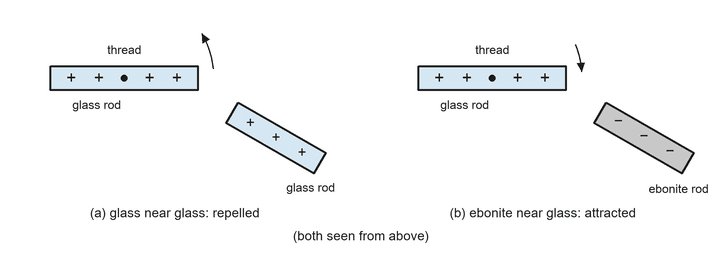
Step 4 — Check with unrubbed rods.
If the rods are not rubbed, nothing happens, so the effects are caused by the charges.
Step 5 — Draw the conclusion.
Rods of the same material carry the same kind of charge and repel. A glass rod and an ebonite rod attract, so their charges must be of different kinds. Hence there are two kinds of charge: positive (on glass rubbed with silk) and negative (on ebonite rubbed with fur).
Therefore, repulsion between like rods and attraction between a glass rod and an ebonite rod show that there are two kinds of charges.
- 1314 marks
Question 131
How will you show that like charges repel and unlike charges attract each other ?
Solve with AIWritten solution
Solution:
Concept: There are two kinds of charge, positive and negative. Like charges repel each other and unlike charges attract each other. A charged body also attracts light uncharged bodies.
Step 1 — Like charges repel.
Rub a glass rod with silk and hang it by a silk thread. Bring another glass rod rubbed with silk near one end of it. The hanging rod moves away: both rods have like (positive) charges, and they repel. Two ebonite rods rubbed with fur behave in the same way.
Step 2 — Unlike charges attract.
Keep the glass rod rubbed with silk (positive) hanging and bring an ebonite rod rubbed with fur (negative) near it. The hanging rod moves towards the ebonite rod: unlike charges attract.
Watch out: Attraction alone does not prove that a body is charged, since a charged rod also attracts an uncharged one; repulsion is the sure sign of like charges.
Therefore, the experiment shows that like charges repel and unlike charges attract each other.
- 1323 marks
Question 132
Briefly describe the structure of an atom.
Solve with AIWritten solution
Solution:
Concept: Every substance is made of atoms. An atom has equal numbers of protons (positive, held in the nucleus) and electrons (negative, moving round the nucleus), so it is electrically neutral. Only electrons, and mainly the loosely held free electrons, can move from one body to another.
Step 1 — The nucleus.
Every substance is made of atoms. At the centre of an atom is a tiny, heavy nucleus containing protons (positive) and neutrons (no charge).
Step 2 — The electrons.
Electrons (negative) move round the nucleus in different orbits (shells).
Step 3 — Overall charge.
The number of electrons equals the number of protons, so the atom is electrically neutral.
Step 4 — Free electrons.
Some outer electrons are loosely held; they can leave their atoms and are called free electrons.
Therefore, an atom has a nucleus of protons and neutrons with an equal number of electrons moving round it, so it is electrically neutral.
- 1333 marks
Question 133
A glass rod is rubbed with silk. Explain the charging of the glass rod and the silk on the basis of electron movement.
Solve with AIWritten solution
Solution:
Concept: When two different materials are rubbed together, electrons are transferred from one to the other. The body that gains electrons becomes negatively charged and the body that loses electrons becomes positively charged, by the same amount. Glass rubbed with silk gives its electrons to the silk; fur rubbed on ebonite gives its electrons to the ebonite.
Step 1 — Before rubbing.
The glass rod and the silk are both electrically neutral: each has equal numbers of electrons and protons.
Step 2 — During rubbing.
Free electrons are transferred from the glass rod to the silk.
Step 3 — The glass rod.
The glass rod loses electrons, so it has more protons than electrons and becomes positively charged.
Step 4 — The silk.
The silk gains the same number of electrons, so it becomes negatively charged by an equal amount.
Therefore, the glass rod becomes positive by losing electrons, and the silk becomes equally negative by gaining them.
- 1343 marks
Question 134
An ebonite rod is rubbed with fur. Explain the charging of the ebonite rod and the fur on the basis of electron movement.
Solve with AIWritten solution
Solution:
Concept: When two different materials are rubbed together, electrons are transferred from one to the other. The body that gains electrons becomes negatively charged and the body that loses electrons becomes positively charged, by the same amount. Glass rubbed with silk gives its electrons to the silk; fur rubbed on ebonite gives its electrons to the ebonite.
Step 1 — Before rubbing.
The ebonite rod and the fur are both electrically neutral.
Step 2 — During rubbing.
Free electrons are transferred from the fur to the ebonite rod.
Step 3 — The fur.
The fur loses electrons, so it becomes positively charged.
Step 4 — The ebonite rod.
The ebonite rod gains the same number of electrons, so it becomes negatively charged by an equal amount.
Therefore, the ebonite rod becomes negative by gaining electrons, and the fur becomes equally positive by losing them.
- 1353 marks
Question 135
Distinguish between conductors and insulators of electricity.
Solve with AIWritten solution
Solution:
Concept: Conductors (metals such as copper, silver, brass and mercury) have a large number of free electrons, so charge flows through them easily. Insulators (glass, ebonite, silk, wood, plastic, rubber) have very few free electrons, so charge stays where it is put.
Step 1 — Compare them point by point.
The table below compares conductors and insulators.
Conductors Insulators They allow electric charge to flow through them easily. They do not allow electric charge to flow through them. Metals have a large number of free electrons. They have very few free electrons. Held in the hand, they cannot be charged by rubbing (the charge flows away). They can be charged by rubbing; the charge stays where it is produced. Examples: silver, copper, aluminium, iron, mercury, the human body. Examples: glass, rubber, plastic, dry wood, ebonite, pure water. Note: The human body conducts through the dissolved salts (ions) in its body water, not through free electrons as metals do; pure water is a very poor conductor, but tap water conducts.
Therefore, conductors let charge flow because they have many free charges, while insulators do not.
- 1364 marks
Question 136
Describe the method of charging a conductor by conduction.
Solve with AIWritten solution
Solution:
Concept: A conductor can be charged in two ways. In conduction the charged body touches the conductor; the charge is shared and the conductor gets the same kind of charge. In induction the charged body is only held near the conductor (without touching) and the conductor is earthed for a moment; it gets the opposite kind of charge.
Step 1 — Say what the method is.
In conduction, the conductor is touched with a charged body. Part of the charge is shared with the conductor, which gets the same kind of charge.
Step 2 — Set up.
Place a metal rod A on an insulating stand, so that charge given to it cannot escape to the earth.
Step 3 — Touch.
Take a positively charged rod B (for example a charged metal ball or rod on an insulating handle) and touch it with rod A.
Step 4 — Remove.
Remove rod B. Rod A is left positively charged.
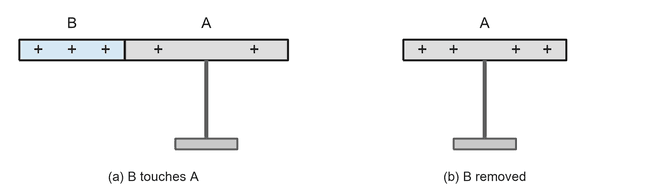
Watch out: To charge rod A negatively in the same way, touch it with a negatively charged body, such as an ebonite rod rubbed with fur rolled along it.
Therefore, in conduction the conductor is touched with a charged body and is left with the same kind of charge (here positive).
- 1373 marks
Question 137
Explain the charging by conduction in terms of movement of electrons.
Solve with AIWritten solution
Solution:
Concept: A conductor can be charged in two ways. In conduction the charged body touches the conductor; the charge is shared and the conductor gets the same kind of charge. In induction the charged body is only held near the conductor (without touching) and the conductor is earthed for a moment; it gets the opposite kind of charge.
Step 1 — A positive charging rod.
A positively charged rod B is short of electrons. When it touches metal rod A, some free electrons of A move to B. A is left short of electrons, so it becomes positively charged.
Step 2 — A negative charging rod.
A negatively charged rod B has extra electrons. When it touches rod A, some of these electrons move to A. A gains electrons, so it becomes negatively charged.
Therefore, in conduction electrons flow between the touching bodies, and the conductor gets the same kind of charge as the charging body.
- 1384 marks
Question 138
Describe the method of charging a conductor by induction.
Solve with AIWritten solution
Solution:
Concept: A conductor can be charged in two ways. In conduction the charged body touches the conductor; the charge is shared and the conductor gets the same kind of charge. In induction the charged body is only held near the conductor (without touching) and the conductor is earthed for a moment; it gets the opposite kind of charge.
Step 1 — Set up.
Place a metal rod A, with ends P and Q, on an insulating stand.
Step 2 — Bring the charged rod near.
Bring a positively charged glass rod B near end P, without touching. End P becomes negative and the far end Q becomes positive. (If B is taken away now, A becomes uncharged again.)
Step 3 — Earth the rod.
Keeping B in place, touch end Q with your hand for a moment (this earths the rod), and then remove the hand.
Step 4 — Remove the charged rod.
Now take away rod B. Rod A is left negatively charged, the opposite of B.

Watch out: Remove the hand before removing rod B; if B is removed first, the induced charge flows back and the rod is left uncharged. To charge A positively, use a negatively charged ebonite rod instead.
Therefore, in induction the conductor is kept near a charged body, earthed for a moment and then separated, and it is left with the opposite charge (here negative).
- 1394 marks
Question 139
Explain the charging by induction in terms of movement of electrons.
Solve with AIWritten solution
Solution:
Concept: A conductor can be charged in two ways. In conduction the charged body touches the conductor; the charge is shared and the conductor gets the same kind of charge. In induction the charged body is only held near the conductor (without touching) and the conductor is earthed for a moment; it gets the opposite kind of charge.
Step 1 — Separation of charge.
The positive glass rod B, held near end P of metal rod A, attracts the free electrons of A. Electrons move from end Q to end P, so P becomes negative and Q becomes positive.
Step 2 — Without earthing.
If B is removed now, the electrons spread back from P and rod A becomes uncharged again.
Step 3 — Earthing.
When end Q is touched with the hand, electrons flow from the earth into the rod and cancel the positive charge at Q.
Step 4 — Final charge.
When the hand and then rod B are removed, the extra electrons spread over the whole rod. Rod A is left negatively charged.
Therefore, in induction the charged body moves the free electrons within the conductor and earthing lets electrons flow in (or out), so the conductor gets the opposite charge.
- 1404 marks
Question 140
Describe a pith ball electroscope. How can you use it to test whether a body is charged or uncharged ?
Solve with AIWritten solution
Solution:
Concept: A pith ball electroscope is a light pith ball hung by a dry silk thread from an insulating stand. A charged body attracts an uncharged pith ball, and a charged pith ball is repelled by a body with the same kind of charge.
Step 1 — Describe it.
A pith ball electroscope is a small, light pith ball (often coated with metal foil or graphite) hung by a dry silk thread from a hook on an insulating stand. Pith is very light, so even a small force moves it.
Step 2 — Test the body.
Make sure the pith ball is uncharged. Bring the body near the pith ball without touching it.
Step 3 — Read the result.
If the pith ball moves towards the body, the body is charged. If the ball stays where it is, the body is uncharged.
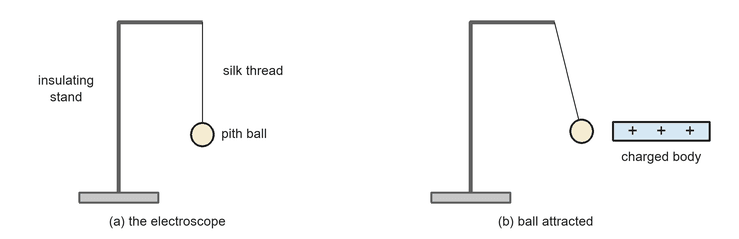
Watch out: Do not let the body touch the ball; on contact the ball takes some charge and is then pushed away.
Therefore, a pith ball electroscope is a light pith ball hung by a silk thread from an insulating stand, and an uncharged ball is attracted only by a charged body.
- 1413 marks
Question 141
How will you use a pith ball electroscope to find out whether the charge on a charged body is positive or negative ?
Solve with AIWritten solution
Solution:
Concept: A pith ball electroscope is a light pith ball hung by a dry silk thread from an insulating stand. A charged body attracts an uncharged pith ball, and a charged pith ball is repelled by a body with the same kind of charge.
Step 1 — Charge the pith ball.
First give the pith ball a known charge, say positive, by touching it with a glass rod rubbed with silk.
Step 2 — Test the body.
Bring the charged body near the pith ball without touching it.
Step 3 — Read the result.
If the pith ball is repelled, the body has the same charge, positive. If the ball is attracted, the body is negative (or it may be uncharged).
Step 4 — Confirm with the other charge.
To be sure, charge the ball negatively (with an ebonite rod rubbed with fur) and test again: now a negative body repels it.
Watch out: Repulsion is the sure test, because a charged pith ball is attracted by an uncharged body too.
Therefore, the charge on the body is the same as that of the pith ball if the ball is repelled, and opposite if it is attracted (after checking with repulsion).
- 1424 marks
Question 142
Draw a labelled diagram of a gold leaf electroscope and describe its construction.
Solve with AIWritten solution
Solution:
Concept: A gold leaf electroscope has two thin gold leaves hanging from a brass rod with a brass disc (cap) at its top. Any charge given to the disc spreads down to both leaves; the leaves then carry like charges and diverge (open out). More charge on the leaves means more divergence; less charge, less divergence.
Step 1 — Draw the diagram.
The labelled diagram of a gold leaf electroscope is shown below.
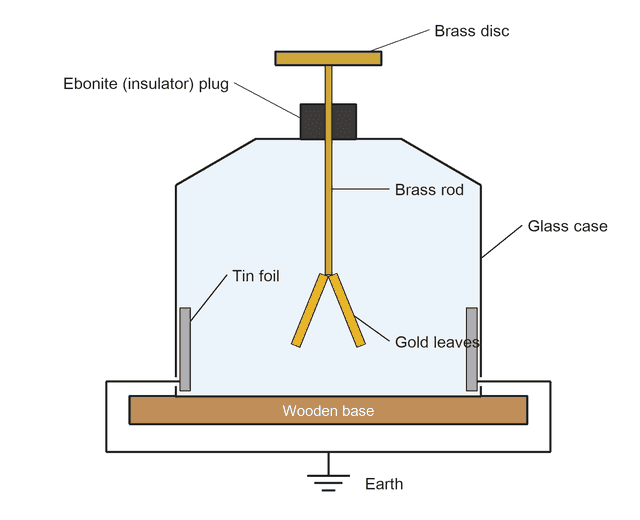
Step 2 — The disc, rod and leaves.
A brass rod has a brass disc (cap) at its upper end. Two thin gold leaves (or aluminium leaves) hang side by side from its lower end.
Step 3 — The insulation.
The rod passes through an ebonite plug (an insulator) fitted in the top of a glass case, so the rod and leaves are insulated from the case.
Step 4 — The case and tin foils.
The glass case protects the delicate leaves from air currents. Tin foils pasted on its inner walls near the bottom are earthed, so that if the leaves open too wide and touch them, the charge passes to the earth and the leaves are not torn.
Step 5 — The base.
The whole case stands on a wooden base.
Therefore, a gold leaf electroscope is a brass rod with a brass disc and two gold leaves, insulated by an ebonite plug inside a glass case with earthed tin foils.
- 1433 marks
Question 143
How will you use a gold leaf electroscope to find out whether a body is charged or uncharged ?
Solve with AIWritten solution
Solution:
Concept: A gold leaf electroscope has two thin gold leaves hanging from a brass rod with a brass disc (cap) at its top. Any charge given to the disc spreads down to both leaves; the leaves then carry like charges and diverge (open out). More charge on the leaves means more divergence; less charge, less divergence.
Step 1 — Start with an uncharged electroscope.
Take an uncharged gold leaf electroscope; its leaves hang together.
Step 2 — Touch the body to the disc.
Touch the body to be tested to the brass disc (or bring it close to the disc).
Step 3 — Read the result.
If the leaves diverge, the body is charged: its charge spreads to both leaves, and like charges repel. If the leaves do not diverge, the body is uncharged.
Therefore, the leaves of an uncharged gold leaf electroscope diverge only if the body touched to its disc is charged.
- 1444 marks
Question 144
How will you use a gold leaf electroscope to find out whether the charge on a charged body is positive or negative ?
Solve with AIWritten solution
Solution:
Concept: A gold leaf electroscope has two thin gold leaves hanging from a brass rod with a brass disc (cap) at its top. Any charge given to the disc spreads down to both leaves; the leaves then carry like charges and diverge (open out). More charge on the leaves means more divergence; less charge, less divergence.
Step 1 — Use an electroscope of known charge.
First charge the electroscope with a known charge, positive or negative. Its leaves diverge.
Step 2 — Test the body.
Touch the charged body to the disc (or bring it near the disc) and watch the leaves.
Step 3 — Read the result.
If the divergence increases, the body has the same charge as the electroscope. If it decreases, the body has the opposite charge. The table below gives all four cases.
Charge on electroscope Divergence of leaves Charge on body Positive Increases Positive Positive Decreases Negative Negative Increases Negative Negative Decreases Positive Watch out: An increase in divergence is the sure test, because an uncharged body held in the hand also reduces the divergence.
Therefore, the body's charge is the same as the electroscope's if the divergence increases, and opposite if it decreases.
- 1454 marks
Question 145
Describe Franklin's experiment. What did he conclude from his experiment?
Solve with AIWritten solution
Solution:
Concept: During a thunderstorm, collisions between ice crystals, hail and water drops in strong air currents (the book calls it friction) separate charge inside the clouds. A charged cloud induces an opposite charge on the earth below it or on a nearby cloud, and when the charge becomes very large a huge spark passes between them. This spark is lightning, an example of static electricity.
Step 1 — The apparatus.
In June 1752, Benjamin Franklin made a kite of silk and fixed a pointed metal wire, about 30 cm long, at its top. The kite was flown on a long hemp string; a metal key was tied near its lower end, and a dry silk ribbon below the key served as an insulating handle.
Step 2 — The experiment.
He flew the kite as a thunderstorm approached, holding the silk ribbon while standing under a shelter so that the silk stayed dry.
Step 3 — The observation.
The loose fibres of the string stood apart (they repelled), and when the string became wet with rain, sparks jumped between the key and his knuckle. He was even able to charge a Leyden jar (an early store of charge) from the key.
Step 4 — The explanation.
Charge from the clouds passed down the wet string (wet string conducts) to the key. His knuckle, brought near the key, got an opposite charge by induction, and a spark passed between them.
Watch out: This experiment is extremely dangerous; a scientist was killed in 1753 trying a similar one. Never fly a kite in a thunderstorm.
Note: Franklin's kite experiment is dated June 1752 (he had proposed such tests in 1750); a date of 1749, sometimes given, is too early.
Therefore, Franklin concluded that the clouds in a thunderstorm carry electric charge and that lightning is a huge electric spark.
- 1463 marks
Question 146
State three safety measures that you will observe in a thunder storm.
Solve with AIWritten solution
Solution:
Concept: Lightning tends to strike the tallest object around and travels easily along conductors such as water, metal pipes and wires, so the safest places are inside a building or a closed metal-roofed vehicle.
Step 1 — Go to a safe shelter.
Go inside a building (or a car with a metal roof and closed windows). Do not shelter under a tree, near a tall isolated object or in an open shed.
Step 2 — If caught in the open.
Do not hold an umbrella or a metal object above your head, and keep away from water and open ground. As a last resort, squat low on the balls of your feet with your head tucked in and hands over the ears; do not lie flat on the ground.
Step 3 — Indoors.
Do not take a bath or use running water or metal taps, keep away from wired (landline) phones, and unplug TV sets, computers and other appliances.
Therefore, in a thunderstorm stay inside a building away from water and wired appliances, never shelter under a tree, and if caught in the open avoid umbrellas and squat low.
- 1472 marks
Question 147
A glass rod is rubbed with silk. State the kind of charge acquired by each.
Solve with AIWritten solution
Solution:
Concept: When two different materials are rubbed together, electrons are transferred from one to the other. The body that gains electrons becomes negatively charged and the body that loses electrons becomes positively charged, by the same amount. Glass rubbed with silk gives its electrons to the silk; fur rubbed on ebonite gives its electrons to the ebonite.
Step 1 — See which way the electrons move.
On rubbing, electrons pass from the glass rod to the silk.
Step 2 — Find each charge.
The glass rod loses electrons and becomes positive; the silk gains them and becomes negative, by an equal amount.
Therefore, the glass rod acquires a positive charge and the silk an equal negative charge.
- 1482 marks
Question 148
An ebonite rod is rubbed with fur. State the kind of charge acquired by each.
Solve with AIWritten solution
Solution:
Concept: When two different materials are rubbed together, electrons are transferred from one to the other. The body that gains electrons becomes negatively charged and the body that loses electrons becomes positively charged, by the same amount. Glass rubbed with silk gives its electrons to the silk; fur rubbed on ebonite gives its electrons to the ebonite.
Step 1 — See which way the electrons move.
On rubbing, electrons pass from the fur to the ebonite rod.
Step 2 — Find each charge.
The ebonite rod gains electrons and becomes negative; the fur loses them and becomes positive, by an equal amount.
Therefore, the ebonite rod acquires a negative charge and the fur an equal positive charge.
- 1493 marks
Question 149
A glass rod rubbed with silk is suspended near an ebonite rod rubbed with fur. What will be your observation ? Give a reason to your answer.
Solve with AIWritten solution
Solution:
Concept: There are two kinds of charge, positive and negative. Like charges repel each other and unlike charges attract each other. A charged body also attracts light uncharged bodies.
Step 1 — Find the charges.
The glass rod rubbed with silk is positive; the ebonite rod rubbed with fur is negative.
Step 2 — Apply the law of charges.
Unlike charges attract, so the suspended glass rod turns towards the ebonite rod.
Therefore, the suspended glass rod is attracted towards the ebonite rod, because unlike charges attract.
- 1503 marks
Question 150
An ebonite rod rubbed with fur is suspended near another ebonite rod rubbed with fur. State your observation and give a reason to support your answer.
Solve with AIWritten solution
Solution:
Concept: There are two kinds of charge, positive and negative. Like charges repel each other and unlike charges attract each other. A charged body also attracts light uncharged bodies.
Step 1 — Find the charges.
Both ebonite rods rubbed with fur are negatively charged.
Step 2 — Apply the law of charges.
Like charges repel, so the suspended ebonite rod turns away from the other rod.
Therefore, the suspended ebonite rod is repelled, because like charges repel.
- 1512 marks
Question 151
An ebonite rod is rubbed with fur. Compare the charges acquired by them.
Solve with AIWritten solution
Solution:
Concept: When two different materials are rubbed together, electrons are transferred from one to the other. The body that gains electrons becomes negatively charged and the body that loses electrons becomes positively charged, by the same amount. Glass rubbed with silk gives its electrons to the silk; fur rubbed on ebonite gives its electrons to the ebonite. Conservation of charge: charge can neither be created nor destroyed; it can only be transferred from one body to another. So the total charge of a set of bodies stays the same.
Step 1 — Find the kinds of charge.
Electrons move from the fur to the ebonite rod, so the rod becomes negative and the fur positive.
Step 2 — Compare the amounts.
Every electron gained by the rod was lost by the fur, so the two charges are equal in amount. Their total is still zero, as before rubbing.
Therefore, the charges on the ebonite rod and the fur are equal in amount but opposite in kind.
- 1523 marks
Question 152
In each of the following cases, state which body loses electrons :
(a) A glass rod when rubbed with silk.
(b) An ebonite rod when rubbed with fur.
Solve with AIWritten solution
Solution:
Concept: When two different materials are rubbed together, electrons are transferred from one to the other. The body that gains electrons becomes negatively charged and the body that loses electrons becomes positively charged, by the same amount. Glass rubbed with silk gives its electrons to the silk; fur rubbed on ebonite gives its electrons to the ebonite.
Step 1 — Use the rule.
The body that becomes positive is the one that loses electrons.
Step 2 — Case (a).
A glass rod rubbed with silk becomes positive, so the glass rod loses electrons (to the silk).
Step 3 — Case (b).
An ebonite rod rubbed with fur becomes negative and the fur positive, so the fur loses electrons (to the ebonite rod).
Therefore, (a) the glass rod loses electrons and (b) the fur loses electrons.
- 1532 marks
Question 153
A metal rod A is to be charged positively by using another charged rod B. What should be the kind of charge on the rod B if charging is to be done by conduction ?
Solve with AIWritten solution
Solution:
Concept: A conductor can be charged in two ways. In conduction the charged body touches the conductor; the charge is shared and the conductor gets the same kind of charge. In induction the charged body is only held near the conductor (without touching) and the conductor is earthed for a moment; it gets the opposite kind of charge.
Step 1 — Use the rule for conduction.
In conduction the conductor gets the same kind of charge as the body that touches it.
Step 2 — Find the charge on B.
To make rod A positive, rod B must be positively charged. On touching, some free electrons of A move to B, and A is left positive.
Therefore, rod B must carry a positive charge.
- 1543 marks
Question 154
Fig.8.37 below shows a metal rod AB placed on an insulating stand. In Fig.(a), a negatively charged ebonite rod C is touched with the metal rod AB, while in Fig.(b), the negatively charged ebonite rod C is held near the rod AB. State the kind of charges at the ends A and B of the rod, in each case.
 Solve with AI
Written solution
Solution:
Concept: A conductor can be charged in two ways. In conduction the charged body touches the conductor; the charge is shared and the conductor gets the same kind of charge. In induction the charged body is only held near the conductor (without touching) and the conductor is earthed for a moment; it gets the opposite kind of charge.
Step 1 — Fig. (a): rod C touches end A.
This is conduction. Extra electrons from the negative rod C flow into the metal rod AB and spread over the whole of it, so the whole rod becomes negative.
Step 2 — Charges in Fig. (a).
End A is negative and end B is negative.
Step 3 — Fig. (b): rod C held near end A.
This is induction. The negative rod C repels the free electrons of the metal rod, pushing them from end A towards end B.
Step 4 — Charges in Fig. (b).
End A (near C) is left short of electrons and is positive; end B (far from C) has extra electrons and is negative.
Watch out: In Fig. (b) the rod as a whole is still neutral; the charges at A and B are equal and opposite and vanish when C is taken away.
Therefore, in Fig. (a) both ends A and B are negative, and in Fig. (b) end A is positive and end B is negative.
- 1552 marks
Question 155
When a charged rod is touched with the disc of a positively charged gold leaf electroscope, it is observed that the divergence of leaves decreases. What is the kind of charge on the rod ?
Solve with AIWritten solution
Solution:
Concept: A gold leaf electroscope has two thin gold leaves hanging from a brass rod with a brass disc (cap) at its top. Any charge given to the disc spreads down to both leaves; the leaves then carry like charges and diverge (open out). More charge on the leaves means more divergence; less charge, less divergence.
Step 1 — Use the rule.
With a charged electroscope, a body with the opposite charge reduces the divergence.
Step 2 — Apply it.
The electroscope is positive and its divergence decreases, so the rod's charge cancels part of the positive charge on the leaves. The rod must be negatively charged.
Therefore, the rod carries a negative charge.
What Class 8 Physics Ch 8 covers
The sections of the chapter, in the order the book takes them. Every question above comes from one of these.
- 01Electrical Energy and Power Consumed in a Circuit
- 02Supply of Power to a House
- 03Electric Fuse (A Safety Device)
- 04Household Electrical Circuits
- 05Power Rating of Appliances
- 06Hazards (Dangers) of Electricity
More ways to study this chapter
The same chapter asked three other ways. Practise it, revise it, and see what the board has set on Ch 8 before.
Class 8 Physics Ch 8 questions students ask
How many questions are there in Class 8 Physics Ch 8?
155 questions. Every one is solved step by step on this page.
Are these Class 8 Physics solutions free?
Yes. Every question and its full working is free to read, with no account needed.
Can I download the Class 8 Physics Ch 8 solutions as a PDF?
There is no PDF to download. Every solution is on this page instead, which means it is searchable, always the current syllabus, and readable on a phone. Use your browser's print option if you want it on paper.