
Opening your dashboard
Class 8 Physics Chapter 8 Electricity: Practice Questions
41 questions on Chapter 8, each worked through on its own page with the AI tutor. Class 8 Physics, ICSE 2026-27.
41 questions
1–5 marks · Mixed difficulty
- 11 mark
Question 1
Bloom's level: Remember
The a.c. supplied to our houses has a frequency of 50 Hz. How many times in one second does its polarity change ?
- 21 mark
Question 2
Bloom's level: Remember
Electric power is generated at the power station at 11 kV. Before it is sent over long distances, the voltage is raised to :
- 31 mark
Question 3
Bloom's level: Remember
The word 'electricity' comes from the Greek word 'elektron', which means :
- 41 mark
Question 4
Bloom's level: Apply
A 6 V battery drives a current of 0.5 A through a small motor for 2 minutes. The electrical energy supplied by the battery is :
- 51 mark
Question 5
Bloom's level: Apply
An electric kettle is rated 1100 W – 220 V. The safe limit of current through it is :
- 61 mark
Question 6
Bloom's level: Evaluate
Rahul connects the two bulbs of his room in series with each other across the 220 V mains, with a single switch. Which is the best judgement of his wiring ?
- 71 mark
Question 7
Bloom's level: Analyse
An electrician wrongly puts the fuse of a geyser in the neutral wire. A short circuit happens and the fuse melts. What is the result ?
- 81 mark
Question 8
Bloom's level: Apply
A metal rod PQ stands on an insulating stand. A negatively charged ebonite rod is brought near the end P without touching it.
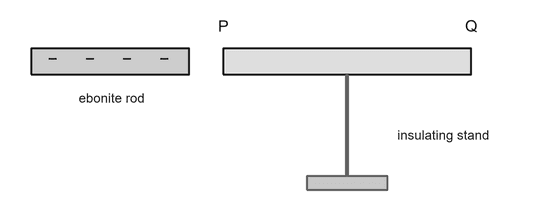
While the ebonite rod is held there :
- 91 mark
Question 9
Bloom's level: Understand
The leaves of an uncharged gold leaf electroscope diverge when its disc is touched with a charged plastic comb. When you then touch the disc with your finger, the leaves collapse. This is because :
- 101 mark
Question 10
Bloom's level: Understand
Read the Assertion (A) and the Reason (R) and choose the correct option.
Assertion (A): A bulb rated 100 W – 220 V, when lit on a 220 V supply, consumes 100 J of electrical energy every second.
Reason (R): Power is the rate of doing work, and 1 watt = 1 joule per second.
- 111 mark
Question 11
Bloom's level: Understand
Read the Assertion (A) and the Reason (R) and choose the correct option.
Assertion (A): We should not touch electric switches with wet hands.
Reason (R): Wet skin does not allow electric current to pass through the body.
- 121 mark
Question 12
Bloom's level: Analyse
Read the Assertion (A) and the Reason (R) and choose the correct option.
Assertion (A): A lightning conductor has sharp points (spikes) at its top, above the building.
Reason (R): A lightning conductor is made of copper, which is a good conductor of electricity.
- 132 marks
Question 13
Bloom's level: Remember
What is direct current (d.c.) and what is alternating current (a.c.) ? Give one source of each.
- 142 marks
Question 14
Bloom's level: Understand
Two balloons are rubbed with the same woollen cloth.
(a) Why does each balloon stick to a wall ?
(b) Why do the two balloons move away from each other when hung close together ?
- 152 marks
Question 15
Bloom's level: Apply
A geyser draws a current of 9 A from the 220 V mains for 20 minutes. Using , find the electrical energy it consumes in joule. Express this energy in kWh.
- 162 marks
Question 16
Bloom's level: Apply
An electric mixer is rated 750 W – 220 V. Find the safe limit of current through it. Which of the fuses 3 A, 5 A and 15 A should be used with it ? Give a reason.
- 172 marks
Question 17
Bloom's level: Understand
Electric power is transmitted from the power station at 132 kV, but it is supplied to our houses at only 220 V. Give one reason for each of these.
- 182 marks
Question 18
Bloom's level: Apply
A kitchen circuit at 220 V is protected by a 15 A fuse. An iron (1100 W) and a heater (1100 W) are working. Find the current drawn. What happens if an electric kettle of 2200 W is also switched on ? Why ?
- 192 marks
Question 19
Bloom's level: Apply
Two identical metal spheres X and Y stand on insulating stands. X is charged by conduction and Y by induction (with earthing), each using a positively charged glass rod. State (a) the kind of charge on X and on Y, and (b) what happens to the charge on the glass rod in each case.
- 202 marks
Question 20
Bloom's level: Analyse
Rod P attracts a glass rod rubbed with silk. Rod Q repels an ebonite rod rubbed with fur. Neha concludes : "P is negative and Q is negative."
(a) What is the charge on Q ? How can you be sure ?
(b) Can you be sure that P is negative ? Explain.
- 212 marks
Question 21
Bloom's level: Evaluate
Judge each habit as safe or unsafe and give a reason.
(a) Switching off the television only with the remote and leaving the plug in at night.
(b) Replacing a melted fuse with a piece of ordinary copper wire.
(c) Running a heater, an iron and a kettle together from one socket using a multi-plug.
(d) Removing the plug of an appliance before repairing it.
- 222 marks
Question 22
Bloom's level: Understand
In a gold leaf electroscope, give a reason for each:
(a) The brass rod passes through an ebonite (insulator) plug in the mouth of the glass bottle.
(b) The gold leaves are enclosed inside a glass bottle.
- 234 marks
Question 23
Bloom's level: Apply
A family uses the following appliances every day :
Appliance Number Power of each Time used per day Bulb 4 60 W 6 h Fan 2 80 W 10 h Refrigerator 1 150 W 24 h Geyser 1 1500 W 1 h (a) Find the electrical energy consumed per day in kWh.
(b) Find the energy consumed in a month of 30 days.
(c) Find the cost of electricity for the month at ₹ 6.50 per kWh.
- 244 marks
Question 24
Bloom's level: Analyse
The readings of the kWh meter of a house, noted at 8 a.m. each day for a week, are :
Day Mon Tue Wed Thu Fri Sat Sun Reading (in kWh) 4520.5 4528.0 4535.0 4543.5 4550.0 4566.5 4574.0 (a) Find the electricity consumed in each of the six days (Monday to Tuesday, Tuesday to Wednesday, and so on).
(b) In which period was the consumption unusual ? Suggest one possible reason, using a suitable appliance from your book.
(c) Find the total consumption for the six days and its cost at ₹ 6.25 per unit.
- 254 marks
Question 25
Bloom's level: Analyse
A gold leaf electroscope is given a negative charge, so its leaves diverge. Three bodies A, B and C are touched one by one with its disc (the electroscope is recharged to the same amount each time). The observations are :
Body Observation A divergence of the leaves increases B divergence of the leaves decreases C no change in the divergence (C is a plastic ruler) (a) State the kind of charge on A and on B, with reasons.
(b) What can you conclude about C ?
(c) Why must the electroscope be charged for finding the kind of charge, while an uncharged electroscope is enough for finding whether a body is charged ?
- 264 marks
Question 26
Bloom's level: Understand
Case study: Priya's room has a bulb, a fan and a plug socket, each with its own switch. One evening the bulb fuses, but the fan keeps running and the phone charger in the socket keeps working. Her father says the metal body of their washing machine is connected to the green wire.
(a) In what arrangement are the bulb, fan and socket connected to the mains ? How does Priya's observation show this ?
(b) In which wire is each switch connected, and why ?
(c) Why is the metal body of the washing machine connected to the green wire ? What is this wire called ?
- 274 marks
Question 27
Bloom's level: Evaluate
Case study: A class is on a picnic in an open park when a thunderstorm begins. The students make different choices: Aman runs to stand under the tallest tree; Bela opens her metal-tipped umbrella and keeps walking across the open ground; Chetan gets inside the school bus and closes its windows; Divya squats low on the ground with her head between her knees.
(a) Judge each student's choice as safe or unsafe, with a reason.
(b) What causes lightning ?
(c) The school building nearby has a lightning conductor. Explain how it protects the building.
- 283 marks
Question 28
Bloom's level: Apply
A heater draws a current of 4 A from the 220 V mains and is used for 30 minutes.
(a) Find its power.
(b) Find the electrical energy consumed in kWh and in joule.
(c) Find the cost at ₹ 7 per unit.
- 295 marks
Question 29
Bloom's level: Create
Plan the electrical circuit of a small kitchen, supplied at 220 V, that has an electric kettle (2000 W), a mixer (750 W), a refrigerator (150 W) and a tube light (40 W).
(a) Decide how the appliances will be connected to the mains and where each switch will go.
(b) Find the total current when all four are on, and choose a suitable rating for the fuse (or MCB) of the kitchen circuit from 5 A, 15 A and 30 A.
(c) Decide which appliances must be earthed, and why.
(d) Write two safety rules to display in the kitchen.
- 305 marks
Question 30
Bloom's level: Create
Case study: Your school is holding an "Electricity Safety Week". You are asked to design a one-page safety checklist that students will take home and fill in with their families.
(a) Write four items for the checklist about the house wiring and appliances, each with a one-line reason.
(b) Write two items about what to do during a thunderstorm, each with a reason.
(c) Add one short activity for the family: a way to find how much electrical energy the house uses in a day, and how to work out its cost.
- 311 mark
Question 31
A water pump of power 500 W runs for 4 hours. The electrical energy it consumes is :
- 321 mark
Question 32
An ebonite rod becomes negatively charged when it is rubbed with fur. This happens because, on rubbing :
- 331 mark
Question 33
A boy walking across an open playground is caught in a thunderstorm. Which of the following should he do to remain safe from lightning ?
- 341 mark
Question 34
Fill in the blank :
The frequency of the alternating current (a.c.) supplied to our houses is .............. Hz.
- 351 mark
Question 35
Write true or false :
When the live wire touches the neutral wire because of poor insulation, the current in the circuit becomes very small.
- 362 marks
Question 36
The circuit of a room has a fuse marked 5 A.
(a) What does the marking 5 A on the fuse tell us ?
(b) Why is the fuse connected in the live wire and not in the neutral wire ?
- 372 marks
Question 37
The bulb of a torch is connected to a battery of 3 V. A current of 0.4 A flows through the bulb.
(a) Calculate the electrical power of the bulb.
(b) Calculate the electrical energy consumed by the bulb in 10 minutes.
- 385 marks
Question 38
The table shows the electrical appliances used daily in a house.
Appliance Number Power of each Time used per day LED lamp 5 12 W 5 h Fan 2 60 W 10 h Geyser 1 2000 W 30 minutes (a) Calculate the electrical energy consumed in one day, in kWh, by (i) the lamps, (ii) the fans, (iii) the geyser.
(b) Find the total electrical energy consumed in the house in a month of 30 days.
(c) Calculate the cost of electricity for the month at the rate of ₹ 8 per unit.
- 394 marks
Question 39
The figure shows an uncharged gold leaf electroscope. Four of its parts are marked 1, 2, 3 and 4.
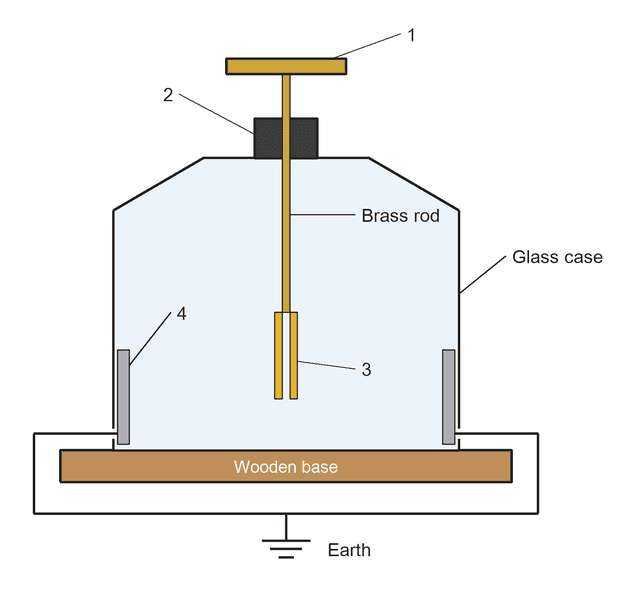
(a) Name the parts marked 1, 2, 3 and 4.
(b) Why does the brass rod pass through the part marked 2 ?
(c) An ebonite rod rubbed with fur is touched with the part marked 1. State what is observed, and give the reason for it.
- 404 marks
Question 40
(a) State two differences between charging a conductor by conduction and charging it by induction.
(b) A metal sphere kept on an insulating stand is to be charged positively by induction. Which rod will you use for this : a glass rod rubbed with silk or an ebonite rod rubbed with fur ? Give a reason.
(c) While the charged rod is held near the sphere, the far side of the sphere is touched with a finger. State what happens to the free electrons of the sphere. Which should be removed first after this : the finger or the rod ?
- 413 marks
Question 41
Differentiate between charging by conduction and charging by induction.