
Opening your dashboard
Class 8 Physics Chapter 6: Heat Transfer Solutions
77 textbook questions with step-by-step answers, free to read, for ICSE 2026-27.
Get talked through Ch 6, not just shown the answer
Reading a finished solution is not the same as being able to do it. The AI tutor takes one question at a time and works it with you, in your own words, until you can.
- Ask it out loud, in your own words
- It gives you the next step, not the answer
- Stuck on part (ii)? Start there
77 questions with solutions
1–4 marks · Mixed difficulty
- 11 mark
Question 1
In evaporation :
Solve with AIAnswer
(A) all molecules of liquid begin to escape out
- Correct
(B) only the molecules at the surface escape out
(C) the temperature of liquid rises by absorbing heat from surroundings.
(D) the molecules get attracted within the liquid.
Answer: (B) only the molecules at the surface escape out
Concept: Evaporation is the change of a liquid into its vapour from its surface, at all temperatures. Only the surface molecules that have enough kinetic energy to overcome the attraction of the other molecules escape, and the heat needed is taken from the surroundings.
Step 1 — Picture the molecules of a liquid.
The molecules of a liquid move about at different speeds and attract one another. A molecule deep inside is pulled equally from all sides, while a molecule at the surface is pulled back only by the molecules below it.
Step 2 — See which molecules can leave.
Only a molecule at the surface that happens to have enough kinetic energy can break away from this pull and escape into the air as vapour. Molecules inside the liquid are surrounded by others and cannot get out.
Step 3 — Match with the options.
So in evaporation only the molecules at the surface escape out, which is option (B).
Watch out: All the molecules take part in boiling, not in evaporation; evaporation is a surface process.
Why the other options are wrong:
- (A) all molecules of liquid begin to escape out: All the molecules take part only in boiling, where vapour forms throughout the liquid. In evaporation only some molecules at the surface escape.
- (C) the temperature of liquid rises by absorbing heat from surroundings: The evaporating liquid does take heat from its surroundings, but this heat is used up in changing liquid into vapour. The temperature of the liquid does not rise; in fact the liquid usually cools.
- (D) the molecules get attracted within the liquid: Molecules that are pulled back into the liquid stay in it. Evaporation is the escape of molecules from the liquid, not their being held in it.
Therefore, in evaporation only the molecules at the surface escape out, option (B).
- 21 mark
Question 2
The rate of evaporation of a liquid increases when :
Solve with AIAnswer
(A) temperature of liquid falls
(B) liquid is poured in a vessel of less surface area
- Correct
(C) air is blown above the surface of liquid
(D) humidity increases.
Answer: (C) air is blown above the surface of liquid
Concept: The rate of evaporation increases with a rise in temperature, a larger surface area and wind (air blowing over the surface). It decreases when the air is humid (already holds much water vapour).
Step 1 — Think about what happens above the surface.
When molecules escape from the surface, they collect in the air just above it. Some of them bump back into the liquid, which slows down evaporation.
Step 2 — See what blowing air does.
Blowing air carries these vapour molecules away as soon as they escape. The air above the surface stays fresh, fewer molecules return, and more molecules can leave every second.
Step 3 — Match with the options.
So blowing air above the surface increases the rate of evaporation, which is option (C). This is why wet clothes dry faster on a windy day.
Watch out: A rise in temperature speeds up evaporation, so a fall in temperature slows it down.
Why the other options are wrong:
- (A) temperature of liquid falls: When the temperature falls, the molecules have less kinetic energy, fewer of them can escape, and evaporation becomes slower.
- (B) liquid is poured in a vessel of less surface area: Evaporation happens only at the surface, so a smaller surface area means fewer molecules at the surface and slower evaporation.
- (D) humidity increases: When humidity increases, the air already holds a lot of water vapour, so the escaping molecules have little room and evaporation becomes slower.
Therefore, the rate of evaporation increases when air is blown above the surface of the liquid, option (C).
- 31 mark
Question 3
During boiling or vaporization :
Solve with AIAnswer
- Correct
(A) all molecules take part
(B) temperature rises
(C) no heat is absorbed
(D) the average kinetic energy of molecules increases.
Answer: (A) all molecules take part
Concept: Boiling (vaporisation) is the change of a liquid into its vapour at a fixed temperature, the boiling point. It happens throughout the liquid: vapour bubbles form in all parts of it, and heat has to be supplied from a source such as a burner. While a liquid boils, its temperature stays constant. The heat supplied is used only to pull the molecules apart against their attraction, so it raises their potential energy, not their kinetic energy. This hidden heat is called the latent heat of vaporisation.
Step 1 — Find where the vapour forms.
In boiling, bubbles of vapour form in all parts of the liquid, at the bottom, at the walls and inside it, not only at the surface. So all the molecules of the liquid take part.
Step 2 — Check the temperature and the heat.
Once boiling starts, the temperature stays fixed at the boiling point even though heat is still being supplied. The heat is absorbed and used to change the liquid into vapour.
Step 3 — Match with the options.
Only option (A), all molecules take part, is true for boiling.
Watch out: Temperature stays constant during boiling, so the average kinetic energy stays constant; only the potential energy of the molecules increases.
Why the other options are wrong:
- (B) temperature rises: The temperature does not rise during boiling; it stays at the boiling point until all the liquid has turned into vapour.
- (C) no heat is absorbed: Heat is absorbed during boiling. It is the latent heat used to change the liquid into vapour.
- (D) the average kinetic energy of molecules increases: Temperature measures the average kinetic energy of the molecules. The temperature stays the same, so the average kinetic energy also stays the same.
Therefore, during boiling all the molecules of the liquid take part, option (A).
- 41 mark
Question 4
The boiling point of a liquid is increased by:
Solve with AIAnswer
(A) increasing the volume of liquid
- Correct
(B) increasing the pressure on liquid
(C) adding ice to the liquid
(D) decreasing pressure on liquid.
Answer: (B) Increasing the pressure
Concept: The boiling point of a liquid rises when the pressure on it is increased, and falls when the pressure is decreased. Water boils at 100 °C only at normal atmospheric pressure.
Step 1 — Recall how pressure affects boiling.
A liquid boils when its molecules can push back the pressure acting on its surface. If the pressure on the liquid is made larger, the molecules need more energy, so the liquid must be hotter before it boils.
Step 2 — Use an everyday example.
In a pressure cooker the steam is trapped and the pressure inside rises to about two atmospheres, so water boils there at about 120 °C instead of 100 °C. Food cooks faster at this higher temperature.
Step 3 — Match with the options.
So the boiling point is increased by increasing the pressure on the liquid, which is option (B).
Watch out: Decreasing the pressure does the opposite: it lowers the boiling point, as on high mountains.
Why the other options are wrong:
- (A) Increasing the volume: The boiling point does not depend on how much liquid there is; a cupful and a bucketful of water both boil at 100 °C at normal pressure.
- (C) Adding ice: Adding ice only cools the liquid down. It does not change the temperature at which the liquid boils.
- (D) Decreasing the pressure: Decreasing the pressure lowers the boiling point. At a hill town where the air pressure is about 0.7 atmosphere, water boils at about 90 °C.
Therefore, the boiling point of a liquid is increased by increasing the pressure on it, option (B).
- 51 mark
Question 5
Two rods A and B of the same metal, but of length 1 m and 2 m respectively, are heated from 0°C to 100°C. Then :
Solve with AIAnswer
(A) both the rods A and B elongate the same
(B) the rod A elongates more than the rod B
- Correct
(C) the rod B elongates more than the rod A
(D) the rod A elongates, but the rod B contracts.
Answer: (C) Rod B elongates more
Concept: The increase in length of a rod on heating is . Here is the original length, the rise in temperature, and the coefficient of linear expansion, a number that depends only on the material (iron per °C, copper per °C).
Step 1 — Write the rule for the increase in length.
Both rods are of the same metal (same ) and get the same rise in temperature ( °C), so the only thing that differs is the original length.
Step 2 — Compare the two rods.
Dividing the increase for rod B by that for rod A, the and cancel and only the lengths remain.
Step 3 — See it with numbers.
If the metal were iron ( per °C), rod A would grow by 1.2 mm and rod B by 2.4 mm, twice as much.
Watch out: The same metal does not mean the same increase in length; a longer rod has more length to stretch.
Why the other options are wrong:
- (A) Both elongate the same: They would elongate by the same amount only if their original lengths were equal; rod B is twice as long.
- (B) Rod A elongates more: Rod A is the shorter rod, so it elongates less, half as much as rod B.
- (D) Rod A elongates, rod B contracts: Both rods are made of a metal, and a metal expands when it is heated, so neither rod contracts.
Therefore, the rod B elongates more than the rod A (twice as much), option (C).
- 61 mark
Question 6
Two rods A and B of the same metal, same length, but one solid and the other hollow, are heated to the same rise in temperature. Then :
Solve with AIAnswer
(A) the solid rod A expands more than the hollow rod B
(B) the hollow rod B expands more than the solid rod A
(C) the hollow rod B contracts, but the solid rod A expands
- Correct
(D) both the rods A and B expand the same.
Answer: (D) Both expand the same
Concept: The increase in length of a rod on heating is . Here is the original length, the rise in temperature, and the coefficient of linear expansion, a number that depends only on the material (iron per °C, copper per °C).
Step 1 — List what the increase in length depends on.
From , the increase in length depends only on the original length , the material (through ) and the rise in temperature .
Step 2 — Compare the two rods.
The rods are of the same metal, have the same length and get the same rise in temperature. All three factors are equal, so the increases in length are equal.
Step 3 — Why being hollow does not matter.
On heating, every part of a body expands in the same proportion, as if the whole body were photographically enlarged. A hollow rod therefore grows in length exactly as a solid rod of the same metal does; even its hollow space gets a little bigger.
Watch out: Do not think that a solid rod, having more metal, must expand more in length; the amount of metal does not appear in .
Why the other options are wrong:
- (A) Solid rod expands more: Being solid does not make a rod expand more in length; only length, material and rise in temperature matter, and these are the same.
- (B) Hollow rod expands more: Being hollow does not make a rod expand more in length either; the two rods expand equally.
- (C) Hollow contracts, solid expands: A hollow metal rod expands on heating just like a solid one; it does not contract.
Therefore, both the rods A and B expand the same, option (D).
- 71 mark
Question 7
A given volume of alcohol and the same volume of water are heated from the room temperature to the same temperature then :
Solve with AIAnswer
(A) alcohol contracts, but water expands
(B) water contracts, but alcohol expands
(C) water expands more than alcohol
- Correct
(D) alcohol expands more than water.
Answer: (D) alcohol expands more than water
Concept: Equal volumes of different liquids expand by different amounts for the same rise in temperature. The book's coefficients of cubical expansion (per °C) are benzene , alcohol and kerosene . Water expands much less (about per °C near room temperature) and has no fixed value.
Step 1 — Note what is the same.
Both liquids start with the same volume and are heated through the same rise in temperature. So any difference in expansion must come from the nature of the liquid.
Step 2 — Compare the two liquids.
Alcohol has a coefficient of cubical expansion of about per °C, roughly five times that of water (about per °C near room temperature). So alcohol expands much more.
Step 3 — Match with the options.
Both liquids expand, and alcohol expands more than water, which is option (D).
Watch out: Water contracts only when it is heated from 0 °C to 4 °C; from room temperature upwards it expands like other liquids.
Why the other options are wrong:
- (A) alcohol contracts, but water expands: Above room temperature both liquids expand on heating. Alcohol does not contract.
- (B) water contracts, but alcohol expands: Water contracts on heating only between 0 °C and 4 °C. Above room temperature it expands.
- (C) water expands more than alcohol: Water expands less than alcohol, not more, because its coefficient of expansion is much smaller.
Therefore, alcohol expands more than water, option (D).
- 81 mark
Question 8
The increase in length of a metal rod depends on :
Solve with AIAnswer
(A) the initial length of the rod only
(B) the rise in temperature only
(C) the material of rod only
- Correct
(D) all the above three factors.
Answer: (D) all the above three factors
Concept: The increase in length of a rod on heating is . Here is the original length, the rise in temperature, and the coefficient of linear expansion, a number that depends only on the material (iron per °C, copper per °C).
Step 1 — Read each factor from the formula.
In there are three quantities on the right-hand side, and each of them changes the answer.
Step 2 — Check each factor.
A longer rod (larger ) expands more. A larger rise in temperature (larger ) gives more expansion. A different metal has a different , so it expands by a different amount.
Step 3 — Match with the options.
The increase in length therefore depends on all three factors together, which is option (D).
Watch out: Each of options (A), (B) and (C) names a true factor, but the word only makes each of them wrong.
Why the other options are wrong:
- (A) the initial length of the rod only: The initial length matters, but not only the length; the rise in temperature and the material matter too.
- (B) the rise in temperature only: The rise in temperature matters, but not only it; the length and the material matter too.
- (C) the material of rod only: The material matters, but not only the material; the length and the rise in temperature matter too.
Therefore, the increase in length of a metal rod depends on all the above three factors, option (D).
- 91 mark
Question 9
The correct statement is :
Solve with AIAnswer
(A) Iron rims are cooled before they are placed on the cart wheels.
(B) A glass stopper gets tightened on warming the neck of the bottle.
(C) Telephone wires sag in winter, but become tight in summer.
- Correct
(D) A little space is left between two rails on a railway track.
Answer: (D) Space is left between rails
Concept: Expansion on heating and contraction on cooling can do harm (bent rails, cracked floors, snapped wires) or be useful (fitting rims, loosening stoppers). In practice we either leave room for the change in size or make use of it.
Step 1 — Test each statement with expansion and contraction.
For each statement, ask whether heating makes the thing expand and cooling makes it contract, and whether the statement says the right one.
Step 2 — Check the railway track.
Rails get hot and expand in summer. A small gap is left between two rails so that they have room to grow in length; without it they would push on each other and bend sideways. So statement (D) is correct.
Step 3 — Check the other three.
Each of the other statements reverses what really happens, as explained below.
Watch out: Telephone wires sag in summer (they expand and become longer) and become tight in winter (they contract).
Why the other options are wrong:
- (A) Iron rims are cooled: Iron rims are heated, not cooled. On heating the rim expands and slips over the wheel; on cooling it contracts and grips the wheel tightly.
- (B) Stopper tightens on warming the neck: Warming the neck makes the neck expand before the stopper does, so the stopper becomes loose, not tight.
- (C) Wires sag in winter: It is the other way round: wires expand and sag in summer, and contract and become tight in winter.
Therefore, the correct statement is that a little space is left between two rails on a railway track, option (D).
- 101 mark
Question 10
Assertion (A) : A humid environment slows the rate of evaporation.
Reason (R) : In humid environment, vapour molecules do not find the space to escape.
Solve with AIAnswer
- Correct
(A) Both A and R are true and R is the correct explanation of A
(B) Both A and R are true and R is not the correct explanation of A
(C) Assertion is true but reason is false
(D) Assertion is false but reason is true
Answer: (A) Both true, R explains A
Concept: The rate of evaporation increases with a rise in temperature, a larger surface area and wind (air blowing over the surface). It decreases when the air is humid (already holds much water vapour).
Step 1 — Judge the assertion.
The assertion says a humid environment slows evaporation. This is true: wet clothes take much longer to dry on a humid, rainy day than on a dry day.
Step 2 — Judge the reason.
The reason says that in humid air the vapour molecules do not find space to escape. This is also true: humid air already holds a lot of water vapour, so it can take in only a little more.
Step 3 — Test whether the reason explains the assertion.
Yes. Because the escaping molecules find little room in the air, fewer of them leave the surface each second, so evaporation slows down. The reason is the cause of the assertion.
Watch out: A reason can be true and still not explain the assertion; always ask whether it gives the cause.
Why the other options are wrong:
- (B) Both true, R does not explain A: The reason does explain the assertion: the lack of room for vapour is exactly why evaporation slows.
- (C) A true, R false: The reason is true; humid air already contains a lot of water vapour.
- (D) A false, R true: The assertion is true; evaporation is slower in humid air.
Therefore, both A and R are true and R is the correct explanation of A, option (A).
- 111 mark
Question 11
Assertion (A) : Glass containers with narrow necks are more likely to break when hot water is poured into them suddenly.
Reason (R) : Glass is a good conductor of heat.
Solve with AIAnswer
(A) Both A and R are true and R is the correct explanation of A
(B) Both A and R are true and R is not the correct explanation of A
- Correct
(C) Assertion is true but reason is false
(D) Assertion is false but reason is true
Answer: (C) A true, R false
Concept: Thermal expansion is the increase in size of a substance on heating. On heating, the molecules move faster and the average distance between them (the inter-molecular separation) increases, so the substance expands. On cooling it contracts. Glass is a poor conductor of heat.
Step 1 — Judge the assertion.
When hot water is poured suddenly into a thick glass container, the inner surface becomes hot and expands, while the outer surface is still at room temperature and does not. This unequal expansion strains the glass and can crack it. So the assertion is true.
Step 2 — Judge the reason.
The reason says glass is a good conductor of heat. This is false: glass is a poor conductor of heat. In fact that is why the heat does not reach the outer surface quickly and the two surfaces expand unequally.
Step 3 — Decide the option.
The assertion is true and the reason is false, which is option (C).
Watch out: If glass were a good conductor, both surfaces would warm up together and the glass would be less likely to crack. The cracking happens because glass is a poor conductor.
Note: the book's printed key says 'assertion false, reason true'. That is clearly wrong by the book's own statement that glass is a poor conductor of heat, so the answer here is 'assertion true, reason false'. The printed keys of Q2(b) and Q2(c) appear to have been swapped.
Why the other options are wrong:
- (A) Both true, R explains A: The reason is false, so it cannot be true, let alone the correct explanation.
- (B) Both true, R does not explain A: The reason is false, so 'both A and R are true' cannot be correct.
- (D) A false, R true: It is the other way round: the assertion is true and the reason is false.
Therefore, the assertion is true but the reason is false, option (C).
- 121 mark
Question 12
Assertion (A) : A gas expands less than a liquid for the same rise in temperature.
Reason (R) : Gases have negligible intermolecular forces of attraction.
Solve with AIAnswer
(A) Both A and R are true and R is the correct explanation of A
(B) Both A and R are true and R is not the correct explanation of A
(C) Assertion is true but reason is false
- Correct
(D) Assertion is false but reason is true
Answer: (D) A false, R true
Concept: For the same rise in temperature, solids expand the least, liquids more, and gases the most. The weaker the attraction between the molecules, the more easily they move apart on heating.
Step 1 — Judge the assertion.
The assertion says a gas expands less than a liquid for the same rise in temperature. This is false: a gas expands much more than a liquid (and a liquid more than a solid).
Step 2 — Judge the reason.
The reason says gases have negligible inter-molecular forces of attraction. This is true: gas molecules are far apart and attract one another only very weakly.
Step 3 — Decide the option.
The assertion is false and the reason is true, which is option (D). Notice that the true reason actually explains why gases expand more: with almost no attraction to hold them, gas molecules move far apart on heating.
Watch out: Read the assertion word by word; 'less' instead of 'more' makes it false.
Note: the book's printed key says 'assertion true, reason false'. That is clearly wrong by the book's own statement that gases expand much more than liquids, so the answer here is 'assertion false, reason true'. The printed keys of Q2(b) and Q2(c) appear to have been swapped.
Why the other options are wrong:
- (A) Both true, R explains A: The assertion is false, so this option cannot be correct.
- (B) Both true, R does not explain A: The assertion is false, so 'both A and R are true' cannot be correct.
- (C) A true, R false: It is the other way round: the assertion is false and the reason is true.
Therefore, the assertion is false but the reason is true, option (D).
- 131 mark
Question 13
Fill in the blank :
Boiling occurs at .................... .
Solve with AIWritten solution
Solution:
Concept: Boiling (vaporisation) is the change of a liquid into its vapour at a fixed temperature, the boiling point. It happens throughout the liquid: vapour bubbles form in all parts of it, and heat has to be supplied from a source such as a burner.
Step 1 — Recall when a liquid boils.
A liquid starts boiling only when it reaches one particular temperature, its boiling point. While it boils, its temperature does not rise any further.
Step 2 — Give an example.
At normal atmospheric pressure, pure water boils at 100 °C and stays at 100 °C until it has all boiled away, even though the burner keeps supplying heat.
Watch out: Evaporation happens at all temperatures, but boiling happens at one fixed temperature only.
Therefore, boiling occurs at a fixed temperature (the boiling point).
- 141 mark
Question 14
Fill in the blank :
Evaporation takes place at ....................
Solve with AIWritten solution
Solution:
Concept: Evaporation is the change of a liquid into its vapour from its surface, at all temperatures. Only the surface molecules that have enough kinetic energy to overcome the attraction of the other molecules escape, and the heat needed is taken from the surroundings.
Step 1 — Recall when evaporation happens.
Some surface molecules always have enough energy to escape, whatever the temperature of the liquid. So evaporation never needs a particular temperature.
Step 2 — Give an example.
Wet clothes dry even on a cool winter day, and water left in a dish slowly disappears without ever being boiled.
Therefore, evaporation takes place at all temperatures.
- 151 mark
Question 15
Fill in the blank :
The molecules of liquid .................... heat from surroundings in evaporation.
Solve with AIWritten solution
Solution:
Concept: Evaporation is the change of a liquid into its vapour from its surface, at all temperatures. Only the surface molecules that have enough kinetic energy to overcome the attraction of the other molecules escape, and the heat needed is taken from the surroundings.
Step 1 — Ask where the energy comes from.
An escaping molecule needs energy to break free from the attraction of the other molecules. In evaporation no burner supplies this energy.
Step 2 — Name the process.
The liquid therefore takes in (absorbs) the heat it needs from its surroundings: the rest of the liquid, the container, the air or our skin. This is why the surroundings feel cold; a drop of spirit on the palm makes the palm feel cool.
Therefore, the molecules of liquid absorb heat from surroundings in evaporation.
- 161 mark
Question 16
Fill in the blank :
Heat is .................... during boiling.
Solve with AIWritten solution
Solution:
Concept: While a liquid boils, its temperature stays constant. The heat supplied is used only to pull the molecules apart against their attraction, so it raises their potential energy, not their kinetic energy. This hidden heat is called the latent heat of vaporisation.
Step 1 — Ask whether heat goes in or out.
A burner has to keep heating a liquid to keep it boiling; if the burner is turned off, the boiling stops. So heat is taken in by the liquid.
Step 2 — Say what the heat does.
This heat does not raise the temperature. It is used to separate the molecules and change the liquid into vapour (latent heat of vaporisation).
Watch out: The temperature stays constant while a liquid boils, but heat is still being absorbed all the time.
Therefore, heat is absorbed during boiling.
- 171 mark
Question 17
Fill in the blank :
Cooling is produced in ....................
Solve with AIWritten solution
Solution:
Concept: Evaporation is the change of a liquid into its vapour from its surface, at all temperatures. Only the surface molecules that have enough kinetic energy to overcome the attraction of the other molecules escape, and the heat needed is taken from the surroundings.
Step 1 — Recall where the heat for evaporation comes from.
An evaporating liquid takes the heat it needs from its surroundings, since no burner supplies it.
Step 2 — See the effect on the surroundings.
Things that lose heat become colder. So the surroundings, and the liquid left behind, are cooled. Sweat evaporating from our skin cools the body, and water in an earthen pot stays cool because it evaporates through the pores.
Therefore, cooling is produced in evaporation.
- 181 mark
Question 18
Fill in the blank :
A longer rod expands .................... than a shorter rod on being heated to the same temperature.
Solve with AIWritten solution
Solution:
Concept: The increase in length of a rod on heating is . Here is the original length, the rise in temperature, and the coefficient of linear expansion, a number that depends only on the material (iron per °C, copper per °C).
Step 1 — Compare the two rods.
The rods are of the same material and get the same rise in temperature, so in only differs.
Step 2 — Decide.
The increase in length is proportional to the original length, so the longer rod expands more. For example, a rod twice as long expands twice as much.
Therefore, a longer rod expands more than a shorter rod on being heated to the same temperature.
- 191 mark
Question 19
Fill in the blank :
Liquids expand ........................ than the solids.
Solve with AIWritten solution
Solution:
Concept: For the same rise in temperature, solids expand the least, liquids more, and gases the most. The weaker the attraction between the molecules, the more easily they move apart on heating.
Step 1 — Compare the forces between molecules.
In a solid the molecules are held strongly in fixed positions. In a liquid the attraction is weaker.
Step 2 — Decide.
With weaker attraction, liquid molecules move apart more easily when they are heated, so for the same rise in temperature a liquid expands more than a solid.
Therefore, liquids expand more than the solids.
- 201 mark
Question 20
Fill in the blank :
Gases expand ............................ than the liquids.
Solve with AIWritten solution
Solution:
Concept: For the same rise in temperature, solids expand the least, liquids more, and gases the most. The weaker the attraction between the molecules, the more easily they move apart on heating.
Step 1 — Compare the forces between molecules.
In a liquid the molecules still attract one another. In a gas the attraction is very small (negligible) and the molecules are far apart.
Step 2 — Decide.
With almost nothing holding them together, gas molecules move apart very easily on heating, so a gas expands much more than a liquid for the same rise in temperature.
Therefore, gases expand more than the liquids.
- 211 mark
Question 21
Fill in the blank :
Alcohol expands ............................ than water.
Solve with AIWritten solution
Solution:
Concept: Equal volumes of different liquids expand by different amounts for the same rise in temperature. The book's coefficients of cubical expansion (per °C) are benzene , alcohol and kerosene . Water expands much less (about per °C near room temperature) and has no fixed value.
Step 1 — Compare the coefficients of cubical expansion.
Alcohol expands by about of its volume for each degree rise in temperature. Water expands only about of its volume per degree near room temperature.
Step 2 — Decide.
Alcohol's coefficient is about five times larger, so equal volumes heated through the same rise in temperature show alcohol expanding much more. This is one reason alcohol is used in some thermometers.
Therefore, alcohol expands more than water.
- 221 mark
Question 22
Fill in the blank :
Iron expands .................... than copper.
Solve with AIWritten solution
Solution:
Concept: The increase in length of a rod on heating is . Here is the original length, the rise in temperature, and the coefficient of linear expansion, a number that depends only on the material (iron per °C, copper per °C).
Step 1 — Compare the coefficients of linear expansion.
From the book's table, iron has per °C and copper has per °C.
Step 2 — Find how many times more copper expands.
For identical rods with the same rise in temperature, the ratio of their expansions is the ratio of their coefficients.
Step 3 — Decide.
Copper expands about 1.4 times as much as iron, so iron expands less than copper.
Therefore, iron expands less than copper.
- 231 mark
Question 23
Write true or false :
Evaporation is rapid on a wet day.
Solve with AIWritten solution
Solution:
Concept: The rate of evaporation increases with a rise in temperature, a larger surface area and wind (air blowing over the surface). It decreases when the air is humid (already holds much water vapour).
Step 1 — Think about the air on a wet day.
On a wet (rainy) day the air is humid; it already holds a lot of water vapour.
Step 2 — See the effect on evaporation.
Humid air has little room for more vapour, so fewer molecules escape from a liquid each second. Evaporation is therefore slow, which is why clothes take long to dry in the rainy season.
Step 3 — Correct the statement.
The statement says evaporation is rapid, which is the opposite of what happens. The correct statement is: evaporation is slow on a wet day.
Therefore, the statement is false; evaporation is slow on a wet day.
- 241 mark
Question 24
Write true or false :
Evaporation takes place only from the surface of a liquid.
Solve with AIWritten solution
Solution:
Concept: Evaporation is the change of a liquid into its vapour from its surface, at all temperatures. Only the surface molecules that have enough kinetic energy to overcome the attraction of the other molecules escape, and the heat needed is taken from the surroundings.
Step 1 — Recall where molecules escape.
A molecule inside the liquid is surrounded on all sides by other molecules that pull it back, so it cannot leave.
Step 2 — Decide.
Only the energetic molecules at the surface can escape. This is why evaporation is called a surface phenomenon, and why a larger surface makes it faster.
Therefore, the statement is true; evaporation takes place only from the surface of a liquid.
- 251 mark
Question 25
Write true or false :
All molecules of a liquid take part in the process of evaporation.
Solve with AIWritten solution
Solution:
Concept: Evaporation is the change of a liquid into its vapour from its surface, at all temperatures. Only the surface molecules that have enough kinetic energy to overcome the attraction of the other molecules escape, and the heat needed is taken from the surroundings.
Step 1 — Recall which molecules escape in evaporation.
In evaporation, only some molecules at the surface, those with enough kinetic energy, escape as vapour.
Step 2 — Correct the statement.
The statement says all the molecules take part. That is true of boiling, not of evaporation. The correct statement is: only some of the molecules at the surface of a liquid take part in evaporation.
Therefore, the statement is false; only some molecules at the surface take part in evaporation.
- 261 mark
Question 26
Write true or false :
Temperature of a liquid rises during boiling or vaporization.
Solve with AIWritten solution
Solution:
Concept: While a liquid boils, its temperature stays constant. The heat supplied is used only to pull the molecules apart against their attraction, so it raises their potential energy, not their kinetic energy. This hidden heat is called the latent heat of vaporisation.
Step 1 — Recall what happens at the boiling point.
Once a liquid starts boiling, the heat supplied is used to change it into vapour, not to make it hotter.
Step 2 — Correct the statement.
So the temperature of the liquid stays constant at the boiling point while it boils. The correct statement is: the temperature of a liquid remains constant during boiling (vaporisation).
Watch out: A thermometer in boiling water keeps reading 100 °C however long the burner stays on.
Therefore, the statement is false; the temperature stays constant during boiling.
- 271 mark
Question 27
Write true or false :
All molecules of a liquid take part in boiling.
Solve with AIWritten solution
Solution:
Concept: Boiling (vaporisation) is the change of a liquid into its vapour at a fixed temperature, the boiling point. It happens throughout the liquid: vapour bubbles form in all parts of it, and heat has to be supplied from a source such as a burner.
Step 1 — Recall where vapour forms in boiling.
In boiling, bubbles of vapour form at the bottom, at the walls and inside the liquid, not just at the surface.
Step 2 — Decide.
Since vapour forms throughout the liquid, all the molecules take part in boiling.
Therefore, the statement is true; all molecules of a liquid take part in boiling.
- 281 mark
Question 28
Write true or false :
Boiling is a rapid phenomenon.
Solve with AIWritten solution
Solution:
Concept: Boiling (vaporisation) is the change of a liquid into its vapour at a fixed temperature, the boiling point. It happens throughout the liquid: vapour bubbles form in all parts of it, and heat has to be supplied from a source such as a burner.
Step 1 — Compare the speeds of the two processes.
Evaporation takes place slowly, only from the surface. In boiling the liquid is heated continuously and vapour forms throughout it.
Step 2 — Decide.
So boiling turns liquid into vapour quickly: it is a rapid process, while evaporation is slow.
Therefore, the statement is true; boiling is a rapid phenomenon.
- 291 mark
Question 29
Write true or false :
All solids expand by the same amount when heated to the same rise in temperature.
Solve with AIWritten solution
Solution:
Concept: The increase in length of a rod on heating is . Here is the original length, the rise in temperature, and the coefficient of linear expansion, a number that depends only on the material (iron per °C, copper per °C).
Step 1 — Look at the role of the material.
In , the coefficient is different for different materials. So two solids of the same size heated through the same rise in temperature expand by different amounts.
Step 2 — Give an example.
Copper ( per °C) expands about 1.4 times as much as iron ( per °C), while invar hardly expands at all.
Step 3 — Correct the statement.
The correct statement is: different solids expand by different amounts when heated to the same rise in temperature.
Therefore, the statement is false; different solids expand by different amounts.
- 301 mark
Question 30
Write true or false :
Telephone wires are kept tight between the two poles in winter.
Solve with AIWritten solution
Solution:
Concept: Expansion on heating and contraction on cooling can do harm (bent rails, cracked floors, snapped wires) or be useful (fitting rims, loosening stoppers). In practice we either leave room for the change in size or make use of it.
Step 1 — Think about the wires in winter.
In winter the temperature is low, so the wires contract and become shorter.
Step 2 — Decide.
Being shorter between the same two poles, the wires are pulled tight in winter; in summer they expand and sag. So in winter the wires are seen stretched tight between the poles. This is why wires are put up with a little slack, so that the extra tightening in winter does not snap them.
Watch out: The wires become tight in winter by themselves (contraction); nobody should stretch them tighter, or they may break.
Therefore, the statement is true; telephone wires are tight between the poles in winter.
- 311 mark
Question 31
Write true or false :
Equal volumes of different liquids expand by different amounts when they are heated to the same rise in temperature.
Solve with AIWritten solution
Solution:
Concept: Equal volumes of different liquids expand by different amounts for the same rise in temperature. The book's coefficients of cubical expansion (per °C) are benzene , alcohol and kerosene . Water expands much less (about per °C near room temperature) and has no fixed value.
Step 1 — Compare the coefficients of different liquids.
Each liquid has its own coefficient of cubical expansion: benzene , alcohol , kerosene per °C, and water much less.
Step 2 — Decide.
Equal volumes of these liquids heated through the same rise in temperature therefore expand by different amounts: benzene the most and water the least.
Therefore, the statement is true; equal volumes of different liquids expand by different amounts.
- 321 mark
Question 32
Write true or false :
Solids expand the least and gases expand the most on being heated.
Solve with AIWritten solution
Solution:
Concept: For the same rise in temperature, solids expand the least, liquids more, and gases the most. The weaker the attraction between the molecules, the more easily they move apart on heating.
Step 1 — Compare the attraction between molecules.
The attraction is strongest in solids, weaker in liquids and almost nil in gases.
Step 2 — Decide.
The weaker the attraction, the more the substance expands on heating. So, for the same rise in temperature, a solid expands the least, a liquid more and a gas the most.
Therefore, the statement is true; solids expand the least and gases the most on heating.
- 331 mark
Question 33
Write true or false :
A mercury thermometer makes use of the property of expansion of liquids on heating.
Solve with AIWritten solution
Solution:
Concept: Thermal expansion is the increase in size of a substance on heating. On heating, the molecules move faster and the average distance between them (the inter-molecular separation) increases, so the substance expands. On cooling it contracts.
Step 1 — Recall how a mercury thermometer works.
A mercury thermometer has a bulb full of mercury joined to a fine glass tube (capillary). When the bulb becomes warmer, the mercury expands.
Step 2 — Decide.
The extra volume can only go up the narrow tube, so the mercury thread rises, and the scale on the tube gives the temperature. The thermometer works because a liquid expands on heating.
Therefore, the statement is true; a mercury thermometer uses the expansion of a liquid on heating.
- 341 mark
Question 34
Write true or false :
Kerosene contracts on heating.
Solve with AIWritten solution
Solution:
Concept: Thermal expansion is the increase in size of a substance on heating. On heating, the molecules move faster and the average distance between them (the inter-molecular separation) increases, so the substance expands. On cooling it contracts.
Step 1 — Recall how liquids behave on heating.
Liquids expand on heating; the only common exception is water between 0 °C and 4 °C.
Step 2 — Correct the statement.
Kerosene is an ordinary liquid with a large coefficient of cubical expansion ( per °C), so it expands on heating. The correct statement is: kerosene expands on heating.
Therefore, the statement is false; kerosene expands on heating.
- 351 mark
Question 35
Match with the correct option from Column B :
Column A : (a) Blowing air increases
Column B :
(i) increase in inter-molecular separation
(ii) pendulum of a clock
(iii) cooking utensils
(iv) boiling point
(v) evaporation
Solve with AIWritten solution
Solution:
Concept: The rate of evaporation increases with a rise in temperature, a larger surface area and wind (air blowing over the surface). It decreases when the air is humid (already holds much water vapour).
Step 1 — See what blowing air does.
Blowing air carries away the vapour molecules from just above the liquid, so fewer return and more can escape every second.
Step 2 — Pick the entry from Column B.
The quantity that increases is the rate of evaporation, entry (v).
Step 3 — Check the other entries.
Each entry of Column B is used once: blowing air → evaporation, pressure → boiling point, thermal expansion → inter-molecular separation, invar → pendulum of a clock, Pyrex glass → cooking utensils.
Therefore, (a) blowing air increases — (v) evaporation.
- 361 mark
Question 36
Match with the correct option from Column B :
Column A : (b) Increase in pressure increases
Column B :
(i) increase in inter-molecular separation
(ii) pendulum of a clock
(iii) cooking utensils
(iv) boiling point
(v) evaporation
Solve with AIWritten solution
Solution:
Concept: The boiling point of a liquid rises when the pressure on it is increased, and falls when the pressure is decreased. Water boils at 100 °C only at normal atmospheric pressure.
Step 1 — Recall the effect of pressure.
When the pressure on a liquid is increased, the liquid must be hotter before it can boil.
Step 2 — Pick the entry from Column B.
So an increase in pressure increases the boiling point, entry (iv). In a pressure cooker water boils at about 120 °C.
Step 3 — Check the other entries.
Each entry of Column B is used once: blowing air → evaporation, pressure → boiling point, thermal expansion → inter-molecular separation, invar → pendulum of a clock, Pyrex glass → cooking utensils.
Therefore, (b) increase in pressure increases — (iv) boiling point.
- 371 mark
Question 37
Match with the correct option from Column B :
Column A : (c) Thermal expansion
Column B :
(i) increase in inter-molecular separation
(ii) pendulum of a clock
(iii) cooking utensils
(iv) boiling point
(v) evaporation
Solve with AIWritten solution
Solution:
Concept: Thermal expansion is the increase in size of a substance on heating. On heating, the molecules move faster and the average distance between them (the inter-molecular separation) increases, so the substance expands. On cooling it contracts.
Step 1 — Recall the molecular cause of expansion.
On heating, the molecules move faster and push one another farther apart.
Step 2 — Pick the entry from Column B.
Thermal expansion is due to the increase in inter-molecular separation, entry (i).
Step 3 — Check the other entries.
Each entry of Column B is used once: blowing air → evaporation, pressure → boiling point, thermal expansion → inter-molecular separation, invar → pendulum of a clock, Pyrex glass → cooking utensils.
Therefore, (c) thermal expansion — (i) increase in inter-molecular separation.
- 381 mark
Question 38
Match with the correct option from Column B :
Column A : (d) Invar
Column B :
(i) increase in inter-molecular separation
(ii) pendulum of a clock
(iii) cooking utensils
(iv) boiling point
(v) evaporation
Solve with AIWritten solution
Solution:
Concept: Invar is an alloy of iron (about 64 %) and nickel (about 36 %). Its coefficient of linear expansion is very small, about one-tenth that of iron, so its length hardly changes with temperature.
Step 1 — See why a clock pendulum needs it.
A pendulum clock keeps time only if the length of its pendulum stays the same. A steel pendulum would become longer in summer and the clock would run slow.
Step 2 — Pick the entry from Column B.
Invar keeps nearly the same length in summer and winter, so it is used for the pendulum of a clock, entry (ii).
Step 3 — Check the other entries.
Each entry of Column B is used once: blowing air → evaporation, pressure → boiling point, thermal expansion → inter-molecular separation, invar → pendulum of a clock, Pyrex glass → cooking utensils.
Therefore, (d) invar — (ii) pendulum of a clock.
- 391 mark
Question 39
Match with the correct option from Column B :
Column A : (e) Pyrex glass
Column B :
(i) increase in inter-molecular separation
(ii) pendulum of a clock
(iii) cooking utensils
(iv) boiling point
(v) evaporation
Solve with AIWritten solution
Solution:
Concept: Pyrex (borosilicate glass) expands only about one-third as much as ordinary glass on heating.
Step 1 — See why this matters in cooking.
Ordinary glass can crack when heated suddenly, because its hot and cold parts expand by different amounts. Pyrex expands so little that this strain stays small.
Step 2 — Pick the entry from Column B.
So Pyrex glass is used for ovenware and other cooking utensils, entry (iii).
Step 3 — Check the other entries.
Each entry of Column B is used once: blowing air → evaporation, pressure → boiling point, thermal expansion → inter-molecular separation, invar → pendulum of a clock, Pyrex glass → cooking utensils.
Therefore, (e) Pyrex glass — (iii) cooking utensils.
- 402 marks
Question 40
What is matter ? What is it composed of ?
Solve with AIWritten solution
Solution:
Concept: Everything around us, solid, liquid or gas, is matter. Physics describes it by two simple tests: does it take up space, and does it have mass?
Step 1 — Define matter.
Matter is anything that occupies space and has mass. Air, water, a stone and our own body are all matter; light and sound are not, because they have no mass and take up no space.
Step 2 — Say what it is made of.
Matter is made of a very large number of extremely small particles called molecules (which are themselves made of atoms). A molecule is the smallest particle of a substance that can exist on its own and still has all the properties of that substance.
Step 3 — Describe the molecules.
Molecules are tiny, about m to m across, far too small to be seen with an ordinary (light) microscope. They are always moving, so they have kinetic energy, and they attract one another, so they also have potential energy.
Therefore, matter is anything that occupies space and has mass, and it is composed of tiny, ever-moving particles called molecules.
- 412 marks
Question 41
Do all the molecules of a liquid take part in evaporation ? If not, explain your answer.
Solve with AIWritten solution
Solution:
Concept: Evaporation is the change of a liquid into its vapour from its surface, at all temperatures. Only the surface molecules that have enough kinetic energy to overcome the attraction of the other molecules escape, and the heat needed is taken from the surroundings.
Step 1 — Answer the question.
No. All the molecules of a liquid do not take part in evaporation.
Step 2 — Describe how molecules move in a liquid.
The molecules of a liquid are always moving and colliding. In the collisions some molecules gain energy and some lose it, so at any moment a few molecules are much more energetic than the average.
Step 3 — Explain why only some escape.
A molecule inside the liquid is pulled back from all sides by its neighbours, so it cannot leave. A molecule at the surface is pulled back only from below; if it has enough kinetic energy it can break free and escape as vapour. So only the energetic molecules at the surface take part.
Watch out: In boiling all the molecules take part; evaporation is different.
Therefore, only those molecules at the surface of the liquid which have enough kinetic energy take part in evaporation, not all the molecules.
- 422 marks
Question 42
No heat is supplied to a liquid during evaporation. How does then the liquid change into its vapour ?
Solve with AIWritten solution
Solution:
Concept: Evaporation is the change of a liquid into its vapour from its surface, at all temperatures. Only the surface molecules that have enough kinetic energy to overcome the attraction of the other molecules escape, and the heat needed is taken from the surroundings.
Step 1 — See why energy is needed.
To change from liquid to vapour, a molecule must break free from the attraction of the other molecules. This needs energy.
Step 2 — Find the energy from inside the liquid.
Even without a burner, the molecules keep moving and colliding. By chance some surface molecules gain enough kinetic energy in these collisions and escape as vapour.
Step 3 — Find the energy from the surroundings.
The escaping molecules are the most energetic ones, so the liquid left behind loses energy. It makes up for this by absorbing heat from its surroundings: the container, the air or the skin it touches. This is why the surroundings get cooled; spirit on the palm feels cold as it evaporates.
Therefore, the liquid changes into vapour because its energetic surface molecules escape, and the heat needed for this is absorbed from the surroundings.
- 432 marks
Question 43
Comment on the statement 'evaporation is a surface phenomenon'.
Solve with AIWritten solution
Solution:
Concept: Evaporation is the change of a liquid into its vapour from its surface, at all temperatures. Only the surface molecules that have enough kinetic energy to overcome the attraction of the other molecules escape, and the heat needed is taken from the surroundings.
Step 1 — Say whether the statement is correct.
The statement is correct: evaporation is a surface phenomenon.
Step 2 — Explain where molecules escape.
Only molecules at the surface that have enough kinetic energy can escape. Molecules inside are pulled back by the molecules all around them, so no vapour bubbles form inside the liquid (unlike boiling, where bubbles form throughout).
Step 3 — Give the evidence.
Because evaporation happens only at the surface, its rate depends on the area of the surface. Water spread out in a flat plate dries much faster than the same amount of water in a narrow bottle.
Therefore, evaporation is a surface phenomenon: it takes place only from the free surface of a liquid, and a larger surface makes it faster.
- 442 marks
Question 44
Why is cooling produced when a liquid evaporates ?
Solve with AIWritten solution
Solution:
Concept: Evaporation is the change of a liquid into its vapour from its surface, at all temperatures. Only the surface molecules that have enough kinetic energy to overcome the attraction of the other molecules escape, and the heat needed is taken from the surroundings.
Step 1 — See that evaporation needs heat.
A liquid needs heat to change into vapour, because its molecules must be pulled apart against their attraction.
Step 2 — Find where the heat comes from.
In evaporation no heat is supplied from outside, so the liquid draws the heat from its surroundings (the container, the air, our skin) and from the liquid itself. Whatever loses heat becomes colder.
Step 3 — See the effect on the liquid left behind.
The molecules that escape are the fastest ones. The molecules left behind have a lower average kinetic energy, and since temperature measures the average kinetic energy, the liquid itself becomes cooler.
Step 4 — Give an example.
A few drops of spirit (or ether) on the palm vanish within seconds and the palm feels cold, because the spirit takes heat from the palm to evaporate.
Therefore, cooling is produced because an evaporating liquid takes the heat it needs from its surroundings, and its fastest molecules leave.
- 452 marks
Question 45
What is the change in average kinetic energy of molecules of a liquid during boiling at its boiling point ?
Solve with AIWritten solution
Solution:
Concept: Matter is made of tiny particles called molecules. They are always moving, so they have kinetic energy, and they attract one another, so they also have potential energy. The temperature of a body is a measure of the average kinetic energy of its molecules. While a liquid boils, its temperature stays constant. The heat supplied is used only to pull the molecules apart against their attraction, so it raises their potential energy, not their kinetic energy. This hidden heat is called the latent heat of vaporisation.
Step 1 — Recall what happens to the temperature.
While a liquid boils at its boiling point, its temperature stays constant, even though heat is still supplied.
Step 2 — Link temperature with kinetic energy.
Temperature is a measure of the average kinetic energy of the molecules. The temperature does not change, so the average kinetic energy does not change either.
Step 3 — Say where the heat goes.
The heat supplied is used to separate the molecules against their attraction, which increases their potential energy only.
Therefore, there is no change in the average kinetic energy of the molecules during boiling at the boiling point; only their potential energy increases.
- 462 marks
Question 46
How is the heat energy supplied to a liquid used during boiling at a fixed temperature ?
Solve with AIWritten solution
Solution:
Concept: While a liquid boils, its temperature stays constant. The heat supplied is used only to pull the molecules apart against their attraction, so it raises their potential energy, not their kinetic energy. This hidden heat is called the latent heat of vaporisation.
Step 1 — Note what does not happen.
During boiling the temperature of the liquid does not rise, so the heat is not used to make the molecules move faster.
Step 2 — Say what the heat does.
The heat is used to do work against the forces of attraction between the molecules, separating them so that the liquid changes into vapour.
Step 3 — Name this heat.
This heat increases only the potential energy of the molecules. It does not show on a thermometer, so it is called latent (hidden) heat of vaporisation.
Therefore, during boiling at a fixed temperature the heat supplied is used to change the liquid into vapour by separating its molecules (latent heat), not to raise the temperature.
- 473 marks
Question 47
Name two ways of changing liquid state to the vapour state and distinguish them.
Solve with AIWritten solution
Solution:
Concept: Evaporation is the change of a liquid into its vapour from its surface, at all temperatures. Only the surface molecules that have enough kinetic energy to overcome the attraction of the other molecules escape, and the heat needed is taken from the surroundings. Boiling (vaporisation) is the change of a liquid into its vapour at a fixed temperature, the boiling point. It happens throughout the liquid: vapour bubbles form in all parts of it, and heat has to be supplied from a source such as a burner.
Step 1 — Name the two ways.
A liquid can change into vapour in two ways: (1) evaporation and (2) boiling (vaporisation).
Step 2 — Distinguish them point by point.
The table compares the two processes on the same points.
Evaporation Boiling Takes place at all temperatures. Takes place at a fixed temperature, the boiling point. Takes place only from the surface of the liquid. Takes place throughout the liquid; bubbles form everywhere. Only some molecules at the surface take part. All the molecules take part. The heat needed is taken from the surroundings, so cooling is produced. Heat is supplied from a source such as a burner. It is a slow process. It is a rapid process. Therefore, the two ways are evaporation and boiling; evaporation is slow and happens at all temperatures from the surface, while boiling is rapid and happens throughout the liquid at a fixed temperature.
- 482 marks
Question 48
What do you understand by thermal expansion of a substance ?
Solve with AIWritten solution
Solution:
Concept: Thermal expansion is the increase in size of a substance on heating. On heating, the molecules move faster and the average distance between them (the inter-molecular separation) increases, so the substance expands. On cooling it contracts.
Step 1 — Define thermal expansion.
When a substance is heated it usually becomes bigger, and when it is cooled it becomes smaller. The increase in size (length, area or volume) of a substance on heating is called its thermal expansion.
Step 2 — Explain the cause.
On heating, the molecules move faster and push one another farther apart, so the average inter-molecular separation increases and the whole body grows.
Step 3 — Say which substances expand.
Solids, liquids and gases all expand on heating. Water between 0 °C and 4 °C is the well-known exception: it contracts on warming in that range.
Therefore, thermal expansion is the increase in the size of a substance when it is heated, caused by its molecules moving farther apart.
- 492 marks
Question 49
Give two examples of the substances which expand on heating.
Solve with AIWritten solution
Solution:
Concept: Thermal expansion is the increase in size of a substance on heating. On heating, the molecules move faster and the average distance between them (the inter-molecular separation) increases, so the substance expands. On cooling it contracts.
Step 1 — Give a solid.
Iron expands on heating. This is why railway lines have gaps between the rails and iron rims are heated before being fitted on wheels.
Step 2 — Give a liquid.
Mercury expands on heating. This is why the mercury thread rises in a thermometer when the bulb gets warmer.
Step 3 — Mention other examples.
Copper, brass, alcohol, kerosene and air also expand on heating.
Therefore, two substances that expand on heating are iron (a solid) and mercury (a liquid).
- 502 marks
Question 50
State three factors on which the linear expansion of a metal rod depends on heating.
Solve with AIWritten solution
Solution:
Concept: The increase in length of a rod on heating is . Here is the original length, the rise in temperature, and the coefficient of linear expansion, a number that depends only on the material (iron per °C, copper per °C).
Step 1 — Read the factors from the formula.
In the increase in length depends on three quantities.
Step 2 — The original length.
The longer the rod (), the more it expands; a 2 m rod expands twice as much as a 1 m rod of the same metal.
Step 3 — The rise in temperature.
The greater the rise in temperature (), the more it expands; a rise of 20 °C gives twice the expansion of a rise of 10 °C.
Step 4 — The material.
Different metals have different . A copper rod expands about 1.4 times as much as an identical iron rod.
Therefore, the linear expansion of a metal rod depends on its original length, the rise in temperature and the material of the rod.
- 512 marks
Question 51
A metal plate is heated. State three factors on which the increase in its area will depend.
Solve with AIWritten solution
Solution:
Concept: When a plate is heated, its area increases (superficial expansion). In the same way as for length, , where is the original area, the rise in temperature and the coefficient of superficial expansion, which depends on the material.
Step 1 — The initial area.
The larger the original area of the plate, the greater the increase in area.
Step 2 — The rise in temperature.
The greater the rise in temperature, the greater the increase in area.
Step 3 — The material.
Plates of different metals expand differently; a brass plate expands more than an iron plate of the same size for the same rise in temperature.
Therefore, the increase in area of the plate depends on its initial area, the rise in temperature and the material of the plate.
- 522 marks
Question 52
A cubical metal solid block is heated. How will its volume change ?
Solve with AIWritten solution
Solution:
Concept: On heating, a solid expands in every direction. The increase in volume is cubical expansion: , where is the original volume, the rise in temperature and the coefficient of cubical expansion of the material.
Step 1 — Look at each edge.
When the block is heated, its length, breadth and height all increase a little.
Step 2 — Combine the three.
Volume is length × breadth × height, so if all three become larger, the volume becomes larger. The block stays a cube, only a slightly bigger one.
Step 3 — Say what the change depends on.
The increase in volume depends on the initial volume, the rise in temperature and the material of the block.
Therefore, the volume of the cubical block increases on heating (cubical expansion).
- 532 marks
Question 53
State one application of thermal expansion of liquids.
Solve with AIWritten solution
Solution:
Concept: Thermal expansion is the increase in size of a substance on heating. On heating, the molecules move faster and the average distance between them (the inter-molecular separation) increases, so the substance expands. On cooling it contracts.
Step 1 — Name the application.
The liquid-in-glass thermometer (for example, the mercury thermometer) works on the thermal expansion of a liquid.
Step 2 — Explain how it works.
The thermometer has a small bulb of mercury joined to a very narrow glass tube. When the bulb touches a hot body, the mercury expands. Its extra volume can only go up the narrow tube, so the thread rises.
Step 3 — Explain how it reads.
Mercury expands by nearly the same amount for each degree rise in temperature, so the tube can be marked with an even scale that gives the temperature directly.
Therefore, one application of the thermal expansion of liquids is the mercury thermometer.
- 542 marks
Question 54
Which of the following will expand more, when heated to the same temperature : (a) solid (b) liquid or (c) gas ?
Solve with AIWritten solution
Solution:
Concept: For the same rise in temperature, solids expand the least, liquids more, and gases the most. The weaker the attraction between the molecules, the more easily they move apart on heating.
Step 1 — Compare the attraction between molecules.
The molecules of a solid are held strongly, those of a liquid less strongly, and those of a gas hardly at all.
Step 2 — Decide which expands most.
The weaker the attraction, the more the molecules move apart on heating. So a gas expands the most, much more than a liquid, and a solid expands the least.
Therefore, (c) the gas will expand the most.
- 552 marks
Question 55
100 ml of each of the following liquids is heated from 10°C to 50°C. Which will expand more : (a) water (b) benzene (c) alcohol ?
Solve with AIWritten solution
Solution:
Concept: Equal volumes of different liquids expand by different amounts for the same rise in temperature. The book's coefficients of cubical expansion (per °C) are benzene , alcohol and kerosene . Water expands much less (about per °C near room temperature) and has no fixed value.
Step 1 — Note what is the same.
All three liquids have the same volume (100 ml) and the same rise in temperature (from 10 °C to 50 °C). So the expansion depends only on the liquid's coefficient of cubical expansion.
Step 2 — Compare the coefficients.
Benzene ( per °C) is greater than alcohol ( per °C), and water is much smaller than both.
Step 3 — Decide.
The liquid with the largest coefficient expands the most, so benzene expands the most, then alcohol, and water the least.
Watch out: Water does not even expand evenly: from 10 °C to 50 °C it expands, but much less than the other two.
Therefore, (b) benzene will expand the most.
- 562 marks
Question 56
Water is heated from 0°C to 4°C. Will it expand ?
Solve with AIWritten solution
Solution:
Concept: Water is unusual: when it is heated from 0 °C to 4 °C it contracts instead of expanding, and only above 4 °C does it expand like other liquids. This is the anomalous behaviour of water; because of it, water has its least volume and greatest density at 4 °C.
Step 1 — Recall how water behaves just above 0 °C.
Ordinary liquids expand on heating, but water heated from 0 °C to 4 °C contracts: its volume decreases.
Step 2 — Answer the question.
So water does not expand when heated from 0 °C to 4 °C. It starts expanding only when heated beyond 4 °C.
Therefore, no; water contracts on heating from 0 °C to 4 °C (anomalous behaviour), so its density is greatest at 4 °C.
- 572 marks
Question 57
What do you mean by anomalous behavior of water ?
Solve with AIWritten solution
Solution:
Concept: Water is unusual: when it is heated from 0 °C to 4 °C it contracts instead of expanding, and only above 4 °C does it expand like other liquids. This is the anomalous behaviour of water; because of it, water has its least volume and greatest density at 4 °C.
Step 1 — Recall the normal behaviour.
Almost every liquid expands steadily when it is heated.
Step 2 — Describe what water does instead.
Water contracts when it is heated from 0 °C to 4 °C, and only on heating beyond 4 °C does it expand like other liquids. Because this is opposite to the normal rule, it is called anomalous (unusual) behaviour.
Step 3 — State the result.
So a given mass of water has its least volume and its greatest density (1 g cm or 1000 kg m) at 4 °C.
Therefore, the anomalous behaviour of water is its contraction (instead of expansion) on heating from 0 °C to 4 °C.
- 583 marks
Question 58
How does the density of a substance (solid, liquid and gas) change on heating ?
Solve with AIWritten solution
Solution:
Concept: Density is mass ÷ volume. On heating, the mass of a body stays the same but its volume increases, so its density decreases.
Step 1 — Apply the rule to every state.
Heating makes solids, liquids and gases expand while their mass stays the same, so their density decreases.
Step 2 — Solids.
A solid expands very little, so its density decreases by a very small amount, which is usually not noticeable.
Step 3 — Liquids and gases.
A liquid expands more, so its density falls noticeably. A gas that is free to expand spreads out a lot, so its density falls the most; this is why hot air rises.
Step 4 — The exception.
Water heated from 0 °C to 4 °C contracts, so its density increases in this range; above 4 °C its density decreases like that of other liquids.
Therefore, on heating the density of a solid, a liquid or a gas decreases (slightly for solids, more for liquids, most for gases), except for water between 0 °C and 4 °C.
- 594 marks
Question 59
Name the three states of matter and distinguish them on the basis of their (i) volume, and (ii) shape
Solve with AIWritten solution
Solution:
Concept: Matter is made of tiny particles called molecules. They are always moving, so they have kinetic energy, and they attract one another, so they also have potential energy. The temperature of a body is a measure of the average kinetic energy of its molecules.
Step 1 — Name the three states.
The three states of matter are solid, liquid and gas.
Step 2 — Compare their volume and shape.
The table compares the three states.
Property Solid Liquid Gas (i) Volume Definite (fixed) volume Definite (fixed) volume No definite volume; fills the whole space available (ii) Shape Definite (fixed) shape No definite shape; takes the shape of its container No definite shape; takes the shape of its container Step 3 — Explain the solid.
In a solid the molecules are packed closely and held strongly in fixed positions. They can only vibrate, so both the shape and the volume are fixed.
Step 4 — Explain the liquid.
In a liquid the molecules are a little farther apart and can move about inside the liquid, but their attraction keeps them together. So the volume is fixed, but the liquid flows and takes the shape of its container.
Step 5 — Explain the gas.
In a gas the molecules are far apart, the attraction between them is negligible, and they move freely in all the space available. So a gas has neither a fixed shape nor a fixed volume.
Therefore, the three states are solid, liquid and gas: a solid has a definite volume and shape, a liquid has a definite volume but no definite shape, and a gas has neither.
- 604 marks
Question 60
Distinguish between liquid and vapour (or gas) states of matter on the basis of the following factors:
(a) Arrangement of molecules
(b) Inter-molecular separation
(c) Inter-molecular force, and
(d) Kinetic energy of molecules
Solve with AIWritten solution
Solution:
Concept: Matter is made of tiny particles called molecules. They are always moving, so they have kinetic energy, and they attract one another, so they also have potential energy. The temperature of a body is a measure of the average kinetic energy of its molecules.
Step 1 — Set the two states side by side.
The table compares a liquid with its vapour (gas) on each factor.
Factor Liquid Vapour (gas) (a) Arrangement of molecules Close together, loosely packed, able to move about within the liquid Far apart, with no order, moving freely in all the space available (b) Inter-molecular separation Small (a little more than in a solid) Very large (much more than in a liquid) (c) Inter-molecular force Weak, but strong enough to keep the molecules together, so the volume is fixed Very small, almost negligible (d) Kinetic energy of molecules Less; the molecules move more slowly More; the molecules move about at high speeds Step 2 — Link the four factors.
The factors go together. Because the vapour's molecules are far apart, the force between them is negligible; because they move fast with large kinetic energy, they spread out and fill any container.
Note: row (d) compares the two states in general, as the book does. When a liquid and its vapour are at the same temperature (water and steam both at 100 °C), their molecules have the same average kinetic energy; the steam's extra energy is potential energy (latent heat).
Therefore, compared with a liquid, the molecules of a vapour are far apart and disordered, have a much larger separation, almost no force between them, and more kinetic energy.
- 613 marks
Question 61
What is evaporation ? Explain it on the basis of molecular motion.
Solve with AIWritten solution
Solution:
Concept: Evaporation is the change of a liquid into its vapour from its surface, at all temperatures. Only the surface molecules that have enough kinetic energy to overcome the attraction of the other molecules escape, and the heat needed is taken from the surroundings.
Step 1 — Define evaporation.
Evaporation is the change of a liquid into its vapour, at all temperatures, from its surface. Wet clothes drying and a drop of spirit disappearing from the palm are examples.
Step 2 — Describe the molecules of a liquid.
The molecules of a liquid move in all directions with different speeds and keep colliding. In these collisions some gain energy and others lose it, so at any moment some molecules have much more kinetic energy than the average.
Step 3 — Explain which molecules escape.
A molecule at the surface is pulled inwards by the molecules below it. If a surface molecule has enough kinetic energy to do work against this pull, it escapes into the space above. The escaped molecules form the vapour of the liquid.
Step 4 — Explain the cooling.
Since the most energetic molecules leave, the average kinetic energy of those left behind falls and the liquid cools. It then takes heat from its surroundings, so evaporation produces cooling.
Step 5 — Describe how it continues.
The process goes on until all the liquid has evaporated. It is faster when the temperature is higher, the surface is larger or air blows over it, and slower when the air is humid.
Therefore, evaporation is the escape of energetic molecules from the surface of a liquid at all temperatures, with the heat needed taken from the surroundings.
- 623 marks
Question 62
What is boiling ? Explain it on the basis of molecular motion.
Solve with AIWritten solution
Solution:
Concept: Boiling (vaporisation) is the change of a liquid into its vapour at a fixed temperature, the boiling point. It happens throughout the liquid: vapour bubbles form in all parts of it, and heat has to be supplied from a source such as a burner. While a liquid boils, its temperature stays constant. The heat supplied is used only to pull the molecules apart against their attraction, so it raises their potential energy, not their kinetic energy. This hidden heat is called the latent heat of vaporisation.
Step 1 — Define boiling.
Boiling is the change of a liquid into vapour on heating at a constant temperature, called its boiling point (100 °C for water at normal atmospheric pressure).
Step 2 — Describe heating up to the boiling point.
When a liquid is heated, its molecules gain kinetic energy and move faster, so its temperature rises.
Step 3 — Explain what happens at the boiling point.
At the boiling point, molecules in all parts of the liquid have enough energy to overcome the attraction of their neighbours. They form vapour not only at the surface but also inside the liquid and at the hot walls of the vessel.
Step 4 — Explain the bubbles.
This vapour forms bubbles throughout the liquid. The bubbles grow, rise quickly to the surface and burst, so the whole liquid is stirred up. This is boiling.
Step 5 — Explain why the temperature stays constant.
Once boiling starts, the heat supplied is used only to separate the molecules (latent heat). Their average kinetic energy, and so the temperature, does not increase any further.
Therefore, boiling is the rapid change of a liquid into vapour throughout its mass at a fixed temperature, when molecules in all parts of the liquid get enough energy to escape.
- 634 marks
Question 63
Describe an experiment to demonstrate the thermal expansion in solids.
Solve with AIWritten solution
Solution:
Concept: Thermal expansion is the increase in size of a substance on heating. On heating, the molecules move faster and the average distance between them (the inter-molecular separation) increases, so the substance expands. On cooling it contracts.
Step 1 — Collect the apparatus.
Take a metal ball hanging from a chain and a metal ring fixed to a stand. The ball is chosen so that at room temperature it just slips through the ring.

Step 2 — Pass the cold ball through the ring.
At room temperature, lower the ball into the ring. It passes through easily [figure (a)].
Step 3 — Heat the ball and try again.
Heat the ball over a burner for a few minutes and place it on the ring. Now the ball does not pass through; it rests on the ring [figure (b)].
Step 4 — Let it cool.
Leave the ball on the ring. After some time it cools and passes through the ring again.
Step 5 — Draw the conclusion.
On heating, the ball expands and its diameter becomes larger than that of the ring, so it cannot pass through. On cooling, it contracts to its original size and passes through again.
Watch out: Heat only the ball, not the ring; heating the ring as well would make the hole larger too.
Therefore, the ball and ring experiment shows that solids expand on heating and contract on cooling.
- 644 marks
Question 64
Describe an experiment to show that liquids expand on heating.
Solve with AIWritten solution
Solution:
Concept: Thermal expansion is the increase in size of a substance on heating. On heating, the molecules move faster and the average distance between them (the inter-molecular separation) increases, so the substance expands. On cooling it contracts.
Step 1 — Collect the apparatus.
Take an empty bottle with a tight cork that has a hole in its middle, a drinking straw, two bricks, a wire gauze and a burner.
Step 2 — Set up the bottle.
Fill the bottle completely with water and add a few drops of ink so that the water can be seen easily. Fix the cork and push the straw through its hole, then seal round the hole with a little molten wax so that no water leaks out.
Step 3 — Mark the initial level.
Pour a little more water into the straw so that the water level can be seen above the cork, and mark this initial level [figure (a)].
Step 4 — Heat the bottle.
Place the bottle on the wire gauze kept over the two bricks and heat it gently with the burner [figure (b)].

Step 5 — Observe and conclude.
As the water gets hotter, its level in the straw rises above the initial mark. The water in the bottle has taken up more volume, and the extra water has been pushed up the straw.
Watch out: At the very start the level may dip slightly, because the glass bottle is heated first and expands; then the water, which expands more, warms up and the level rises.
Therefore, the rise of the water level in the straw shows that water (a liquid) expands on heating.
- 654 marks
Question 65
Describe an experiment to show that air expands on heating.
Solve with AIWritten solution
Solution:
Concept: Gases expand much more than solids and liquids for the same rise in temperature. Thermal expansion is the increase in size of a substance on heating. On heating, the molecules move faster and the average distance between them (the inter-molecular separation) increases, so the substance expands. On cooling it contracts.
Step 1 — Collect the apparatus.
Take an empty bottle (it is full of air), a rubber balloon and a water bath containing boiling water.
Step 2 — Fit the balloon.
Stretch the mouth of the balloon over the neck of the bottle. At first the balloon is deflated [figure (a)].
Step 3 — Heat the air.
Place the bottle in the water bath of boiling water, so that the air inside the bottle gets heated [figure (b)].
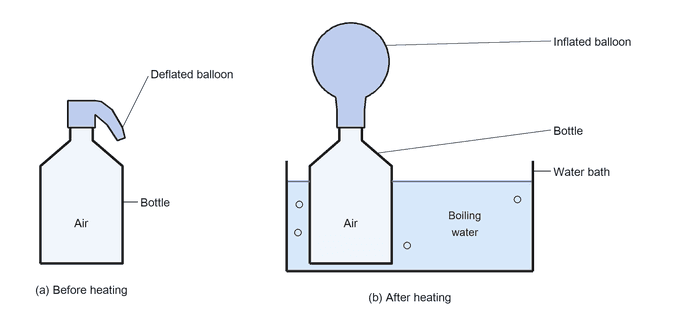
Step 4 — Observe.
After some time the balloon becomes inflated.
Step 5 — Conclude.
On heating, the air in the bottle expands. It can no longer fit inside the bottle, so the extra air goes into the balloon and blows it up. If the bottle is taken out and allowed to cool, the air contracts and the balloon goes flat again.
Therefore, the inflating of the balloon shows that air (a gas) expands on heating.
- 664 marks
Question 66
Describe an experiment to show that same volume of different liquids heated to same rise in temperature expand by different amounts.
Solve with AIWritten solution
Solution:
Concept: Equal volumes of different liquids expand by different amounts for the same rise in temperature. The book's coefficients of cubical expansion (per °C) are benzene , alcohol and kerosene . Water expands much less (about per °C near room temperature) and has no fixed value.
Step 1 — Collect the apparatus.
Take four identical glass flasks, each fitted with a cork and a narrow glass tube of the same bore, a large water bath with hot water, and four liquids: water, kerosene, alcohol and benzene.
Step 2 — Fill equal volumes.
Fill flasks A, B, C and D with water, kerosene, alcohol and benzene, so that each liquid stands at the same level in its tube. The flasks are identical, so the volumes are equal.
Step 3 — Give the same rise in temperature.
Place all four flasks together in the common hot-water bath, so that all the liquids are heated through the same rise in temperature.

Step 4 — Observe.
After some time the liquids stand at different levels. Benzene rises the most, then alcohol, then kerosene, and water rises the least. This is the order of their coefficients of cubical expansion.
Step 5 — Conclude.
Equal volumes of different liquids, heated through the same rise in temperature, expand by different amounts. The expansion depends on the nature of the liquid. Since the flasks are identical, the glass expands equally in all of them, so the difference in levels is due to the liquids alone.
Watch out: The tubes must have the same bore and the flasks must be identical; otherwise the levels cannot be compared.
Therefore, the different levels show that equal volumes of different liquids expand by different amounts for the same rise in temperature.
- 673 marks
Question 67
Give reason for the increase in rate of evaporation of a liquid when
(a) air is blown above the liquid
(b) surface area of liquid is increased
(c) temperature of liquid is increased.
Solve with AIWritten solution
Solution:
Concept: Evaporation is the change of a liquid into its vapour from its surface, at all temperatures. Only the surface molecules that have enough kinetic energy to overcome the attraction of the other molecules escape, and the heat needed is taken from the surroundings. The rate of evaporation increases with a rise in temperature, a larger surface area and wind (air blowing over the surface). It decreases when the air is humid (already holds much water vapour).
Step 1 — Air blown above the liquid.
The molecules that escape collect just above the surface, and some fall back into the liquid. Blowing air carries these vapour molecules away, so they cannot return and the air above stays ready to take more. More molecules leave each second, so evaporation is faster. Clothes dry quickly on a windy day.
Step 2 — Surface area increased.
Evaporation takes place only from the surface. A larger surface has more molecules at the surface, so more of them can escape at the same time. Water spread in a flat dish dries faster than the same water in a narrow glass.
Step 3 — Temperature increased.
At a higher temperature the molecules have more kinetic energy. A larger number of surface molecules then have enough energy to overcome the attraction of the others and escape, so evaporation is faster. Clothes dry faster in the sun than in the shade.
Therefore, evaporation becomes faster because (a) blowing air removes the escaped vapour, (b) a larger surface exposes more molecules, and (c) a higher temperature gives more molecules enough energy to escape.
- 682 marks
Question 68
Why does bubbles appear when a liquid is heated ?
Solve with AIWritten solution
Solution:
Concept: Boiling (vaporisation) is the change of a liquid into its vapour at a fixed temperature, the boiling point. It happens throughout the liquid: vapour bubbles form in all parts of it, and heat has to be supplied from a source such as a burner.
Step 1 — The first small bubbles.
Water and most liquids contain some dissolved air. As the liquid warms, it can hold less dissolved air, so the air comes out as tiny bubbles on the walls of the vessel, well before the liquid boils.
Step 2 — Vapour forming inside the liquid.
As heating continues, the molecules near the hot bottom and walls gain enough kinetic energy to overcome the attraction of their neighbours and change into vapour there, inside the liquid. This vapour collects as bubbles.
Step 3 — The bubbles grow and rise.
As more vapour forms, the bubbles grow, rise and burst at the surface, releasing the vapour. At the boiling point bubbles form throughout the liquid and the liquid boils.
Therefore, bubbles appear on heating because dissolved air comes out first, and then vapour forms inside the liquid where its molecules gain enough energy, and rises as bubbles.
- 692 marks
Question 69
Two iron rods – one 10 m long and the other 5 m long, are heated to the same rise in temperature. Which will expand more ?
Solve with AIWritten solution
Solution:
Concept: The increase in length of a rod on heating is . Here is the original length, the rise in temperature, and the coefficient of linear expansion, a number that depends only on the material (iron per °C, copper per °C).
Step 1 — Note what is the same.
Both rods are of iron (same ) and get the same rise in temperature . Only their original lengths differ, 10 m and 5 m.
Step 2 — Compare the expansions.
Dividing for the two rods, the and cancel.
Step 3 — See it with numbers.
For a rise of 50 °C, with per °C for iron, the longer rod grows by 6 mm and the shorter one by 3 mm.
Therefore, the 10 m long rod will expand more, twice as much as the 5 m rod.
- 702 marks
Question 70
Two identical rods of copper are heated to different temperatures – one by 5°C and the other by 10°C. Which rod will expand more ?
Solve with AIWritten solution
Solution:
Concept: The increase in length of a rod on heating is . Here is the original length, the rise in temperature, and the coefficient of linear expansion, a number that depends only on the material (iron per °C, copper per °C).
Step 1 — Note what is the same.
The rods are identical: same material (copper, same ) and same original length . Only the rise in temperature differs, 5 °C and 10 °C.
Step 2 — Compare the expansions.
Dividing for the two rods, the and cancel.
Step 3 — See it with numbers.
For 1 m rods of copper ( per °C), the rod heated by 10 °C grows by 0.17 mm and the other by 0.085 mm.
Therefore, the rod heated by 10 °C will expand more, twice as much as the rod heated by 5 °C.
- 712 marks
Question 71
One rod of copper and another identical rod of iron are heated to the same rise in temperature. Which rod will expand more ? Give reason.
Solve with AIWritten solution
Solution:
Concept: The increase in length of a rod on heating is . Here is the original length, the rise in temperature, and the coefficient of linear expansion, a number that depends only on the material (iron per °C, copper per °C).
Step 1 — Note what is the same.
The rods are identical in length and get the same rise in temperature. Only the material differs, so only differs.
Step 2 — Compare the coefficients.
The coefficient of linear expansion of copper ( per °C) is greater than that of iron ( per °C).
Step 3 — Give the reason in words.
Since the length and the rise in temperature are the same, the rod whose material has the larger coefficient of linear expansion expands more, and that is copper.
Therefore, the copper rod will expand more (about 1.4 times as much as the iron rod), because copper has the greater coefficient of linear expansion.
- 722 marks
Question 72
Two identical rods – one hollow and the other solid, are heated to the same rise in temperature. Which will expand more ?
Solve with AIWritten solution
Solution:
Concept: The increase in length of a rod on heating is . Here is the original length, the rise in temperature, and the coefficient of linear expansion, a number that depends only on the material (iron per °C, copper per °C).
Step 1 — List what the increase in length depends on.
The increase in length depends only on the original length, the rise in temperature and the material.
Step 2 — Compare the rods.
The rods are identical (same material, same length) and get the same rise in temperature, so all three factors are equal.
Step 3 — Why hollowness does not matter.
On heating, every part of a body expands in the same proportion, like a photographic enlargement; even the hollow space grows. So a hollow rod lengthens exactly as much as a solid one.
Watch out: A solid rod contains more metal, but the amount of metal does not appear in .
Therefore, both rods will expand equally.
- 732 marks
Question 73
In the ball and ring experiment, if the ball after heating is left to cool on the ring for some time, the ball again passes through the ring. Explain the reason.
Solve with AIWritten solution
Solution:
Concept: Thermal expansion is the increase in size of a substance on heating. On heating, the molecules move faster and the average distance between them (the inter-molecular separation) increases, so the substance expands. On cooling it contracts.
Step 1 — Recall why the heated ball stopped.
On heating, the ball expanded, so its diameter became larger than the hole of the ring and it could not pass through.
Step 2 — See what happens while it rests on the ring.
The hot ball gives out heat to the ring and to the air around it, so the ball cools. On cooling it contracts back towards its original size.
Step 3 — Add the effect on the ring.
The ring takes in some of this heat and expands a little, so its hole becomes slightly larger. Both changes help the ball through.
Therefore, the ball passes through again because on cooling it contracts to its original size (and the warmed ring's hole widens a little).
- 743 marks
Question 74
Explain the following :
(a) The telephone wires break in winter.
(b) Iron rims are heated before they are fixed on the wooden wheels.
(c) Gaps are left between the successive rails on a railway track.
(d) A glass stopper stuck in the neck of a bottle can be removed by pouring hot water on the neck of the bottle.
(e) A cement floor is laid in small pieces with gaps in between.
Solve with AIWritten solution
Solution:
Concept: Expansion on heating and contraction on cooling can do harm (bent rails, cracked floors, snapped wires) or be useful (fitting rims, loosening stoppers). In practice we either leave room for the change in size or make use of it.
Step 1 — (a) Telephone wires break in winter.
In winter the temperature falls, so the wires contract and become shorter. Since their ends are fixed to the poles, the contraction stretches them tight. If they were put up without enough slack, the extra pull can snap them. That is why wires put up in summer are left slightly loose.
Step 2 — (b) Iron rims are heated before fixing on wooden wheels.
The iron rim is made slightly smaller than the wheel. On heating, the rim expands and becomes just big enough to slip over the wheel. On cooling it contracts and grips the wheel very tightly.
Step 3 — (c) Gaps between successive rails.
In summer the rails get heated and expand. If no gaps were left, the expanding rails would push against each other and bend sideways, which could derail a train. The small gaps give them room to expand.
Step 4 — (d) Hot water frees a stuck glass stopper.
When hot water is poured on the neck, the neck gets heated and expands before the heat reaches the stopper inside. The neck becomes slightly wider than the stopper, so the stopper becomes loose and can be taken out.
Step 5 — (e) Cement floors are laid in pieces with gaps.
In summer the floor gets heated and expands. A single large slab would have no room to grow, so it would crack or bulge. Laid in small pieces with gaps, each piece can expand into the gap without cracking the floor.
Therefore, each case is explained by expansion on heating and contraction on cooling: either room is left for the change in size (a, c, e) or the change is made use of (b, d).
- 752 marks
Question 75
Why is one end of a steel girder in a bridge kept on rollers instead of fixing it in a pillar ?
Solve with AIWritten solution
Solution:
Concept: Expansion on heating and contraction on cooling can do harm (bent rails, cracked floors, snapped wires) or be useful (fitting rims, loosening stoppers). In practice we either leave room for the change in size or make use of it.
Step 1 — See how the girder changes.
A long steel girder expands in summer and contracts in winter, so its length changes a little through the year.
Step 2 — See what the rollers do.
One end of the girder is fixed on a pillar, and the other end rests on rollers. The rollers let this end move a little forward when the girder expands and backward when it contracts.
Step 3 — See what would happen without them.
If both ends were fixed, the girder could not change its length freely. It would push or pull on the pillars with very large forces, which could bend the girder or damage the pillars and the bridge.
Therefore, one end of the girder is kept on rollers so that it can expand and contract freely with changes in temperature without damaging the bridge.
- 762 marks
Question 76
An empty glass bottle is fitted with a narrow tube at its mouth. The open end of the tube is kept in a beaker containing water. When the bottle is heated, bubbles of air are seen escaping into water. Explain the reason.
Solve with AIWritten solution
Solution:
Concept: For the same rise in temperature, solids expand the least, liquids more, and gases the most. The weaker the attraction between the molecules, the more easily they move apart on heating.
Step 1 — See what is in the 'empty' bottle.
The 'empty' bottle is really full of air.
Step 2 — See what heating does.
When the bottle is heated, the air inside is heated and expands. A gas expands much more than the glass of the bottle, so the expanded air can no longer fit inside.
Step 3 — Explain the bubbles.
The extra air is pushed out through the narrow tube. Since the open end of the tube is under water, the air comes out as bubbles in the water.
Watch out: When heating stops and the air cools, it contracts and water may be drawn up into the tube.
Therefore, bubbles escape because the air in the bottle expands on heating and the extra air is pushed out through the tube into the water.
- 773 marks
Question 77
An iron washer is heated. State the effect on its (i) mass, (ii) internal diameter, (iii) external diameter, and (iv) density.
Solve with AIWritten solution
Solution:
Concept: Thermal expansion is the increase in size of a substance on heating. On heating, the molecules move faster and the average distance between them (the inter-molecular separation) increases, so the substance expands. On cooling it contracts. Density is mass ÷ volume. On heating, the mass of a body stays the same but its volume increases, so its density decreases.
Step 1 — (i) Mass.
Heating does not add or remove any iron, so the mass of the washer remains unchanged.
Step 2 — (ii) Internal diameter.
On heating, every part of the washer expands in the same proportion, like a photographic enlargement. The hole grows as if it were filled with iron, so the internal diameter increases.
Step 3 — (iii) External diameter.
The outer edge also moves outwards, so the external diameter increases.
Step 4 — (iv) Density.
The volume of the washer increases while its mass stays the same, so its density (mass ÷ volume) decreases.
Watch out: The hole does not become smaller on heating; it becomes larger along with the rest of the washer.
Therefore, on heating the washer's mass is unchanged, its internal and external diameters both increase, and its density decreases.
What Class 8 Physics Ch 6 covers
The sections of the chapter, in the order the book takes them. Every question above comes from one of these.
- 01Effects of Heat
- 02Effect of Temperature on Molecular Motion
- 03Evaporation
- 04Boiling
- 05Difference Between Evaporation and Boiling
- 06Thermal Expansion in Solids
- 07Thermal Expansion in Liquids
More ways to study this chapter
The same chapter asked three other ways. Practise it, revise it, and see what the board has set on Ch 6 before.
Class 8 Physics Ch 6 questions students ask
How many questions are there in Class 8 Physics Ch 6?
77 questions. Every one is solved step by step on this page.
Are these Class 8 Physics solutions free?
Yes. Every question and its full working is free to read, with no account needed.
Can I download the Class 8 Physics Ch 6 solutions as a PDF?
There is no PDF to download. Every solution is on this page instead, which means it is searchable, always the current syllabus, and readable on a phone. Use your browser's print option if you want it on paper.