
Opening your dashboard
Class 8 Physics Chapter 6 Heat Transfer: Competency-Based Questions (CBQ)
40 questions on Chapter 6, each worked through on its own page with the AI tutor. Class 8 Physics, ICSE 2026-27.
40 questions
1–5 marks · Mixed difficulty
- 11 mark
Question 1
Competency: Application
Meera comes out of a swimming pool on a day when a thermometer near the pool reads 30°C. While she stands in a sheltered corner she feels comfortable. When she walks into a strong breeze she starts shivering, although the thermometer still reads 30°C.
Which is the best explanation ?
- 21 mark
Question 2
Competency: Application & Analysis
The figure shows the bimetallic strip of the thermostat of an electric iron when the iron is cold. The strip is made of brass and iron riveted together, one forming the upper layer X and the other the lower layer Y. The current reaches the heating coil through the contact screw and the strip. When the iron becomes too hot, the strip must bend away from the screw so that the circuit breaks.

The coefficient of linear expansion of brass is per °C and that of iron is per °C.
Which arrangement is correct, and why ?
- 31 mark
Question 3
Competency: Analysis
A glass flask is filled with coloured water at 25°C and closed with a cork carrying a narrow glass tube that is open at the top. The water stands in the tube at a mark M. The flask is suddenly dipped into a trough of hot water. The level in the tube is seen to fall a little below M at first, and then to rise steadily far above M.
Which explanation fits both observations ?
- 41 mark
Question 4
Competency: Analysis
The same quantity of water is boiled in three vessels and the steady temperature of the boiling water is noted.
Vessel Where the water is boiled Temperature of the boiling water P open pan in a town by the sea 100°C Q open pan at a camp high on a mountain 90°C R closed pressure cooker in the same town by the sea 120°C Which conclusion can be drawn from these readings ?
- 51 mark
Question 5
Competency: Understanding
Assertion (A): When hot tea in a closed steel flask cools from 80°C to 30°C, its molecules move more slowly than before.
Reason (R): The average kinetic energy of the molecules of a substance is a measure of its temperature.
- 61 mark
Question 6
Competency: Understanding
Assertion (A): When water at 0°C is warmed to 4°C, its density increases.
Reason (R): Water, like every other liquid, expands whenever it is heated.
- 72 marks
Question 7
Competency: Evaluation
After a morning shower there was a shallow puddle on a tarred road. By noon the puddle had dried up completely. Rohan says, "Water changes into vapour at 100°C, so the puddle must have reached 100°C in the sun."
Is Rohan right ? Judge his statement, giving two reasons.
- 82 marks
Question 8
Competency: Application & Evaluation
A workshop has two metre rules, one of aluminium and one of steel. Each is exactly 1 m long at 0°C.
Metal Coefficient of linear expansion (per °C) Aluminium Steel (a) Find the increase in length of each rule on a day when the temperature is 40°C. Give your answers in mm.
(b) Which of the two metals is the better choice for a measuring rule ? Give a reason.
- 92 marks
Question 9
Competency: Understanding & Application
Asha screws the cap tightly on an empty plastic bottle in a warm kitchen and leaves the bottle in a freezer. An hour later the sides of the bottle are found pressed inwards. She then leaves the same closed bottle in the sun, and its sides come out again.
Explain both observations in terms of the motion of molecules.
- 102 marks
Question 10
Competency: Application & Analysis
A can contains 4 kg of kerosene. Its volume is 0.00500 m (5.00 litre) on a winter morning at 10°C and 0.00512 m (5.12 litre) on a summer afternoon at 40°C.
(a) Find the density of the kerosene at each temperature.
(b) A shop sells kerosene by the litre. Does a customer get more kerosene (by mass) in one litre on the winter morning or on the summer afternoon ? Give a reason.
- 114 marks
Question 11
Competency: Analysis
Case study: In the laboratory of a school in a hill town, a beaker of water is heated on a burner with a steady flame. A thermometer dipped in the water is read every minute. The graph shows the readings.
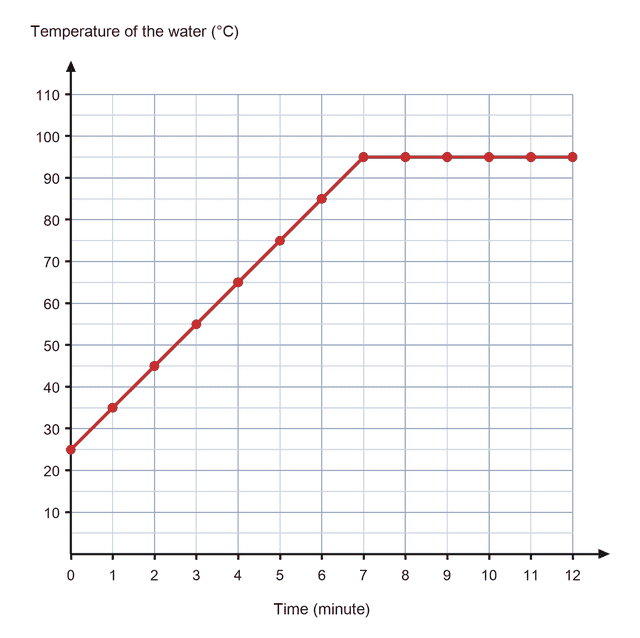
(a) From the graph, find the boiling point of water in this laboratory, the time at which the water starts to boil and the rise in temperature per minute before that.
(b) From the 7th to the 12th minute the burner keeps supplying heat, yet the temperature does not rise. What is this heat used for ? Answer in terms of the molecules of water.
(c) What does the boiling point found in (a) tell you about the atmospheric pressure in this town ? The experiment is repeated with the water in a pressure cooker. State one way in which the flat part of the graph will be different.
- 124 marks
Question 12
Competency: Application & Evaluation
Case study: A wheelwright has to fit a steel rim on the wooden wheel of a horse cart. The diameter of the wooden wheel is 1.002 m. In his workshop the inner diameter of the steel rim is 1.000 m. He heats the rim evenly in a ring of fire, slips it over the wheel and then pours water on it.
The diameter of a metal ring increases on heating just as the length of a rod of that metal does. Coefficient of linear expansion of steel per °C.
(a) Why is the rim made a little smaller than the wheel, and why is water poured on it at the end ?
(b) Find the inner diameter of the rim when its temperature has risen by 200°C. Will it slip over the wheel ?
(c) To save firewood, his helper suggests raising the temperature of the rim by only 100°C. Judge this suggestion with a calculation, and find the least rise in temperature that is needed.
- 134 marks
Question 13
Competency: Application & Analysis
Case study: A teacher shows how a liquid thermometer works. Two identical small glass bottles are filled completely, one with liquid X and the other with liquid Y. Each bottle is closed with a cork carrying an identical narrow glass tube, and both stand in the same water bath. The height of the liquid in each tube above the cork is noted as the bath is warmed.
Temperature of the bath (°C) 20 30 40 50 Height of X in its tube (mm) 10 15 20 25 Height of Y in its tube (mm) 10 14 18 22 One of the liquids is turpentine and the other is benzene. Coefficient of cubical expansion: turpentine per °C, benzene per °C. Take the expansion of the glass as too small to matter.
(a) By how much does each liquid rise in its tube for every 10°C rise in temperature ?
(b) Which liquid, X or Y, is benzene ? Give a reason.
(c) Each tube ends 32 mm above the cork. Up to what temperature can each bottle be used as a thermometer ? Suggest one change that would let thermometer Y be used up to 100°C.
- 143 marks
Question 14
Competency: Analysis & Evaluation
Case study: On a sea coast, salt is made by letting sea water stand in wide, shallow pans until all the water has evaporated. The owner notes the time taken for one filling of a pan to dry up in three periods of the year. The wind is about the same in all three.
Period Temperature in the daytime Air Days taken to dry P 36°C dry 8 Q 36°C humid 20 R 22°C dry 14 (a) Why are the pans made wide and shallow ?
(b) Which two periods should be compared to see the effect of temperature, and which two to see the effect of humidity ? State what each comparison shows.
(c) To save land, a worker suggests storing the same quantity of sea water in one narrow, deep tank instead of a wide pan. Judge this suggestion.
- 154 marks
Question 15
Competency: Creation
You are asked to make a simple air thermometer. You are given a small glass bottle, a cork with one hole, a narrow transparent tube about 30 cm long that fits the hole, a little coloured water, a ruler, a laboratory thermometer and a tub of water whose temperature can be changed by adding hot or cold water.
Design the thermometer and a test for it. Write :
(a) how you will set it up and take readings,
(b) two things you will keep the same so that the test is fair,
(c) a table for your readings, the result you expect and the reason for it.
- 161 mark
Question 16
Competency: Application
A steam pipeline in a sugar mill is made of steel. A straight stretch of it is 40 m long when the pipe is at 25°C. When steam flows through it, the pipe reaches 125°C. The coefficient of linear expansion of steel is per °C. The engineer fits a U-shaped loop in the line so that the pipe is not damaged when it lengthens. (Hypothetical data.)
By how much must the loop be able to take up the lengthening of this stretch?
- 171 mark
Question 17
Competency: Analysis
Three beakers P, Q and R hold the same liquid. A student watches each one for a while and writes down what she sees. (Hypothetical data.)
Beaker Thermometer reading What is seen Fall in the liquid level P 30°C, the same as the room, for a whole hour Vapour leaves only from the top surface; no bubbles 1 mm in an hour Q 60°C, rising slowly while the burner heats it Vapour leaves only from the top surface; no bubbles 5 mm in an hour R 78°C, steady for 10 minutes although the burner stays on Bubbles form all through the liquid, rise and burst at the surface 2 cm in 10 minutes Which statement is correct?
- 181 mark
Question 18
Competency: Evaluation
A cup holds 150 g of tea at 80°C. A bucket holds 10 kg of water at 30°C. Four students make statements about them. (Hypothetical data.)
Which student is correct?
- 191 mark
Question 19
Competency: Understanding
Assertion (A): When a block of ice at 0°C melts into water at 0°C, the average kinetic energy of its molecules stays the same.
Reason (R): The heat absorbed during melting is used to increase the average kinetic energy of the molecules.
- 201 mark
Question 20
Competency: Analysis
Assertion (A): A steel measuring tape that is correct at 20°C reads slightly too small when it is used to measure a fixed distance on a very hot day.
Reason (R): On the hot day the steel tape expands, so its marks move farther apart.
- 211 mark
Question 21
Competency: Application
Sana keeps an empty glass bottle in a refrigerator for an hour. She takes it out, wets a small coin and places it flat on the mouth of the bottle so that the mouth is closed. She then holds the bottle between her warm palms. After a few seconds the coin lifts a little with a clicking sound, drops back, and lifts again a few times.
Which is the best explanation?
- 221 mark
Question 22
Competency: Analysis
A few small pieces of camphor are heated gently in a dry test tube whose upper part is kept cool by a wet cloth. The pieces of camphor become smaller. No liquid is seen at the bottom of the tube, and white crystals gather on the cool upper wall of the tube.
Which pair of changes took place?
- 231 mark
Question 23
Competency: Evaluation
Lata is cooking rice in an open pan of water on a gas stove at a place near sea level. The water has just started to boil, and she turns the flame from medium to high, saying, "Now the water will get hotter than before, and the rice will cook faster."
Which is the best judgement of Lata's statement?
- 241 mark
Question 24
Competency: Analysis
The volumes of 500 g of each of three liquids P, Q and R were measured at different temperatures. One of them behaves like water. (Hypothetical data.)
Temperature (°C) 0 2 4 6 8 Volume of liquid P (cm) 500.08 500.03 500.00 500.03 500.08 Volume of liquid Q (cm) 500.0 500.9 501.8 502.7 503.6 Volume of liquid R (cm) 500.0 501.4 502.8 504.2 505.6 Which statement is supported by the table?
- 251 mark
Question 25
Competency: Analysis
A metal ball just passes through a ring made of the same metal when both are at 30°C. The figure shows four trials. In each one the ball and the ring are first brought to the temperatures given, and then the ball is tried on the ring.

In which trials will the ball not pass through the ring?
- 262 marks
Question 26
Competency: Application
A laboratory thermometer has a bulb that holds 0.20 cm of mercury at 0°C. The mercury thread rises in a very narrow tube whose cross-section has an area of cm. The coefficient of cubical expansion of mercury is per °C. Ignore the expansion of the glass. The volume of a thread of mercury is its cross-section area multiplied by its length. (Hypothetical data.)
(a) Find the increase in the volume of the mercury when the bulb is warmed from 0°C to 50°C.
(b) Through what distance does the end of the thread move along the tube?
- 272 marks
Question 27
Competency: Analysis
Ravi's tea is too hot to drink. His grandmother pours some of it into a saucer, and in a minute or two the tea in the saucer is cool enough to drink, while the tea left in the cup is still very hot.
Give two reasons, using the idea of molecules, why the tea in the saucer cools faster.
- 282 marks
Question 28
Competency: Application
One kilogram of steam at 100°C gives out J of heat when it condenses into water at 100°C. A cook's hand is touched by 10 g of steam at 100°C.
(a) Find the heat given out to the hand when this steam condenses into water at 100°C.
(b) Boiling water at 100°C also burns, but 10 g of it cooling to the temperature of the skin, 37°C, gives out only about J. Using this and your answer to (a), explain why steam causes a more severe burn than the same mass of boiling water.
- 292 marks
Question 29
Competency: Understanding
A drop of blue ink is added to the middle of a beaker of cold water at 10°C, and an identical drop to the middle of a beaker of hot water at 70°C. Both beakers are left perfectly still. The blue colour spreads through the hot water much faster than through the cold water.
(a) In which beaker do the molecules have the greater average kinetic energy?
(b) Using the idea of molecular motion, explain why the colour spreads faster there.
- 302 marks
Question 30
Competency: Understanding
In making a steel boiler, two steel plates are joined with rivets. Each rivet is heated red hot, put through the holes in the plates, and its plain end is hammered into a head. When the rivet cools, the joint is tight and does not leak steam.
(a) Why is the rivet heated before it is hammered?
(b) Why does the joint become tight when the rivet cools?
- 312 marks
Question 31
Competency: Evaluation
Kabir says, "When a metal rod is heated, the molecules inside it grow bigger, and that is why the rod becomes longer."
Is Kabir right? Give your reasoning in terms of what happens to the molecules.
- 323 marks
Question 32
Competency: Analysis
Paraffin wax is heated steadily in a beaker kept in a water bath, and its temperature is read every 2 minutes. (Hypothetical data.)
Time (minute) 0 2 4 6 8 10 12 14 16 Temperature (°C) 30 42 54 55 55 55 55 66 77 State of the wax solid solid solid starting to melt solid and liquid solid and liquid all liquid liquid liquid (a) Find the melting point of the wax and for how long it was melting.
(b) Name the effect of heat that is seen from 0 to 4 minutes, and the effect that is seen from 6 to 12 minutes.
(c) From 6 to 12 minutes, what happens to the average kinetic energy and the potential energy of the molecules of the wax? Give a reason.
- 333 marks
Question 33
Competency: Analysis
Ananya fills a tall, clear glass jar with cold water at 20°C and lets it become still. Holding the nozzle of a dropper at the bottom of the jar, she slowly releases a few drops of red-coloured hot water at 70°C.
(a) Predict what she sees the red water do.
(b) Explain this using the change in the density of water with temperature.
(c) What would you expect if she released a few drops of blue-coloured ice-cold water at 5°C at the top of a jar of water at 40°C?
- 343 marks
Question 34
Competency: Evaluation
A school lab assistant fills a glass bottle of capacity 1000 mL to the brim with ethyl alcohol and screws the cap on tightly. The bottle stands on a shelf near a window, where the temperature can rise from 15°C in the morning to 40°C in the afternoon. A colleague says, "You should fill the bottle only to about 95 % of its capacity." The coefficient of cubical expansion of ethyl alcohol is per °C. Take the volumes as measured at 15°C, and ignore the expansion of the glass. (Hypothetical data.)
(a) Find the increase in the volume of the alcohol in the brim-full bottle for the rise from 15°C to 40°C.
(b) Judge the colleague's advice.
(c) For the same volume and the same rise in temperature, would mercury need more or less air space than ethyl alcohol? Use the coefficient of mercury, per °C.
- 353 marks
Question 35
Competency: Application
A solid steel cube has edges of 10.00 cm at 0°C. When it is heated, its volume increases by 3.9 cm. The coefficient of linear expansion of steel is per °C. (Hypothetical data.)
(a) Find the coefficient of cubical expansion of steel.
(b) Find the temperature to which the cube is heated.
(c) Find the increase in the length of each edge.
- 363 marks
Question 36
Competency: Creativity
You are asked to make a simple model for your class that shows a metal rod becoming longer when it is heated. You may use a metal knitting needle (the rod), two wooden blocks with clamps, a thin drinking straw, a pin, a candle, a ruler and a sheet of paper.
(a) Describe how you will set up the model so that the very small increase in length can be seen.
(b) State two precautions you will take.
(c) State what you expect to see and why, and how you would show that an aluminium rod lengthens more than an iron rod of the same length.
- 374 marks
Question 37
Competency: Analysis
Case study: In a school laboratory two identical thermometers hang side by side in a room at 30°C. The bulb of thermometer A is left bare. The bulb of thermometer B is wrapped in a thin wet cotton cloth. Both are read every 2 minutes, and at the 10th minute a table fan is switched on. The graph shows the readings. (Hypothetical data.)
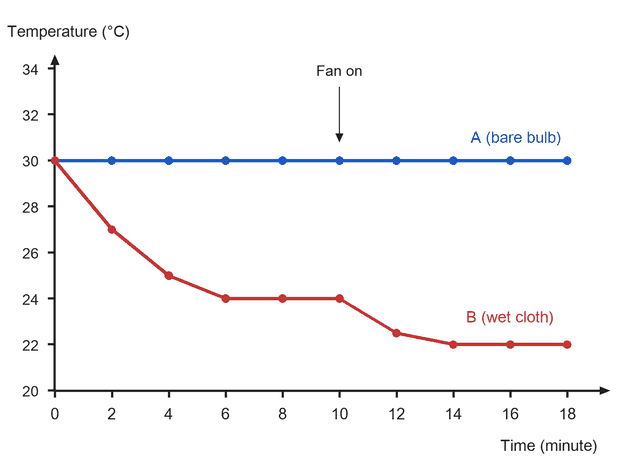
(a) Read from the graph the steady reading of thermometer A, and the lowest reading of B before the fan was switched on. By how many degrees did B fall?
(b) Why does the reading of B fall while the reading of A does not?
(c) What does the graph show about the effect of the fan on B? Explain it in terms of evaporation.
- 384 marks
Question 38
Competency: Analysis
Case study: A workshop owner in a small town buys two unmarked metal rods, P and Q, from a scrap dealer and wants to find out which metals they are. Each rod is exactly 1.000 m long at 0°C. He heats them in a furnace and measures how much each rod lengthens at different temperatures. The graph shows his results, and the table gives the coefficients of linear expansion of some metals. (Hypothetical data.)
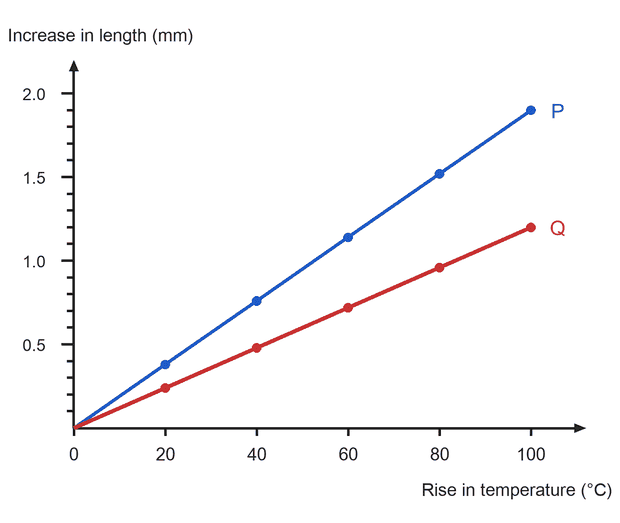
Metal Aluminium Brass Copper Steel Iron Coefficient of linear expansion ( per °C) 24 19 17 13 12 (a) From the graph, read the increase in length of each rod at 100°C.
(b) Calculate the coefficient of linear expansion of each rod, and name the metals.
(c) A 2.5 m rod of the metal of Q is heated from 0°C to 60°C. Find the increase in its length. Would a 2.5 m rod of the metal of P lengthen more or less under the same conditions?
- 395 marks
Question 39
Competency: Evaluation
Case study: A kitchenware shop owner wants to know which of three tumblers is safe for serving hot tea to her customers. She pours boiling water at 100°C into each tumbler, which is at room temperature, 25°C, and watches for a minute to see whether it cracks. The table shows the kind of glass, the thickness of the wall and the result for each tumbler. (Hypothetical data.)
Tumbler Kind of glass Thickness of the wall Coefficient of linear expansion ( per °C) Result X ordinary glass 6 mm 9 cracked at once Y ordinary glass 2 mm 9 did not crack Z Pyrex glass 6 mm 3 did not crack (a) Both X and Y are made of the same glass. Why did X crack and Y not?
(b) Z has a wall as thick as X. Why did Z not crack?
(c) Rank the three tumblers from the safest to the least safe for hot tea. Give a reason for your order.
- 404 marks
Question 40
Competency: Creativity
Case study: In a village without electricity, Mohan's mother wants to keep milk and tomatoes cool in the summer, when the daytime temperature is 42°C and the air is dry. A potter suggests a "pot-in-pot" cooler: a small earthen pot is placed inside a larger earthen pot, the space between them is packed with sand that is kept wet, and a wet cloth covers the top. The cooler is kept in the shade in the open air.
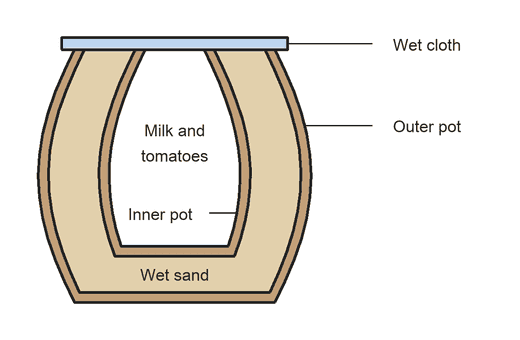
(a) Explain how this cooler keeps the food cool without electricity.
(b) Why will it work better in dry weather than in humid weather, and why should it be kept in the shade in the open air?
(c) Suggest two changes that would make it cool better. Give a reason for each.