Answer: (A) (1)
Concept: In an Assertion–Reason item, first judge whether A is true, then whether R is true, and only then ask whether R is the reason that makes A true.
In a pie chart the whole circle (360°) stands for the total. Each component gets a sector whose central angle is the same fraction of 360° as the component is of the total: Central angle=total valuevalue of the component×360∘. So the number a sector stands for is proportional to its central angle.
Step 1 — Read the angles.
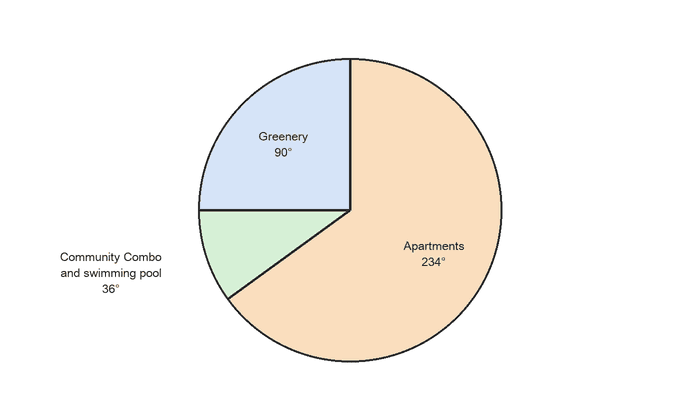
From the pie chart, the open area (greenery) has a central angle of 90° and the apartments have 234°. The three angles add up to 90∘+234∘+36∘=360∘, as they must.
Step 2 — Find the two areas.
Each area is its share of 360° times the total land, 144000 m².
Open area=36090×144,000=36,000 m2
Apartment area=360234×144,000=93,600 m2
Step 3 — Find the ratio.
We divide both areas by their H.C.F., 7,200.
Apartment areaOpen area=93,60036,000=135
So the ratio is 5 : 13, and A is true. Notice that it is also 90:234, the ratio of the angles.
Step 4 — Judge the Reason and whether it explains A.
R says the central angle of a sector is proportional to the value it represents. This is true, and it is exactly why the ratio of the areas equals the ratio of the angles. So R explains A: code (1).
Why the other options are wrong:
- (B): This says R does not explain A, but R is the very fact that makes the ratio of the areas equal to 90 : 234.
- (C): This says R is false, but a sector's angle is indeed proportional to the value it represents.
- (D): This says A is false, but 36,000 : 93,600 is 5 : 13, so A is true.
Therefore, both A and R are true and R explains A, code (1), option (A).