Answer: (B) (2)
Concept: In an Assertion–Reason item, first judge whether A is true, then whether R is true, and only then ask whether R is the reason that makes A true.
A bar graph shows data by bars (rectangles) of the same width standing on one axis, with equal gaps between them. Only the height of a bar carries information: it is proportional to the value the bar shows, so a suitable scale is chosen first.
Step 1 — Read the tallest and the shortest bars.
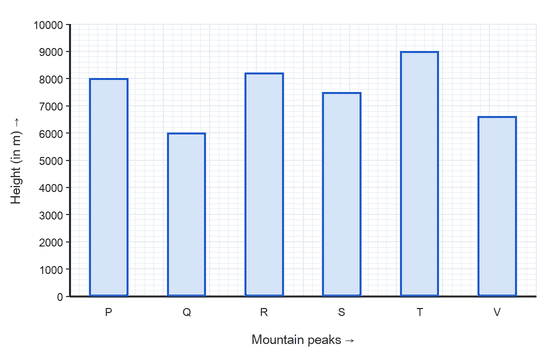
On the graph the tallest bar is T, which reaches 9000 m, and the shortest bar is Q, which reaches 6000 m.
Step 2 — Judge the Assertion.
We compare the two heights and simplify the ratio by dividing both by 3000.
9000:6000=3:2
So A is true.
Step 3 — Judge the Reason.
R is a correct rule for drawing bar graphs: the gaps between bars may be of any size, but they must all be equal. So R is true.
Step 4 — Decide whether R explains A.
R is about the spacing of the bars, while A is about their heights. R does not explain A, so this is code (2).
Why the other options are wrong:
- (A): This says R explains A, but R is about the gaps between bars and says nothing about their heights.
- (C): This says R is false, but equal gaps between the bars is a correct rule for bar graphs.
- (D): This says A is false, but 9000 : 6000 is 3 : 2, so A is true.
Therefore, both A and R are true but R does not explain A, code (2), option (B).