Answer: (A) (1)
Concept: In an Assertion–Reason item, first judge whether A is true, then whether R is true, and only then ask whether R is the reason that makes A true.
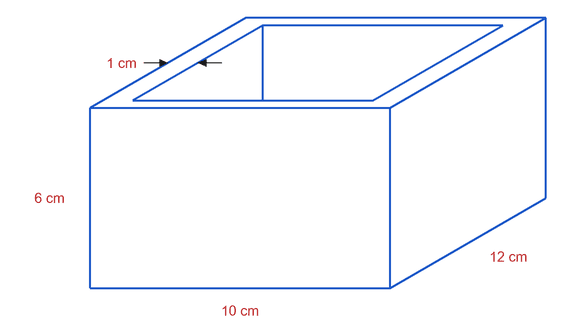
An open box has no lid. With walls t thick, its internal length and breadth are each 2t less than the external ones (a wall at both ends), but its internal height is only t less, because there is a base and no top.
Step 1 — Judge the Reason.
An open box has a wall at both ends of its length and of its breadth, so each loses 2x. It has a base but no lid, so the height loses only x. So R is true.
Step 2 — Judge the Assertion.
We use R with x=1 cm.
Internal length=10−2=8 cm
Internal breadth=12−2=10 cm
Internal height=6−1=5 cm
These are the values in A, so A is true.
Step 3 — Decide whether R explains A.
A is obtained by putting the numbers straight into R, so R is the correct explanation of A. This is code (1).
Watch out: For an OPEN box take off only one thickness from the height.
Why the other options are wrong:
- (B): This says R does not explain A, but A is just R used with x=1 cm.
- (C): This says R is false, but R is the correct rule for an open box.
- (D): This says A is false, but 8 cm, 10 cm and 5 cm are the correct internal dimensions.
Therefore, both A and R are true and R explains A, code (1), option (A).