
Opening your dashboard
Class 8 Maths Chapter 23: Surface Area, Volume and Capacity Solutions
68 textbook questions with step-by-step answers, free to read, for ICSE 2026-27.
Get talked through Ch 23, not just shown the answer
Reading a finished solution is not the same as being able to do it. The AI tutor takes one question at a time and works it with you, in your own words, until you can.
- Ask it out loud, in your own words
- It gives you the next step, not the answer
- Stuck on part (ii)? Start there
68 questions with solutions
1–3 marks · Mixed difficulty
The first 28 solutions are on this page. This chapter is a long one, so the rest open on their own page to keep this one quick to load.
- 11 mark
Question 1
The volume of a cuboid is 4800 cm³. If its length is 24 cm and breadth is 20 cm; its height is :
Solve with AIAnswer
(A) 5 cm
- Correct
(B) 10 cm
(C) 12 cm
(D) 15 cm
Answer: (B) 10 cm
Concept: A cuboid is a box shape with length , breadth and height . Its volume is . Its total surface area (all six faces) is , and its lateral surface area (the four side faces only, also called the area of the four walls) is .
Step 1 — Write the volume formula.
The volume of a cuboid is length × breadth × height, so the height is the volume divided by the area of the base (length × breadth).
Step 2 — Find the area of the base.
The base is 24 cm long and 20 cm broad.
Step 3 — Divide the volume by the base area.
Now we divide 4800 cm³ by 480 cm².
Why the other options are wrong:
- (A) 5 cm: A height of 5 cm gives a volume of 24 × 20 × 5 = 2400 cm³, only half of 4800 cm³.
- (C) 12 cm: A height of 12 cm gives 24 × 20 × 12 = 5760 cm³, more than 4800 cm³.
- (D) 15 cm: A height of 15 cm gives 24 × 20 × 15 = 7200 cm³, far more than 4800 cm³.
Therefore, the height of the cuboid is 10 cm, option (B).
- 21 mark
Question 2
The length, breadth and height of cuboid are in the ratio 3 : 2 : 1 and its volume is 162 cm³; the longest side of the cuboids is:
Solve with AIAnswer
(A) 6 cm
- Correct
(B) 9 cm
(C) 18 cm
(D) 54 cm
Answer: (B) 9 cm
Concept: When the sides are in a given ratio, write each side as its ratio number times one unknown ; the condition given (volume or surface area) then gives an equation in .
A cuboid is a box shape with length , breadth and height . Its volume is . Its total surface area (all six faces) is , and its lateral surface area (the four side faces only, also called the area of the four walls) is .
Step 1 — Write the sides using one unknown.
The sides are in the ratio 3 : 2 : 1, so we take them as , and cm. Their product is the volume.
Step 2 — Solve for x.
We divide both sides by 6 and then take the cube root.
Step 3 — Find the longest side.
The longest side is the one with the biggest ratio number, .
Watch out: The volume is the product of the three sides, so the equation is in , not ; take a cube root at the end.
Why the other options are wrong:
- (A) 6 cm: 6 cm is , the middle side (the breadth), not the longest one.
- (C) 18 cm: 18 cm is , the sum of the three sides, not the longest side.
- (D) 54 cm: 54 cm is 162 ÷ 3: it divides the volume by a ratio number instead of solving . Sides of 54, 36 and 18 cm would give a volume of 34,992 cm³.
Therefore, the longest side of the cuboid is 9 cm, option (B).
- 31 mark
Question 3
The length of a cuboid is doubled, breadth is halved and height is tripled, the volume of the cuboid will become :
Solve with AIAnswer
(A) 1·5 times
(B) 2 times
- Correct
(C) three times
(D) six times
Answer: (C) three times
Concept: A cuboid is a box shape with length , breadth and height . Its volume is . Its total surface area (all six faces) is , and its lateral surface area (the four side faces only, also called the area of the four walls) is .
Step 1 — Write the new dimensions.
Let the old length, breadth and height be , and . The new length is , the new breadth is and the new height is .
Step 2 — Multiply them to get the new volume.
The volume of a cuboid is length × breadth × height, so we multiply the new dimensions and collect the numbers.
Step 3 — Compare with the old volume.
The old volume is , so the new volume is 3 times the old one.
Watch out: Each change multiplies the volume by its own factor: ×2, then ×½, then ×3. Multiply all three factors; do not add them.
Why the other options are wrong:
- (A) 1·5 times: 1.5 is ½ × 3: it uses the halved breadth and the tripled height but forgets that the length is doubled.
- (B) 2 times: 2 times uses only the doubled length and ignores the other two changes.
- (D) six times: 6 = 2 × 3 uses the doubled length and the tripled height but forgets that the breadth is halved.
Therefore, the volume becomes three times the original, option (C).
- 41 mark
Question 4
Each side of a cube is tripled, its surface area will become :
Solve with AIAnswer
(A) 3 times
(B) six times
- Correct
(C) nine times
(D) 27 times
Answer: (C) nine times
Concept: A cube is a cuboid whose length, breadth and height are all equal to its edge . Its volume is , its total surface area is (six equal square faces) and its lateral surface area is (four faces).
Step 1 — Write the old surface area.
Let the edge of the cube be . A cube has 6 square faces, each of area .
Step 2 — Write the new surface area.
Each edge is tripled, so the new edge is and each face has area .
Step 3 — Compare.
The new surface area is 9 times the old one ().
Watch out: An area changes with the SQUARE of the scale factor (3² = 9), a volume with its CUBE (3³ = 27).
Why the other options are wrong:
- (A) 3 times: 3 times is the change in each edge (a length), not in an area.
- (B) six times: 6 is the number of faces of a cube; it is not a scale factor at all.
- (D) 27 times: 27 = 3³ is the change in the VOLUME of the cube, not its surface area.
Therefore, the surface area becomes nine times the original, option (C).
- 51 mark
Question 5
A cuboid has a total surface area of 80 m² and the lateral surface area of 50 m²; the area of its base is :
Solve with AIAnswer
(A) 30 m²
(B) 60 m²
- Correct
(C) 15 m²
(D) 10 m²
Answer: (C) 15 m²
Concept: A cuboid is a box shape with length , breadth and height . Its volume is . Its total surface area (all six faces) is , and its lateral surface area (the four side faces only, also called the area of the four walls) is .
Step 1 — See what T.S.A. minus L.S.A. leaves.
The total surface area covers all six faces; the lateral surface area covers only the four side faces. The difference is the top and the base, which are equal rectangles.
Step 2 — Halve it.
The top and the base are equal, so the base is half of 30 m².
Watch out: 80 − 50 gives the top AND the base together; halve it to get the base alone.
Why the other options are wrong:
- (A) 30 m²: 30 m² is the top and the base together, not the base alone.
- (B) 60 m²: 60 m² doubles 30 m² instead of halving it.
- (D) 10 m²: A base of 10 m² would make the top and base 20 m², and the total surface area 50 + 20 = 70 m², not 80 m².
Therefore, the area of the base is 15 m², option (C).
- 63 marks
Question 6
The length, the breadth and the height of a cuboid are in the ratio 5 : 3 : 2. If its volume is 240 cm³, find its dimensions. Also, find the total surface area of the cuboid.
Solve with AIWritten solution
Solution:
Concept: When the sides are in a given ratio, write each side as its ratio number times one unknown ; the condition given (volume or surface area) then gives an equation in .
A cuboid is a box shape with length , breadth and height . Its volume is . Its total surface area (all six faces) is , and its lateral surface area (the four side faces only, also called the area of the four walls) is .
Given: Length : breadth : height = 5 : 3 : 2 and volume = 240 cm³.
Step 1 — Write the sides using one unknown.
The ratio is 5 : 3 : 2, so let the length, breadth and height be , and cm. Their product is the volume, 240 cm³.
Step 2 — Solve for x.
We divide both sides by 30 and then take the cube root ().
Step 3 — Find the dimensions.
We put into each side.
Step 4 — Find the total surface area.
The total surface area of a cuboid is .
Watch out: The volume equation has , so take a cube root (), not a square root or a plain division.
Therefore, the dimensions are 10 cm, 6 cm and 4 cm, and the total surface area is 248 cm².
- 73 marks
Question 7
The length, breadth and height of a cuboid are in the ratio 6 : 5 : 3. If its total surface area is 504 cm², find its dimensions. Also, find the volume of the cuboid.
Solve with AIWritten solution
Solution:
Concept: When the sides are in a given ratio, write each side as its ratio number times one unknown ; the condition given (volume or surface area) then gives an equation in .
A cuboid is a box shape with length , breadth and height . Its volume is . Its total surface area (all six faces) is , and its lateral surface area (the four side faces only, also called the area of the four walls) is .
Given: Length : breadth : height = 6 : 5 : 3 and total surface area = 504 cm².
Step 1 — Write the sides using one unknown.
The ratio is 6 : 5 : 3, so let the sides be , and cm. We put them into the total surface area .
Step 2 — Solve for x.
We divide both sides by 126 and take the positive square root, since a length is positive.
Step 3 — Find the dimensions.
We put into each side.
Step 4 — Find the volume.
The volume is length × breadth × height.
Watch out: The surface area equation has (areas), so take a square root here; the volume equation in the previous question had .
Therefore, the dimensions are 12 cm, 10 cm and 6 cm, and the volume is 720 cm³.
- 83 marks
Question 8
Find the length of each edge of a cube, if its volume is :
(i) 216 cm³ (ii) 1·728 m³
Solve with AIWritten solution
Solution:
Concept: A cube is a cuboid whose length, breadth and height are all equal to its edge . Its volume is , its total surface area is (six equal square faces) and its lateral surface area is (four faces).
Step 1 — Part (i): find the cube root of 216.
The volume of a cube is , so the edge is the cube root of the volume. We split 216 into prime factors and group them in threes.
Step 2 — Write the edge for part (i).
Since , the edge is 6 cm.
Step 3 — Part (ii): write 1.728 as a fraction.
Moving the decimal point three places gives a fraction whose top and bottom are both cubes ( and ).
Step 4 — Write the edge for part (ii).
Since , the edge is 1.2 m.
Watch out: The edge is the CUBE root of the volume, not the square root, and not the volume divided by 3.
Therefore, the edge is (i) 6 cm and (ii) 1.2 m.
- 93 marks
Question 9
The total surface area of a cube is 216 cm². Find its volume.
Solve with AIWritten solution
Solution:
Concept: A cube is a cuboid whose length, breadth and height are all equal to its edge . Its volume is , its total surface area is (six equal square faces) and its lateral surface area is (four faces).
Given: Total surface area = 216 cm².
Step 1 — Use the total surface area.
A cube has 6 equal square faces, so its total surface area is .
Step 2 — Find the volume.
The edge is 6 cm, and the volume of a cube is the edge cubed.
Watch out: 216 cm² is the area of all six faces; divide by 6 first to get one face ().
Therefore, the volume of the cube is 216 cm³.
- 103 marks
Question 10
A wall 9 m long, 6 m high and 20 cm thick, is to be constructed using bricks of dimensions 30 cm, 15 cm and 10 cm. How many bricks will be required ?
Solve with AIWritten solution
Solution:
Concept: A cuboid is a box shape with length , breadth and height . Its volume is . Its total surface area (all six faces) is , and its lateral surface area (the four side faces only, also called the area of the four walls) is .
Number of bricks = volume of the wall ÷ volume of one brick (both in the same unit). The mortar between bricks is ignored.
Given: Wall 9 m × 6 m × 20 cm; brick 30 cm × 15 cm × 10 cm.
Step 1 — Change every length to centimetres.
The bricks are measured in cm, so the wall must be too: 9 m = 900 cm and 6 m = 600 cm; the thickness is already 20 cm.
Step 2 — Find the volume of the wall.
The wall is a cuboid.
Step 3 — Find the volume of one brick.
Each brick is also a cuboid.
Step 4 — Divide.
The number of bricks is the volume of the wall divided by the volume of one brick.
Watch out: Change metres to centimetres BEFORE multiplying; mixing m and cm gives a wrong count.
Therefore, 2400 bricks will be required.
- 113 marks
Question 11
A solid cube of edge 14 cm is melted down and recast into smaller and equal cubes each of edge 2 cm. Find the number of smaller cubes obtained.
Solve with AIWritten solution
Solution:
Concept: When a solid is melted and recast, its volume stays the same; only the shape changes.
A cube is a cuboid whose length, breadth and height are all equal to its edge . Its volume is , its total surface area is (six equal square faces) and its lateral surface area is (four faces).
Given: Big cube edge 14 cm; small cubes of edge 2 cm.
Step 1 — Find the volume of the big cube.
The big cube has edge 14 cm.
Step 2 — Find the volume of one small cube.
Each small cube has edge 2 cm.
Step 3 — Divide.
Melting keeps the volume, so the number of small cubes is the big volume divided by one small volume.
Watch out: Dividing the edges (14 ÷ 2) gives 7, only the number of small cubes along ONE edge; the total number is .
Therefore, 343 smaller cubes are obtained.
- 123 marks
Question 12
A closed box is a cuboid in shape with length = 40 cm, breadth = 30 cm and height = 50 cm. It is made of thin metal sheet. Find the cost of metal sheets required to make 20 such boxes, if 1 m² of metal sheet costs ₹ 45.
Solve with AIWritten solution
Solution:
Concept: A cuboid is a box shape with length , breadth and height . Its volume is . Its total surface area (all six faces) is , and its lateral surface area (the four side faces only, also called the area of the four walls) is .
Units must match before you divide or multiply: and .
Given: Closed box 40 cm × 30 cm × 50 cm; 20 boxes; sheet at ₹ 45 per m².
Step 1 — Find the sheet for one box.
The box is closed, so the sheet covers all six faces: its total surface area.
Step 2 — Change to square metres.
The rate is per m², and 1 m² = 10,000 cm².
Step 3 — Find the sheet for 20 boxes.
We multiply by the number of boxes.
Step 4 — Find the cost.
Each m² costs ₹ 45, so we multiply the area by 45. The cost is ₹ 846.
Watch out: 1 m² is 10,000 cm², not 100 cm²: divide by 10,000 to change cm² to m².
Therefore, the cost of the metal sheet for 20 boxes is ₹ 846.
- 133 marks
Question 13
Four cubes, each of edge 9 cm, are joined as shown below :
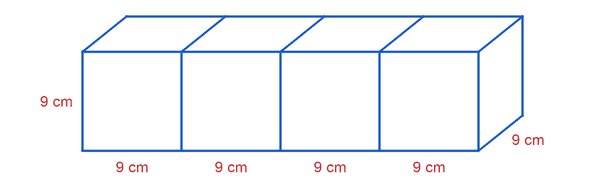
Write the dimensions of the cuboid obtained. Also, find total surface area and volume.
Solve with AIWritten solution
Solution:
Concept: A cuboid is a box shape with length , breadth and height . Its volume is . Its total surface area (all six faces) is , and its lateral surface area (the four side faces only, also called the area of the four walls) is .
Given: Four cubes of edge 9 cm joined in a row.
Step 1 — Write the dimensions.
The four cubes stand in a row, so their edges add up along the length, while the breadth and the height stay one edge (9 cm).
Step 2 — Find the total surface area.
The result is a cuboid 36 cm × 9 cm × 9 cm, so we use .
Step 3 — Find the volume.
The volume is length × breadth × height.
Step 4 — Check the volume.
Joining the cubes does not change the total volume, so it must equal 4 cubes of cm³ each.
Watch out: The surface area is NOT 4 × (6 × 81) = 1944 cm², because the faces pressed together are hidden; the volume, however, is just added.
Therefore, the cuboid is 36 cm × 9 cm × 9 cm, its total surface area is 1458 cm² and its volume is 2916 cm³.
- 143 marks
Question 14
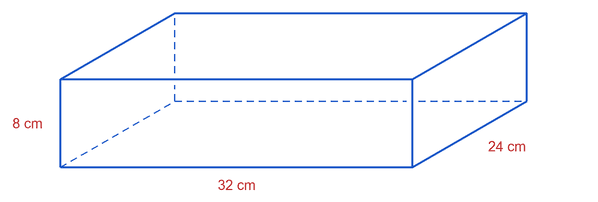
What is the maximum length of a rod which can be kept in a rectangular box with internal dimensions 32 cm × 24 cm × 8 cm.
 Solve with AI
Written solution
Solution:
Concept: A cuboid is a box shape with length , breadth and height . Its volume is . Its total surface area (all six faces) is , and its lateral surface area (the four side faces only, also called the area of the four walls) is .
The diagonal of a cuboid (corner to opposite corner through the inside) is , by using Pythagoras' theorem twice.
Given: Internal dimensions 32 cm × 24 cm × 8 cm.
Step 1 — Decide where the longest rod fits.
The longest straight rod reaches from one corner of the box to the opposite corner: this is the diagonal of the cuboid, .

Step 2 — Put in the dimensions.
Here , and (all in cm).
Watch out: The diagonal of the floor, cm, is not the longest; tilting the rod up to the far top corner gives a little more.
Therefore, the maximum length of the rod is cm, that is about 40.79 cm.
- 153 marks
Question 15
The diagonal of a cube is m.

Find its surface area.
Solve with AIWritten solution
Solution:
Concept: A cube is a cuboid whose length, breadth and height are all equal to its edge . Its volume is , its total surface area is (six equal square faces) and its lateral surface area is (four faces).
The diagonal of a cube (corner to opposite corner through the inside) is .
Given: Diagonal of the cube = m.
Step 1 — Find the edge.
The diagonal of a cube of edge is , so we compare it with .
Step 2 — Find the surface area.
A cube has 6 square faces, so its surface area is .
Watch out: The face diagonal is ; the cube's own diagonal is .
Therefore, the surface area of the cube is 3,750 m².
- 163 marks
Question 16
A rectangular room is 4·5 m long, 4 m wide and 3 m high. Find the cost of white washing its walls and the roof at ₹ 15 per square metre.
Solve with AIWritten solution
Solution:
Concept: The four walls of a room are rectangles whose total length is the perimeter of the floor, so the area of the four walls is . Doors and windows are not painted or papered, so their areas are taken away. Cost = area × rate.
Given: Room 4.5 m × 4 m × 3 m; rate ₹ 15 per m².
Step 1 — Find the area of the four walls.
The walls go all round the room, so their area is the perimeter of the floor times the height.
Step 2 — Find the area of the roof.
The roof is a rectangle the same size as the floor.
Step 3 — Add and find the cost.
White washing covers the walls and the roof, at ₹ 15 per m². The cost is ₹ 1,035.
Watch out: The floor is not white-washed, so do not use the total surface area ; use the four walls plus the roof only.
Therefore, the cost of white washing the walls and the roof is ₹ 1,035.
- 171 mark
Question 17
The dimensions of a hall are 40 m × 25 m × 5 m. The number of persons which can be accommodated in the hall is (each person requires 5 m³ of air) :
Solve with AIAnswer
- Correct
(A) 1000
(B) 2000
(C) 5000
(D) 2500
Answer: (A) 1000
Concept: A cuboid is a box shape with length , breadth and height . Its volume is . Its total surface area (all six faces) is , and its lateral surface area (the four side faces only, also called the area of the four walls) is .
Step 1 — Find the volume of the hall.
The hall is a cuboid, so its volume is length × breadth × height.
Step 2 — Divide by the air for one person.
Each person needs 5 m³ of air, so we divide the volume by 5.
Why the other options are wrong:
- (B) 2000: 2000 = 5000 ÷ 2.5: it gives each person only 2.5 m³ of air instead of 5 m³.
- (C) 5000: 5000 is the volume of the hall in m³, not the number of persons.
- (D) 2500: 2500 = 5000 ÷ 2: it gives each person only 2 m³ of air instead of 5 m³.
Therefore, 1000 persons can be accommodated, option (A).
- 181 mark
Question 18
The external dimensions of a closed rectangular box are 82 cm × 47 cm × 60 cm. If it is made of wood of 1 cm thickness, the internal dimensions of the box are :
Solve with AIAnswer
(A) 80 cm × 47 cm × 60 cm
(B) 82 cm × 45 cm × 60 cm
(C) 82 cm × 47 cm × 58 cm
- Correct
(D) 80 cm × 45 cm × 58 cm
Answer: (D) 80 cm × 45 cm × 58 cm
Concept: For a closed box whose walls are thick, each internal dimension is less than the external one, because there is a wall at both ends of every dimension. The capacity of the box is its internal volume, and the volume of material used is the external volume minus the internal volume.
Step 1 — See how much each dimension loses.
The box is closed, so there is a 1 cm wall at both ends of the length, of the breadth and of the height. Each internal dimension is 2 × 1 = 2 cm less than the external one.
Step 2 — Subtract 2 cm from each.
We take 2 cm off all three external dimensions.
Watch out: A closed box has walls on BOTH sides in every direction, so subtract twice the thickness from every dimension.
Why the other options are wrong:
- (A) 80 cm × 47 cm × 60 cm: This reduces only the length (82 → 80) and leaves the breadth and height unchanged.
- (B) 82 cm × 45 cm × 60 cm: This reduces only the breadth (47 → 45) and leaves the length and height unchanged.
- (C) 82 cm × 47 cm × 58 cm: This reduces only the height (60 → 58) and leaves the length and breadth unchanged.
Therefore, the internal dimensions are 80 cm × 45 cm × 58 cm, option (D).
- 191 mark
Question 19
The outer dimensions of a closed small box are 12 cm × 12 cm × 10 cm. If it is made of 1 cm thick walls, its capacity is :
Solve with AIAnswer
(A) 1440 cm³
(B) 1000 cm³
(C) 640 cm³
- Correct
(D) 800 cm³
Answer: (D) 800 cm³
Concept: For a closed box whose walls are thick, each internal dimension is less than the external one, because there is a wall at both ends of every dimension. The capacity of the box is its internal volume, and the volume of material used is the external volume minus the internal volume.
Step 1 — Find the internal dimensions.
The walls are 1 cm thick on both sides, so each dimension is 2 cm less inside.
Step 2 — Find the capacity.
The capacity is the volume of the space inside.
Watch out: Capacity is the INSIDE volume; never use the outer dimensions for it.
Why the other options are wrong:
- (A) 1440 cm³: 1440 cm³ = 12 × 12 × 10 is the external volume, not the capacity.
- (B) 1000 cm³: 1000 cm³ = 10 × 10 × 10 reduces the length and breadth but forgets to reduce the height to 8 cm.
- (C) 640 cm³: 640 cm³ = 8 × 8 × 10 takes 4 cm off the length and breadth and nothing off the height.
Therefore, the capacity of the box is 800 cm³, option (D).
- 201 mark
Question 20
A room is 3 m long, 2 m broad and 2 m high. It has one door 2 m × 1 m; two windows each 1 m × 0·5 m; the remaining area of the walls is :
Solve with AIAnswer
(A) 16 m²
- Correct
(B) 17 m²
(C) 20 m²
(D) 5 m²
Answer: (B) 17 m²
Concept: The four walls of a room are rectangles whose total length is the perimeter of the floor, so the area of the four walls is . Doors and windows are not painted or papered, so their areas are taken away. Cost = area × rate.
Step 1 — Find the area of the four walls.
The area of the four walls is the perimeter of the floor times the height.
Step 2 — Find the area of the door and windows.
These openings are not part of the wall surface.
Step 3 — Subtract.
We take the openings away from the walls.
Watch out: There are TWO windows of 0.5 m² each, so together they are 1 m².
Why the other options are wrong:
- (A) 16 m²: 16 m² = 20 − 2 − 2 takes off 2 m² for the windows; two windows of 1 m × 0.5 m have a total area of only 1 m².
- (C) 20 m²: 20 m² is the area of all four walls with nothing taken off for the door and windows.
- (D) 5 m²: 5 m² is far too small: the walls are 20 m² and the openings only 3 m², so 17 m² is left.
Therefore, the remaining area of the walls is 17 m², option (B).
- 213 marks
Question 21
A room 5 m long, 4·5 m wide and 3·6 m high has one door 1·5 m by 2·4 m and two windows, each 1 m by 0·75 m. Find :
(i) the area of its walls, excluding doors and windows.
(ii) the cost of distempering its walls at the rate of ₹ 4·50 per m².
(iii) the cost of painting its roof at the rate of ₹ 9 per m².
Solve with AIWritten solution
Solution:
Concept: The four walls of a room are rectangles whose total length is the perimeter of the floor, so the area of the four walls is . Doors and windows are not painted or papered, so their areas are taken away. Cost = area × rate.
Given: Room 5 m × 4.5 m × 3.6 m; one door 1.5 m × 2.4 m; two windows 1 m × 0.75 m each.
Step 1 — Find the area of the four walls.
The area of the four walls is the perimeter of the floor times the height.
Step 2 — Find the area of the door and the windows.
These openings are left out of the wall area.
Step 3 — Part (i): subtract the openings.
We take the door and the windows away from the walls.
Step 4 — Part (ii): cost of distempering.
Each m² costs ₹ 4.50, so we multiply the area by 4.50. The cost is ₹ 284.85.
Step 5 — Part (iii): cost of painting the roof.
The roof is the same size as the floor, 5 m × 4.5 m, and each m² costs ₹ 9. The cost is ₹ 202.50.
Watch out: Count BOTH windows, and use the floor's length and breadth (not the height) for the roof.
Therefore, (i) the area of the walls is 63.3 m², (ii) the cost of distempering is ₹ 284.85 and (iii) the cost of painting the roof is ₹ 202.50.
- 223 marks
Question 22
The dining hall of a hotel is 75 m long, 60 m broad and 16 m high. It has five doors 4 m by 3 m each and four windows 3 m by 1·6 m each. Find the cost of :
(i) papering its walls at the rate of ₹ 12 per m²;
(ii) carpeting its floor at the rate of ₹ 25 per m².
Solve with AIWritten solution
Solution:
Concept: The four walls of a room are rectangles whose total length is the perimeter of the floor, so the area of the four walls is . Doors and windows are not painted or papered, so their areas are taken away. Cost = area × rate.
Given: Hall 75 m × 60 m × 16 m; five doors 4 m × 3 m; four windows 3 m × 1.6 m.
Step 1 — Find the area of the four walls.
The area of the four walls is the perimeter of the floor times the height.
Step 2 — Find the area of the doors and windows.
There are five doors of 4 m × 3 m and four windows of 3 m × 1.6 m.
Step 3 — Part (i): area to be papered and its cost.
We take the openings away from the walls and multiply by the rate of ₹ 12 per m². The cost is ₹ 50,889.60.
Step 4 — Part (ii): cost of carpeting the floor.
The floor is 75 m × 60 m and the rate is ₹ 25 per m². The cost is ₹ 1,12,500.
Watch out: Multiply each opening's area by how many there are (5 doors, 4 windows) before subtracting.
Therefore, (i) the cost of papering the walls is ₹ 50,889.60 and (ii) the cost of carpeting the floor is ₹ 1,12,500.
- 233 marks
Question 23
Find the volume of wood required to make a closed box of external dimensions 80 cm, 75 cm and 60 cm, the thickness of walls of the box being 2 cm throughout.
Solve with AIWritten solution
Solution:
Concept: For a closed box whose walls are thick, each internal dimension is less than the external one, because there is a wall at both ends of every dimension. The capacity of the box is its internal volume, and the volume of material used is the external volume minus the internal volume.
Given: Closed box, external dimensions 80 cm × 75 cm × 60 cm; walls 2 cm thick.
Step 1 — Find the internal dimensions.
The box is closed and its walls are 2 cm thick, so each internal dimension is 4 cm less than the external one (a 2 cm wall at each end).
Step 2 — Find the external and internal volumes.
Both are volumes of cuboids.
Step 3 — Subtract.
The wood fills the space between the outside and the inside.
Watch out: Take off 2 × 2 = 4 cm from each dimension, not 2 cm, because there is a wall at both ends.
Therefore, the volume of wood required is 57,824 cm³.
- 243 marks
Question 24
A closed box measures 66 cm, 36 cm and 21 cm from outside. If its walls are made of metal sheet, 0·5 cm thick, find :
(i) the capacity of the box;
(ii) volume of metal sheet used and
(iii) weight of the box, if 1 cm³ of metal weighs 3·6 g.
Solve with AIWritten solution
Solution:
Concept: For a closed box whose walls are thick, each internal dimension is less than the external one, because there is a wall at both ends of every dimension. The capacity of the box is its internal volume, and the volume of material used is the external volume minus the internal volume.
Given: Closed box, external 66 cm × 36 cm × 21 cm; sheet 0.5 cm thick; 1 cm³ of metal weighs 3.6 g.
Step 1 — Find the internal dimensions.
The walls are 0.5 cm thick on both sides, so each internal dimension is 1 cm less than the external one (a 0.5 cm wall at each end).
Step 2 — Part (i): capacity.
The capacity is the internal volume.
Step 3 — Part (ii): volume of metal.
The metal is the external volume minus the internal volume.
Step 4 — Part (iii): weight of the box.
Each cm³ of metal weighs 3.6 g, so we multiply the volume of metal by 3.6.
Since 1 kg = 1000 g, this weight in kilograms is 15,825.6 ÷ 1000 = 15.8256 kg, about 15.83 kg.
Watch out: The weight comes from the metal only, so multiply 3.6 g by the volume of METAL (4396 cm³), not by the capacity.
Therefore, (i) the capacity is 45,500 cm³, (ii) the volume of metal is 4396 cm³ and (iii) the box weighs 15,825.6 g (about 15.83 kg).
- 253 marks
Question 25
The internal length, breadth and height of a closed box are 1 m, 80 cm and 25 cm respectively. If its sides are made of 2·5 cm thick wood, find :
(i) the capacity of the box
(ii) the volume of wood used to make the box.
Solve with AIWritten solution
Solution:
Concept: For a closed box whose walls are thick, each internal dimension is less than the external one, because there is a wall at both ends of every dimension. The capacity of the box is its internal volume, and the volume of material used is the external volume minus the internal volume.
Given: Closed box, INTERNAL dimensions 1 m × 80 cm × 25 cm; wood 2.5 cm thick.
Step 1 — Use the same units.
1 m = 100 cm, so the internal dimensions are 100 cm, 80 cm and 25 cm.
Step 2 — Part (i): capacity.
The given dimensions are the INTERNAL ones, so they give the capacity directly.
Step 3 — Find the external dimensions.
The box is closed and the wood is 2.5 cm thick, so each external dimension is 2 × 2.5 = 5 cm MORE than the internal one: 105 cm, 85 cm and 30 cm.
Step 4 — Part (ii): volume of wood.
The wood is the external volume minus the internal volume.
Watch out: Here the internal dimensions are given, so ADD twice the thickness to get the outside; do not subtract it.
Note: If 1 m, 80 cm and 25 cm were taken as the external dimensions, the answers would be 1,42,500 cm³ and 57,500 cm³; the question says they are internal, so the answers above follow the question.
Therefore, (i) the capacity of the box is 2,00,000 cm³ (0.2 m³) and (ii) the volume of wood used is 67,750 cm³.
- 263 marks
Question 26
Find the area of metal sheet required to make an open tank of length = 10 m, breadth = 7·5 m and depth = 3·8 m.
Solve with AIWritten solution
Solution:
Concept: An open box has no lid. With walls thick, its internal length and breadth are each less than the external ones (a wall at both ends), but its internal height is only less, because there is a base and no top.
The four walls of a room are rectangles whose total length is the perimeter of the floor, so the area of the four walls is . Doors and windows are not painted or papered, so their areas are taken away. Cost = area × rate.
Given: Open tank 10 m × 7.5 m × 3.8 m deep.
Step 1 — Find the area of the four walls.
The tank has four side walls whose area is the perimeter of the base times the depth.
Step 2 — Find the area of the base.
The tank is open, so it has a base but no top.
Step 3 — Add.
The metal sheet covers the four walls and the base.
Watch out: An open tank has no lid, so add the base only once; the total surface area would wrongly include a top.
Therefore, the area of metal sheet required is 208 m².
- 273 marks
Question 27
A tank 30 m long, 24 m wide and 4·5 m deep is to be made. It is open from the top. Find the cost of iron sheet required, at the rate of ₹ 65 per m², to make the tank.
Solve with AIWritten solution
Solution:
Concept: An open box has no lid. With walls thick, its internal length and breadth are each less than the external ones (a wall at both ends), but its internal height is only less, because there is a base and no top.
The four walls of a room are rectangles whose total length is the perimeter of the floor, so the area of the four walls is . Doors and windows are not painted or papered, so their areas are taken away. Cost = area × rate.
Given: Open tank 30 m × 24 m × 4.5 m deep; iron sheet at ₹ 65 per m².
Step 1 — Find the area of the four walls.
The four walls have area equal to the perimeter of the base times the depth.
Step 2 — Find the area of the base.
The tank is open at the top, so only the base is added.
Step 3 — Find the total sheet and its cost.
We add the walls and the base, then multiply by the rate of ₹ 65 per m². The cost is ₹ 78,390.
Watch out: The top is open, so do not include a top face in the sheet.
Therefore, the cost of the iron sheet is ₹ 78,390.
- 283 marks
Question 28
The edges of three solid cubes are 6 cm, 8 cm and 10 cm. These cubes are melted and recasted into a single cube. Find the edge of the resulting cube.
Solve with AIWritten solution
Solution:
Concept: When a solid is melted and recast, its volume stays the same; only the shape changes.
A cube is a cuboid whose length, breadth and height are all equal to its edge . Its volume is , its total surface area is (six equal square faces) and its lateral surface area is (four faces).
Given: Cubes of edges 6 cm, 8 cm and 10 cm melted into one cube.
Step 1 — Find the total volume.
Melting keeps the volume, so the new cube's volume is the sum of the three volumes.
Step 2 — Take the cube root.
The new edge satisfies , and .
Watch out: Add the VOLUMES, not the edges: 6 + 8 + 10 = 24 cm is wrong.
Therefore, the edge of the resulting cube is 12 cm.
- 293 marks
Question 29
The ratio between the lengths of the edges of two cubes are in the ratio 3 : 2. Find the ratio between their :
(i) total surface area (ii) volume.
- 303 marks
Question 30
The length, breadth and height of a cuboid (rectangular solid) are 4 : 3 : 2.
(i) If its surface area is 2548 cm², find its volume.
(ii) If its volume is 3000 m³, find its surface area.
- 311 mark
Question 31
The curved surface area of a cylinder, with length 10 cm and radius 7 cm, is :
- 321 mark
Question 32
Radius of the base of a solid cylinder is 1 cm and its length is 7 cm. Its volume is :
- 331 mark
Question 33
The radius and the length of a cylindrical rod are 5 cm and 10 cm respectively. Its lateral surface area is :
- 341 mark
Question 34
The formula for the volume of the given cylindrical pipe is :

- 351 mark
Question 35
A rectangular piece of paper 10 cm by 8 cm is rolled along its width to get the cylinder of largest size. The curved surface area of the cylinder formed is :
- 363 marks
Question 36
Find the height of the cylinder whose radius is 7 cm and the total surface area is 1100 cm².
- 373 marks
Question 37
The ratio between the curved surface area and the total surface area of a cylinder is 1 : 2. Find the ratio between the height and the radius of the cylinder.
- 383 marks
Question 38
The total surface area of a cylinder is 6512 cm² and the circumference of its base is 88 cm. Find :
(i) its radius (ii) its volume
- 393 marks
Question 39
The sum of the radius and the height of a cylinder is 37 cm and the total surface area of the cylinder is 1628 cm². Find the height and the volume of the cylinder.
- 403 marks
Question 40
A cylindrical pillar has radius 21 cm and height 4 m. Find :
(i) the curved surface area of the pillar
(ii) the cost of polishing 36 such cylindrical pillars at the rate of ₹ 12 per m².
- 413 marks
Question 41
If the radii of two cylinders are in the ratio 4 : 3 and their heights are in the ratio 5 : 6, find the ratio of their curved surfaces.
- 423 marks
Question 42
A thin rectangular card board has dimensions 44 cm × 22 cm. It is rolled along its length to get a hollow cylinder of largest size. Find the volume of the cylinder formed.
- 433 marks
Question 43
The ratio between the curved surface area and the total surface area of a right circular cylinder is 3 : 5. Find the ratio between the height and the radius of the cylinder.
- 443 marks
Question 44
If radii of two circular cylinders are in the ratio 3 : 4 and their heights are in the ratio 6 : 5, find the ratio of their curved surface areas.
- 451 mark
Question 45
The lateral surface area of a cube is 100 cm²; then its volume is :
- 461 mark
Question 46
The length, the breadth and the height of a cuboid are doubled, the ratio between the volumes of the new cuboid and the original cuboid is :
- 471 mark
Question 47
The radius of a cylinder is doubled and its height is halved; then the new volume is :
- 481 mark
Question 48
The dimensions of a solid metallic cuboid are 9 cm × 8 cm × 3 cm. It is melted and recast into a cube. The edge of the cube so formed is :
- 491 mark
Question 49
The volume of a cuboid is 448 cm³. Its height is 7 cm and the base is square. Then each side of the base is :
- 501 mark
Question 50
Statement 1 : The volume of a right circular cylinder = Area of cross section (area of circle) × Distance between two circular parallel ends.
Statement 2 : Lateral surface area of a closed cylinder is 2πr(h + r) cubic units.
Which of the following options is correct?
- 511 mark
Question 51
The following questions are Assertion-Reason based questions. Choose your answer based on the codes given below.
(1) Both A and R are correct, and R is the correct explanation for A.
(2) Both A and R are correct, and R is not the correct explanation for A.
(3) A is true, but R is false.
(4) A is false, but R is true.
Assertion (A) : The length, breadth and height of an open cuboid are 10 cm, 12 cm and 6 cm respectively. If the thickness is 1 cm, then internal dimensions are 8 cm, 10 cm and 5 cm respectively.
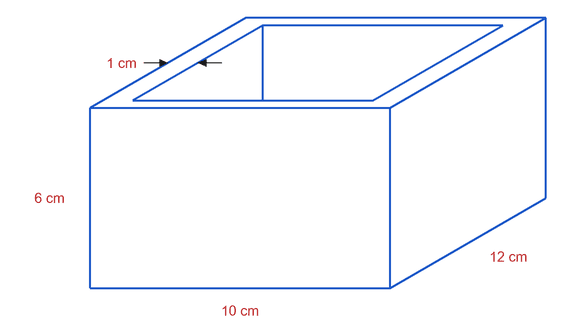
Reason (R) : If l, b and h are the external dimensions of an open cuboid of thickness 'x', then its internal dimensions are (l − 2x), (b − 2x) and (h − x) respectively.
- 521 mark
Question 52
The following questions are Assertion-Reason based questions. Choose your answer based on the codes given below.
(1) Both A and R are correct, and R is the correct explanation for A.
(2) Both A and R are correct, and R is not the correct explanation for A.
(3) A is true, but R is false.
(4) A is false, but R is true.
Assertion (A) : Three solid silver cubes of sides 6 cm, 8 cm and 10 cm are melted and recasted into a single solid cube. The side of the new cube = 2 times the side of the smallest cube.
Reason (R) : Volume of a cuboid = (l × b × h) cubic units.
- 531 mark
Question 53
The following questions are Assertion-Reason based questions. Choose your answer based on the codes given below.
(1) Both A and R are correct, and R is the correct explanation for A.
(2) Both A and R are correct, and R is not the correct explanation for A.
(3) A is true, but R is false.
(4) A is false, but R is true.
Assertion (A) : The length, breadth and height of a cuboid are 15 cm, 12 cm and 9 cm respectively. Lateral surface area of the cuboid = 846 cm².
Reason (R) : Lateral surface area of cuboid = 2 × h × (l + b) square units.
- 541 mark
Question 54
The following questions are Assertion-Reason based questions. Choose your answer based on the codes given below.
(1) Both A and R are correct, and R is the correct explanation for A.
(2) Both A and R are correct, and R is not the correct explanation for A.
(3) A is true, but R is false.
(4) A is false, but R is true.
Assertion (A) : If radius of a right circular cylinder is doubled and the height is reduced to of the original, the ratio of the volume of the new cylinder thus formed to the volume of the original cylinder is 1:1.
Reason (R) : Volume of a cylinder = πr²h, where r is the radius of circular base and h is height.
- 553 marks
Question 55
A cuboid is 8 m long, 12 m broad and 3·5 m high. Find its
(i) total surface area
(ii) lateral surface area
- 563 marks
Question 56
How many bricks will be required for constructing a wall which is 16 m long, 3 m high and 22·5 cm thick, if each brick measures 25 cm × 11·25 cm × 6 cm ?
- 573 marks
Question 57
The length, breadth and height of a cuboid are in the ratio 6 : 5 : 3. If its total surface area is 504 cm², find its volume.
- 583 marks
Question 58
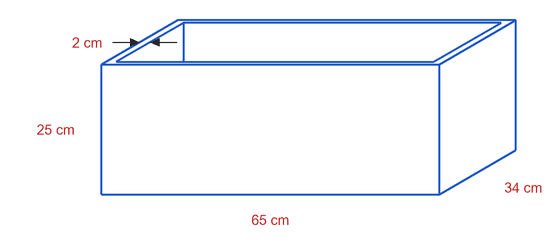
The external dimensions of an open wooden box are 65 cm, 34 cm and 25 cm. If the box is made up of wood 2 cm thick, find the capacity of the box and the volume of wood used to make it.
- 593 marks
Question 59
The curved surface area and the volume of a toy, cylindrical in shape, are 132 cm² and 462 cm³ respectively. Find its diameter and its length.
- 603 marks
Question 60
The floor of a rectangular hall has a perimeter 250 m. If the cost of painting the four walls at the rate of ₹ 10 per m² is ₹ 15,000, find the height of the hall.
- 613 marks
Question 61
The length of a hall is double its breadth. Its height is 3 m. The area of its four walls (including doors and windows) is 108 m², find its volume.
- 623 marks
Question 62
A solid cube of side 12 cm is cut into 8 identical cubes. What will be the side of the new cube? Also, find the ratio between the surface area of the original cube and the total surface area of all the small cubes formed.
- 633 marks
Question 63
The diameter of a garden roller is 1·4 m and it is 2 m long. Find the maximum area covered by it in 50 revolutions ?
- 643 marks
Question 64
In a building, there are 24 cylindrical pillars. For each pillar, radius is 28 cm and height is 4 m. Find the total cost of painting the curved surface area of the pillars at the rate of ₹ 8 per m².
- 653 marks
Question 65
The ratio between the curved surface area and the total surface area of a cylinder is 1 : 2. Find the volume of the cylinder, given its total surface area is 616 cm².
- 663 marks
Question 66
The areas of three adjacent faces of a box are 120 cm², 72 cm² and 60 cm². Find the volume of the box.
- 673 marks
Question 67
Eight identical cubes, each of edge 5 cm, are joined end to end.

Find the total surface area and the volume of the resulting cuboid.
- 683 marks
Question 68
A rectangular swimming pool 20 m long, 10 m wide and 2 m deep is to be tiled. If each tile is 40 cm × 40 cm, find the number of tiles required.
What Class 8 Maths Ch 23 covers
The sections of the chapter, in the order the book takes them. Every question above comes from one of these.
- 01Cuboid (A Rectangular Solid)
- 02Cube
- 03Applications
- 04Cylinder
More ways to study this chapter
The same chapter asked three other ways. Practise it, revise it, and see what the board has set on Ch 23 before.
Class 8 Maths Ch 23 questions students ask
How many questions are there in Class 8 Maths Ch 23?
68 questions. Every one is solved step by step on this page.
Are these Class 8 Maths solutions free?
Yes. Every question and its full working is free to read, with no account needed.
Can I download the Class 8 Maths Ch 23 solutions as a PDF?
There is no PDF to download. Every solution is on this page instead, which means it is searchable, always the current syllabus, and readable on a phone. Use your browser's print option if you want it on paper.