
Question 245 marksMedium
Name the terms marked as A, B. C, D and E in the following and state the type of changes.
(a)

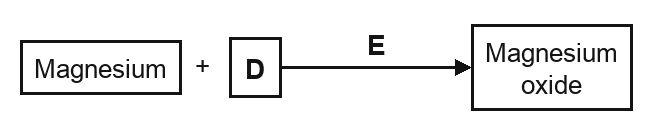
(b)
In which of the above changes does a gain in mass take place ?
Confirming your payment
Sign up now and get 250 free tokens.
Physical and Chemical Changes · Question 24 of 24
Name the terms marked as A, B. C, D and E in the following and state the type of changes.
(a)
(b)
In which of the above changes does a gain in mass take place ?
Solution:
Concept: Scheme (a) shows the sublimation of camphor; scheme (b) shows magnesium burning in air.
Step 1 — Name A, B and C in scheme (a).
On heating, solid camphor changes straight into white vapours, so A is sublimation. On cooling, the vapours change straight back into a solid, so B is deposition (the reverse of sublimation). The solid collected is C, the sublimate (solid camphor).
Step 2 — Type of change in scheme (a).
The camphor is got back unchanged and no new substance is formed, so scheme (a) is a physical change.
Step 3 — Name D and E in scheme (b).
Magnesium combines with D, oxygen from the air, and the arrow E is burning (combustion) of magnesium on heating:
Step 4 — Type of change in scheme (b).
A new substance, magnesium oxide, is formed and cannot be changed back into magnesium, so scheme (b) is a chemical change.
Step 5 — Find the gain in mass.
In scheme (b) oxygen from the air joins the magnesium, so the magnesium oxide weighs more than the magnesium taken. In scheme (a) the camphor collected has the same mass as the camphor heated (if none escapes).
Watch out: The gain in mass in (b) does not break the law of conservation of mass: the extra mass is the oxygen taken from the air.
Therefore, A is sublimation, B is deposition, C is the sublimate (a physical change); D is oxygen, E is burning (a chemical change); and the gain in mass takes place in change (b).