
Opening your dashboard
Class 8 Chemistry Chapter 2: Physical and Chemical Changes Solutions
24 textbook questions with step-by-step answers, free to read, for ICSE 2026-27.
Get talked through Ch 2, not just shown the answer
Reading a finished solution is not the same as being able to do it. The AI tutor takes one question at a time and works it with you, in your own words, until you can.
- Ask it out loud, in your own words
- It gives you the next step, not the answer
- Stuck on part (ii)? Start there
24 questions with solutions
1–5 marks · Mixed difficulty
- 11 mark
Question 1
Which of the following is a non-periodic change ?
Solve with AIAnswer
(A) Change of day and night
(B) Change of seasons
- Correct
(C) Landslides
(D) Full moon and new moon nights
Answer: (C) Landslides
Concept: A periodic change repeats itself at regular intervals of time; a non-periodic change does not repeat at regular intervals and can happen at any time.
Step 1 — Test each change for regular repetition.
Day and night, the seasons, and full moon and new moon nights all come back after fixed, known intervals of time, so all three are periodic.
Step 2 — Pick the change that has no fixed interval.
A landslide can happen at any time, for example after heavy rain or an earthquake, and nobody can say when the next one will come. So it is a non-periodic change.
Watch out: A change that happens often is not periodic unless it repeats at regular intervals.
Why the other options are wrong:
- (A) Change of day and night: This repeats every 24 hours, so it is a periodic change.
- (B) Change of seasons: This repeats in the same order every year, so it is a periodic change.
- (D) Full moon and new moon nights: This repeats about once a month, so it is a periodic change.
Therefore, a landslide is a non-periodic change, option (C).
- 21 mark
Question 2
Burning of a piece of paper into ash is a:
Solve with AIAnswer
(A) periodic change
(B) natural change
(C) reversible change
- Correct
(D) permanent change
Answer: (D) permanent change
Concept: In a chemical change one or more new substances are formed, with a composition and properties different from those of the original substance. Such a change is permanent: the original substance cannot be got back.
Step 1 — See what is formed when paper burns.
Burning paper gives ash, carbon dioxide and water vapour, with heat and light. These are new substances.
Step 2 — Ask whether the paper can be got back.
There is no way to turn the ash and gases back into the same sheet of paper, so the change is permanent.
Watch out: A change that cannot be undone is permanent; do not confuse it with a natural change, which is about who or what causes it.
Why the other options are wrong:
- (A) periodic change: This would need the paper to burn again and again at regular intervals, which does not happen.
- (B) natural change: This is wrong because paper is burnt by people; it does not burn by itself in nature, so it is a man-made change.
- (C) reversible change: This is wrong because the ash cannot be changed back into paper, so the change is irreversible.
Therefore, burning of a piece of paper into ash is a permanent change, option (D).
- 31 mark
Question 3
Which of the following is a slow change?
Solve with AIAnswer
- Correct
(A) Rusting of iron
(B) Burning of wood
(C) Burning of a cracker
(D) Switching on a fan
Answer: (A) Rusting of iron
Concept: A slow change takes a long time (hours, days, months or even years) to complete; a fast change is over in a very short time.
Step 1 — Compare the time each change takes.
A cracker bursts in a fraction of a second, a fan starts turning at once, and a piece of wood burns away within minutes or hours.
Step 2 — Pick the slowest change.
Iron left in moist air takes days before a layer of reddish brown rust appears, and much longer to rust through. So rusting of iron is a slow change.
Why the other options are wrong:
- (B) Burning of wood: This is a fast change compared with rusting: wood catches fire and burns away within a short time.
- (C) Burning of a cracker: This is a fast change: a cracker bursts in a fraction of a second.
- (D) Switching on a fan: This is a fast change: the fan starts moving almost the moment it is switched on.
Therefore, rusting of iron is a slow change, option (A).
- 41 mark
Question 4
Which of the following is a physical change?
Solve with AIAnswer
(A) Cooking of food
(B) Formation of curd
- Correct
(C) A glass cut into pieces
(D) Boiling of eggs
Answer: (C) A glass cut into pieces
Concept: In a physical change no new substance is formed: only physical properties such as state, shape, size or colour change, and the chemical composition stays the same.
Step 1 — Look for a new substance in each change.
Cooking, curdling and boiling an egg each give a product with a new taste, smell or texture that cannot be turned back, so new substances are formed.
Step 2 — Pick the change with no new substance.
When a glass is cut into pieces, only its size and shape change. Each piece is still glass with the same composition, so this is a physical change.
Watch out: A physical change can still be irreversible: the cut pieces cannot be joined back, yet no new substance is formed.
Why the other options are wrong:
- (A) Cooking of food: This is a chemical change: cooking forms new substances with a new taste and smell, and the food cannot become raw again.
- (B) Formation of curd: This is a chemical change: curd is a new substance formed from milk and cannot be changed back into milk.
- (D) Boiling of eggs: This is a chemical change: the proteins of the egg set into new substances that cannot become raw again.
Therefore, a glass cut into pieces is a physical change, option (C).
- 51 mark
Question 5
In a chemical change :
Solve with AIAnswer
(A) a new substance is formed
(B) energy is either released or absorbed
(C) the change is irreversible
- Correct
(D) all of the above
Answer: (D) all of the above
Concept: In a chemical change one or more new substances are formed, with a composition and properties different from those of the original substance. A chemical change is permanent and is always accompanied by an energy change.
Step 1 — Check each statement.
Statement (A) is true: a new substance is formed. Statement (B) is true: heat or light is given out (burning of wood) or taken in (photosynthesis). Statement (C) is true at this level: a chemical change is permanent and irreversible.
Step 2 — Choose the complete answer.
Since (A), (B) and (C) are all true, the option that includes all three is the correct choice.
Watch out: At this level chemical changes are called permanent and irreversible; in higher classes you will meet a few chemical reactions that can be reversed.
Why the other options are wrong:
- (A) a new substance is formed: This is true, but it is only one feature; (B) and (C) are true as well, so it is not the complete answer.
- (B) energy is either released or absorbed: This is true, but it leaves out the formation of a new substance and the permanence of the change.
- (C) the change is irreversible: This is true, but it leaves out the formation of a new substance and the energy change.
Therefore, in a chemical change all three statements hold, option (D).
- 61 mark
Question 6
Assertion (A) : The changes which result in the formation of new substances with entirely different composition and properties are called chemical changes.
Reason (R) : Chemical changes are permanent and irreversible.
Solve with AIAnswer
(A) Both A and R are true and R is the correct explanation of A.
- Correct
(B) Both A and R are true but R is not the correct explanation of A.
(C) A is true but R is false.
(D) A is false but R is true.
Answer: (B) Both A and R are true but R is not the correct explanation of A.
Concept: Judge the Assertion first, then the Reason, and only then ask whether the Reason explains the Assertion. In a chemical change one or more new substances are formed, with a composition and properties different from those of the original substance.
Step 1 — Judge the Assertion.
The Assertion is the definition of a chemical change: new substances with a different composition and properties are formed. So A is true.
Step 2 — Judge the Reason.
Chemical changes are indeed permanent and irreversible (burnt paper cannot become paper again). So R is true.
Step 3 — Decide whether R explains A.
A change is called chemical because new substances are formed, not because it is permanent. Permanence is a second, separate feature of chemical changes, so R does not explain A.
Watch out: At this level chemical changes are called permanent and irreversible; in higher classes you will meet a few chemical reactions that can be reversed.
Why the other options are wrong:
- (A): This is wrong because R gives another feature of chemical changes, not the reason they are called chemical.
- (C): This is wrong because R is true: chemical changes are permanent and irreversible.
- (D): This is wrong because A is true: it is the definition of a chemical change.
Therefore, both A and R are true but R is not the correct explanation of A, option (B).
- 71 mark
Question 7
Assertion (A) : When a change in a substance can be reversed by changing the conditions, it is said to be a reversible and temporary change.
Reason (R) : Burning a piece of paper is a reversible change.
Solve with AIAnswer
(A) Both A and R are true and R is the correct explanation of A.
(B) Both A and R are true but R is not the correct explanation of A.
- Correct
(C) A is true but R is false.
(D) A is false but R is true.
Answer: (C) A is true but R is false.
Concept: Judge the Assertion first, then the Reason, and only then ask whether the Reason explains the Assertion. A reversible change can be undone by changing the conditions, such as heating or cooling.
Step 1 — Judge the Assertion.
Water freezes into ice on cooling and the ice melts back into water on warming. A change that can be undone by changing the conditions is called reversible and temporary, so A is true.
Step 2 — Judge the Reason.
Burning paper gives ash, carbon dioxide and water vapour, which cannot be changed back into paper. So burning paper is an irreversible change, and R is false.
Step 3 — Choose the option.
With A true and R false, the only option that fits is "A is true but R is false".
Why the other options are wrong:
- (A): This is wrong because R is false, so it cannot be true or explain A.
- (B): This is wrong because R is false, so "both A and R are true" does not hold.
- (D): This is wrong because A is true and R is false, the reverse of this option.
Therefore, A is true but R is false, option (C).
- 81 mark
Question 8
Assertion (A) : Sublimation of camphor is a physical change.
Reason (R) : No new substance is formed.
Solve with AIAnswer
- Correct
(A) Both A and R are true and R is the correct explanation of A.
(B) Both A and R are true but R is not the correct explanation of A.
(C) A is true but R is false.
(D) A is false but R is true.
Answer: (A) Both A and R are true and R is the correct explanation of A.
Concept: Judge the Assertion first, then the Reason, and only then ask whether the Reason explains the Assertion. In a physical change no new substance is formed: only physical properties such as state, shape, size or colour change, and the chemical composition stays the same.
Step 1 — Judge the Assertion.
On heating, solid camphor changes directly into white vapour, and on cooling the vapour changes straight back into solid camphor (the sublimate). Sublimation of camphor is a physical change, so A is true.
Step 2 — Judge the Reason.
The sublimate is the same camphor; no new substance is formed. So R is true.
Step 3 — Decide whether R explains A.
A change is physical precisely because no new substance is formed, so R is the correct explanation of A.
Why the other options are wrong:
- (B): This is wrong because R is the very reason sublimation counts as a physical change, so R does explain A.
- (C): This is wrong because R is true: the sublimate is the same camphor.
- (D): This is wrong because A is true: sublimation of camphor is a physical change.
Therefore, both A and R are true and R is the correct explanation of A, option (A).
- 91 mark
Question 9
Assertion (A) : For rust formation to take place, iron must be exposed to air and water for some time.
Reason (R) : Rust is a reddish brown substance formed on the surface of iron.
Solve with AIAnswer
(A) Both A and R are true and R is the correct explanation of A.
- Correct
(B) Both A and R are true but R is not the correct explanation of A.
(C) A is true but R is false.
(D) A is false but R is true.
Answer: (B) Both A and R are true but R is not the correct explanation of A.
Concept: Judge the Assertion first, then the Reason, and only then ask whether the Reason explains the Assertion. Rusting is a slow chemical change in which iron reacts with oxygen and water to form reddish brown hydrated iron(III) oxide (rust).
Step 1 — Judge the Assertion.
Iron does not rust in dry air or in water that has no dissolved air; it needs both air and moisture, and rust forms only slowly, over some time. So A is true.
Step 2 — Judge the Reason.
Rust is indeed a reddish brown substance that forms on the surface of iron. So R is true.
Step 3 — Decide whether R explains A.
R only describes what rust looks like and where it forms. It says nothing about why air and water are needed, so R does not explain A.
Why the other options are wrong:
- (A): This is wrong because R describes rust; it does not give the reason for the conditions stated in A.
- (C): This is wrong because R is true: rust is reddish brown and forms on the surface of iron.
- (D): This is wrong because A is true: without both air and water iron does not rust.
Therefore, both A and R are true but R is not the correct explanation of A, option (B).
- 101 mark
Question 10
Assertion (A) : Burning of a candle is a physical change.
Reason (R) : When a candle burns, some of its wax melts and gets solidified on cooling. Also carbon dioxide and water vapour are formed which cannot be recovered easily and converted back into the candle.
Solve with AIAnswer
(A) Both A and R are true and R is the correct explanation of A.
(B) Both A and R are true but R is not the correct explanation of A.
(C) A is true but R is false.
- Correct
(D) A is false but R is true.
Answer: (D) A is false but R is true.
Concept: Judge the Assertion first, then the Reason, and only then ask whether the Reason explains the Assertion. Some processes involve a physical change and a chemical change happening together.
Step 1 — Judge the Reason.
When a candle burns, some wax melts and solidifies again on cooling (a physical change), and the wax vapour burns to give carbon dioxide and water vapour, which cannot be turned back into a candle (a chemical change). So R is true.
Step 2 — Judge the Assertion.
Because new substances are formed, burning of a candle is not only a physical change; it is an example of physical and chemical changes taking place together. So A is false.
Step 3 — Choose the option.
With A false and R true, the matching option is "A is false but R is true".
Watch out: The melting of wax is only one part of what happens; the burning part forms new substances.
Why the other options are wrong:
- (A): This is wrong because A is false, so R cannot be its correct explanation.
- (B): This is wrong because A is false, so "both A and R are true" does not hold.
- (C): This is wrong because A is false and R is true, the reverse of this option.
Therefore, A is false but R is true, option (D).
- 115 marks
Question 11
Fill in the blanks.
(a) The process of a liquid changing into a solid is called ________ .
(b) A change which alters the composition of a substance is known as a ________ change.
(c) There is no change in the ________ of the substance during a physical change.
(d) The reaction in which energy is evolved is called ________ .
(e) The process in which a substance in solid state directly changes into ________ is called sublimation.
Solve with AIWritten solution
Solution:
Concept: Recall the names of the changes of state and the two broad kinds of change. In a physical change no new substance is formed: only physical properties such as state, shape, size or colour change, and the chemical composition stays the same.
Step 1 — Part (a), liquid to solid.
A liquid turns into a solid when it is cooled; this change of state is called freezing (solidification).
Step 2 — Part (b), change in composition.
Only a chemical change forms new substances, so a change that alters the composition is a chemical change.
Step 3 — Part (c), what stays the same in a physical change.
No new substance is formed in a physical change, so the chemical composition of the substance does not change (its mass stays the same too).
Step 4 — Part (d), energy given out.
A reaction that gives out (evolves) energy, usually as heat, is called an exothermic reaction.
Step 5 — Part (e), sublimation.
In sublimation a solid changes directly into vapour (the gaseous state) without becoming a liquid first.
Watch out: The word "exothermic" means energy is given out; "endothermic" means energy is taken in.
Therefore, the blanks are (a) freezing (solidification), (b) chemical, (c) chemical composition, (d) an exothermic reaction and (e) vapour (gaseous state).
- 125 marks
Question 12
Match the following :
Column A Column B (a) Freezing of water (i) Natural change (b) Change of seasons (ii) Chemical change (c) Burning of wood (iii) Physical change (d) Permanent change (iv) Sublimation (e) Heating of solid camphor (v) Fast process Solve with AIWritten solution
Solution:
Concept: Each item in Column A is matched with the one description in Column B that fits it best, using every option once.
Step 1 — Match the changes of state.
Freezing of water gives ice, which is still water and melts back, so (a) goes with (iii) physical change. Heating solid camphor turns it straight into vapour, so (e) goes with (iv) sublimation.
Step 2 — Match the change that happens by itself.
The change of seasons takes place in nature without any human action, so (b) goes with (i) natural change.
Step 3 — Match the remaining two.
A permanent change forms new substances that cannot be changed back, which is a chemical change, so (d) goes with (ii) chemical change. That leaves burning of wood, which is over in a short time, so (c) goes with (v) fast process.
Watch out: Burning of wood is also a chemical change, but (ii) is needed for "permanent change", so (c) takes "fast process".
Therefore, (a)–(iii), (b)–(i), (c)–(v), (d)–(ii) and (e)–(iv).
- 132 marks
Question 13
Name the following :
(a) The solid formed when vapours of a sublimable substance cool down.
(b) The compound formed when magnesium burns in air.
Solve with AIWritten solution
Solution:
Concept: When the vapour of a sublimable solid is cooled, it changes straight back into a solid. When magnesium burns, it combines with oxygen from the air.
Step 1 — Part (a), the solid from cooled vapour.
When camphor or iodine vapour cools, it deposits as a solid on the cold surface. This solid is called the sublimate.
Step 2 — Part (b), the product of burning magnesium.
Magnesium burns in air with a dazzling white flame and combines with oxygen to form the white powder magnesium oxide:
Therefore, (a) the sublimate and (b) magnesium oxide, MgO.
- 145 marks
Question 14
Write true or false against the following statements and correct the false ones.
(a) Heating of an iron rod is a chemical change. ________
(b) Condensation of steam is not a chemical change. ________
(c) Rusting of iron is a fast change. ________
(d) A physical change is reversible. ________
(e) There is a change in the mass of a substance in a physical change. ________
Solve with AIWritten solution
Solution:
Concept: In a physical change no new substance is formed: only physical properties such as state, shape, size or colour change, and the chemical composition stays the same. In a chemical change one or more new substances are formed, with a composition and properties different from those of the original substance.
Step 1 — Statement (a).
Heating an iron rod makes it hot and it may glow red, but it is still iron and returns to its original state on cooling. The statement is false; correct form: heating of an iron rod is a physical change.
Step 2 — Statement (b).
Steam condenses into water, which is the same substance in another state, so condensation is a physical change. The statement is true.
Step 3 — Statement (c).
Iron takes days to rust in moist air. The statement is false; correct form: rusting of iron is a slow change.
Step 4 — Statement (d).
A physical change is temporary and can usually be reversed by reversing the conditions, as when ice melts back into water. The statement is true (a few physical changes, such as tearing paper, cannot be reversed).
Step 5 — Statement (e).
No new substance is formed in a physical change and nothing is added or removed, so the mass stays the same. The statement is false; correct form: there is no change in the mass of a substance in a physical change.
Watch out: Being reversible is the usual rule for physical changes, not a test: whether a new substance forms decides the type of change.
Therefore, (a) false: heating an iron rod is a physical change; (b) true; (c) false: rusting of iron is a slow change; (d) true; (e) false: there is no change in mass in a physical change.
- 155 marks
Question 15
Classify the following changes as a physical or a chemical change :
(a) Drying of wet clothes
(b) Curdling of milk
(c) Butter getting rancid
(d) Boiling of water
(e) Burning of paper
(f) Melting of wax
(g) Burning of coal
(h) Formation of clouds
(i) Rusting of iron
(j) Roasting of potatoes
(k) Formation of alloys
(l) Making of a sugar solution
(m) Glowing of an electric bulb
(n) Manufacture of salt from sea water.
Solve with AIWritten solution
Solution:
Concept: If a new substance with different properties is formed, the change is chemical; if only the state, shape, size or appearance changes and no new substance is formed, the change is physical.
Step 1 — Pick out the physical changes.
In each of these only the state or the arrangement changes, and no new substance is formed:
- (a) Drying of wet clothes: the water only evaporates.
- (d) Boiling of water: water changes into steam.
- (f) Melting of wax: solid wax becomes liquid wax.
- (h) Formation of clouds: water vapour condenses into tiny droplets.
- (k) Formation of alloys: the metals are melted and mixed; an alloy is a mixture of metals.
- (l) Making of a sugar solution: sugar only dissolves and is got back by evaporating the water.
- (m) Glowing of an electric bulb: the filament glows only while the current flows and is unchanged when switched off.
- (n) Manufacture of salt from sea water: the water evaporates and the salt already dissolved in it is left behind.
Step 2 — Pick out the chemical changes.
In each of these a new substance is formed that cannot easily be changed back:
- (b) Curdling of milk: curd is a new substance.
- (c) Butter getting rancid: the fats in butter react with air and moisture to form new, bad-smelling substances.
- (e) Burning of paper: ash, carbon dioxide and water vapour are formed.
- (g) Burning of coal: carbon dioxide is formed, with heat and light given out.
- (i) Rusting of iron: reddish brown rust is a new substance.
- (j) Roasting of potatoes: the starch changes into new substances with a new taste and smell.
Watch out: A glowing bulb gives out light, but the filament does not change into a new substance, so it is a physical change.
Therefore, (a), (d), (f), (h), (k), (l), (m) and (n) are physical changes, and (b), (c), (e), (g), (i) and (j) are chemical changes.
- 165 marks
Question 16
Give one example of the following changes :
(a) Natural, non-periodic change
(b) Natural, periodic change
(c) Irreversible, physical change
(d) A chemical change in which energy is absorbed.
(e) A man-made fast change.
(f) A process in which both physical and chemical changes take place simultaneously.
Solve with AIWritten solution
Solution:
Concept: A change can be described in several ways at once: natural or man-made, periodic or non-periodic, reversible or irreversible, physical or chemical, slow or fast, and by whether energy is given out or taken in. For each part we pick one change that has both properties asked for.
Step 1 — Part (a), natural and non-periodic.
An earthquake (or a landslide) happens in nature by itself, at no regular interval.
Step 2 — Part (b), natural and periodic.
The change of day and night (or the change of seasons) happens by itself and repeats at regular intervals.
Step 3 — Part (c), irreversible and physical.
Tearing of paper (or chopping vegetables) forms no new substance, yet the pieces cannot be joined back.
Step 4 — Part (d), a chemical change that absorbs energy.
In photosynthesis green plants take in light energy from the sun to make food (glucose) and oxygen from carbon dioxide and water.
Step 5 — Part (e), man-made and fast.
The bursting of a cracker is caused by people and is over in a moment.
Step 6 — Part (f), physical and chemical together.
In the burning of a candle the wax melts and solidifies again (physical change) while the wax vapour burns to form carbon dioxide and water vapour (chemical change).
Watch out: Check both words in each part; for example, a landslide is natural but non-periodic, so it cannot answer (b).
Therefore, examples are (a) an earthquake, (b) day and night, (c) tearing of paper, (d) photosynthesis, (e) bursting of a cracker and (f) burning of a candle.
- 174 marks
Question 17
Define :
(a) Physical change
(b) Chemical change
Solve with AIWritten solution
Solution:
Concept: The two kinds of change are told apart by one question: is a new substance formed?
Step 1 — Define a physical change.
A physical change is a change in which no new substance is formed and the chemical composition of the substance stays the same, although some physical properties such as colour, state, shape or size may change. Example: melting of ice.
Step 2 — Define a chemical change.
A chemical change is a permanent change in which new substances are formed, whose chemical composition and physical and chemical properties are different from those of the original substance. Example: burning of paper.
Watch out: A change of colour or state alone does not make a change chemical; look for a new substance.
Therefore, a physical change forms no new substance, while a chemical change forms new substances with a different composition.
- 185 marks
Question 18
Differentiate between the following :
(a) Periodic and non-periodic changes
(b) Reversible and irreversible changes
(c) Slow and fast changes
Solve with AIWritten solution
Solution:
Concept: Each pair is told apart by one property: regular repetition, whether the original substance can be got back, or the time taken.
Step 1 — Periodic and non-periodic changes.
These differ in whether the change repeats at regular intervals.
Periodic change Non-periodic change It is repeated at regular intervals of time. It is not repeated at regular intervals; it may occur at any time. We can tell in advance when it will happen again. We cannot tell when it will happen. Example: change of day and night. Example: an earthquake. Step 2 — Reversible and irreversible changes.
These differ in whether the substance can be brought back to its original state.
Reversible change Irreversible change It can be reversed by changing the conditions. The substance cannot be brought back to its original state. The original substance can be got back. The original substance cannot be got back. Example: freezing of water into ice and melting of ice into water. Example: burning a piece of paper into ash. Step 3 — Slow and fast changes.
These differ in the time the change takes.
Slow change Fast change It takes a long time (hours, days, months or even years) to complete. It is over in a very short time. Example: rusting of iron. Example: bursting of a cracker. Therefore, periodic changes repeat at regular intervals, reversible changes can be undone, and slow changes take a long time, while their partners do not.
- 195 marks
Question 19
Give reason :
(a) Freezing of water is a physical change.
(b) Evaporation of water is a physical change.
(c) Burning of paper is a chemical change.
(d) Cutting of a cloth piece is a physical change, although it cannot be reversed.
(e) An inflated balloon bursts when brought near a lit bulb.
(f) Sublimation of camphor is a physical change.
Solve with AIWritten solution
Solution:
Concept: In a physical change no new substance is formed: only physical properties such as state, shape, size or colour change, and the chemical composition stays the same. In a chemical change one or more new substances are formed, with a composition and properties different from those of the original substance.
Step 1 — Part (a), freezing of water.
When water freezes it only changes its state from liquid to solid. Ice has the same composition as water, , so no new substance is formed, and the ice melts back into water when warmed. Hence freezing is a physical change.
Step 2 — Part (b), evaporation of water.
When water evaporates, liquid water only changes into water vapour. The vapour is still and condenses back into water on cooling, so no new substance is formed. Hence evaporation is a physical change.
Step 3 — Part (c), burning of paper.
When paper burns, new substances (ash, carbon dioxide and water vapour) are formed, and heat and light are given out. The ash cannot be changed back into paper. Hence burning of paper is a chemical change.
Step 4 — Part (d), cutting a cloth piece.
Cutting cloth changes only its size and shape. Each small piece is the same cloth with the same composition, so no new substance is formed. A change is called physical or chemical by whether a new substance forms, not by whether it can be reversed, so cutting cloth is a physical change even though the pieces cannot be joined back.
Step 5 — Part (e), the balloon near a lit bulb.
The lit bulb heats the air inside the balloon. The air particles gain energy and move faster, so they hit the inner walls harder and the air expands. The rubber stretches until it can no longer bear the pressure, and the balloon bursts. No new substance is formed, so this is a physical change.
Step 6 — Part (f), sublimation of camphor.
On heating, solid camphor changes directly into white vapour, and on cooling the vapour turns back into solid camphor (the sublimate). The sublimate is the same substance, camphor, so no new substance is formed. Hence sublimation of camphor is a physical change.
Watch out: Being impossible to reverse does not make a change chemical; cutting and tearing are irreversible physical changes.
Therefore, (a), (b), (d) and (f) are physical because no new substance forms, (c) is chemical because ash and gases form, and (e) happens because heated air expands and bursts the balloon.
- 203 marks
Question 20
State the characteristics of physical changes.
Solve with AIWritten solution
Solution:
Concept: In a physical change a substance changes only in its physical properties, not in its chemical composition.
Step 1 — List the characteristics.
Each point below follows from the fact that the particles of the substance stay the same:
- No new substance is formed. Ice melts into water, which is still .
- There is no change in the chemical composition of the substance.
- The change is usually temporary and can be reversed by reversing the conditions: molten sulphur turns back into solid sulphur on cooling.
- Only the state, size, shape, colour or texture changes.
- There is no change in mass. A beaker of wax weighs the same before and after the wax is melted.
- There is no net gain or loss of energy. The heat taken in when water changes into steam is given out again when the steam condenses back into water.
Watch out: A physical change can take in or give out energy while it happens (melting takes in heat); the point is that the same energy is returned when the change is reversed.
Therefore, in a physical change no new substance forms, the composition and mass stay the same, the change is usually reversible and there is no net energy change.
- 213 marks
Question 21
State the characteristics of chemical changes.
Solve with AIWritten solution
Solution:
Concept: In a chemical change the original substance gives rise to one or more new substances with entirely different compositions and properties.
Step 1 — New substances are formed.
Iron and sulphur heated together form iron(II) sulphide. Unlike iron, it is not attracted by a magnet, and unlike sulphur, it does not dissolve in carbon disulphide:
Step 2 — The composition changes completely.
The product has a different composition from each of the starting substances.
Step 3 — The change is permanent and irreversible.
The original substance cannot be got back by simple physical methods: ash cannot be changed back into paper.
Step 4 — The mass of the original substance usually changes.
When magnesium is burnt in a crucible, the magnesium oxide formed weighs more than the magnesium taken, because oxygen from the air has combined with it:
The total mass of all the reactants (magnesium + oxygen) still equals the mass of the product.
Step 5 — There is an exchange of energy.
Energy as heat and light may be given out (burning of wood) or taken in (photosynthesis).
Watch out: Mass is never created or destroyed; the solid gains mass only because a gas from the air joins it.
Therefore, in a chemical change new substances form, the composition changes, the change is permanent, the mass of the original substance usually changes and energy is given out or taken in.
- 223 marks
Question 22
Why is burning of a candle an example of both a physical and a chemical change ?
Solve with AIWritten solution
Solution:
Concept: Two different things happen to the wax when a candle burns: some of it only changes state, and some of it reacts with oxygen.
Step 1 — The physical change.
When the candle is lit, some solid wax near the flame melts into liquid wax. When this molten wax drips down the side, it cools and solidifies again. Only the state of the wax changes, so this part is a physical change.
Step 2 — The chemical change.
The molten wax rises up the wick, turns into vapour and burns in air to give the flame. New substances, carbon dioxide and water vapour, are formed, and heat and light are given out. These products cannot be changed back into wax, so this part is a chemical change.
Step 3 — Put the two together.
Both changes go on at the same time while the candle burns.
Watch out: The wax that drips and sets again is still wax; only the wax that burns forms new substances.
Therefore, burning of a candle shows a physical change (melting and solidifying of wax) and a chemical change (burning of wax to carbon dioxide and water vapour) taking place together.
- 233 marks
Question 23
Give four differences between physical and chemical changes.
Solve with AIWritten solution
Solution:
Concept: The main test is whether a new substance is formed; the other differences follow from it.
Step 1 — Compare the two kinds of change point by point.
The table gives four differences, with an example of each change:
Physical change Chemical change No new substance is formed; only the state or physical properties change. New substances with a different composition and properties are formed. The change is temporary and usually reversible. The change is permanent and irreversible. There is no change in mass. The mass of the original substance usually changes (the total mass of reactants still equals the total mass of products). The original substance can be got back by simple physical methods. The original substance cannot be got back by simple physical methods. Example: melting of ice. Example: burning of paper. Watch out: Any four rows are enough, but each row must compare the same property for both kinds of change.
Therefore, physical changes form no new substance, are reversible, keep the mass the same and let the substance be recovered, while chemical changes do the opposite.
- 245 marks
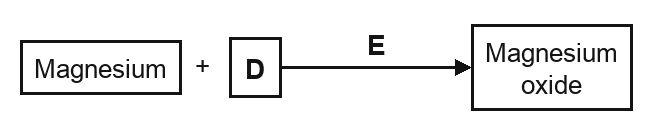
Question 24
Name the terms marked as A, B. C, D and E in the following and state the type of changes.
(a)

(b)
In which of the above changes does a gain in mass take place ?
Solve with AIWritten solution
Solution:
Concept: Scheme (a) shows the sublimation of camphor; scheme (b) shows magnesium burning in air.
Step 1 — Name A, B and C in scheme (a).
On heating, solid camphor changes straight into white vapours, so A is sublimation. On cooling, the vapours change straight back into a solid, so B is deposition (the reverse of sublimation). The solid collected is C, the sublimate (solid camphor).
Step 2 — Type of change in scheme (a).
The camphor is got back unchanged and no new substance is formed, so scheme (a) is a physical change.
Step 3 — Name D and E in scheme (b).
Magnesium combines with D, oxygen from the air, and the arrow E is burning (combustion) of magnesium on heating:
Step 4 — Type of change in scheme (b).
A new substance, magnesium oxide, is formed and cannot be changed back into magnesium, so scheme (b) is a chemical change.
Step 5 — Find the gain in mass.
In scheme (b) oxygen from the air joins the magnesium, so the magnesium oxide weighs more than the magnesium taken. In scheme (a) the camphor collected has the same mass as the camphor heated (if none escapes).
Watch out: The gain in mass in (b) does not break the law of conservation of mass: the extra mass is the oxygen taken from the air.
Therefore, A is sublimation, B is deposition, C is the sublimate (a physical change); D is oxygen, E is burning (a chemical change); and the gain in mass takes place in change (b).
What Class 8 Chemistry Ch 2 covers
The sections of the chapter, in the order the book takes them. Every question above comes from one of these.
- 01Slow and Fast Changes
- 02Natural and Man-made Changes
- 03Periodic and Non-periodic Changes
- 04Reversible and Irreversible Changes
- 05Physical Change: Change of State
- 06Chemical Change
More ways to study this chapter
The same chapter asked three other ways. Practise it, revise it, and see what the board has set on Ch 2 before.
Class 8 Chemistry Ch 2 questions students ask
How many questions are there in Class 8 Chemistry Ch 2?
24 questions. Every one is solved step by step on this page.
Are these Class 8 Chemistry solutions free?
Yes. Every question and its full working is free to read, with no account needed.
Can I download the Class 8 Chemistry Ch 2 solutions as a PDF?
There is no PDF to download. Every solution is on this page instead, which means it is searchable, always the current syllabus, and readable on a phone. Use your browser's print option if you want it on paper.