
Opening your dashboard
Class 8 Biology Chapter 5: Endocrine System and Adolescence Solutions
25 textbook questions with step-by-step answers, free to read, for ICSE 2026-27.
Get talked through Ch 5, not just shown the answer
Reading a finished solution is not the same as being able to do it. The AI tutor takes one question at a time and works it with you, in your own words, until you can.
- Ask it out loud, in your own words
- It gives you the next step, not the answer
- Stuck on part (ii)? Start there
25 questions with solutions
1–12 marks · Mixed difficulty
- 11 mark
Question 1
Put a tick mark (✓) against the correct alternative in the following statements :
Cortisol hormone is secreted by :
Solve with AIAnswer
(A) Medulla of adrenal
- Correct
(B) Cortex of adrenal
(C) Pancreas
(D) Thyroid
Answer: (B) Cortex of adrenal
Concept: Each adrenal gland sits like a cap on a kidney and has two parts: the outer cortex, which secretes cortisol and related hormones, and the inner medulla, which secretes adrenaline (epinephrine), the emergency hormone.
Step 1 — Recall the hormones of each part.
The adrenal cortex secretes many hormones, and the best known of them is cortisol; the medulla secretes adrenaline.
Step 2 — Pick the option.
So cortisol comes from the cortex of the adrenal gland, option (B).
Watch out: Cortisol and cortex both start with "cort": that is an easy way to remember the pair.
Why the other options are wrong:
- (A) Medulla of adrenal: the adrenal medulla secretes adrenaline, not cortisol.
- (C) Pancreas: the pancreas secretes insulin and glucagon.
- (D) Thyroid: the thyroid secretes thyroxine.
Therefore, cortisol is secreted by the cortex of the adrenal gland, option (B).
- 21 mark
Question 2
Put a tick mark (✓) against the correct alternative in the following statements :
Which one of the following hormones stimulates the breakdown of glycogen in the liver into glucose ?
Solve with AIAnswer
(A) Insulin
(B) Adrenaline
- Correct
(C) Glucagon
(D) Thyroxine
Answer: (C) Glucagon
Concept: The islets of Langerhans in the pancreas control blood sugar with two hormones: insulin lowers it (extra glucose is stored as glycogen in the liver and muscles) and glucagon raises it (glycogen in the liver is broken down to glucose).
Step 1 — Find the hormone whose job this is.
Breaking glycogen down into glucose in the liver raises blood sugar. That is the main job of glucagon, the pancreas hormone that works against insulin.
Step 2 — Pick the option.
So the hormone that stimulates this breakdown is glucagon, option (C).
Watch out: Insulin and glucagon do opposite jobs: insulin stores glucose as glycogen, glucagon releases it.
Note: Adrenaline also speeds up glycogen breakdown, so (B) is partly true; the printed key, glucagon, is the hormone whose main function this is.
Why the other options are wrong:
- (A) Insulin: insulin does the opposite: it converts extra glucose into glycogen and lowers blood sugar.
- (B) Adrenaline: adrenaline can also make the liver release glucose in an emergency, but that is a side effect of its emergency role; the hormone whose main job is this breakdown is glucagon.
- (D) Thyroxine: thyroxine controls the overall rate of metabolism; it is not the hormone that breaks glycogen down in the liver.
Therefore, the hormone that stimulates the breakdown of liver glycogen into glucose is glucagon, option (C).
- 31 mark
Question 3
Put a tick mark (✓) against the correct alternative in the following statements :
Which one of the following hormones converts excess of glucose into glycogen ?
Solve with AIAnswer
(A) Glucagon
(B) Thyroxine
- Correct
(C) Insulin
(D) Adrenaline
Answer: (C) Insulin
Concept: The islets of Langerhans in the pancreas control blood sugar with two hormones: insulin lowers it (extra glucose is stored as glycogen in the liver and muscles) and glucagon raises it (glycogen in the liver is broken down to glucose).
Step 1 — Find the hormone that stores glucose.
When there is extra glucose in the blood, insulin makes the liver and muscles change it into glycogen and store it, which lowers blood sugar.
Step 2 — Pick the option.
So the hormone that converts excess glucose into glycogen is insulin, option (C).
Watch out: Glycogen is the stored form; insulin builds it up and glucagon breaks it down.
Why the other options are wrong:
- (A) Glucagon: glucagon does the reverse: it breaks glycogen down into glucose.
- (B) Thyroxine: thyroxine speeds up body activities; it does not store glucose as glycogen.
- (D) Adrenaline: adrenaline releases more glucose into the blood; it does not store it.
Therefore, excess glucose is converted into glycogen by insulin, option (C).
- 41 mark
Question 4
Put a tick mark (✓) against the correct alternative in the following statements :
Which one of the following glands is also called the master gland ?
Solve with AIAnswer
- Correct
(A) Pituitary gland
(B) Adrenal gland
(C) Thyroid gland
(D) Ovary
Answer: (A) Pituitary gland
Concept: The pituitary gland is a pea-sized gland below the brain. Several of its hormones control other endocrine glands, for example TSH stimulates the thyroid and FSH acts on the ovaries and testes.
Step 1 — Recall why one gland is the master.
A "master gland" is one that controls other glands. The pituitary does this through its stimulating hormones.
Step 2 — Pick the option.
So the master gland is the pituitary gland, option (A).
Watch out: The master gland is not the biggest gland; it is the one that controls others.
Why the other options are wrong:
- (B) Adrenal gland: the adrenal cortex is itself controlled by a pituitary hormone; the adrenal gland does not control other glands.
- (C) Thyroid gland: the thyroid is itself controlled by the pituitary, through TSH.
- (D) Ovary: the ovary is controlled by FSH and other hormones from the pituitary.
Therefore, the pituitary gland is called the master gland, option (A).
- 51 mark
Question 5
Put a tick mark (✓) against the correct alternative in the following statements :
The emergency hormone to face the danger or to fight is secreted by :
Solve with AIAnswer
(A) Islets of Langerhans
(B) Adrenal cortex
(C) Pituitary
- Correct
(D) Adrenal medulla
Answer: (D) Adrenal medulla
Concept: Each adrenal gland sits like a cap on a kidney and has two parts: the outer cortex, which secretes cortisol and related hormones, and the inner medulla, which secretes adrenaline (epinephrine), the emergency hormone.
Step 1 — Name the emergency hormone.
The hormone that prepares the body to face danger or to fight is adrenaline (epinephrine).
Step 2 — Find where it is made.
Adrenaline is secreted by the inner part of the adrenal gland, the adrenal medulla, so the answer is option (D).
Watch out: The adrenal gland has two parts; the emergency hormone comes from the inner medulla, not the outer cortex.
Why the other options are wrong:
- (A) Islets of Langerhans: the islets of Langerhans secrete insulin and glucagon, which control blood sugar.
- (B) Adrenal cortex: the adrenal cortex secretes cortisol and related hormones, not adrenaline.
- (C) Pituitary: the pituitary secretes growth hormone, TSH, FSH and others, not adrenaline.
Therefore, the emergency hormone is secreted by the adrenal medulla, option (D).
- 61 mark
Question 6
Put a tick mark (✓) against the correct alternative in the following statements :
Which one of the following endocrine glands produces its hormone in large quantities as a result of emotional stimulation ?
Solve with AIAnswer
(A) Thyroid
(B) Islets of Langerhans
- Correct
(C) Adrenal medulla
(D) Adrenal cortex
Answer: (C) Adrenal medulla
Concept: Each adrenal gland sits like a cap on a kidney and has two parts: the outer cortex, which secretes cortisol and related hormones, and the inner medulla, which secretes adrenaline (epinephrine), the emergency hormone.
Step 1 — Link emotion to a hormone.
When a person is frightened, angry or excited, the body must react at once. The adrenal medulla then quickly releases large amounts of adrenaline.
Step 2 — Pick the option.
So the gland that pours out its hormone in large amounts on emotional stimulation is the adrenal medulla, option (C).
Watch out: The cortex helps the body cope with longer-lasting stresses; the sudden rush on emotion comes from the medulla.
Why the other options are wrong:
- (A) Thyroid: the thyroid releases thyroxine steadily to keep up the metabolic rate; emotions do not make it pour out its hormone suddenly.
- (B) Islets of Langerhans: the islets of Langerhans respond mainly to the blood sugar level, not to emotions.
- (D) Adrenal cortex: the adrenal cortex helps the body adapt to stresses such as extreme heat, cold and infection; the sudden burst on emotion comes from the medulla.
Therefore, the adrenal medulla produces its hormone in large amounts on emotional stimulation, option (C).
- 71 mark
Question 7
Put a tick mark (✓) against the correct alternative in the following statements :
In humans, increased thyroxine production results in :
Solve with AIAnswer
- Correct
(A) Increased metabolism
(B) Decreased metabolism
(C) Dwarfism
(D) Cretinism
Answer: (A) Increased metabolism
Concept: Thyroxine from the thyroid controls the metabolic rate, the speed at which the body uses food to give energy. More thyroxine means faster metabolism; too little slows it down.
Step 1 — Apply the rule.
If thyroxine production increases, the metabolic rate rises: the heart beats faster, the person loses weight and feels restless.
Step 2 — Pick the option.
So increased thyroxine results in increased metabolism, option (A).
Watch out: Cretinism and decreased metabolism come from too little thyroxine, not too much.
Why the other options are wrong:
- (B) Decreased metabolism: decreased metabolism is caused by too little thyroxine.
- (C) Dwarfism: dwarfism is caused by too little growth hormone in childhood.
- (D) Cretinism: cretinism is caused by too little thyroxine in infants.
Therefore, increased thyroxine production results in increased metabolism, option (A).
- 81 mark
Question 8
Put a tick mark (✓) against the correct alternative in the following statements :
Akash is suffering from a disease caused due to insufficient secretion of thyroxine. It shows general sluggishness with swelling on the face and hands. This disease is caused due to the deficiency of :
Solve with AIAnswer
(A) Iron
- Correct
(B) Iodine
(C) Calcium
(D) Phosphorus
Answer: (B) Iodine
Concept: Thyroxine contains iodine, so the thyroid cannot make enough thyroxine without iodine in the diet. Too little thyroxine in an adult causes myxoedema: general sluggishness with swelling on the face and hands.
Step 1 — Identify the disease.
Akash has too little thyroxine, with sluggishness and swelling of the face and hands, which is myxoedema.
Step 2 — Find the mineral.
Of the four minerals, only iodine is needed to make thyroxine. So the disease in the question is linked to a deficiency of iodine, option (B).
Watch out: Iodine is the mineral of the thyroid; iron is the mineral of haemoglobin.
Note: Iodised salt has made iodine deficiency rare in many places, and today most adults with too little thyroxine have an autoimmune disease of the thyroid instead.
Why the other options are wrong:
- (A) Iron: a lack of iron causes anaemia, because iron is needed for haemoglobin.
- (C) Calcium: calcium is needed for bones, teeth and muscle action, not for making thyroxine.
- (D) Phosphorus: phosphorus is needed for bones and teeth, not for making thyroxine.
Therefore, the disease is linked to a deficiency of iodine, option (B).
- 91 mark
Question 9
Put a tick mark (✓) against the correct alternative in the following statements :
Pituitary gland is considered as the 'master gland' of the body. Which of the following reasons supports this statement ?
P. It is a pea-sized gland.
Q. It is the largest and strongest gland.
R. It regulates the activities of all other endocrine glands.
Solve with AIAnswer
(A) Only P and R
(B) Only Q
- Correct
(C) Only R
(D) Only P and Q
Answer: (C) Only R
Concept: A "master gland" is one whose hormones control other endocrine glands; it is not named for its size.
Step 1 — Check P.
P (pea-sized) is a true fact about the pituitary, but its size is not why it is the master gland.
Step 2 — Check Q.
Q is false: the pituitary is a small, pea-sized gland, not the largest.
Step 3 — Check R.
R gives the real reason: the pituitary regulates the activities of other endocrine glands, for example the thyroid (through TSH) and the ovaries and testes (through FSH). Strictly, it controls many of them rather than all; the islets of Langerhans and the adrenal medulla work without it.
Step 4 — Pick the option.
Only R supports the statement, option (C).
Watch out: A true statement (P) is not automatically a reason; ask whether it explains the title.
Why the other options are wrong:
- (A) Only P and R: P is true, but being pea-sized does not explain why the pituitary is the master gland.
- (B) Only Q: Q is false: the pituitary is small, not the largest gland.
- (D) Only P and Q: Q is false, and P is not the reason.
Therefore, only R supports the statement, option (C).
- 101 mark
Question 10
Put a tick mark (✓) against the correct alternative in the following statements :
Aman is in the state of mental or emotional strain which can be termed as 'stress'. In simple terms, people call it 'tension'. Which of the following ways can help Aman manage his stress?
P. Yoga and exercise.
Q. Uncontrolled eating and watching television.
R. Deep breathing and meditation
Solve with AIAnswer
(A) Only P and Q
(B) Only Q and R
(C) Only Q
- Correct
(D) Only P and R
Answer: (D) Only P and R
Concept: Stress (tension) is mental or emotional strain. Healthy habits that relax the body and calm the mind help to manage it.
Step 1 — Check each way.
Yoga and exercise (P) relax the muscles and lift the mood. Deep breathing and meditation (R) calm the mind. Uncontrolled eating and long hours of television (Q) harm health and do not remove the cause of stress.
Step 2 — Pick the option.
So P and R help Aman, option (D).
Watch out: Comfort eating and screen time may feel relaxing for a moment, but they are not ways to manage stress.
Why the other options are wrong:
- (A) Only P and Q: this includes Q, which is an unhealthy habit, and leaves out R.
- (B) Only Q and R: this includes Q, which is an unhealthy habit, and leaves out P.
- (C) Only Q: Q alone is an unhealthy habit, not a way to manage stress.
Therefore, yoga, exercise, deep breathing and meditation help to manage stress, option (D).
- 111 mark
Question 11
The following questions are Assertion-Reason based questions. Choose your answer based on the codes given below.
Assertion (A): The exocrine glands send their secretions (enzymes) to the target organs through ducts.
Reason (R): Such glands are called exocrine glands because their secretions act on the surface of organs.
Solve with AIAnswer
(A) (1) Both A and R are true and R is the correct explanation of A.
(B) (2) Both A and R are true but R is not the correct explanation of A.
- Correct
(C) (3) A is true but R is false.
(D) (4) A is false but R is true.
Answer: (C) (3) A is true but R is false.
Concept: In an assertion-reason item, first judge the Assertion (A) and the Reason (R) separately as true or false; only when both are true do we ask whether R correctly explains A.
Step 1 — Judge the Assertion.
A is true. Exocrine glands, such as the salivary glands, send their secretions (for example enzymes) through ducts to the place where they act.
Step 2 — Judge the Reason.
R is false. They are called exocrine ("secreting outwards") because they pour their secretions out through ducts, not because the secretions act on the surface of organs.
Step 3 — Pick the option.
A is true and R is false, so the answer is option (C).
Watch out: Exocrine = with ducts; endocrine = ductless, secreting into the blood.
Why the other options are wrong:
- (A) (1) Both A and R are true and R is the correct explanation of A: R is false, so it cannot explain A.
- (B) (2) Both A and R are true but R is not the correct explanation of A: R is false, so both cannot be true.
- (D) (4) A is false but R is true: A is true: exocrine glands do send their secretions through ducts.
Therefore, A is true but R is false, option (C).
- 121 mark
Question 12
The following questions are Assertion-Reason based questions. Choose your answer based on the codes given below.
Assertion (A): Thyroxine is the hormone which regulates basal metabolism of the body and speeds up the rate of most activities of the body.
Reason (R): Its undersecretion is harmful which can cause different types of ailments but its oversecretion is very important as it increases the metobolic rate of the body.
Solve with AIAnswer
(A) (1) Both A and R are true and R is the correct explanation of A.
(B) (2) Both A and R are true but R is not the correct explanation of A.
- Correct
(C) (3) A is true but R is false.
(D) (4) A is false but R is true.
Answer: (C) (3) A is true but R is false.
Concept: In an assertion-reason item, first judge the Assertion (A) and the Reason (R) separately as true or false; only when both are true do we ask whether R correctly explains A.
Step 1 — Judge the Assertion.
A is true. Thyroxine regulates the basal metabolism of the body and speeds up most body activities.
Step 2 — Judge the Reason.
R is false. Its first part is right, since too little thyroxine causes goitre, cretinism and myxoedema. But oversecretion is also harmful: it raises the metabolic rate too much, with a fast heart beat, weight loss and restlessness.
Step 3 — Pick the option.
A is true and R is false, so the answer is option (C).
Watch out: A statement with one wrong part is false as a whole.
Why the other options are wrong:
- (A) (1) Both A and R are true and R is the correct explanation of A: R is false, so it cannot explain A.
- (B) (2) Both A and R are true but R is not the correct explanation of A: R is false, so both cannot be true.
- (D) (4) A is false but R is true: A is true: thyroxine does regulate metabolism.
Therefore, A is true but R is false, option (C).
- 131 mark
Question 13
The following questions are Assertion-Reason based questions. Choose your answer based on the codes given below.
Assertion (A): The hormone epinephrine is secreted by the adrenal medulla when a person is under stress (physical or emotional), fearful or angry.
Reason (R): This hormone prepares the body to meet any emergency situation, i.e. to face the danger or flee from a situation.
Solve with AIAnswer
- Correct
(A) (1) Both A and R are true and R is the correct explanation of A.
(B) (2) Both A and R are true but R is not the correct explanation of A.
(C) (3) A is true but R is false.
(D) (4) A is false but R is true.
Answer: (A) (1) Both A and R are true and R is the correct explanation of A.
Concept: In an assertion-reason item, first judge the Assertion (A) and the Reason (R) separately as true or false; only when both are true do we ask whether R correctly explains A.
Step 1 — Judge the Assertion.
A is true. The adrenal medulla releases epinephrine (adrenaline) when a person is under physical or emotional stress, fearful or angry.
Step 2 — Judge the Reason.
R is true. Epinephrine prepares the body for an emergency: the heart beats faster, breathing quickens, and more glucose and blood reach the muscles, so the person can face the danger or run away.
Step 3 — Does R explain A?
Yes. The hormone is released at such moments because it prepares the body for the emergency. So the answer is option (A).
Why the other options are wrong:
- (B) (2) Both A and R are true but R is not the correct explanation of A: R does explain A: the hormone is released in stress because it prepares the body to act.
- (C) (3) A is true but R is false: R is true: epinephrine does prepare the body to face danger or flee.
- (D) (4) A is false but R is true: A is true: the adrenal medulla does release epinephrine in stress, fear and anger.
Therefore, both A and R are true and R explains A, option (A).
- 141 mark
Question 14
The following questions are Assertion-Reason based questions. Choose your answer based on the codes given below.
Assertion (A): Oversecretion of insulin causes diabetes mellitus.
Reason (R): Insulin converts extra glucose to glycogen which is ultimately stored in the liver and muscles.
Solve with AIAnswer
(A) (1) Both A and R are true and R is the correct explanation of A.
(B) (2) Both A and R are true but R is not the correct explanation of A.
(C) (3) A is true but R is false.
- Correct
(D) (4) A is false but R is true.
Answer: (D) (4) A is false but R is true.
Concept: In an assertion-reason item, first judge the Assertion (A) and the Reason (R) separately as true or false; only when both are true do we ask whether R correctly explains A.
Step 1 — Judge the Assertion.
A is false. Diabetes mellitus is caused by too little insulin (or by the body not responding to it), so the blood sugar stays high. Too much insulin does the opposite: it lowers the blood sugar too far.
Step 2 — Judge the Reason.
R is true. Insulin converts extra glucose into glycogen, which is stored in the liver and muscles.
Step 3 — Pick the option.
A is false and R is true, so the answer is option (D).
Watch out: Diabetes means too much sugar in the blood, which comes from too little insulin action.
Why the other options are wrong:
- (A) (1) Both A and R are true and R is the correct explanation of A: A is false, so both cannot be true.
- (B) (2) Both A and R are true but R is not the correct explanation of A: A is false, so both cannot be true.
- (C) (3) A is true but R is false: this says A is true and R is false; in fact A is false and R is true.
Therefore, A is false but R is true, option (D).
- 155 marks
Question 15
Match the items in Column A with those in Column B.
Column A Column B (a) Cretinism (i) Pituitary gland (b) Diabetes mellitus (ii) Abnormal development of infant (c) Increased metabolic rate (iii) Oversecretion of thyroxine (d) Simple goitre (iv) Insufficient iodine in food (e) Growth hormone (v) Insufficient insulin in blood. Solve with AIWritten solution
Solution:
Concept: Link each disorder with its cause and each hormone with its source: thyroxine problems give cretinism, goitre or a high metabolic rate, lack of insulin gives diabetes, and growth hormone comes from the pituitary.
Step 1 — Match each item.
Each disorder is matched with its cause, and the hormone with its source.
Column A Column B Why (a) Cretinism (ii) Abnormal development of infant too little thyroxine in an infant (b) Diabetes mellitus (v) Insufficient insulin in blood blood sugar stays high (c) Increased metabolic rate (iii) Oversecretion of thyroxine thyroxine speeds up metabolism (d) Simple goitre (iv) Insufficient iodine in food the thyroid swells when it lacks iodine (e) Growth hormone (i) Pituitary gland its source Watch out: Cretinism is seen in infants and myxoedema in adults; both come from too little thyroxine.
Therefore, (a)-(ii), (b)-(v), (c)-(iii), (d)-(iv), (e)-(i).
- 1612 marks
Question 16
Define the terms:
(a) Endocrine glands
(b) Cretinism
(c) Glucagon
(d) Adolescence
(e) Puberty
(f) Hormone
Solve with AIWritten solution
Solution:
Concept: Each definition says what the thing is and gives its one key feature.
Step 1 — (a) Endocrine glands.
Endocrine glands are ductless glands that pour their secretions (hormones) directly into the blood, which carries them to their target organs; for example, the thyroid.
Step 2 — (b) Cretinism.
Cretinism is a condition in an infant caused by too little thyroxine, in which both physical and mental development are held back.
Step 3 — (c) Glucagon.
Glucagon is a hormone of the islets of Langerhans in the pancreas that makes the liver break glycogen down into glucose, so it raises the blood sugar.
Step 4 — (d) Adolescence.
Adolescence is the period of life between about 10 and 19 years when the body changes from childhood towards adulthood and reproductive maturity.
Step 5 — (e) Puberty.
Puberty is the stage during adolescence when the reproductive organs of boys and girls mature and they become able to produce children.
Step 6 — (f) Hormone.
A hormone is a chemical substance secreted by an endocrine gland directly into the blood, which carries it to a target organ or cell where it acts.
Watch out: Adolescence is the whole period of change; puberty is the part of it when reproductive maturity is reached.
Therefore, the six terms are defined as in Steps 1 to 6.
- 175 marks
Question 17
Write the exact locations of the following :
(a) Thyroid gland
(b) Adrenal gland
(c) Pancreas
(d) Pituitary gland
(e) Adam's apple
Solve with AIWritten solution
Solution:
Concept: Each endocrine gland has a fixed place in the body, which is what "exact location" asks for.
Step 1 — (a) Thyroid gland.
It lies in the neck, on either side of the windpipe (trachea), just below the larynx.
Step 2 — (b) Adrenal gland.
There is one on top of each kidney, sitting like a cap over the kidney.
Step 3 — (c) Pancreas.
It lies behind the stomach, in the loop of the duodenum.
Step 4 — (d) Pituitary gland.
It hangs below the brain, at its base.
Step 5 — (e) Adam's apple.
It is in the front of the neck: the enlarged larynx (voice box) that sticks out, mainly in boys and men.
Watch out: The Adam's apple is part of the larynx, not a gland.
Therefore, (a) on either side of the trachea below the larynx, (b) like a cap over each kidney, (c) behind the stomach, (d) below the brain, (e) in the front of the neck (the larynx).
- 188 marks
Question 18
In table given below, fill in the blanks by naming endocrine glands, the hormones they secrete, and the function they perform in a normal person.
S. No Name of the gland Hormone produced Function 1. Thyroid .......... .......... 2. .......... Insulin .......... 3. .......... .......... Prepares the body for action 4. .......... Growth hormone .......... Solve with AIWritten solution
Solution:
Concept: Each endocrine gland makes its own hormone, and each hormone has a specific job in a normal person.
Step 1 — Fill in the table.
Each row names the gland, its hormone and the hormone's job.
S. No Name of the gland Hormone produced Function 1. Thyroid Thyroxine Controls the metabolic rate 2. Pancreas (islets of Langerhans) Insulin Lowers blood sugar by turning extra glucose into glycogen 3. Adrenal (medulla) Adrenaline Prepares the body for action 4. Pituitary Growth hormone Regulates the growth of the body Step 2 — Check each row.
In row 3, "prepares the body for action" is the emergency (fight or flight) job of adrenaline, so the gland is the adrenal medulla.
Watch out: Insulin comes from the islets of Langerhans in the pancreas, not from the whole pancreas.
Therefore, 1 thyroxine, controls metabolism; 2 pancreas, lowers blood sugar; 3 adrenal gland, adrenaline; 4 pituitary, regulates growth.
- 1910 marks
Question 19
Name the source and the function of each of the following hormones :
Hormone Source Function (a) Glucagon .......... .......... (b) Thyroxine .......... .......... (c) Adrenaline .......... .......... (d) Insulin .......... .......... (e) Cortisone .......... .......... Solve with AIWritten solution
Solution:
Concept: For each hormone, name the gland that makes it (source) and its main job (function).
Step 1 — Fill in the table.
Each row gives the gland that makes the hormone and its main job.
Hormone Source Function (a) Glucagon Pancreas (islets of Langerhans) Breaks glycogen down into glucose in the liver; raises blood sugar (b) Thyroxine Thyroid gland Controls the metabolic rate; speeds up body activities and growth (c) Adrenaline Adrenal medulla Prepares the body for an emergency (fight or flight) (d) Insulin Pancreas (islets of Langerhans) Turns extra glucose into glycogen; lowers blood sugar (e) Cortisone Adrenal cortex Influences carbohydrate, fat and protein metabolism and helps the body adapt to stresses such as heat, cold and infection Step 2 — Note the pairs.
Glucagon and insulin come from the same source but do opposite jobs, and adrenaline and cortisone come from the two different parts of the same adrenal gland.
Watch out: Adrenaline is from the medulla (inner part) and cortisone from the cortex (outer part).
Note: The cortex's main hormone of this kind is cortisol; cortisone is a closely related form. Salt and water balance is controlled by a different cortical hormone, aldosterone.
Therefore, (a) pancreas, raises blood sugar; (b) thyroid, controls metabolism; (c) adrenal medulla, prepares for emergency; (d) pancreas, lowers blood sugar; (e) adrenal cortex, controls metabolism and helps adapt to stress.
- 2010 marks
Question 20
Distinguish between the following pairs on the basis of the words indicated in the brackets [ ].
(a) Exocrine and Endocrine glands (secretion)
(b) Cretinism and Myxoedema (symptoms)
(c) Insulin and Glucagon (function)
(d) Thyroxine and adrenaline (source)
(e) Human male and female hormone (one example of each)
Solve with AIWritten solution
Solution:
Concept: Compare each pair only on the feature given in the bracket.
Step 1 — (a) Exocrine and endocrine glands: secretion.
The two kinds of gland send out their secretions in different ways.
Exocrine glands Endocrine glands Their secretions, such as enzymes, are carried through ducts to the target organ. Their secretions, hormones, are poured directly into the blood (no ducts). Step 2 — (b) Cretinism and myxoedema: symptoms.
Both come from too little thyroxine, but at different ages.
Cretinism Myxoedema Seen in infants: physical and mental development are held back. Seen in adults: general sluggishness with swelling of the face and hands. Step 3 — (c) Insulin and glucagon: function.
The two pancreas hormones work in opposite directions.
Insulin Glucagon Turns extra glucose into glycogen; lowers blood sugar. Breaks glycogen down into glucose; raises blood sugar. Step 4 — (d) Thyroxine and adrenaline: source.
Each hormone comes from a different gland.
Thyroxine Adrenaline Thyroid gland Adrenal medulla (inner part of the adrenal gland) Step 5 — (e) One male and one female hormone.
The testes make the male hormone and the ovaries the female hormone.
Human male hormone Human female hormone Testosterone Oestrogen Watch out: Both cretinism and myxoedema come from too little thyroxine; the age of the person decides which one it is.
Therefore, the five pairs differ as shown in the tables above.
- 214 marks
Question 21
Give reason/explain :
(a) Pituitary gland is considered as the "master gland".
(b) Epinephrine is also called as the 'emergency hormone'.
Solve with AIWritten solution
Solution:
Concept: A gland or hormone earns a special title because of what it does in the body.
Step 1 — (a) Why the pituitary is the master gland.
The pituitary secretes several hormones that regulate other endocrine glands. For example, TSH makes the thyroid produce thyroxine, and FSH acts on the ovaries and testes. Because it controls other glands, it is called the master gland.
Step 2 — (b) Why epinephrine is the emergency hormone.
Epinephrine (adrenaline) is released when a person is under stress, frightened or angry. It prepares the body to face danger or flee: the heart beats faster, breathing quickens, blood pressure rises, more blood goes to the muscles and more glucose enters the blood. So it is called the emergency (fight or flight) hormone.
Watch out: In (a), say what the pituitary controls; its small size is not the reason for its title.
Therefore, (a) the pituitary controls other endocrine glands, and (b) epinephrine prepares the body for emergencies.
- 224 marks
Question 22
Draw neat and labelled diagrams of the thyroid gland showing its :
(a) Front view
(b) Back view
Solve with AIWritten solution
Solution:
Concept: The thyroid is a bilobed gland lying on either side of the windpipe (trachea), just below the larynx. Its two lobes are joined across the front of the trachea by a narrow band, the isthmus.
Step 1 — (a) Draw the front view.
From the front we see the larynx at the top, the two lobes on either side of the trachea and the isthmus joining them across the trachea.
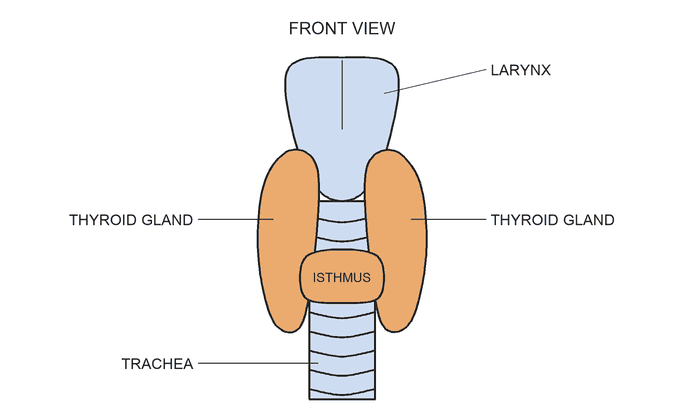
Labels: larynx, thyroid gland (two lobes), isthmus, trachea.
Step 2 — (b) Draw the back view.
From the back the pharynx and the oesophagus run down the middle between the two lobes, covering the trachea, which shows only at its edges.
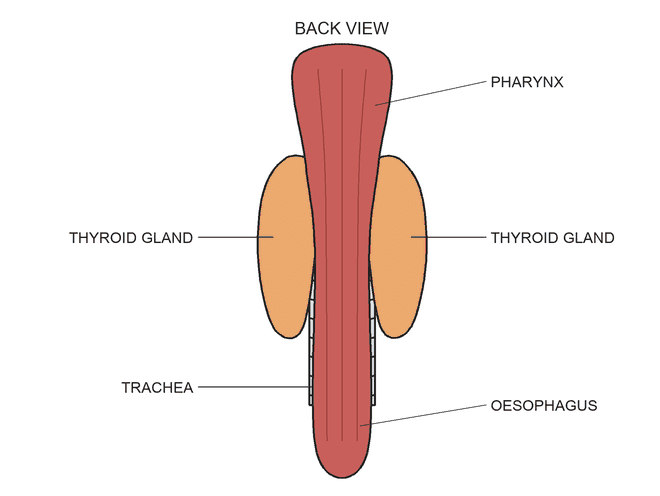
Labels: pharynx, thyroid gland, oesophagus, trachea.
Watch out: The isthmus is seen only from the front; from the back the oesophagus covers the middle.
Therefore, the front view shows the larynx, both lobes, the isthmus and the trachea, and the back view shows the pharynx, both lobes, the oesophagus and the trachea.
- 233 marks
Question 23
Briefly write about the importance of physical hygiene during adolescence.
Solve with AIWritten solution
Solution:
Concept: In adolescence the body grows fast and the sweat and oil glands become more active, so good care of the body is needed to stay healthy.
Step 1 — Proper and safe food.
Eat a balanced diet with proteins, carbohydrates, fats, vitamins and minerals to support rapid growth. Choose fresh food and avoid stale food and too much fast food.
Step 2 — Cleanliness.
Bathe regularly, wash hands with soap before and after meals and after using the toilet, brush the teeth, and change clothes, especially undergarments, daily. This prevents body odour, acne and infections. Girls should take special care of hygiene during menstruation.
Step 3 — A proper lifestyle.
Get enough sleep, avoid long hours of television or computer games, and stay away from smoking, alcohol and drugs.
Step 4 — Physical exercise.
Walking, exercise and outdoor games keep the body fit and help to fight the stress of adolescence.
Watch out: Hygiene means more than cleanliness; food, sleep and exercise are part of it too.
Therefore, physical hygiene in adolescence means a balanced diet, cleanliness, a healthy lifestyle and regular exercise, which keep the growing body healthy.
- 243 marks
Question 24
Briefly dicuss any four activities which can be practised to overcome stress.
Solve with AIWritten solution
Solution:
Concept: Stress management means taking charge of one's lifestyle, thoughts and feelings with regular healthy activities.
Step 1 — Yoga.
Yoga combines body poses, controlled breathing and relaxation. It increases flexibility, muscle strength and energy, and it calms the mind.
Step 2 — Exercise.
About 30 to 45 minutes of exercise at least three times a week, such as running, swimming or a team sport, makes one feel healthier and more in control.
Step 3 — Meditation and deep breathing.
Sitting quietly for 15 to 20 minutes a day with the eyes closed and attention on the breath clears the mind of negative and stressful thoughts.
Step 4 — Hobbies and planning.
Doing something enjoyable, such as music, reading or puzzles, takes the mind off worries, and planning one's work reduces the feeling of being overloaded.
Watch out: The question asks for activities that are practised; unhealthy escapes like overeating do not count.
Therefore, yoga, exercise, meditation with deep breathing, and hobbies with good planning are four ways to overcome stress.
- 254 marks
Question 25
Sanjeev, a class 8 student, has noticed that his father has become unusually quiet and irritable. He often returns from work complaining of headache. His eating habits and sleep patterns have also worsened. His family simply says he has "tension" but the doctor said that constant work stress may be overstimulating his adrenal glands. Based on this information, answer the questions that follow :
(a) Name the 'fight or flight' hormone released by the adrenal glands during stress.
(b) Which of the following is not a typical effect of the 'fight or flight' hormone on the body?
(i) Increased heartbeat
(ii) Increased rate of respiration
(iii) Release of more glucose into the blood
(iv) Decreased blood supply to the muscles.
(c) Prolonged stress can also increase the level of cortisol in the blood. From which part of the adrenal gland is cortisol released ?
(d) Mention any two ways by which stress can be easily managed at home.
Solve with AIWritten solution
Solution:
Concept: Stress makes the adrenal glands release adrenaline from the medulla (a quick emergency response) and cortisol from the cortex (when stress goes on for a long time).
Step 1 — (a) The fight or flight hormone.
The adrenal glands release adrenaline (also called epinephrine) during stress.
Step 2 — (b) The effect that is not typical.
Adrenaline makes the heart beat faster, quickens breathing and releases more glucose into the blood, so (i), (ii) and (iii) are its usual effects. It increases the blood supply to the muscles, so they can act. Hence (iv) decreased blood supply to the muscles is not a typical effect.
Step 3 — (c) Source of cortisol.
Cortisol is released from the adrenal cortex, the outer part of the adrenal gland.
Step 4 — (d) Managing stress at home.
Any two of these:
- Deep breathing and meditation for 15 to 20 minutes daily.
- Yoga or light exercise, and a regular sleep schedule.
- Time for hobbies, reading, music and laughing with the family.
Watch out: In (b), the question asks which effect is NOT typical; adrenaline sends more blood to the muscles, not less.
Therefore, (a) adrenaline (epinephrine), (b) (iv), (c) the adrenal cortex, (d) any two ways from Step 4.
What Class 8 Biology Ch 5 covers
The sections of the chapter, in the order the book takes them. Every question above comes from one of these.
- 01Endocrine Glands
- 02Thyroid Gland
- 03Adrenal Glands
- 04Pancreas
- 05Pituitary Gland
- 06Adolescence
More ways to study this chapter
The same chapter asked three other ways. Practise it, revise it, and see what the board has set on Ch 5 before.
Class 8 Biology Ch 5 questions students ask
How many questions are there in Class 8 Biology Ch 5?
25 questions. Every one is solved step by step on this page.
Are these Class 8 Biology solutions free?
Yes. Every question and its full working is free to read, with no account needed.
Can I download the Class 8 Biology Ch 5 solutions as a PDF?
There is no PDF to download. Every solution is on this page instead, which means it is searchable, always the current syllabus, and readable on a phone. Use your browser's print option if you want it on paper.