
Opening your dashboard
Class 8 Biology Chapter 5 Endocrine System and Adolescence: Competency-Based Questions (CBQ)
40 questions on Chapter 5, each worked through on its own page with the AI tutor. Class 8 Biology, ICSE 2026-27.
40 questions
1–5 marks · Mixed difficulty
- 11 mark
Question 1
Cognitive domain: Analysis
The figure shows two glands of the human body, X and Y. One of them is a salivary gland and the other is the thyroid gland, but not in that order.
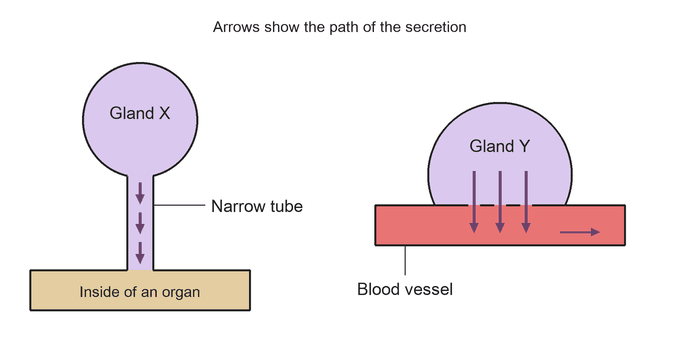
Study the path taken by the secretion of each gland. Which statement is correct ?
- 21 mark
Question 2
Cognitive domain: Application
A doctor examines the pancreas of a patient. She finds that the part of the pancreas which makes the digestive juice is working well. But the clusters of cells called the Islets of Langerhans are damaged. Which problem is this patient most likely to have ?
- 31 mark
Question 3
Cognitive domain: Analysis
The blood sugar of Farhan, a healthy Class 8 student, was measured five times on one day.
Time What Farhan was doing Blood sugar (mg per 100 mL of blood) 7.00 a.m. Before breakfast 85 8.00 a.m. One hour after breakfast 130 10.00 a.m. Sitting in class 95 1.00 p.m. Sitting in class, no food since breakfast 80 1.30 p.m. Still sitting in class, still no food 88 Between 1.00 p.m. and 1.30 p.m. Farhan ate nothing, yet his blood sugar went up from 80 to 88. What best explains this rise ?
- 41 mark
Question 4
Cognitive domain: Application
Each adrenal gland has two parts, a central medulla and a peripheral cortex. In a patient, the medulla of both adrenal glands is working normally, but the cortex is not secreting enough of its hormones. Which of these will this patient find most difficult ?
- 51 mark
Question 5
Cognitive domain: Understanding
Assertion (A): When a girl is suddenly chased by a barking dog, more blood starts flowing to the muscles of her legs.
Reason (R): Adrenaline prepares the body to face danger or to flee, and for this the muscles need extra energy and strength.
- 61 mark
Question 6
Cognitive domain: Analysis
Assertion (A): The sex hormones that bring on puberty, such as testosterone and the oestrogens, are produced by the pituitary gland.
Reason (R): The follicle-stimulating hormone (FSH) of the pituitary gland acts on the sex glands (the ovaries and the testes).
- 71 mark
Question 7
Cognitive domain: Application
Nisha is in Class 8. She has homework, a dance class and a science project, all in the same week. She starts each task late, forgets what is due on which day and then feels tense. Her dance class and her sleep are fine, and she enjoys her work once she begins.
Complete the sentence :
Of the ways to manage stress given in the chapter, the one that deals most directly with Nisha's problem is ______ ______, because getting organised will help her to plan her work.
- 81 mark
Question 8
Cognitive domain: Understanding
A hormone made by the pituitary gland, which lies below the brain, makes the thyroid gland in the neck produce thyroxine. No tube joins the two glands. The same hormone also flows past the heart, the lungs and the kidneys, but it does not change their working.
Complete the sentence :
The hormone reaches the thyroid because it is carried by the ______, and it acts only on the thyroid because the thyroid is its ______ organ.
- 91 mark
Question 9
Cognitive domain: Application
After a football match on a dusty ground, Kabir's eyes feel itchy. He keeps rubbing them with his muddy fingers. His sister stops him and reminds him of the rules of personal hygiene they learnt in class.
Complete the sentence :
Kabir should not rub his eyes with his hands because this lets ______ enter the eyes ; instead, the eyes should be washed daily with clean and ______ water.
- 102 marks
Question 10
Cognitive domain: Evaluation
Tanvi has just been chosen as the captain of her school. She is happy, but for a week her heart has been beating fast before every assembly and she cannot pay attention in class. Her friend says, "You cannot be stressed. Stress comes only from bad things, and something good has happened to you."
Is the friend's claim correct ? Justify your answer with two points.
- 112 marks
Question 11
Cognitive domain: Understanding
Riya is 13. Earlier she told her mother everything. Now she spends a long time in front of the mirror and keeps pointing out faults in her looks. She feels shy and does not share her problems at home. On some days she is cheerful and on other days she is low for no clear reason. Her mother thinks Riya is ill.
Explain to Riya's mother why Riya is behaving in this way. Is this likely to last for ever ?
- 122 marks
Question 12
Cognitive domain: Evaluation
Varun is 14. Most boys of his class grew much taller last year, but he is still the shortest. He tells his elder sister, "Something is wrong with my body. I will stop drinking milk, because it has not helped me, and I will not tell Mummy and Papa."
Evaluate Varun's conclusion and his two decisions.
- 134 marks
Question 13
Cognitive domain: Application
Case: Shreya, who is 13, visits a hospital where her mother has just given birth to a baby boy. The nurse tells her, "A gland no bigger than a pea, lying below the brain, helped your mother twice today — once during the birth and once again when she fed the baby." Shreya herself has grown 7 cm taller in the last year, and her ovaries have started to release eggs.
(a) Name the gland the nurse is talking about. How did it help Shreya's mother during the birth of the baby ?
(b) Which hormone of this gland helped the mother when she fed the baby ? What does it do ?
(c) Name the two hormones of the same gland that are behind the two changes seen in Shreya, and state what each one does.
(d) The nurse adds, "This little gland even tells the thyroid when to work." Explain what she means.
- 145 marks
Question 14
Cognitive domain: Analysis
Case: At a health camp, a doctor examined three adults, P, Q and R. She also tested the amount of thyroxine in their blood. Her notes are given below.
Person Heart beat (per minute) Body weight in the last 3 months Other signs Thyroxine in blood P 112 Lost 5 kg Restless, cannot sit still High Q 60 No loss Very sluggish ; swelling on the face and hands Low R 74 No loss Swelling in the neck ; uses only non-iodised rock salt Slightly low (a) Which person's thyroid gland is secreting too much thyroxine ? Pick out two pieces of evidence, other than the blood test, from the table.
(b) Name the condition of person Q. If the same shortage of thyroxine occurs in an infant, the ailment has a different name. Name it and state how it affects the infant.
(c) Name the ailment of person R and explain what causes the swelling. What change in R's food would you recommend, and why ?
(d) Thyroxine comes from one gland in the neck, yet a change in its amount affected the heart, the body weight and how active these persons were. Explain why.
- 155 marks
Question 15
Cognitive domain: Creativity
Case: Forty students of Class 8 are going to a five-day scout camp in the hills. They will sleep in tents, share washrooms and eat food cooked in a camp kitchen. Their teacher wants every student to carry a pocket-sized "Healthy Camper Card". You have been asked to design it, using what the chapter says about personal hygiene.
(a) Write four short rules of cleanliness for the card. Each rule must fit camp life.
(b) Write two rules about food for the camp kitchen and the campers, and give the reason for each.
(c) Some campers feel tense and homesick. Plan one activity for each evening of the first three days that can help them, and say why you chose it. Also suggest a catchy title for your card.
- 161 mark
Question 16
Cognitive domain: Analysis
The figure shows the head, neck and trunk of a human body with four endocrine glands marked P, Q, R and S. The two kidneys are drawn only for reference.

Which option names correctly the gland that secretes thyroxine and the gland that secretes glucagon ?
- 171 mark
Question 17
Cognitive domain: Application
A hospital studies a gland of the body with the help of a tiny, safe dose of a radioactive form of iodine. (Hypothetical case.) A patient swallows it. The next day a detector is moved over the patient's body. Much of the iodine has passed out in the urine, but most of the iodine still left in the body has collected in two lobes, one on each side of the wind pipe just below the larynx. Very little is found in other parts of the body.
Which statement explains this result best ?
- 181 mark
Question 18
Cognitive domain: Analysis
The pituitary gland makes thyroid-stimulating hormone (TSH), which tells the thyroid gland to produce thyroxine. A doctor measured the TSH and the thyroxine in the blood of three persons. (Hypothetical data.)
Person TSH in blood Thyroxine in blood P Low Low Q High Low R Normal Normal Persons P and Q both have too little thyroxine. Assume that a healthy gland does its job when it receives the right signal. Where does the fault most likely lie in each of P and Q ?
- 191 mark
Question 19
Cognitive domain: Understanding
Assertion (A): A child whose body makes too much growth hormone may grow unusually tall.
Reason (R): The pituitary gland also makes prolactin, which stimulates the breasts to produce milk after child birth.
- 201 mark
Question 20
Cognitive domain: Analysis
Assertion (A): An adult whose thyroid gland makes too little thyroxine may develop myxoedema, but not cretinism.
Reason (R): Cretinism and myxoedema are caused by the shortage of two different hormones.
- 211 mark
Question 21
Cognitive domain: Application
Aryan, aged 14, is a member of his school choir. For a few weeks his voice has become deeper, and now and then it cracks and sounds hoarse when he sings. He has no fever, no pain in the throat and no swelling in the neck. A classmate says, "You have damaged your voice by singing too loudly."
Which explanation agrees best with your chapter ?
- 221 mark
Question 22
Cognitive domain: Understanding
A firecracker bursts with a loud bang right next to Imran as he walks to school. His adrenal glands release adrenaline into his blood.
Which of these changes will not be caused by adrenaline ?
- 231 mark
Question 23
Cognitive domain: Evaluation
Neel got out of marks in a Maths test. He lost most of his marks in the geometry questions, and now he feels very tense. Rational thinking means looking calmly at the facts and then finding a sensible way to solve the problem. It is one of the ways of managing stress.
Four friends gave Neel their thoughts. Which thought is an example of rational thinking ?
- 241 mark
Question 24
Cognitive domain: Analysis
A student wrote down four rows of a table about the hormone-producing glands. In only one row are the location, the hormone and the function all correct. Which row is it ?
- 251 mark
Question 25
Cognitive domain: Analysis
The pancreas of a healthy person makes two hormones, insulin and glucagon. The amounts of two hormones, P and Q, in this person's blood were noted at two times. (Hypothetical data.)
Time Hormone P Hormone Q Half an hour after a heavy meal High Low Ten hours after the last meal Low High Which option identifies P and Q and gives the correct reason ?
- 262 marks
Question 26
Cognitive domain: Understanding
During puberty, the changes in the body of a boy or a girl are of two kinds. In the first kind the sex organs become active. The other changes are called secondary sexual characteristics.
Put each of the following changes in the right group : the testes start producing sperms ; breasts develop ; a beard and moustache grow ; the ovaries start releasing eggs.
- 272 marks
Question 27
Cognitive domain: Analysis
A small stone blocks the tube that carries the digestive juice of a patient's pancreas to the small intestine. (Hypothetical case.) The Islets of Langerhans of the same pancreas are not damaged.
(a) Which work of the pancreas will be disturbed ?
(b) Will the patient's blood sugar control be disturbed ? Give a reason.
- 282 marks
Question 28
Cognitive domain: Application
After a Sunday lunch, Mohan's family left the leftover paneer curry, rice and a jug of boiled milk on the kitchen table. Next morning Mohan wants to eat the food for his breakfast.
(a) Name two rules of "proper and safe food" that the family did not follow.
(b) What should the family have done ?
- 292 marks
Question 29
Cognitive domain: Application
Neha's exams are near, and she feels tense. She tries four things to relieve her stress.
(i) She draws and paints for half an hour every evening.
(ii) She plays football with her friends on Saturday.
(iii) She sits in a quiet place for fifteen minutes with her eyes closed, focuses on her breathing and clears her mind of worrying thoughts.
(iv) She writes down every subject and the date of its exam, and divides her study hours among them.
Name the way of managing stress that each activity stands for.
- 302 marks
Question 30
Cognitive domain: Understanding
Our body has two types of glands. Four glands are listed below.
(i) salivary gland (ii) thyroid gland (iii) adrenal gland (iv) the part of the pancreas that makes the digestive juice
Put them in two groups, exocrine and endocrine, and state what decides the group of a gland.
- 312 marks
Question 31
Cognitive domain: Evaluation
Neeraj says, "Puberty and adolescence are two names for the same period, and both begin at the age of and end at the age of ."
Is Neeraj correct ? Support your answer with two points from the chapter.
- 323 marks
Question 32
Cognitive domain: Evaluation
Ravi and Sunita are in Class 8. Their daily habits are given in the table. (Hypothetical data.)
Habit Ravi Sunita Breakfast Skips it and eats a packet of chips near the school gate Roti, vegetables and a glass of milk Washing hands Only once, in the evening With soap before and after meals Cleaning teeth Only in the morning After each meal and before going to bed Games and screen Four hours of mobile games, no outdoor play One hour of screen time and forty-five minutes of badminton Sleep About hours About hours (a) Whose daily routine is healthier ?
(b) Support your answer with two differences from the table. For each, name the heading of personal hygiene under which it falls.
(c) Suggest one change that Ravi should make first, with a reason.
- 333 marks
Question 33
Cognitive domain: Analysis
A Class 8 teacher asked students how they felt about the changes of adolescence. Each student could tick more than one feeling. The results are given in the table. (Hypothetical data.)
Feeling Number of students Worried about how they look Shy to share problems at home Like to stay with their friends most of the time Feel low or moody for no clear reason Worried about the future (a) Which feeling is the most common, and what percentage of the students ticked it ?
(b) What percentage of the students feel low or moody ? What does the chapter say is the scientific cause of such feelings ?
(c) Why do so many adolescents like to stay with their friends ?
- 343 marks
Question 34
Cognitive domain: Evaluation
Fatima wrote four lines in her notebook while revising the chapter. (Hypothetical notes.)
1. Thyroxine is made by the pituitary gland, and it controls the metabolic rate.
2. Glucagon lowers the sugar in the blood by changing glucose into glycogen.
3. Adrenaline, the emergency hormone, is secreted by the medulla of the adrenal glands.
4. Growth hormone is made by the thyroid gland, and it regulates growth.
Only one line is correct. Find it, and correct the other three.
- 353 marks
Question 35
Cognitive domain: Analysis
A teacher explained how hormones work with an example. "A radio station sends out a programme from its tower. Every radio in the town receives the signal, but only the radios tuned to that station play the programme."
(a) Match the three parts of the example with the three things they stand for in the body : the radio station, the signal, and the radios that are tuned to the station.
(b) In the body, what carries the signal everywhere, as the air carries the radio signal ?
(c) State one fact about endocrine glands that the example does not show.
- 363 marks
Question 36
Cognitive domain: Understanding
Dhruv is . He spends a long time in the mirror and worries about his looks. He feels shy to tell his parents his problems, and he likes to do what his friends do. He is also worried about his future, although he has no set goals. His cousin Ankit is . He has a steady job, has strong and stable friendships, and accepts the responsibilities of his family.
(a) Name the stage of life of Dhruv and the stage of Ankit.
(b) Give two differences between them, taken from the psychological side.
(c) Dhruv says, "I will never be calm and sure of my goals like Ankit." Using the chapter, predict two changes in Dhruv's mind and life as he grows into an adult.
- 374 marks
Question 37
Cognitive domain: Analysis
Case: A smart watch recorded the heart beat of Meera, a Class 8 girl, at six moments of a school day. The graph shows the readings A to F. Her activities at these moments are given in the table. (Hypothetical data.)
Reading Time What Meera was doing A 8.00 a.m. Just woken up at home B 9.30 a.m. Sitting in the classroom C 10.00 a.m. The teacher announces a surprise test D 10.45 a.m. Writing the test E 11.30 a.m. The test is over F 1.00 p.m. Having lunch with her friends 
(a) Between which two neighbouring readings did the heart beat rise the most ? By how many beats per minute did it rise ?
(b) Name the hormone that was released at this time, and the part of the gland that released it. State one other change it caused in her body.
(c) Meera's friend says, "A heart beat of shows that your heart is diseased." Use the graph to evaluate this claim.
- 384 marks
Question 38
Cognitive domain: Analysis
Case: Researchers studied three groups of young rats of the same age in a laboratory. Group X was left as it was. In group Y the thyroid gland was removed, and in group Z the pituitary gland was removed. After four weeks, the results were noted. (Hypothetical experiment.)
Group What was done Gain in body length in four weeks (cm) Thyroxine in the blood X Nothing Normal Y Thyroid gland removed Almost none Z Pituitary gland removed Very low (a) Work out the gain in length of group Y and of group Z as a percentage of the gain of group X. Which removal slowed the growth more ?
(b) The thyroid gland of group Z was not touched, yet the thyroxine in its blood was very low and it grew even less than group Y. Explain both facts with the help of the hormones of the pituitary gland.
(c) Group Z is now given injections of thyroxine only. Predict whether its growth will become equal to that of group X. Give a reason.
- 394 marks
Question 39
Cognitive domain: Creativity
Case: In a small town, some shops sell cheap loose salt to which no iodine has been added, while others sell packets of iodised salt. The school science club notices that several adults in the town have a swelling at the front of the neck. The club wants to find out whether the swelling is more common in families that use the loose salt. It may visit homes and talk to the families, but it may not examine anybody medically.
(a) Write two questions the club members should ask each family. Say why each is useful.
(b) Design a table with four columns in which the club can record its findings for each family.
(c) Describe one result that would support the idea that the loose salt is linked with the swelling, and one result that would not support it.
- 405 marks
Question 40
Cognitive domain: Evaluation
Case: A school plans a new routine for Class 8. The plan has the following points. (Hypothetical plan.)
1. School will begin at a.m. and end at p.m., with no games period until the syllabus is completed.
2. The canteen will sell only fried snacks, packaged chips and cold drinks, because they sell fast.
3. In the free period after lunch, students may play games on the computer for as long as they like.
4. A counsellor will visit the school only once in a year.
(a) Pick out three points of the plan that are harmful for adolescents. For each, give a reason from your chapter.
(b) Suggest two changes in the canteen's list of foods.
(c) Suggest one change in point , and give a reason.