
Opening your dashboard
Class 8 Biology Chapter 4: Ecosystems Solutions
27 textbook questions with step-by-step answers, free to read, for ICSE 2026-27.
Get talked through Ch 4, not just shown the answer
Reading a finished solution is not the same as being able to do it. The AI tutor takes one question at a time and works it with you, in your own words, until you can.
- Ask it out loud, in your own words
- It gives you the next step, not the answer
- Stuck on part (ii)? Start there
27 questions with solutions
1–14 marks · Mixed difficulty
- 11 mark
Question 1
Put a tick mark (✓) against the correct alternative in the following statements :
The term "ecosystem" is derived from the Greek word "Oikos" meaning :
Solve with AIAnswer
(A) Body weight
(B) Food
- Correct
(C) House
(D) Size
Answer: (C) House
Concept: The word ecosystem comes from the Greek word "oikos", meaning a house or dwelling place, together with "system". An ecosystem is the "house" in which organisms live and interact with each other and with their surroundings.
Step 1 — Recall the meaning of oikos.
"Oikos" means a house or home. The same root gives the word ecology, the study of living things in their home surroundings.
Step 2 — Match with the options.
House is option (C).
Watch out: Do not mix up "oikos" (house) with "troph" (food), which appears in words like autotroph.
Why the other options are wrong:
- (A) Body weight: this has nothing to do with "oikos"; no part of the word "ecosystem" refers to body weight.
- (B) Food: the Greek word for food used in this chapter is "troph" (as in autotroph and trophic level), not "oikos".
- (D) Size: "oikos" does not mean size.
Therefore, "oikos" means house, option (C).
- 21 mark
Question 2
Put a tick mark (✓) against the correct alternative in the following statements :
Rat in any food chain would occupy the position of :
Solve with AIAnswer
(A) Tertiary consumer
(B) Secondary consumer
- Correct
(C) Primary consumer
(D) Producer
Answer: (C) Primary consumer
Concept: In a food chain, green plants (producers, trophic level 1) are eaten by primary consumers (herbivores, level 2), which are eaten by secondary consumers (carnivores, level 3), which may be eaten by tertiary consumers (level 4).
Step 1 — Recall what a rat eats.
A rat feeds mainly on grains, seeds and other plant parts, that is, directly on producers.
Step 2 — Place it in the chain.
An animal that eats plants directly is a herbivore, a primary consumer at trophic level 2, as in Plants → Rat → Snake → Peacock. So the answer is option (C).
Watch out: A rat is eaten by snakes, but that makes the snake the secondary consumer, not the rat.
Why the other options are wrong:
- (A) Tertiary consumer: a tertiary consumer eats secondary consumers, as a peacock eats a snake; a rat does not.
- (B) Secondary consumer: a secondary consumer eats herbivores, as a snake eats a rat; the rat is the herbivore it eats.
- (D) Producer: producers are green plants that make their own food by photosynthesis; a rat cannot.
Therefore, a rat occupies the position of a primary consumer, option (C).
- 31 mark
Question 3
Put a tick mark (✓) against the correct alternative in the following statements :
Evergreen broad-leaved trees are characteristic of :
Solve with AIAnswer
- Correct
(A) Tropical rain forests
(B) Temperate deciduous forests
(C) Coniferous forests
(D) All of the above types of forests
Answer: (A) Tropical rain forests
Concept: The kind of forest depends on the climate. Tropical rain forests get heavy rain all through the year, so their trees never need to shed all their leaves at once; they stay evergreen, with broad leaves.
Step 1 — Recall the flora of each forest.
The chapter lists evergreen trees, bamboos and ferns as the flora of tropical rain forests, such as those on the western coast of India and in the north-east.
Step 2 — Pick the option.
Evergreen broad-leaved trees are therefore characteristic of tropical rain forests, option (A).
Watch out: Conifers such as pine are also evergreen, but their leaves are needles, not broad leaves.
Why the other options are wrong:
- (B) Temperate deciduous forests: the trees of deciduous forests shed their leaves in one season of the year, so they are not evergreen.
- (C) Coniferous forests: coniferous forests have fir and pine trees, which are evergreen but have needle-like leaves, not broad leaves.
- (D) All of the above types of forests: the deciduous and coniferous forests do not have evergreen broad-leaved trees, so 'all' is wrong.
Therefore, evergreen broad-leaved trees are characteristic of tropical rain forests, option (A).
- 41 mark
Question 4
Put a tick mark (✓) against the correct alternative in the following statements :
The number of steps in a food chain can never be more than :
Solve with AIAnswer
(A) Four
(B) Five
- Correct
(C) Six
(D) Seven
Answer: (C) Six
Concept: Each step of a food chain is one member (one trophic level), so Rice → Man has two steps. Energy is lost at every step, so only a little reaches the top. The chapter states that food chains have 2 to 5 steps, very rarely 6, but never 7.
Step 1 — Use the chapter's rule.
Since a food chain can rarely have 6 steps but never 7, the largest possible number is six.
Step 2 — Pick the option.
A food chain can never have more than six steps, option (C).
Watch out: The question asks for the largest number ever possible, not the usual number (which is 2 to 5).
Why the other options are wrong:
- (A) Four: food chains with five steps do occur, so four is not the upper limit.
- (B) Five: the chapter says a few food chains reach six steps, so five is not the upper limit.
- (D) Seven: the chapter states that a food chain never reaches seven steps, because too little energy would be left at the top.
Therefore, the number of steps in a food chain can never be more than six, option (C).
- 51 mark
Question 5
Put a tick mark (✓) against the correct alternative in the following statements :
Sameer while studying the topic of 'Interdependence between organisms' found that some organisms live together and benefit each other. Which of the following is a suitable example of such a relationship ?
Solve with AIAnswer
(A) Algae
(B) Bacteria
(C) Fungi
- Correct
(D) Lichen
Answer: (D) Lichen
Concept: When two different organisms live together and both benefit, the relationship is called symbiosis. A lichen is a classic example: a fungus living together with an alga (or a cyanobacterium).
Step 1 — Look for a partnership.
Sameer needs an example of two organisms living together, so the answer must be a partnership, not a single kind of organism.
Step 2 — Check the lichen.
In a lichen, the alga makes food by photosynthesis and shares it, while the fungus gives shelter and holds water and minerals. Both gain, so the lichen is the answer, option (D).
Watch out: Algae and fungi are the two partners; the partnership itself is called a lichen.
Why the other options are wrong:
- (A) Algae: this names only one kind of organism, not two organisms living together.
- (B) Bacteria: this names only one group of organisms, not a partnership of two.
- (C) Fungi: fungi alone are one kind of organism; only together with an alga do they form a lichen.
Therefore, a lichen is the example of organisms living together and benefiting each other, option (D).
- 61 mark
Question 6
Put a tick mark (✓) against the correct alternative in the following statements :
Predators are the animals who chase other animals, kill them and feed on their flesh. Which of the following statements supports this given explanation ?
P. They are carnivores.
Q. They belong to trophic level-2 of the food chain.
R. They are also considered as decomposers.
Solve with AIAnswer
- Correct
(A) Only P
(B) Only Q and R
(C) Only P and Q
(D) Only P and R
Answer: (A) Only P
Concept: A predator catches, kills and eats other animals (its prey). Animals that eat flesh are carnivores, and they sit at trophic level 3 or higher.
Step 1 — Check P.
Predators eat the flesh of the animals they kill, so they are carnivores. P is true.
Step 2 — Check Q.
Trophic level 2 is the level of herbivores (plant eaters). Predators eat animals, so they are at level 3 or above. Q is false.
Step 3 — Check R.
Decomposers (bacteria and fungi) feed on dead matter and break it down; they do not hunt. R is false.
Step 4 — Pick the option.
Only P supports the explanation, option (A).
Watch out: Trophic level 2 belongs to herbivores; meat-eaters start at level 3.
Why the other options are wrong:
- (B) Only Q and R: Q and R are both false: level 2 is the herbivores, and decomposers feed on dead matter, not on animals they kill.
- (C) Only P and Q: P is true, but Q is false, because predators are at trophic level 3 or above.
- (D) Only P and R: P is true, but R is false, because decomposers break down dead matter and do not hunt.
Therefore, only P supports the explanation, option (A).
- 71 mark
Question 7
Put a tick mark (✓) against the correct alternative in the following statements :
Latika has prepared a food web which is a network of interconnected food chains. Which of the following are involved in a food web ?
-
Producers
-
Sunlight
-
Herbivores
-
Secondary consumers
Solve with AIAnswer
(A) Only 2 and 3
(B) Only 1, 2 and 3
- Correct
(C) Only 1, 3 and 4
(D) Only 1 and 3
Answer: (C) Only 1, 3 and 4
Concept: A food web is a network of interconnected food chains. Its members are living organisms linked by who eats whom: producers, herbivores and carnivores.
Step 1 — Check each item.
Producers (1), herbivores (3) and secondary consumers (4) are all living organisms that eat or are eaten, so they are members of a food web.
Step 2 — Check sunlight.
Sunlight (2) is a non-living (abiotic) factor. It supplies the energy that plants use, but it is not an organism, so it is not a member of the web.
Step 3 — Pick the option.
The members are 1, 3 and 4, option (C).
Watch out: Sunlight drives every food chain, but it is not a link in the chain itself.
Why the other options are wrong:
- (A) Only 2 and 3: it includes sunlight, which is not an organism, and leaves out producers and secondary consumers.
- (B) Only 1, 2 and 3: it includes sunlight and leaves out the secondary consumers.
- (D) Only 1 and 3: it leaves out the secondary consumers, which are part of the web.
Therefore, a food web involves producers, herbivores and secondary consumers, option (C).
-
- 81 mark
Question 8
The following questions are Assertion-Reason based questions. Choose your answer based on the codes given below.
Assertion (A): All plant eating animals are considered as primary producers.
Reason (R): Producers are the first step of the food chain which can supply food to the next trophic level.
Solve with AIAnswer
(A) (1) Both A and R are true and R is the correct explanation of A.
(B) (2) Both A and R are true but R is not the correct explanation of A.
(C) (3) A is true but R is false.
- Correct
(D) (4) A is false but R is true.
Answer: (D) (4) A is false but R is true.
Concept: In an assertion-reason item, first judge the Assertion (A) and the Reason (R) separately as true or false; only when both are true do we ask whether R correctly explains A.
Step 1 — Judge the Assertion.
A is false. Plant-eating animals (herbivores) cannot make their own food; they eat the food made by plants. So they are primary consumers, not producers.
Step 2 — Judge the Reason.
R is true. Producers (green plants) form the first step of every food chain and supply food to the next trophic level, the herbivores.
Step 3 — Pick the option.
A is false and R is true, so the answer is option (D).
Watch out: "Primary" goes with "consumer" for herbivores; only green plants are producers.
Why the other options are wrong:
- (A) (1) Both A and R are true and R is the correct explanation of A: A is false, so both cannot be true.
- (B) (2) Both A and R are true but R is not the correct explanation of A: A is false, so both cannot be true.
- (C) (3) A is true but R is false: this says A is true and R is false; in fact A is false and R is true.
Therefore, A is false but R is true, option (D).
- 91 mark
Question 9
The following questions are Assertion-Reason based questions. Choose your answer based on the codes given below.
Assertion (A): An ecosystem consists of two categories of components — Biotic and Abiotic which are interdependent on each other.
Reason (R): Biotic components are dependent on abiotic components but never on other biotic components.
Solve with AIAnswer
(A) (1) Both A and R are true and R is the correct explanation of A.
(B) (2) Both A and R are true but R is not the correct explanation of A.
- Correct
(C) (3) A is true but R is false.
(D) (4) A is false but R is true.
Answer: (C) (3) A is true but R is false.
Concept: In an assertion-reason item, first judge the Assertion (A) and the Reason (R) separately as true or false; only when both are true do we ask whether R correctly explains A.
Step 1 — Judge the Assertion.
A is true. Every ecosystem has biotic (living) and abiotic (non-living) components, and they depend on each other: plants need sunlight and water, and living things in turn change the soil and air.
Step 2 — Judge the Reason.
R is false because of the word "never". Living things also depend on other living things: herbivores eat plants, many plants need insects for pollination, and decomposers return nutrients to the soil.
Step 3 — Pick the option.
A is true and R is false, so the answer is option (C).
Watch out: Watch for absolute words like "never" in a Reason; one counter-example makes it false.
Why the other options are wrong:
- (A) (1) Both A and R are true and R is the correct explanation of A: R is false, so it cannot explain A.
- (B) (2) Both A and R are true but R is not the correct explanation of A: R is false, so both cannot be true.
- (D) (4) A is false but R is true: A is true: every ecosystem has biotic and abiotic components that depend on each other.
Therefore, A is true but R is false, option (C).
- 101 mark
Question 10
The following questions are Assertion-Reason based questions. Choose your answer based on the codes given below.
Assertion (A): Symbiosis, parasitism and predation are the categories of interdependence between organisms, which are the ways of transferring energy.
Reason (R): The transfer of energy from one trophic level to the other always occurs through the food chain.
Solve with AIAnswer
(A) (1) Both A and R are true and R is the correct explanation of A.
- Correct
(B) (2) Both A and R are true but R is not the correct explanation of A.
(C) (3) A is true but R is false.
(D) (4) A is false but R is true.
Answer: (B) (2) Both A and R are true but R is not the correct explanation of A.
Concept: In an assertion-reason item, first judge the Assertion (A) and the Reason (R) separately as true or false; only when both are true do we ask whether R correctly explains A.
Step 1 — Judge the Assertion.
A is true. The chapter names symbiosis, parasitism and predation as the categories of interdependence, and in each one food, and so energy, passes from one organism to another; for example, a predator gets energy by eating its prey.
Step 2 — Judge the Reason.
R is true. Energy passes from one trophic level to the next when one organism eats another, that is, along the food chain.
Step 3 — Does R explain A?
No. R is a general statement about how energy flows; it does not explain why organisms are interdependent in these three particular ways. So the answer is option (B).
Watch out: Two true statements on the same topic need not explain each other; ask whether R answers "why A?".
Why the other options are wrong:
- (A) (1) Both A and R are true and R is the correct explanation of A: R is only a general statement about energy flow; it does not explain the three categories named in A.
- (C) (3) A is true but R is false: R is true: energy does pass between trophic levels along the food chain.
- (D) (4) A is false but R is true: A is true: the chapter names symbiosis, parasitism and predation as the categories of interdependence.
Therefore, both A and R are true but R is not the correct explanation of A, option (B).
- 111 mark
Question 11
The following questions are Assertion-Reason based questions. Choose your answer based on the codes given below.
Assertion (A): Flora and fauna of forests differ throughout the world.
Reason (R): Different regions of the world have different climatic conditions, so only those plants and animals that are adapted to those conditions can survive there.
Solve with AIAnswer
- Correct
(A) (1) Both A and R are true and R is the correct explanation of A.
(B) (2) Both A and R are true but R is not the correct explanation of A.
(C) (3) A is true but R is false.
(D) (4) A is false but R is true.
Answer: (A) (1) Both A and R are true and R is the correct explanation of A.
Concept: In an assertion-reason item, first judge the Assertion (A) and the Reason (R) separately as true or false; only when both are true do we ask whether R correctly explains A.
Step 1 — Judge the Assertion.
A is true. Forests of very cold, moderately warm and hot regions each have their own particular plants (flora) and animals (fauna).
Step 2 — Judge the Reason.
R is true. Regions differ in climate, and only the plants and animals adapted to a climate can survive there.
Step 3 — Does R explain A?
Yes. Different climates allow different adapted organisms to survive, which is why the flora and fauna differ from place to place. So the answer is option (A).
Why the other options are wrong:
- (B) (2) Both A and R are true but R is not the correct explanation of A: R does explain A: the climate decides which organisms can live in each forest.
- (C) (3) A is true but R is false: R is true: organisms survive only where they are adapted to the climate.
- (D) (4) A is false but R is true: A is true: the flora and fauna of forests do differ across the world.
Therefore, both A and R are true and R explains A, option (A).
- 121 mark
Question 12
The following questions are Assertion-Reason based questions. Choose your answer based on the codes given below.
Assertion (A): Scavengers are considered as cleaners of the earth as they feed on dead animal and plant remains.
Reason (R): Scavengers consume the remains left by detritivores and decomposers.
Solve with AIAnswer
(A) (1) Both A and R are true and R is the correct explanation of A.
(B) (2) Both A and R are true but R is not the correct explanation of A.
- Correct
(C) (3) A is true but R is false.
(D) (4) A is false but R is true.
Answer: (C) (3) A is true but R is false.
Concept: In an assertion-reason item, first judge the Assertion (A) and the Reason (R) separately as true or false; only when both are true do we ask whether R correctly explains A.
Step 1 — Judge the Assertion.
A is true. Scavengers such as vultures, kites and crows eat dead animal bodies and remains, so they clean up the surroundings; they are called cleaners of the earth.
Step 2 — Judge the Reason.
R is false. The order is the other way round: scavengers feed first, and detritivores and decomposers then work on the remains left by the scavengers.
Step 3 — Pick the option.
A is true and R is false, so the answer is option (C).
Watch out: Scavengers come first; detritivores and decomposers finish what is left.
Why the other options are wrong:
- (A) (1) Both A and R are true and R is the correct explanation of A: R is false, so it cannot explain A.
- (B) (2) Both A and R are true but R is not the correct explanation of A: R is false, so both cannot be true.
- (D) (4) A is false but R is true: A is true: scavengers do feed on dead remains and clean the surroundings.
Therefore, A is true but R is false, option (C).
- 135 marks
Question 13
Fill in the blanks :
(a) Lichens are the good example of .......... association.
(b) Two intermediate hosts of liver fluke are .......... and .......... .
(c) Evergreen trees are common flora of .......... forests.
(d) .......... will always be trophic level-1 in a food chain.
(e) .......... sanctuary is found in West Bengal which is famous for rhinoceros.
Solve with AIWritten solution
Solution:
Concept: Each blank uses an example or fact from the chapter: types of interdependence, parasites, forest types, trophic levels and protected areas of India.
Step 1 — (a) Lichens.
A lichen is a fungus and an alga living together, both benefiting, so it is a symbiotic association.
Step 2 — (b) Liver fluke.
The human liver fluke, a parasitic flatworm, completes its life cycle through two intermediate hosts: a snail and a fish.
Step 3 — (c) Evergreen trees.
Evergreen trees are common flora of tropical rain forests, which get rain all through the year.
Step 4 — (d) Trophic level 1.
Green plants (producers) always form trophic level 1, because they make the food that all other levels depend on.
Step 5 — (e) Rhinoceros in West Bengal.
Jaldapara in West Bengal is famous for the one-horned rhinoceros.
Watch out: The liver fluke is a flatworm (a fluke), not a roundworm.
Note: The two hosts in (b) are those of the human (Chinese) liver fluke; the sheep liver fluke needs only a snail. Jaldapara, a sanctuary when the chapter was written, has been a national park since 2014.
Therefore, (a) symbiotic, (b) snail and fish, (c) tropical rain, (d) green plants (producers), (e) Jaldapara.
- 143 marks
Question 14
Mention if the following statements are true (T) or false (F)
(a) Snakes are primary consumers.
(b) Some humans are strictly primary consumers while others are secondary or tertiary consumers as well.
(c) No ecosystem can survive without light.
Solve with AIWritten solution
Solution:
Concept: Primary consumers eat plants; secondary and tertiary consumers eat animals. Green plants need light to make food, and other organisms depend on that food.
Step 1 — (a) Snakes.
False. Snakes eat frogs, rats and other animals, so they are secondary or tertiary consumers, not primary consumers.
Step 2 — (b) Humans.
True. A strict vegetarian eats only plants and is a primary consumer, while people who also eat meat or fish act as secondary or tertiary consumers too.
Step 3 — (c) Light.
True (the chapter's answer). Green plants need light to make food by photosynthesis, and almost every ecosystem depends on that food.
Watch out: Decide each statement by what the organism eats, not by its size.
Note: For (c), scientists have found rare deep-sea communities around hot vents that live without sunlight: there, bacteria make food from chemicals (chemosynthesis). For the ecosystems in this chapter, light is essential.
Therefore, (a) F, (b) T, (c) T.
- 155 marks
Question 15
Match the items in Column A with those in Column B.
Column A Column B (a) Grass (i) Carnivore (b) Deer (ii) Decomposers (c) Cobra (iii) Primary consumer (d) Vulture (iv) Autotroph (e) Microbes (v) Scavenger Solve with AIWritten solution
Solution:
Concept: Place each organism by how it gets its food: autotrophs make food, primary consumers eat plants, carnivores eat animals, scavengers eat dead bodies and decomposers break down dead matter.
Step 1 — Match each item.
Each organism is matched by the way it gets its food.
Column A Column B Why (a) Grass (iv) Autotroph makes its own food by photosynthesis (b) Deer (iii) Primary consumer eats grass and leaves (c) Cobra (i) Carnivore eats rats, frogs and other animals (d) Vulture (v) Scavenger eats dead animal bodies (e) Microbes (ii) Decomposers break down dead matter Watch out: A vulture eats dead bodies but does not break them down chemically; that is the decomposers' work.
Therefore, (a)-(iv), (b)-(iii), (c)-(i), (d)-(v), (e)-(ii).
- 165 marks
Question 16
Rewrite the following in their correct sequence in a food chain :
(a) Snake → Grasshopper → Grass → Frog
(b) Grass → Tiger → Deer
(c) Snake → Peacock → Rat → Wheat
(d) Lizard → Grass → Crow → Grasshopper
(e) Goat → Man → Maize
Solve with AIWritten solution
Solution:
Concept: A food chain always starts with a green plant (producer), and each member is eaten by the next one, so the arrow points from the eaten to the eater.
Step 1 — (a).
Grass is eaten by the grasshopper, the grasshopper by the frog and the frog by the snake: Grass → Grasshopper → Frog → Snake.
Step 2 — (b).
Grass is eaten by the deer, and the deer by the tiger: Grass → Deer → Tiger.
Step 3 — (c).
Wheat is eaten by the rat, the rat by the snake and the snake by the peacock: Wheat → Rat → Snake → Peacock.
Step 4 — (d).
Grass is eaten by the grasshopper, the grasshopper by the lizard and the lizard by the crow: Grass → Grasshopper → Lizard → Crow.
Step 5 — (e).
Maize is eaten by the goat, and the goat by man: Maize → Goat → Man.
Watch out: The arrow means "is eaten by", so it always points towards the eater.
Therefore, (a) Grass → Grasshopper → Frog → Snake, (b) Grass → Deer → Tiger, (c) Wheat → Rat → Snake → Peacock, (d) Grass → Grasshopper → Lizard → Crow, (e) Maize → Goat → Man.
- 175 marks
Question 17
Choose the odd one out and write the category of the remaining terms :
(a) Bacteria, Fungi, Vulture, Protists
(b) Air, Water, Plants, Temperature
(c) Rice, Grass, Grasshopper, Maize
(d) Deer, Rabbits, Tigers, Rats
(e) Plasmodium, Tiger, Liver fluke, Tapeworm
Solve with AIWritten solution
Solution:
Concept: Find the one term that does not share the feeding type, or the living or non-living nature, of the other three; then name the group the other three form.
Step 1 — (a) Bacteria, fungi, vulture, protists.
The vulture is the odd one: it is a scavenger that eats dead bodies. Bacteria, fungi and protists are decomposers.
Step 2 — (b) Air, water, plants, temperature.
Plants are the odd one: they are living (biotic). Air, water and temperature are abiotic components.
Step 3 — (c) Rice, grass, grasshopper, maize.
The grasshopper is the odd one: it is a consumer. Rice, grass and maize are producers.
Step 4 — (d) Deer, rabbits, tigers, rats.
Tigers are the odd one: they are carnivores. Deer, rabbits and rats are herbivores (primary consumers).
Step 5 — (e) Plasmodium, tiger, liver fluke, tapeworm.
The tiger is the odd one: it is a predator. Plasmodium, the liver fluke and the tapeworm are parasites.
Watch out: Write both parts for each set: the odd one out and the category of the rest.
Therefore, the odd ones are (a) vulture, (b) plants, (c) grasshopper, (d) tigers, (e) tiger; the rest are (a) decomposers, (b) abiotic components, (c) producers, (d) herbivores, (e) parasites.
- 185 marks
Question 18
Given below is a box containing some words/phrases. Out of these, ten can be used to make five suitable pairs. Choose and make 5 such pairs.
Oikos, Food, Grasshopper, Troph, Tertiary consumer, Producers, House, Green plants, Evergreen trees, Gir forests, Ecosystem, Man, Lion
Solve with AIWritten solution
Solution:
Concept: Pair each term with its meaning or with the example that fits it; three words of the box are left over.
Step 1 — Pair the Greek words with their meanings.
Oikos – House and Troph – Food: these are the Greek roots of "ecosystem" and "trophic".
Step 2 — Pair the groups with examples.
Producers – Green plants, because green plants make food; and Tertiary consumer – Man, because man can be at the top of a food chain.
Step 3 — Pair the place with its animal.
Gir forests – Lion: the Gir forest of Gujarat is the home of the Asiatic lion.
Step 4 — Check the leftovers.
Grasshopper, evergreen trees and ecosystem are not needed, which leaves exactly five pairs from ten words.
Watch out: Each word may be used only once.
Therefore, the pairs are Oikos – House, Troph – Food, Producers – Green plants, Gir forests – Lion and Tertiary consumer – Man.
- 195 marks
Question 19
Name the following :
(a) 3 categories of organisms that feed on dead materials
(b) 5 abiotic components of the ecosystem
(c) 4 kinds of the ecosystem
(d) 3 categories of interdependence between the organisms
(e) 3 categories of consumers
Solve with AIWritten solution
Solution:
Concept: Give exactly the number of items each part asks for, using the groups named in the chapter.
Step 1 — (a) Feeders on dead materials.
Scavengers, detritivores and decomposers all feed on dead material.
Step 2 — (b) Abiotic components.
Sunlight, air, water, temperature and soil are five non-living components.
Step 3 — (c) Kinds of ecosystem.
Forest, pond, ocean and desert are four kinds of ecosystem.
Step 4 — (d) Interdependence.
The three categories are symbiosis, parasitism and predation.
Step 5 — (e) Consumers.
The three categories are primary, secondary and tertiary consumers.
Watch out: In (e), herbivores, carnivores and omnivores is another accepted way of grouping consumers.
Therefore, the lists are as given in Steps 1 to 5.
- 206 marks
Question 20
Give two examples of each :
(a) Producers
(b) Herbivores
(c) Carnivores
(d) Predators
(e) Parasites
(f) Scavengers
Solve with AIWritten solution
Solution:
Concept: Choose examples by how each organism gets its food.
Step 1 — (a) and (b): plants and plant eaters.
Producers: grass and the mango tree. Herbivores: deer and rabbit.
Step 2 — (c) and (d): flesh eaters and hunters.
Carnivores: tiger and snake. Predators: lion and eagle, which catch and kill their prey.
Step 3 — (e) and (f): parasites and scavengers.
Parasites: Plasmodium and the tapeworm, which live on or in a host. Scavengers: vulture and crow, which eat dead bodies.
Watch out: A predator is always a carnivore, but give hunting animals as its examples.
Therefore, (a) grass, mango tree; (b) deer, rabbit; (c) tiger, snake; (d) lion, eagle; (e) Plasmodium, tapeworm; (f) vulture, crow.
- 2114 marks
Question 21
Define the terms :
(a) Ecosystem
(b) Autotrophs
(c) Heterotrophs
(d) Food chain
(e) Food web
(f) Consumers
(g) Symbiosis
Solve with AIWritten solution
Solution:
Concept: Each definition names the group and says how it lives or feeds.
Step 1 — (a) Ecosystem.
An ecosystem is a self-contained area in which all the organisms living there interact with each other and with the physical conditions (sunlight, air, water, soil, climate) of that area.
Step 2 — (b) Autotrophs.
Autotrophs are organisms, mainly green plants, that make their own food by photosynthesis; they are the producers.
Step 3 — (c) Heterotrophs.
Heterotrophs are organisms that cannot make their own food and depend on other organisms for food; all animals are heterotrophs.
Step 4 — (d) Food chain.
A food chain is a linear sequence of organisms in which each one eats the one below it and is eaten by the one above it, for example Grass → Deer → Tiger.
Step 5 — (e) Food web.
A food web is a network of several interconnected food chains in a natural community.
Step 6 — (f) Consumers.
Consumers are organisms that eat the food made by producers, either directly (herbivores) or indirectly (carnivores).
Step 7 — (g) Symbiosis.
Symbiosis is a relationship in which two different organisms live together and both benefit, for example the fungus and the alga in a lichen.
Watch out: A food chain is one straight line; a food web is many chains joined together.
Therefore, the seven terms are defined as in Steps 1 to 7.
- 2210 marks
Question 22
Differentiate between the following pairs :
(a) Flora and fauna
(b) Primary and secondary consumers
(c) Parasitism and predation
(d) Biotic and abiotic components
(e) Scavengers and detritivores
Solve with AIWritten solution
Solution:
Concept: To differentiate a pair, compare the same feature of both side by side and give an example of each.
Step 1 — (a) Flora and fauna.
Flora are the plants of an area and fauna its animals.
Flora Fauna The plants naturally occurring in a particular area. The animals naturally living in that area. Example: teak and sal trees in deciduous forests. Example: deer and wolves in deciduous forests. Step 2 — (b) Primary and secondary consumers.
The two differ in what they eat and so in their trophic level.
Primary consumers Secondary consumers Plant-eating animals (herbivores). Flesh-eating animals (carnivores) that eat herbivores. Trophic level 2, for example deer and grasshopper. Trophic level 3, for example frog and snake. Step 3 — (c) Parasitism and predation.
In both, one organism feeds on another, but in different ways.
Parasitism Predation The parasite lives on or in the host and harms it slowly. The predator catches and kills its prey for food. The host is usually not killed at once, for example Plasmodium in man. The prey is killed and eaten, for example a tiger eating a deer. Step 4 — (d) Biotic and abiotic components.
An ecosystem has a living part and a non-living part.
Biotic components Abiotic components The living parts of an ecosystem. The non-living parts of an ecosystem. Examples: plants, animals and microorganisms. Examples: sunlight, air, water, temperature and soil. Step 5 — (e) Scavengers and detritivores.
Both feed on dead material, but at different stages.
Scavengers Detritivores Feed on dead animal and plant bodies. Feed on detritus (broken-down plant and animal remains) and faeces, including what scavengers leave. Examples: vultures, kites and crows. Examples: earthworms, millipedes and slugs. Watch out: A parasite usually keeps its host alive for a long time; a predator kills its prey at once.
Therefore, the five pairs differ as shown in the tables above.
- 233 marks
Question 23
Differentiate among primary, secondary and tertiary consumers. Give one example of each in a food chain.
Solve with AIWritten solution
Solution:
Concept: Consumers are ranked by what they eat. Each rank feeds on the one below it, starting from the green plants.
Step 1 — Compare the three kinds.
Each kind feeds on the level just below it.
Primary consumers Secondary consumers Tertiary consumers Herbivores that eat plants directly. Carnivores that eat the primary consumers. Top carnivores that eat the secondary consumers. Trophic level 2 Trophic level 3 Trophic level 4 Example: rat Example: snake Example: peacock Step 2 — Put them in one food chain.
The rat eats the plants, the snake eats the rat and the peacock eats the snake: Plants → Rat (primary) → Snake (secondary) → Peacock (tertiary).
Watch out: The same animal can hold different ranks in different chains; judge it by what it eats in that chain.
Therefore, primary consumers eat plants (rat), secondary consumers eat herbivores (snake) and tertiary consumers eat secondary consumers (peacock).
- 243 marks
Question 24
List any three members each of the flora and fauna of tropical rain forests.
Solve with AIWritten solution
Solution:
Concept: Tropical rain forests, such as those on the western coast of India and in the north-east, get heavy rain all the year, so they have dense evergreen plant life and many animals.
Step 1 — Flora (plants).
Three members of the flora are evergreen trees, bamboos and ferns (shrubs also grow there).
Step 2 — Fauna (animals).
Three members of the fauna are leopards, monkeys and flying squirrels (jungle cats, snakes, centipedes and snails also live there).
Watch out: Flora means plants and fauna means animals; do not mix the two lists.
Therefore, flora: evergreen trees, bamboos, ferns; fauna: leopards, monkeys, flying squirrels.
- 254 marks
Question 25
Give reason /explain :
(a) Food web is important to maintain an ecosystem.
(b) The existence of plant life is integral to the continuity and development of most ecosystems.
Solve with AIWritten solution
Solution:
Concept: A food web joins many food chains, so each animal has more than one source of food. Green plants are the only members that make food from simple non-living substances.
Step 1 — (a) Why the food web matters.
In a food web each animal has alternative foods. If one food becomes scarce, the animal can eat another and survive, so one loss does not break the whole system. A food web therefore gives an ecosystem more stability than a single food chain.
Step 2 — (b) Why plant life is essential.
Green plants are the producers. They are the only link that can change inorganic substances (carbon dioxide, water and minerals from the soil) into organic food, using sunlight. This food passes to every other organism through the trophic levels, so without plants animals would get no food and the ecosystem could not continue.
Watch out: In (b), say what plants do that no other member can do: make food from non-living substances.
Therefore, (a) a food web gives alternative foods and so keeps the ecosystem stable, and (b) plants alone turn inorganic substances into food for all other organisms.
- 264 marks
Question 26
Draw the following with a suitable example:
(a) Pyramid of numbers
(b) Pyramid of biomass
Solve with AIWritten solution
Solution:
Concept: A pyramid shows one quantity at each trophic level of a food chain, with the producers as the broad base. In the example Grass → Deer → Tiger, both the number and the mass become smaller at each higher level.
Step 1 — (a) Draw the pyramid of numbers.
Millions of grass plants support hundreds of deer, which support only a few tigers, so each tier is narrower than the one below it.
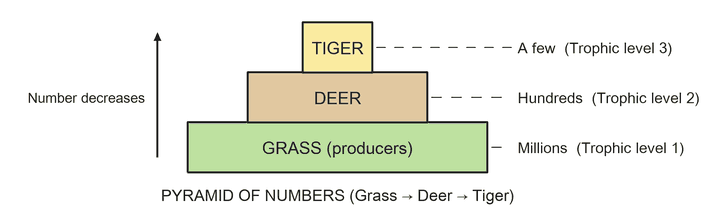
Labels: grass (millions), deer (hundreds), tiger (a few).
Step 2 — (b) Draw the pyramid of biomass.
The total mass of the grass is the greatest, the mass of all the deer is less and the mass of the tigers is the least, so this pyramid also narrows upwards.

Labels: grass (maximum), deer (lesser), tiger (least).
Watch out: Draw the producers at the bottom and label every tier with the organism and its amount.
Therefore, both pyramids for Grass → Deer → Tiger have grass at the broad base and tigers at the narrow top.
- 275 marks
Question 27
A river ecosystem is one where living organisms interact with each other and with the physical environment of flowing water. The Yamuna River in Delhi supports a variety of plants, fish, insects, birds and microorganisms. People also depend on it for water, recreation and cultural reasons. But over the years, pollution and encroachment have become major threats to this ecosystem.
To bring the river back to life, the Delhi government has launched a 'Yamuna Rejuvenation Plan'. Under this plan, the government has allocated large funds to build many small sewage treatment plants so that the waste water from homes is treated before reaching the river. The plan also includes reducing pollution by intercepting major drains and the government is even buying special dredging machines to clean up waste and silt in the river.
On the tourism side, there is a proposal to run eco-friendly cruises on the Yamuna. The boats would be solar- or battery-powered. Some people welcome this as a way to bring attention and care to the river. Others worry that tourism should only start after the river is fully cleaned.
(a) Name two abiotic and two biotic components of the Yamuna river ecosystem.
(b) Name two producers and two consumers in this river ecosystem.
(c) Write a simple food chain that is possible in this river ecosystem.
(d) As a student, what small actions can you take to prevent pollution and protect the Yamuna River?
Solve with AIWritten solution
Solution:
Concept: A river is an ecosystem: its living things (plants, animals and microbes) and its non-living factors (water, sunlight, soil) depend on each other.
Step 1 — (a) Abiotic and biotic components.
Abiotic: water and sunlight (also the soil or silt and the temperature). Biotic: fish and water plants (also insects, birds and microorganisms).
Step 2 — (b) Producers and consumers.
Producers: algae and water plants such as Hydrilla, which make food by photosynthesis. Consumers: fish and birds such as the kingfisher (insects too).
Step 3 — (c) A food chain.
Algae are eaten by insect larvae, the larvae by fish and the fish by a kingfisher: Algae → Insect larvae → Fish → Kingfisher.
Step 4 — (d) Actions a student can take.
Any two of these small actions help:
- Do not throw plastic, garbage, flowers or idols into the river.
- Save water and use less soap and detergent, so less waste water goes into the drains.
- Take part in river clean-up drives and spread awareness among family and friends.
Watch out: A food chain must start with a producer, here algae or water plants.
Therefore, (a) water, sunlight; fish, water plants; (b) algae, water plants; fish, birds; (c) Algae → Insect larvae → Fish → Kingfisher; (d) any two actions from Step 4.
What Class 8 Biology Ch 4 covers
The sections of the chapter, in the order the book takes them. Every question above comes from one of these.
- 01What Is an Ecosystem
- 02Forest Ecosystem
- 03Components of an Ecosystem
- 04Food Chains and Food Webs
- 05Food Pyramids
- 06Interdependence Between Organisms
More ways to study this chapter
The same chapter asked three other ways. Practise it, revise it, and see what the board has set on Ch 4 before.
Class 8 Biology Ch 4 questions students ask
How many questions are there in Class 8 Biology Ch 4?
27 questions. Every one is solved step by step on this page.
Are these Class 8 Biology solutions free?
Yes. Every question and its full working is free to read, with no account needed.
Can I download the Class 8 Biology Ch 4 solutions as a PDF?
There is no PDF to download. Every solution is on this page instead, which means it is searchable, always the current syllabus, and readable on a phone. Use your browser's print option if you want it on paper.